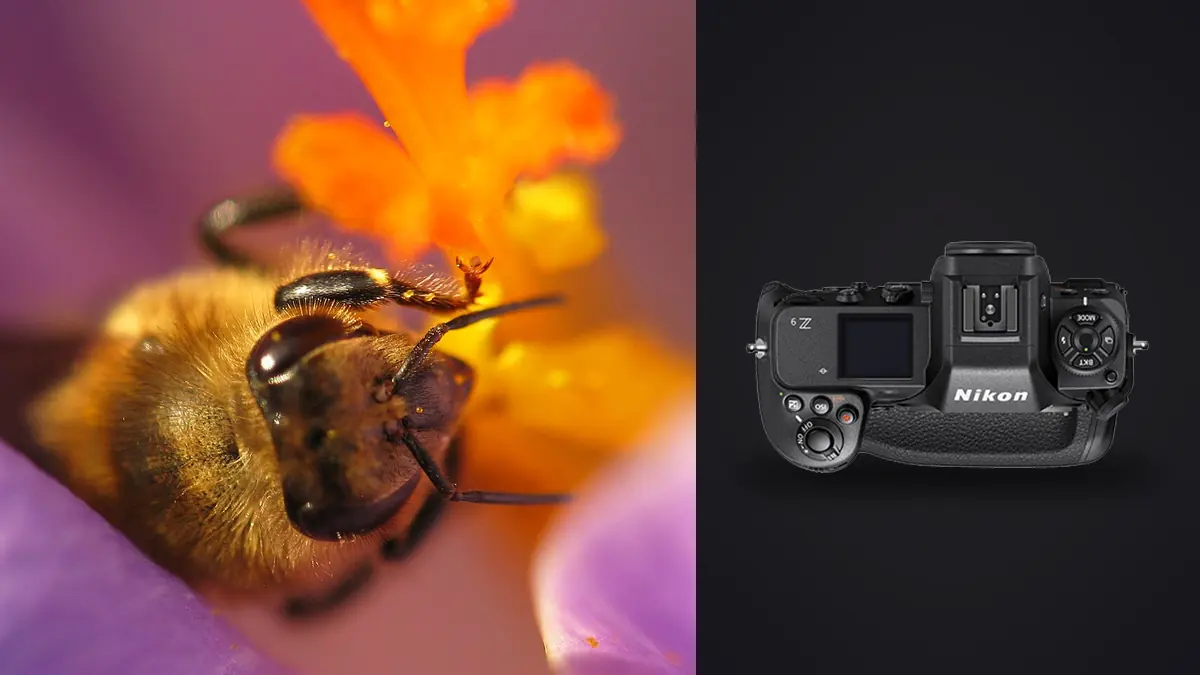
I spent most of last June kneeling in wet grass at 6am trying to photograph damselflies before the sun warmed them up enough to fly off, and the thing that convinced me the Z9 was worth carrying on those mornings had nothing to do with resolution or autofocus points. It was the shutter, or rather the total absence of one. No mechanical curtain slapping open and closed a few millimeters from a lens that's magnifying every vibration by a factor of one or more. At true macro magnifications that shudder shows up as a soft frame you won't notice until you're looking at it on a 27 inch monitor that evening, cursing.
The shutterless design matters more here than for wildlife
Everyone talks about the Z9 going fully electronic for sports and bird photographers who need silent, blackout-free bursts. Fair enough. But the more interesting benefit for macro insect work is mechanical: there is nothing inside the body that moves when you press the shutter button except the aperture blades closing down. At 1:1 magnification with a 105mm macro lens, or beyond that with extension tubes or a dedicated high-magnification lens, even the tiny jolt from a focal-plane shutter firing can smear fine detail like the hairs on a bee's thorax or the facets in a fly's compound eye. I never ran a controlled test against my old D850 to put a number on it, but the difference in keeper rate on tripod-mounted stacks was obvious enough within the first roll of the dice that I stopped questioning it.
The sensor readout speed (Nikon quotes roughly 3.7 milliseconds for a full-resolution scan) is also why the Z9 can do something most fully electronic shutters can't: sync with flash. It tops out around 1/200s in electronic mode, which is not fast by mechanical-shutter standards, but it's usable, and usable flash sync with zero shutter shock is exactly what insect macro work wants. Most of my keeper frames of active subjects (jumping spiders turning their heads, a hoverfly mid-groom) are lit with a small twin-flash bracket at f/13 or f/16, synced through that electronic-only path.
Where the AI subject detection actually helps, and where it doesn't
I want to be honest about this because I see it oversold online: the Z9's subject-detection autofocus is trained on birds, dogs, cats, and a handful of vehicle categories. There is no insect-specific recognition mode, and at macro distances the usual 3D-tracking behavior gets confused by shallow depth of field and low contrast edges anyway. For anything under about 1:2 magnification, wide-area AF with subject detection left on "Auto" will sometimes snap onto an insect's eye by luck, and it's worth leaving on for that chance. Past 1:1, I turn it off entirely and go single-point, often pinpoint AF-S, or straight to manual focus with focus peaking set to red and sensitivity turned up. The camera's own focus confirmation dot is honestly more reliable than autofocus once you're working with a few millimeters of usable depth.
Focus-shift shooting turns the body into a field stacking rig
This is the feature that actually changed my insect work, more than the sensor or the AF system. Focus-shift shooting lets the Z9 fire a sequence of frames, each one nudging focus forward by a step you set (1 to 10), up to 300 shots in a single sequence, with an adjustable interval between shots to let flash recycle. Set it up, half-press, and the camera does the rest while you keep the tripod head steady and hope the wind cooperates.
What I couldn't get right for the first month was the step width. Too coarse and you get visible seams between focus planes when you stack the sequence in Helicon Focus or Zerene Stacker afterward. Too fine and you're burning through 250 frames for a subject that only needed 60, filling a card and eating battery for no visual gain. The settings below are what I've settled into after a season of shooting mostly odonata (dragonflies and damselflies) and jumping spiders around a local wetland, plus a few sessions on captive subjects indoors where wind isn't a factor.
| Subject & framing | Approx. magnification | Aperture | Focus step | Frames per stack |
|---|---|---|---|---|
| Damselfly, full body at rest | 0.3-0.5x | f/8 | 4 | 40-60 |
| Jumping spider, face portrait | ~1:1 | f/11 | 2 | 80-120 |
| Bee, compound eye detail | 2:1 (extension tube added) | f/13 | 1 | 150-220 |
| Butterfly wing scales | 3:1+ | f/16 | 1 | 200-300 (hits the ceiling) |
That last row is a real limitation worth flagging: the 300-frame cap is a hard ceiling in the menu, and at 3:1 and beyond you'll bump into it on anything with real depth like an open butterfly wing. When that happens I just run two overlapping sequences and merge the results manually in the stacking software rather than fight the camera for more frames.
A note on flash recycle and the interval setting
If you're stacking with continuous ambient light, an interval of zero is fine, the Z9 fires as fast as the readout allows. The moment you add flash, though, you need enough gap between frames for the strobes to recycle to full power, or you'll get a sequence with random underexposed frames scattered through it that ruin the stack. I run mine at 0.5 to 1 second on a Godox twin flash setup at low-to-mid power, which keeps a 120-frame sequence under two minutes, short enough that a spider or fly will usually sit still for it if it's cold or recently fed.
Handheld stacking versus a rail, and when each makes sense
A geared focus rail (I use a Cognisys StackShot for controlled indoor work) gives you mechanically precise, repeatable steps and is genuinely the better tool for stationary subjects where you have time. But most insects don't give you time. A dragonfly perched on a reed in the wind, or a jumping spider that might jump at any second, isn't going to wait while you dial in a rail. For those subjects I rely entirely on the Z9's in-camera focus-shift shooting, handheld, bracing my elbows against my knees and letting the body's in-body stabilization do what it can. Combined with the VR in the Nikkor Z MC 105mm f/2.8 VR S, Nikon's own figures put the combined stabilization somewhere around five and a half stops, though at true macro distances that number gets optimistic fast since VR is calibrated for typical shooting distances, not centimeters from the lens.
Worth saying plainly: the Z9 is not a light camera. Body alone is around 1340g with the integrated vertical grip, and after three hours of handheld macro work my wrist knows it in a way it never did with a smaller Z6 or Z7. If your insect photography is mostly a leisurely walk with occasional stops, that weight is a non-issue. If you're hiking to a site and then crouching in mud for hours, it's a real consideration, and I know several macro shooters who've gone back to a Z8 for exactly that reason while keeping the Z9 for their bird and sports work.
Lens choices that actually get used
The native Nikkor Z MC 105mm f/2.8 VR S is what's mounted on my Z9 probably eighty percent of the time. True 1:1 magnification, a customizable OLED info panel that shows magnification ratio and focus distance without pulling the camera from your eye, and focus limiter switches that matter more than they sound like they should when you're trying to rack past a busy foreground fast. For anything beyond 1:1, I add a 20mm or 36mm Kenko extension tube rather than buy a dedicated super-macro lens, since I only need that magnification a handful of times a season.
For the genuinely extreme stuff, the eye of a jumping spider filling most of the frame, I've borrowed a Laowa 25mm f/2.8 2.5-5x manual lens a couple of times. It's fully manual focus and manual aperture, no electronic contacts at all, which means no VR, no focus confirmation dot lighting up, nothing but your own eye and a lot of patience with the rail or the focus-shift sequence doing the heavy lifting. It's not a lens I'd want to shoot handheld in the field with anything that moves.
What the shoot actually leaves you with afterward
A single productive morning of focus-shift stacking easily produces two thousand frames once you count every attempted stack, including the ones where the subject moved halfway through and the sequence is unusable. Going through that manually, at 100% zoom, trying to work out which of 150 near-identical frames in a stack are the sharp ones worth feeding into the stacking software, is the part of macro photography nobody romanticizes. That's honestly the reason I moved my culling pass to imagic rather than doing it in whatever catalog app I happened to be using. It scores sharpness locally on the actual pixel data rather than relying on you squinting at a thumbnail, and because everything runs on the laptop itself rather than uploading to a cloud service, I can do the whole pass sitting in the car at the wetland car park with no signal, which matters more than I expected it to.
The other piece that's genuinely useful for this specific kind of shooting is the way imagic groups a focus-shift sequence together instead of showing you 150 flat thumbnails in a row. A stack is functionally a burst as far as the software is concerned, near-identical frames shot in quick succession, so it clusters them and lets you jump straight to comparing the handful of frames actually worth stacking rather than scrolling past frame after frame of the same spider's leg in slightly different focus. If you haven't dealt with the specific tedium of culling a 200-frame macro stack by hand, the piece on how AI photo culling actually works covers the sharpness-scoring approach in more general terms than I've gone into here, and the pacing advice in 10 tips for a faster photo workflow carries over here too, even though none of it was written with insects in mind.
Once a stack is culled down and merged, I run the finished composite through imagic's apply_my_style preset, trained on a batch of my own previously edited macro shots. I shoot insects in a fairly consistent way: dark low-key background, slightly cool shadows, a warm highlight on the subject itself, and having that trained on my own edits rather than a generic macro preset someone else built means it actually holds up across a season of wildly different lighting conditions instead of needing to be re-tuned every outing.
Kit that ends up mattering more than people expect
Dual CFexpress Type B slots sound like overkill for a camera mostly shooting stationary insects, but a 300-frame focus-shift sequence at 45.7 megapixels writes a genuinely large amount of data in a short window, and a slower card will make the buffer stall mid-sequence, which ruins the stack. I run a 325GB card in slot one and mirror to a slower SD-equivalent in slot two purely as a backup, since insect stacks aren't something you can easily reshoot once the light or the subject has moved on.
Battery life has been a pleasant surprise. The EN-EL18d rarely worries me even on a day with a dozen full stacking sequences, which is more than I can say for the smaller batteries in Nikon's lighter bodies. If your macro sessions run long and remote, that's a real advantage the spec sheet undersells.
Frequently Asked Questions
Can the Z9's animal detection autofocus actually track insects?
Not reliably, and Nikon doesn't market it as an insect mode. It's built around birds, dogs, cats, and a few vehicle categories, and it occasionally locks onto an insect's eye at lower magnifications by coincidence more than design. Past roughly 1:1 magnification I don't rely on it at all and switch to single-point or manual focus with peaking.
Is focus-shift shooting worth using instead of a dedicated focus rail?
For anything that might move, yes, because it's faster to set up and doesn't require the subject to sit still while you position a rail. For a genuinely stationary subject with time to spare, a geared rail like a StackShot still gives more mechanically consistent steps. I use both depending on what's in front of me that day.
Does the Z9's electronic shutter actually sync with flash for macro work?
Yes, up to around 1/200s, which is unusual for a fully electronic shutter and is genuinely useful for insect macro since most of that work is flash-lit at small apertures. It's not fast by mechanical-shutter standards but it's fully usable in practice.
Is the Z9 too heavy to be a sensible macro insect body?
Depends on how you shoot. Body alone is around 1340g with the built-in vertical grip, noticeably heavier than a Z6 or Z7 after a few hours handheld. If your sessions are short or you're shooting mostly on a tripod or rail, the weight barely registers. If you're crouching in the field for hours at a time, it's a legitimate reason some macro shooters carry a lighter body alongside it.