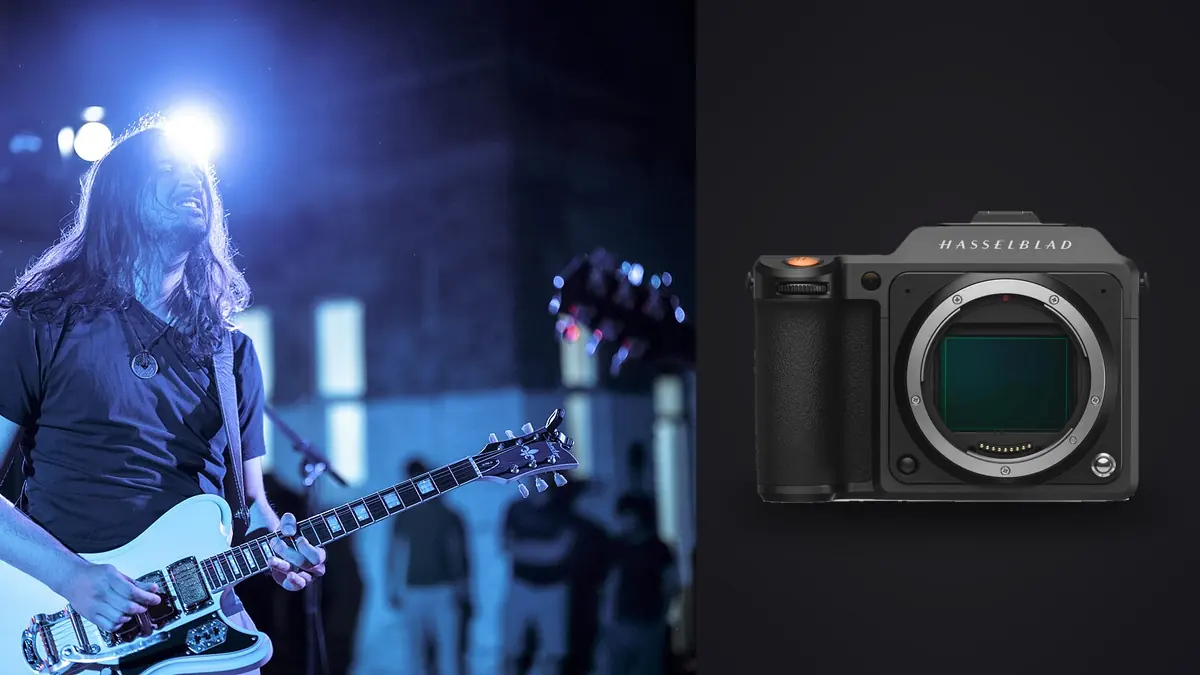
Medium Format Walks Into a Punk Show
The first time I saw a Hasselblad X2D 100C in a photo pit, the photographer next to me actually laughed. Not unkindly, just genuine surprise. Medium format cameras live in studios, on tripods, pointed at buildings and landscapes and models who hold still when asked. They do not, as a rule, get shoved between two monitor wedges three feet from a drummer who is about to throw a stick into the crowd. And yet there it was, a body built for architectural interiors and product work, doing three songs of no-flash coverage on a touring rock band.
This is not a camera anyone recommends for concert work off the shelf. It was never designed for it. But a growing number of photographers who already own an X2D for portrait or landscape jobs have started asking whether it can double as their live music camera too, mostly because the files are extraordinary and they'd rather not buy a second system. The honest answer is that it can, in specific and fairly narrow circumstances, and it will actively work against you in others. This piece is about where that line sits, based on what the sensor, the autofocus system, and the lens lineup actually do once the house lights go down.
What the Sensor Actually Buys You Under Stage Lights
The X2D 100C's 100-megapixel medium format sensor (43.8 x 32.9mm) is genuinely a different tool than anything crop or full frame offers, and stage lighting is one of the few real-world scenarios where the difference is obvious rather than academic. Concert lighting is brutal on sensors: a spotlight can hit 5,000 lux on a singer's face while the drum riser twelve feet back sits in near darkness, and a wash of saturated red or magenta gel will crush a lot of cameras' color channels into mush. The X2D's 16-bit color depth and roughly 15 stops of dynamic range give you real recovery room in both directions, pulling detail back out of a blown highlight on a white shirt under a follow spot, or lifting shadow detail on a bassist standing just outside the key light without the noise climbing in ugly steps.
Where it gets more complicated is ISO. Native range runs 64 to 25,600, but in practice the files start showing their medium format character (finer grain structure than full frame at low ISO, but noticeably more visible noise per pixel than you'd expect once you're north of ISO 3200) because 100 million photosites packed onto that sensor are each smaller than you'd get on a lower-resolution body of the same physical size. Club shows and small venues, where you're regularly pushing ISO 6400 and higher just to hold a workable shutter speed, are where this camera is at its least comfortable. Bigger stages with proper lighting rigs, where you can often sit in the ISO 800 to 3200 range, are where the sensor does what it's actually good at.
The Autofocus Problem You Need to Plan Around
This is the part that trips people up. The X2D 100C uses contrast-detection autofocus only, with no phase-detect pixels on the sensor. Contrast AF works by nudging focus back and forth until contrast peaks, which is fine for a portrait sitter or a still product shot and genuinely difficult when the subject is a singer whipping their head side to side under a strobe that's changing color every two seconds. In steady, evenly lit conditions the system locks confidently. Under fast-changing stage light, especially with strobes, hazers, or hard color shifts, it hunts, and it hunts at a speed that will cost you the moment you were trying to catch.
The workaround is to stop treating this camera like a tracking-AF sports body and start treating it more like a rangefinder. Pre-focus on a mic stand position, a monitor wedge, or a spot on the stage where you know the performer will pass, and wait for them to arrive rather than trying to chase focus onto them mid-motion. Zone focusing at f/4 to f/5.6 with a wider XCD lens gives you enough depth of field to absorb small misses. Manual focus with the EVF's peaking overlay, while slower to set up, is often more reliable than letting the camera hunt through a strobe hit. None of this makes the X2D fast. It makes it usable if you accept the discipline it demands.
Because misses are a real and regular part of shooting this camera live, sorting a night's take becomes its own problem. A hundred-megapixel file is not something you want to zoom into one at a time across four hundred frames looking for the handful that actually locked focus. This is the one place I lean on imagic rather than scrolling through a catalog by hand: its local sharpness scoring flags which frames in a burst actually landed critical focus on the eyes or the instrument, running entirely on the machine rather than uploading a set of unreleased tour photos anywhere, which matters when you've signed an embargo agreement with a band's management.
Burst Rate, Buffer, and Working the Three-Song Rule
Most photo pit access follows the same unwritten rule: first three songs, no flash, then out. That window is short, and the X2D 100C's continuous shooting tops out around 3.3 frames per second, which is roughly a sixth of what a dedicated sports-oriented mirrorless body will give you. You cannot spray a two-second burst through a guitar jump and expect ten frames to choose from. You get maybe six, and if the AF hunted for even a fraction of that burst, fewer.
What this forces, whether you want it or not, is a rangefinder photographer's habit of anticipating the peak of an action rather than machine-gunning through it. Watch a guitarist's body language for the windup before the jump. Watch a drummer's stick hand for the backswing. Fire two or three frames right around that peak instead of holding the shutter down for two seconds. The internal 1TB SSD means buffer depth is rarely the limiting factor for a three-song set, it's the frame rate itself that sets the pace.
Even at 3.3fps, a short burst around a peak moment produces three or four nearly identical frames, and at 100 megapixels each, flipping between them one at a time in a viewer is slow going. I group these with imagic's duplicate and burst clustering, which stacks the near-identical frames from a single burst together so I'm picking a winner from a group of four instead of scrolling past the same jump four separate times in a folder of six hundred images.
Lens Choices for the Pit
The XCD lens lineup skews toward moderate primes rather than the long fast zooms concert photographers typically reach for. A 90mm XCD, with the sensor's roughly 0.79x crop factor relative to full frame, behaves closer to a 71mm equivalent in terms of field of view, and there's nothing in the native lineup that gets you real telephoto reach for shooting from a distant riser or an arena's second-tier photo position. This camera works best from close pit access, not from forty rows back with a monitor blocking half the stage.
Maximum apertures on most XCD glass sit in the f/2.5 to f/3.5 range rather than the f/1.4 to f/2.8 that concert shooters on other systems lean on for isolating a performer from a busy background and keeping shutter speeds up in low light. Combined with the contrast-AF hunting issue, this pushes you toward wider primes stopped down slightly for a focus margin rather than shooting wide open and trusting the system to nail focus on a moving eye.
Photo Pit Reality Check: X2D 100C vs. Typical Concert-Ready Bodies
| Spec | Hasselblad X2D 100C | Full-frame speed body (typical) | APS-C compact body (typical) |
|---|---|---|---|
| Sensor / resolution | 43.8 x 32.9mm, 100MP | 24 x 36mm, 24-50MP | ~23.5 x 15.6mm, 26MP |
| Autofocus system | Contrast-detect only | Phase-detect w/ eye tracking | Phase-detect w/ eye tracking |
| Max continuous burst | ~3.3 fps | 20-30 fps (electronic) | 15-20 fps |
| Practical ISO ceiling for clean files | ~ISO 3200 | ~ISO 12,800 | ~ISO 6,400 |
| RAW file size (approx.) | 100-130MB | 25-50MB | 25-35MB |
| Dynamic range (measured, approx.) | ~15 stops | ~14 stops | ~13 stops |
| Video capability | None | 4K/8K | 4K |
| Body weight (approx.) | 895g | 650-700g | 450-550g |
| Body-only price bracket | ~$8,200 | $4,500-6,500 | $1,800-2,500 |
RAW Files, Storage, and a Workflow That Doesn't Bury You
A single 3FR RAW file out of the X2D 100C runs somewhere in the 100 to 130 megabyte range depending on scene complexity. A modest three-song take of three hundred frames lands north of 30GB before you've touched a single edit, and that's a light night by concert-shooting standards if you're used to spraying frames on a faster body. Backing that up on-site, culling it that same evening, and turning around a handful of selects for a publicist by morning is a very different job than doing the same with 30-megabyte files.
The culling step is where the file size actually bites. Opening eighty 100-megapixel RAWs one at a time in a standard cataloging tool to check focus and expression is slow enough that it eats into the turnaround window photo desks expect. I run the night's take through imagic first: local sharpness scoring flags the genuinely sharp frames before I open a single one at full resolution, and because the processing happens on the machine rather than a cloud service, unreleased tour images never leave the laptop before the band's team has cleared them. If you haven't compared how different culling approaches actually handle this kind of volume, this breakdown of how AI photo culling works covers the mechanics in more depth than I can here.
Color Grading Mixed Stage Lighting
Concert lighting rarely holds one color temperature for more than a few seconds. A verse might sit under warm amber, the chorus hits under cold blue-white LED wash, and a bridge gets a hard magenta strobe, sometimes all within the same song. The 16-bit color depth on the X2D's files gives you noticeably more room to pull a coherent white balance and color grade out of that mess in post than 8-bit output would, particularly when you're trying to recover skin tone under a heavily gelled key light without the color banding badly.
Because I shoot the same three or four bands' worth of shows most months, I've settled on a grading approach for stage light that I don't want to rebuild from scratch every time. imagic's apply_my_style feature, trained on a set of my own previously graded concert edits, gets a full night's selects to roughly the right place in one pass, and I finish from there rather than starting flat on every frame. It's not a substitute for judgment on a genuinely difficult mixed-light frame, but it removes the repetitive part of the job. For the grading fundamentals behind this, this guide to photo color grading is a reasonable starting point if you're building your own approach to mixed venue lighting.
Field Notes: Settings That Actually Hold Up
A few things that consistently matter once you're actually standing in the pit with this camera. Keep shutter speed at 1/320s or faster for a guitarist's hands and vocalist's head movement, and closer to 1/800s if you're trying to freeze a drummer's stick work without motion blur eating the shot. Stop down to f/4 or f/5.6 where the venue's light allows it, both for the extra depth of field that forgives a slightly missed focus point and because most XCD glass is noticeably sharper a stop or two down from wide open. Budget for the EVF blackout between frames, it's longer than what you'd get on a body built for continuous tracking, and it means you genuinely won't see the moment right as you press the shutter. Battery life across a full set with the SSD writing constantly runs shorter than the spec sheet suggests, so a charged spare in a pocket is not optional.
Who Should Bring This Camera to a Show (and Who Shouldn't)
This camera earns its place for acoustic sets, jazz clubs, seated theater shows, and slower-tempo indie or folk acts where the performers aren't sprinting across a stage every thirty seconds. It's also a strong choice for festival work where you have a fixed riser position and predictable blocking, or for artist promo shoots during soundcheck where you control the pace. Anywhere the files are headed for a large print or gallery exhibition, the resolution and dynamic range genuinely pay for themselves.
It's a poor fit for mosh pits, hardcore and punk shows, arena rock with erratic strobing and constant crowd surfing, or any assignment where a same-night file turnaround to a wire service matters more than the last stop of dynamic range. And if part of the job is grabbing behind-the-scenes video for socials between stills, this camera can't help you there at all, it doesn't shoot video in any form.
Frequently Asked Questions
Does the Hasselblad X2D 100C shoot video for behind-the-scenes concert content?
No. The X2D 100C has no video recording mode whatsoever, stills only. If a gig requires even short behind-the-scenes clips alongside photos, you'll need a second camera or a phone for that footage.
Is the X2D 100C's autofocus fast enough for mosh pits and stage dives?
Not reliably. The contrast-detection-only AF system struggles to keep pace with fast, unpredictable subject movement, especially under strobing or rapidly shifting colored light. Pre-focusing on a known spot and waiting for the subject works far better than trying to track a crowd-surfer in real time.
How many RAW files fit on the internal SSD during a full show?
With 3FR files running roughly 100 to 130MB each, the 1TB internal SSD holds somewhere around 7,000 to 9,000 uncompressed RAW frames before it fills, though most photographers will offload well before hitting that ceiling. A typical three-song pit set of a few hundred frames uses a small fraction of that capacity.
Do I need a faster card or external SSD for a three-song photo pit set?
Given the burst rate tops out around 3.3fps, write speed to the internal SSD is rarely the bottleneck the way it would be on a high-speed sports body. The bigger practical concern is offloading and backing up 100MB-plus files quickly enough between sets or before a next-day deadline, which is where a fast external SSD and a reliable backup routine matter more than in-camera buffer specs.