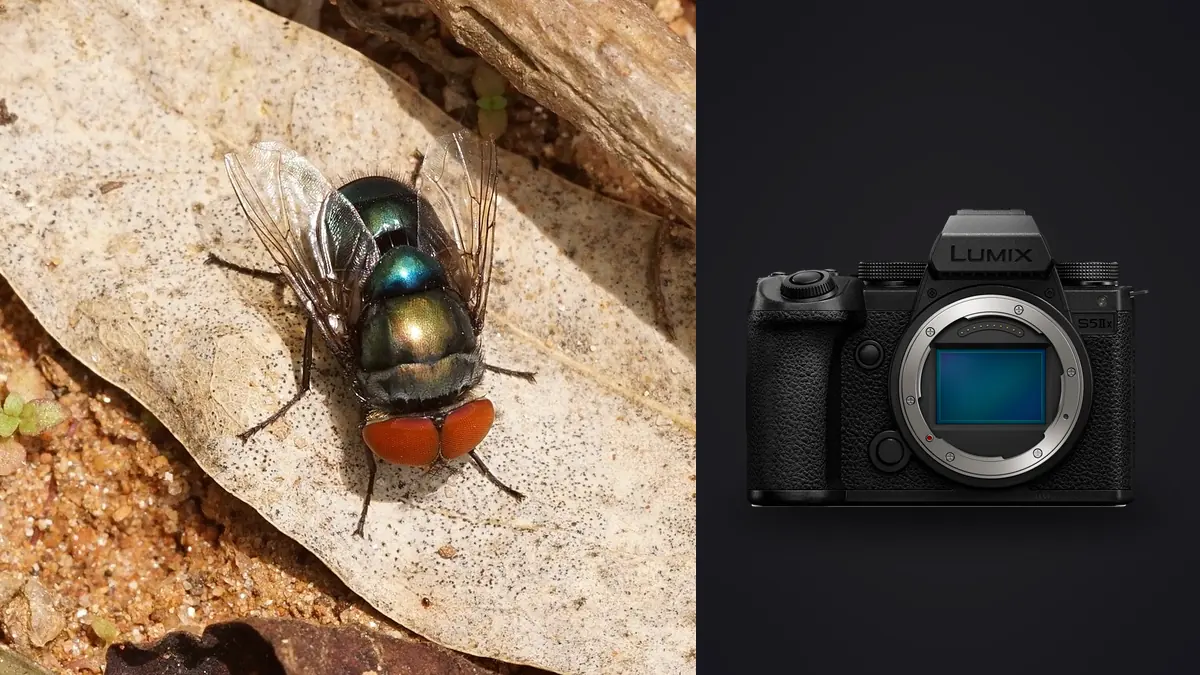
I bought the S5IIx for a video project, a series of short product clips that needed internal ProRes and I didn't want to carry an external recorder. Then I got curious about what it could do with a macro lens on a Saturday morning chasing hoverflies around a lavender bed, and it turned into a summer-long habit. Nobody at Panasonic designed this body with insects in mind. The video-first marketing around the S5IIx makes that obvious. But once you strip away the parts aimed at run-and-gun filmmakers, what's left underneath is a very usable stills camera for close-up work, provided you understand which of its headline features actually apply to you and which don't.
The S5IIx and S5II are the same camera for this purpose
This is the part that trips people up when they're comparing the two before buying. The S5IIx uses the identical 24.2-megapixel full-frame sensor as the S5II, the same phase-hybrid autofocus system with the same coverage, and the same in-body stabilization rated around 6 to 7.5 stops depending on the lens. For a macro shooter, that means autofocus behavior, burst rate, and stabilization performance on insects will be indistinguishable between the two bodies. Everything Panasonic added for the IIx variant lives on the video side: internal ProRes 422 HQ recording, a waveform and vectorscope in the viewfinder, an active cooling fan for unlimited high-bitrate recording, USB-C live streaming, and a matte black finish with no red tally lamp. None of that touches how the camera meters, focuses, or renders a bee's compound eye at 1:1.
If you're buying new and you shoot stills only, save the money and get the S5II. If you already have the S5IIx because you also shoot video, or you got a good deal on a used body, there's no reason to hesitate on the insect work. The one genuine crossover benefit is the fan: if you're doing macro timelapses of a chrysalis splitting or slow-motion wingbeat footage in direct sun for twenty minutes at a stretch, the S5IIx won't throttle where the S5II eventually will. For a normal stills session that's irrelevant.
| Feature | S5II | S5IIx | Matters for insect stills? |
|---|---|---|---|
| Sensor / AF system | 24.2MP, 779-point hybrid PDAF | Identical | No difference at all |
| Continuous shooting (e-shutter) | Up to ~30fps | Identical | No difference |
| Focus bracketing / stacking | Up to 999 frames | Identical | No difference |
| Active cooling fan | No | Yes | Only for extended macro video, not stills |
| Internal video codec | No ProRes | ProRes 422 HQ, higher bitrates | Irrelevant unless you also film insects |
| Approximate body weight | ~740g | ~780g | Slight, noticeable after hours handheld |
| Typical price premium (new) | Baseline | Roughly $300-400 more | Not worth paying for stills-only use |
Autofocus on something that won't hold still
Panasonic's contrast-detect-plus-PDAF hybrid system on this generation is genuinely good at tracking eyes, faces, and larger animals. It is noticeably less confident on a jumping spider that's three millimeters across and moving unpredictably against a busy leaf background. In practice I use continuous autofocus for maybe a third of my insect frames: subjects that are relatively large and cooperative, like dragonflies perched and pumping their wings, or caterpillars that are, by definition, not going anywhere fast.
For anything smaller or twitchier, I switch to manual focus with focus peaking turned up and the rear screen magnified. That sounds slower than it is. At high magnification the depth of field is so thin (we're talking fractions of a millimeter at 1:1 with a wide aperture) that autofocus hunting wastes more time than manually rocking the camera forward and back on the focus plane while firing bursts. This is the classic macro technique and it works exactly the same on the S5IIx as it did on cameras from a decade ago, because physics hasn't changed.
The camera's Focus Stacking mode (up to 999 bracketed frames with adjustable step width) is useful for anything that will sit still: dew-covered spiders early in the morning before they've warmed up, or insects you've found roosting overnight. It's essentially useless for an active bee working a flower head, since the subject moves between frames and stacking software chokes on misalignment. For live, moving insects, your realistic options are a single well-focused frame at a smaller aperture, or a fast burst where you manually walk focus through the subject and pick the sharpest result afterward.
Prefocus and burst beats tracking, most of the time
My actual working method for anything that flies: pick a flower or perch the insect is favoring, manually preset focus to the distance I expect it to land at, and fire a burst the instant it settles. Electronic shutter at high frame rates is silent, which matters more than people expect. A mechanical shutter clack at close range will send a hoverfly off before you've fired a second frame. The tradeoff is rolling shutter: fast wingbeats can smear or show banding under electronic shutter, so if wing detail matters for the shot, I'll drop to mechanical shutter and accept the noise.
Lens choice matters more than the body
L-mount macro options have gotten genuinely good over the last few years, and which one you pick changes the insect photography experience more than anything the S5IIx vs S5II debate does.
| Lens | Max magnification | Closest focus | Approx. weight | Notes |
|---|---|---|---|---|
| Panasonic Lumix S 100mm F2.8 Macro | 1.0x | ~24cm | ~298g | Lightest option, OIS pairs with body IBIS for the steadiest handheld results |
| Sigma 105mm F2.8 DG DN Macro Art | 1.0x | ~29.5cm | ~715g | Sharper wide open in my testing, no optical stabilization, relies fully on body IBIS |
| Laowa 100mm F2.8 2x Ultra Macro APO | 2.0x | ~23cm | ~638g | Manual focus only, but the only one here that gets you past life-size for tiny subjects like aphids or ant heads |
| Sigma 70mm F2.8 DG Macro Art | 1.0x | ~25.8cm | ~515g | Shorter working distance means you're closer to the insect, which spooks more skittish species |
My daily lens is the Panasonic 100mm. It's light enough that a four-hour walk doesn't wreck my wrist, the optical stabilization noticeably helps compose handheld at high magnification, and the working distance keeps me far enough back that most pollinators tolerate me. I keep the Laowa in the bag specifically for subjects under about a centimeter, where even 1:1 doesn't fill the frame. It's manual focus only and has no electronic contacts, so you're fully on focus peaking and the loupe function, but for genuinely tiny insects there's no substitute for the extra magnification.
Settings that actually hold up outdoors
Depth of field at high magnification is measured in fractions of a millimeter, so the temptation is to stop down hard. In practice I rarely go past f/11 on this sensor. Diffraction softening becomes visible in full-resolution files past that point, and you're often better served by a slightly thinner focus plane and a well-chosen angle than by chasing more depth at the cost of overall sharpness. For a resting insect where I have time, f/8 to f/11 with a diffused flash is my default. The flash lets me keep shutter speed around 1/250s and ISO around 400-800 while still getting a properly exposed background instead of the black-hole look that underexposed ambient light gives you at those apertures.
For anything in motion, I'll open up to f/5.6 or f/4 and accept a much thinner slice in focus, betting that a burst gives me one frame where the eyes land in that slice. This is where shooting volume goes up fast. A single five-second burst at high frame rate on a dragonfly can produce forty or fifty near-identical frames, and the difference between the keeper and the reject is often a fraction of a millimeter of focus shift that's invisible on a phone screen and very visible at 100%.
Where the sorting actually happens
This is the part of macro insect photography that doesn't get talked about enough: the shooting is maybe a third of the work. A good outing produces hundreds of frames that look nearly identical at a glance, and the job afterward is finding the handful where focus actually landed on the eye rather than the antenna or the wing tip in front of it. I've been running these sessions through imagic rather than scrubbing through them one by one in a folder. Its local sharpness scoring is genuinely useful here because it's evaluating actual pixel-level focus rather than guessing from thumbnails, which matters a lot when the difference between two frames is which part of a three-millimeter subject is crisp. The duplicate and burst clustering also saves real time, since it groups those forty-frame dragonfly bursts together instead of making me scroll past all of them individually to find the one worth keeping. Because it processes everything locally, I'm not uploading a full day's worth of macro RAWs anywhere before I even know which ones are worth keeping, which matters when you're working with SD cards full of insect bursts. If you haven't looked at how automated culling actually evaluates sharpness under the hood, it's worth understanding how AI photo culling works before trusting it with a season's worth of macro files.
The other place it's helped is consistency across editing sessions. Insect photos have a particular look I've settled into over a couple of years, slightly cooler shadows, restrained saturation on greens so foliage doesn't fight the subject for attention, and I built imagic's apply_my_style preset from a batch of my own previously edited macro shots rather than starting from a generic preset pack. It gets me most of the way to my usual look automatically, and I finish the standout frames by hand from there.
Battery life and the practical stuff nobody mentions in reviews
Macro sessions burn through batteries faster than general shooting because you're using the rear screen at high magnification constantly, and often flipping it out to shoot low to the ground where insects actually are. I carry two spares for a full morning session and that's usually enough, three if I know I'll be doing extended focus stacking on stationary subjects, since each stack fires dozens of frames back to back. The fully articulating screen is genuinely one of the more underrated features for this kind of shooting: a huge amount of interesting insect activity happens low, on leaf undersides or ground-level flowers, and being able to flip the screen out rather than lying flat in the dirt to use the viewfinder changes how long you're willing to stay in position waiting for a shot.
Weather sealing has held up fine through dew-heavy mornings and one unplanned light rain, though I don't push it in genuinely wet conditions with the lens hood off, since the front element on most macro lenses sits close enough to the working distance that moisture on the glass ruins a shot instantly anyway.
Frequently Asked Questions
Does the S5IIx autofocus reliably on dragonflies and bees, or should I focus manually?
For larger, relatively stationary subjects like a perched dragonfly, continuous autofocus with a small focus area works reasonably well. For small or fast-moving insects at high magnification, manual focus with peaking enabled is more reliable and often faster in practice, since autofocus hunting at 1:1 magnification wastes more time than manually walking the focus plane through the subject.
Is the S5IIx worth the extra cost over the S5II if I only shoot macro stills?
No. The sensor, autofocus system, burst rate, and stabilization are identical between the two bodies. Everything the S5IIx adds is video-oriented (internal ProRes, active cooling, waveform monitoring). Unless you're also filming, the S5II gets you the same insect photography results for less money.
What aperture actually works best for 1:1 insect macro on this sensor?
f/8 to f/11 is the practical range for stationary subjects where you want reasonable depth without visible diffraction softening on the 24.2MP sensor. Past f/11 the loss in overall sharpness usually outweighs the gain in depth of field. For moving subjects, opening up to f/4 or f/5.6 and relying on a burst to catch the right focus plane often produces a better keeper than stopping down and hoping.
Can I adapt Micro Four Thirds macro lenses to the S5IIx?
Not directly and not well. L-mount is a full-frame mount with a different flange distance and image circle requirement than Micro Four Thirds. There's no simple mechanical adapter that preserves autofocus and infinity focus the way, say, adapting Canon EF lenses to L-mount does. You're better off buying into native L-mount macro glass (Panasonic, Sigma, or Laowa all make solid options) rather than trying to bring an old Olympus or Panasonic MFT macro lens across.