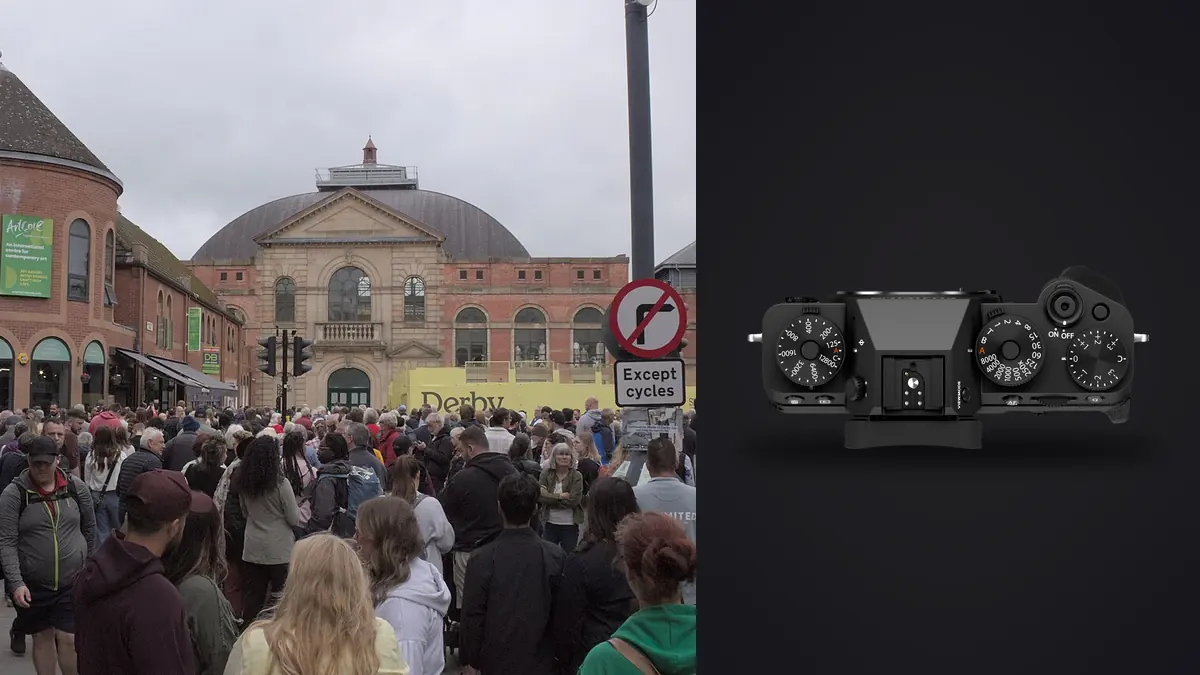
I spent four months last winter shooting a documentary series on a fish market that opens at 4 a.m., and the camera bag I settled on had exactly one body in it: a Fujifilm X-T5. Not because it was the fastest thing I owned (it isn't) or the camera with the best low-light autofocus (also not it), but because it disappeared into the work in a way my full-frame kit never did. Nobody in that market flinched when I raised it. Nobody asked if I was "the press." That's the whole game in street and documentary work, and it's worth talking about the X-T5 specifically through that lens rather than as a generic "best camera for street photography" listicle entry.
This isn't a spec sheet regurgitation. I want to walk through where the X-T5 genuinely earns its keep for candid, fast, often uncomfortable shooting situations, where it falls short, and what actually changes in your results versus a bigger body. I'll also get into lens choices and, further down, what happens once you're home with a card full of near-duplicate burst frames from a market brawl or a protest march, because that part of the workflow matters just as much as the camera in your hand.
Size and weight change how people react to you
The X-T5 body is around 557 grams with a battery and card in it. Pair it with something like the XF 23mm f/2 and you're carrying well under a kilogram total. That matters more than any autofocus benchmark for documentary work, because the entire discipline depends on subjects behaving naturally in front of you. A DSLR with a 24-70mm f/2.8 reads as "professional photographer, possibly here to make trouble." The X-T5 with a small prime reads as "tourist" or "hobbyist," and that misreading buys you time. People stop performing for the camera faster when the camera looks unthreatening.
The in-body stabilization rated around seven stops is a genuine bonus here too, not because you're shooting long exposures on the street (you mostly aren't) but because it lets you drop your shutter speed in dim interiors, market stalls, back alleys at dusk, without pushing ISO into territory where the X-Trans sensor starts looking smeared rather than grainy. I've handheld frames at 1/15s with the 35mm f/2 that came out clean enough to print, which simply wasn't happening with older X-series bodies that lacked IBIS.
Autofocus in a moving crowd, not in a controlled test
Fujifilm's marketing leans hard on subject detection numbers, and in isolated testing the X-T5's face and eye detection is solid. In an actual crowd, though, with a dozen faces at different depths and half of them turned away or partially occluded by shoulders and umbrellas, subject detection gets confused more often than the brochure suggests. What I actually rely on is the joystick. I keep the camera in single-point AF-C most of the time and nudge the point with my thumb without taking my eye off the viewfinder. It sounds old-fashioned next to "AI-powered subject tracking," but it's more predictable, and predictability is what you want when a decisive moment lasts three-quarters of a second.
Where the AF genuinely helps is walking-pace street work: someone crossing a market aisle toward you, a kid running between stalls. The hybrid phase and contrast-detection system across the frame keeps up fine at those speeds. Where it struggles is fast, erratic motion at close range, someone spinning a vendor cart, a scuffle breaking out. In those moments I've had better luck pre-focusing on a spot and waiting for the action to arrive at that plane than trusting continuous tracking to lock on mid-chaos.
The tilt-only screen, and why that's actually the right call here
Fuji walked back the fully-articulating screen from the X-T4 and gave the X-T5 a three-way tilt mechanism instead, and a lot of vloggers complained about it. For street and documentary shooting, I think it's the better design. A flip-out side screen means holding the camera away from your body at an angle to see it, which telegraphs "I am photographing you" from thirty feet away. A tilt screen lets you shoot from the hip or from waist height, glance down at a shallow angle, and frame without ever raising the camera to eye level. That low, unhurried gesture reads as completely different body language to a subject than an eye-level DSLR stance. I use hip-height tilt-screen framing constantly in market and street scenes where I want a genuine, unposed moment rather than the version of someone that appears the instant they clock a lens pointed at their face.
Film simulations as a documentary style, not a gimmick
I shoot RAW+JPEG on documentary work and use the JPEGs for same-day social posting and quick previews. Classic Chrome is the one I reach for constantly on documentary work: it flattens contrast slightly and mutes saturation in a way that reads as reportage rather than advertising. Acros with the red filter simulation is my default for anything I know is going black and white from the start, market scenes with harsh overhead light where color would be a distraction from gesture and expression. These aren't neutral technical choices, they're closer to picking a film stock, and having them baked in at capture time changes how you see a scene while you're shooting it, not just how you process it afterward.
| Camera | Viewfinder | In-body stabilization | Rear screen | Body weight (approx.) | Lens flexibility |
|---|---|---|---|---|---|
| Fujifilm X-T5 | 3.69m-dot EVF, 0.8x | Yes, rated ~7 stops | 3-way tilt | ~557g | Full XF/XC mount, any focal length |
| Fujifilm X-Pro3 | Hybrid optical/electronic, hidden rear LCD | No | Fixed, flips down and hides | ~497g | Full XF/XC mount, any focal length |
| Fujifilm X100VI | Hybrid optical/electronic | Yes (added in this generation) | 2-way tilt | ~521g | Fixed 23mm f/2 (35mm equiv.), teleconverters only |
The X-Pro3's hidden screen is a deliberate anti-chimping design, Fuji wants you composing through the optical finder like a rangefinder, and some documentary shooters swear by that discipline. I find it slows down the review-and-adjust loop too much for fast-moving scenes. The X100VI is the more honest "street camera" of the three in terms of pure discretion (nobody clocks a fixed-lens compact as a serious camera the way they clock an interchangeable-lens body with a big prime on it), but you're locked to one field of view for the whole shoot, which doesn't work for documentary assignments where you need to go from environmental wide shots to tighter portrait framing in the same session.
Lenses that actually fit this kind of shooting
The XF 23mm f/2 WR is the lens I'd tell someone to buy first. It's small, weather-sealed, focuses fast enough for walking-pace work, and the 35mm-equivalent field of view is close enough to how your eyes actually see a scene that framing becomes instinctive after a few weeks. The XF 35mm f/2 WR is my second body's worth of glass for tighter, more intimate documentary portraits, roughly a 50mm equivalent, close to "normal" perspective with minimal distortion on faces.
The XF 18mm f/1.4 is a newer addition I've been using for cramped interiors, market stalls, small apartments during documentary work, where you need width but also need the f/1.4 aperture to keep shutter speeds workable in bad light. It's heavier than the 23mm f/2 but still small enough not to change your silhouette much. For longer documentary days where I know I'll need range and don't want to swap lenses mid-scene, I'll bring the XF 16-55mm f/2.8, but it's a noticeably bigger, heavier setup, and it does cost you some of that "unthreatening" body language the prime lenses give you for free.
What happens after the shoot matters as much as the camera
A single morning at that fish market routinely produced 1,000 to 1,500 frames once you count bursts fired during fast-moving moments, a fight breaking out, a truck unloading, a kid darting between stalls. Culling that by eye, at full size, one frame at a time, is how you burn an entire evening you don't have. This is the part of the X-T5 workflow that doesn't get discussed nearly enough: the camera is only half the equation when your shooting style leans on burst mode to catch a fleeting expression.
I run everything through imagic before I open anything in an editor. It scores sharpness and focus locally, on the machine, without uploading a single frame anywhere, which matters a lot when half your files contain identifiable strangers photographed on a public street. It also clusters burst sequences and near-duplicate frames together, so instead of scrolling through nineteen almost-identical shots of the same gesture, I get the cluster with the sharpest, best-timed frame already flagged. For documentary work specifically, where a decisive moment might live in frame 6 of a 12-frame burst and nowhere else, that clustering step alone saves real time.
The other piece I lean on is the apply_my_style preset. I trained it on a batch of Classic Chrome-leaning edits from an earlier project, and now new imports land already pushed toward that same contrast and tonal feel before I touch a single slider, which keeps a multi-week documentary project visually consistent without me manually matching grade decisions across hundreds of images. If you're new to building a faster culling habit in general, our workflow speed guide covers the broader version of this, and this breakdown of how AI culling actually works is worth reading if you want the mechanics behind the sharpness scoring rather than just the result.
Where the X-T5 falls short for this genre
Battery life is the honest weak point. The NP-W235 gets you somewhere around 580 frames CIPA-rated, but documentary days with a lot of screen review and burst shooting eat through that faster in practice. I carry two spares minimum on any all-day assignment. Buffer depth is the other one: shoot long RAW bursts back to back and the X-T5 will eventually make you wait a few seconds while it clears, which is exactly the moment a second important thing happens across the street. It's not a dealbreaker, but it's the trade-off you make for a 40-megapixel APS-C sensor in a body this size, and it's worth knowing before you're standing there watching the buffer indicator during a moment you wanted to keep shooting through.
Frequently Asked Questions
Is the X-T5 fast enough for genuinely unpredictable street scenes, like protests or crowded events?
For walking-pace and moderately fast action, yes. For chaotic, close-range, erratic movement, single-point AF-C with manual joystick nudges has been more reliable for me than trusting full subject tracking. It's a very capable camera, just not the one I'd reach for if I shot nothing but sports-speed action.
Do I need the in-body stabilization if I mostly shoot during daylight hours?
Less critical in bright conditions, but documentary work rarely stays in bright conditions all day. Interiors, dusk, early morning markets before sunrise, the stabilization earns its place the moment the light drops, and it costs you nothing when it isn't needed.
Should I start with a zoom or a prime for street and documentary work?
Start with a prime, specifically the 23mm f/2 or 35mm f/2. Zooms feel efficient on paper but they change how you move through a scene, you tend to stand still and zoom rather than physically walk closer, which changes your relationship to the subject and, honestly, the resulting photographs.
Is the X-T5 quiet enough to shoot close to people without drawing attention?
The mechanical shutter is noticeably quieter than a DSLR's mirror slap but it's not silent. Switch to the electronic shutter for genuinely silent operation in situations where sound would give you away, just watch for rolling shutter distortion on anything moving fast under artificial lighting.