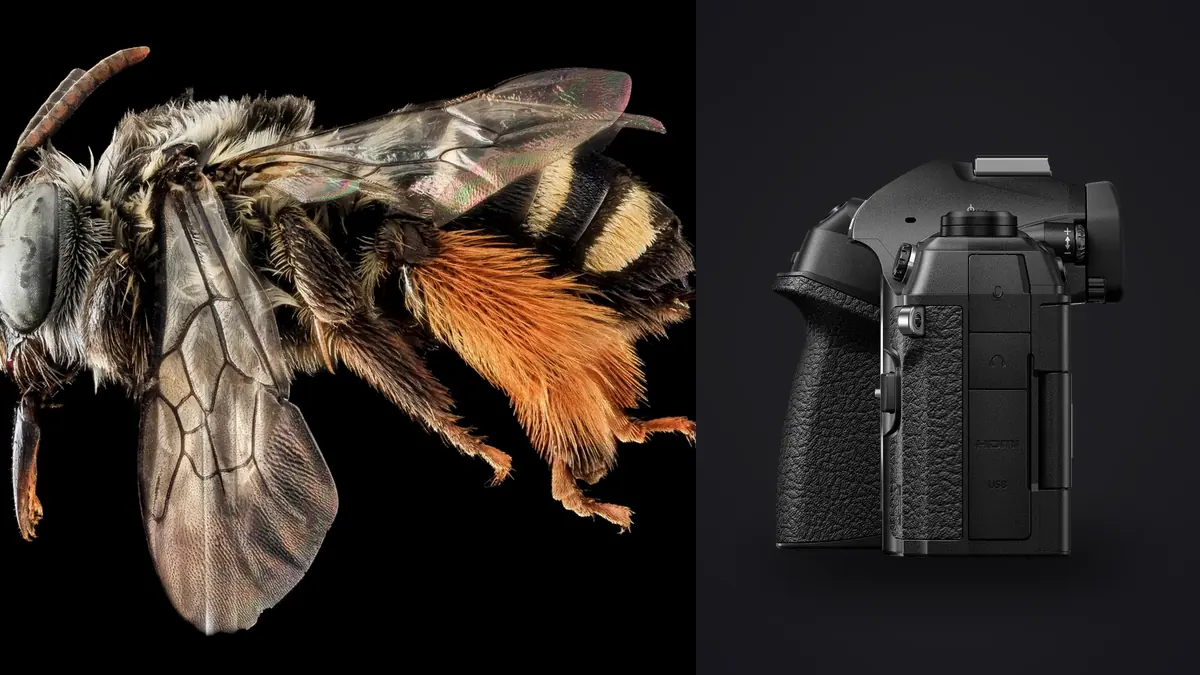
I picked up the OM System OM-1 Mark II last spring specifically to chase dragonflies, jumping spiders, and whatever else turned up at a wetland reserve I shoot most weekends, and six months later it's still the camera I grab over my full-frame kit the moment the subject gets smaller than a thumbnail. That's not a blanket endorsement of the system for everything (I still reach for the bigger sensor for landscapes and portraits), but for insect macro specifically, the case for Micro Four Thirds and this body in particular is more concrete than the marketing copy suggests. This is what actually changed in my results, and where the camera still fights me.
Why the smaller sensor stops being a compromise at macro distances
The usual argument against Micro Four Thirds is noise at high ISO and a shallower dynamic range ceiling, both true, both mostly irrelevant once you're working at 1:1 or 2:1 magnification in daylight or with flash. What matters more at those distances is depth of field, and this is where the 2x crop factor stops being a marketing number and starts doing real work. A 90mm macro lens on this body frames like a 180mm lens would on full frame, which means I can stand back a few extra centimetres from a damselfly without changing my composition, and that distance is often the difference between it holding still and it bolting.
Depth of field at true macro magnifications is razor-thin no matter what you're shooting with, but in practice I find I can work a third to two-thirds of a stop more open on the OM-1 II than I could on my old full-frame macro rig at the same framing before the depth of field starts feeling uncomfortably thin. That's not free lunch, diffraction softening on this 20-megapixel sensor becomes visible earlier too, noticeably by f/11 and clearly by f/13, so I stay in the f/5.6 to f/8 range for single frames and lean on focus bracketing rather than stopping down further to fake more depth.
Autofocus works differently for bugs than it does for birds
OM System built its reputation on the AI subject detection in this camera line, and for birds in flight it's genuinely excellent, sticky, fast, rarely wanders off onto the background. Insects are a different story. As of the firmware I'm running, insects aren't one of the recognized categories in the AI detection list (birds, mammals, and several vehicle types are), so the camera has no idea it's looking at a beetle or a hoverfly. Occasionally the bird algorithm will latch onto a dragonfly's head and thorax because the silhouette is close enough, but I've had it just as often grab the leaf behind the dragonfly instead, so I don't build a workflow around it.
What I actually use is a small AF target (single point, the smallest size available) parked exactly on the compound eye, focus limiter set on the lens to cut hunting range, and manual focus with the focus clutch ring for anything under a centimetre long where autofocus starts to breathe in and out looking for contrast. Pro Capture (the SH2 buffered burst mode) has probably saved more shots than the AI system has, since it starts recording before you fully press the shutter and lets you go back and grab the frame from a half-second earlier, which is exactly the window when a dragonfly's wings blur into takeoff.
Picking a macro lens for this body
OM System's own lineup gives you two realistic options for insect work, and they solve different problems. The 60mm f/2.8 Macro is the cheaper, lighter, more forgettable-in-your-bag option, native 1:1 magnification, sharp wide open, but the working distance at maximum magnification is uncomfortably close for anything that can sense you coming. The 90mm f/3.5 Macro IS PRO is the one I actually reach for on insect days: 2:1 native magnification (meaning the subject renders at twice life size on the sensor before you've done anything else), in-lens stabilization synced with the body, and a working distance at full magnification that's roughly triple the 60mm's, which buys enough room to shoot a wary jumping spider without it bolting mid-frame.
| Lens | Native magnification | With MC-20 teleconverter | Weight | Working distance at max magnification | Best for |
|---|---|---|---|---|---|
| M.Zuiko 60mm f/2.8 Macro | 1:1 | Not compatible | 185g | ~4cm | Flowers, static subjects, travel kit |
| M.Zuiko 90mm f/3.5 Macro IS PRO | 2:1 | 4:1 (AF retained) | 453g | ~13.5cm | Skittish insects, wing detail, handheld stacking |
The MC-20 teleconverter on the 90mm is the party trick most reviews mention and few people actually use, because at 4:1 magnification the depth of field is measured in fractions of a millimetre and autofocus, even manual focus, gets genuinely difficult to nail handheld. I use it maybe twice a season, for wing scale detail on a moth that's cooperating, and I always shoot it on a small tripod or bean bag rather than freehand.
In-camera focus stacking, and where it actually breaks
The OM-1 Mark II can shoot a focus-bracketed sequence (up to 999 frames, though I've never used more than 20-30 for insect work) and merge a batch of up to 15 of them into a stacked composite in-camera. For a motionless subject like a pinned specimen or a dew-covered spider at dawn before it's warmed up enough to move, this is close to magic: set the step width, fire once, and you get a composite with the antenna, the eyes, and the legs all in focus at once, something that would be physically impossible at f/5.6 and 2:1 magnification in a single frame.
Where it falls apart is any insect with a pulse. A breathing thorax, a twitching antenna, or a leg that shifts half a millimetre between frames three and four of a fifteen-frame stack shows up as a ghosted double edge in the merge, and the in-camera algorithm doesn't handle that gracefully. My actual workflow now is to shoot the bracket anyway, even on live subjects, but treat the in-camera merge as a preview and keep every individual frame. If the composite has ghosting I pick the two or three sharpest frames from the sequence by hand and blend just those instead of all fifteen, which usually solves it without the alignment artifacts.
That habit is also why culling matters so much more for macro work than for most other genres I shoot. A single afternoon chasing insects with bracketing turned on can leave four or five thousand frames on the card, most of them near-duplicates of the same six-legged subject at slightly different focus points. I run those through imagic before I open anything in an editor, its local sharpness scoring flags which frame in each bracket sequence is actually the crispest on the eyes rather than the wings, and because the whole pass runs on my laptop with no upload step, I can do it that same evening at a campsite with no signal instead of waiting until I'm back near wifi. If you haven't compared tools for this kind of triage before, this rundown of how AI photo culling actually works covers the mechanics better than I can in a paragraph here.
Field settings I actually dial in
Ambient light macro at 2:1 forces small apertures and therefore either high ISO or supplemental light, and I've settled into a few combinations depending on what's in front of me and whether it's cooperating.
| Scenario | Aperture | Shutter | Light source |
|---|---|---|---|
| Static subject, morning dew, tripod | f/5.6 | 1/125s, 15-frame bracket | Natural light only |
| Perched insect, handheld, some wind | f/8 | 1/500s | Twin macro flash, -1.3 EV |
| Insect in flight (dragonflies, bees) | f/8-f/9 | 1/2000s, Pro Capture SH2 | Full sun or high-speed sync flash |
| Wing detail with MC-20 teleconverter | f/9 | 1/200s, bean bag | Diffused ring light |
The twin flash setup is doing more work than people expect from a small MFT-friendly rig. Two small heads mounted either side of the lens hood, dialed down two or three stops below full power, freeze wing motion far better than shutter speed alone can manage on an insect that's beating its wings faster than any mechanical shutter will catch, and the shorter flash duration at reduced power is the actual freezing mechanism, not the exposure time.
Carrying it for a full day outdoors
Body weight is 599g, and the 90mm PRO lens adds another 453g, so the whole rig sits well under a kilogram before you add a flash bracket. That matters more than it sounds like it should when you're crouched in wet grass for three hours tracking a single dragonfly's territory. The IP53 weather sealing has shrugged off drizzle and pond spray without complaint, and I've had the body out in temperatures close to freezing on early-season shoots with no issues, though I keep a spare BLX-1 battery in an inside pocket since cold does knock down the rated 520-shot CIPA figure noticeably. USB-C charging means a power bank in the bag covers a long weekend away from mains power, which matters more for reserve trips than most spec sheets let on.
Sorting the season's take
The unglamorous part of shooting this much macro is that by August I have tens of thousands of frames across a dozen outings, a large share of them Pro Capture bursts of the same beetle from twenty consecutive frames that differ by a millimetre of wing position. Scrubbing through that by hand is how a hobby stops being fun. I lean on imagic's burst and duplicate clustering to group those sequences automatically so I'm reviewing one representative thumbnail per burst instead of twenty near-identical ones, and once I've settled on a color treatment for a batch (I tend to warm up the greens on foliage backgrounds and pull down highlights on shiny chitin so it doesn't blow out under flash), the apply_my_style preset carries that same edit across the rest of the season's shoots without me rebuilding it from scratch every time. It's a small thing, but at this volume the hours it saves add up faster than any single camera feature does. For anyone drowning in a similar backlog, these workflow habits pair well with whatever culling tool you end up using.
Frequently Asked Questions
Is the 60mm f/2.8 Macro good enough, or do I need the 90mm PRO for insects?
The 60mm is fine for flowers, fungi, and subjects that won't flee, and it's much lighter to carry all day. For anything with legs and a flight response, the extra working distance on the 90mm PRO earns its weight and price difference within the first outing where a damselfly lets you get close because you're not looming over it.
Does the AI subject detection recognize insects the way it recognizes birds?
Not in my experience over six months of use. Insects aren't a listed category in the AI detection modes, so autofocus for bugs comes down to a small manual AF point on the eye or full manual focus, not the tracking system that makes bird photography with this body feel almost automated.
Can I rely on in-camera focus stacking for live insects, or only for dead or dormant subjects?
It works reasonably well on subjects that are genuinely still, cold mornings before insects have warmed up, or specimens that have settled to roost. Anything actively breathing or twitching between frames tends to produce ghosting in the automatic merge, so I keep the individual bracket frames and blend a smaller hand-picked selection when that happens.
Is the smaller sensor actually a depth-of-field advantage at macro magnifications, or just a marketing claim?
In my own side-by-side shooting I get a modest but real advantage, roughly a third to two-thirds of a stop more usable aperture at the same framing before depth of field feels too thin, though diffraction also arrives earlier on this sensor so the advantage isn't as large as the crop factor alone would suggest.