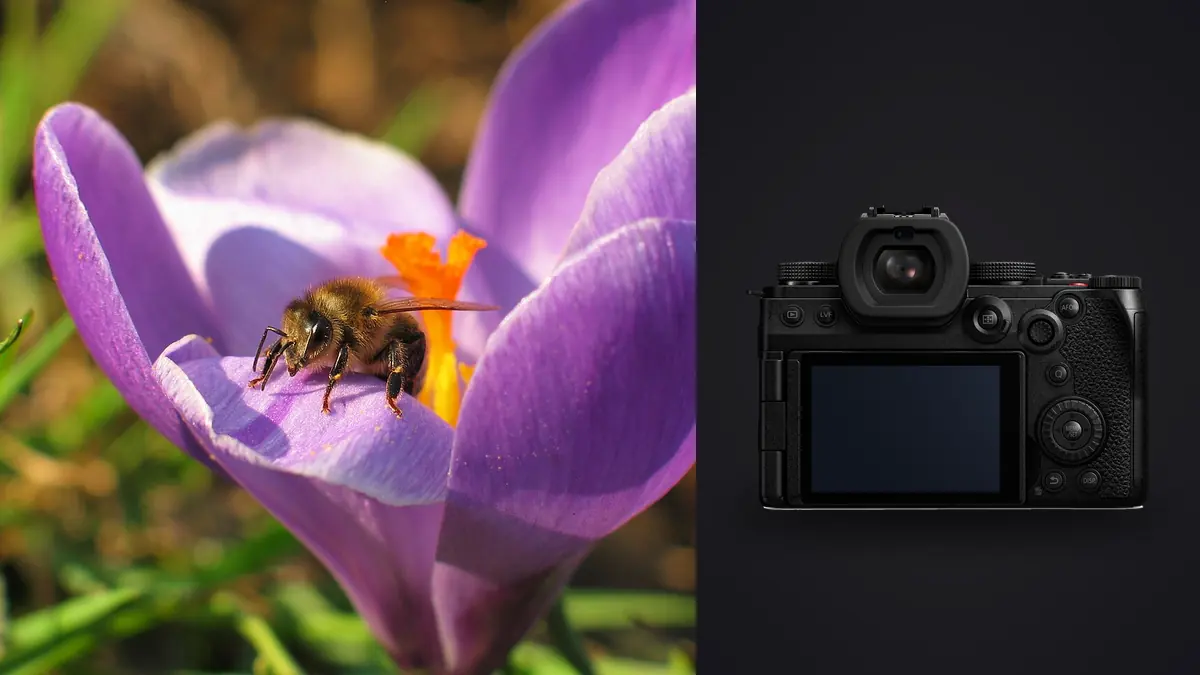
I bought the Panasonic Lumix S5IIx for a video project. It sat in a bag for three weeks doing nothing but B-roll for a product video, and then a heatwave hit and my garden filled up with hoverflies and a family of jumping spiders that had colonized the herb pots. I grabbed the camera because it was the one already charged, bolted on a borrowed macro lens, and spent the next six weekends finding out whether a hybrid body built around ProRes recording and live streaming has any business photographing insects. Short answer: yes, with caveats worth knowing before you buy a macro lens for it.
A video-first body that turns out to handle bugs fine
The S5IIx gets talked about almost entirely in terms of its video spec sheet: internal ProRes, 5.9K open-gate recording to an external SSD over USB-C, waveform monitors, all the streaming plumbing. None of that matters for a Wednesday morning spent on your knees in wet grass photographing a robber fly. What does carry over is the chassis underneath it: the same 24.2-megapixel full-frame sensor as the standard S5II, the same phase-hybrid autofocus system, the same in-body stabilization unit. The IIx variant also drops the optical low-pass filter that the base S5II keeps, which on paper buys you a touch more per-pixel sharpness on static, high-detail subjects. An insect's compound eye or the fuzz on a bee's thorax is about as static-and-high-detail as subjects get, so that's a real, if modest, advantage rather than a marketing footnote.
What you're not getting is a dedicated macro or wildlife camera. There's no top-plate LCD, the menu system still nests deep for things you'll want quick access to in the field like focus bracketing settings, and the active cooling fan (there for long ProRes recording sessions) is dead weight for stills work. It doesn't hurt image quality, it's just a few extra grams and a vent you'll never use pointed at nothing.
Autofocus at 1:1: what the phase-hybrid system actually gives you
The headline upgrade over the original S5 is phase-detection autofocus, Panasonic's first full-frame body with it after years of DFD contrast-only systems that hunted visibly in low light. For general photography this closed a real gap against Sony and Canon. For macro insect work at or near 1:1 magnification, temper your expectations: Panasonic's subject-recognition AI covers humans, animals (including birds), and vehicles. It does not have an insect or bug detection mode, and at native magnification the depth of field is often under a millimeter, which is narrower than any autofocus system, phase-detect or otherwise, can reliably nail on a moving subject without help.
In practice I stopped relying on continuous AF entirely once magnification passed about 0.5x. The workflow that actually produces sharp files: switch to AF-S with the smallest available focus point, place it directly over the eye or the antennae base, half-press to lock, then make micro-adjustments by rocking my body weight forward and back rather than touching the focus ring. For anything under 0.3x magnification (a dragonfly perched at a comfortable distance, say), the phase-detect AF is fast and confident enough to track a slight breeze moving the perch without hunting. It's a genuinely useful improvement over the older S5 for the wider-angle macro shots, just don't expect it to bail you out on a jumping spider's front eyes at full extension.
Focus peaking, set to high sensitivity with a color that contrasts against green foliage (I use blue), ends up doing more real work than the AF system once you're past half life-size. It's not glamorous, but it's the single setting change that improved my keeper rate the most.
In-body stabilization: the number on the box versus the number on your card
Panasonic rates the S5IIx's 5-axis IBIS at up to 6.5 stops with a compatible Dual I.S. lens, and that number is honestly earned for normal shooting distances. At macro magnifications it doesn't hold. Stabilization systems fight angular shake, and at 1:1 you're also dealing with translational shake (your whole body swaying forward and back a few millimeters), which IBIS barely touches. My real-world experience handheld at 1:1 with the Panasonic 100mm macro was closer to 2-3 stops of usable benefit, enough to shoot handheld at 1/125s instead of needing 1/500s, not enough to shoot at 1/8s the way you might for a handheld landscape.
Where the IBIS earns its keep is in the framing, not the final sharpness. Trying to hold a floating AF point steady on a moving insect's eye through a viewfinder at high magnification without stabilization is close to unworkable, the frame jumps around too much to compose. With IBIS active the viewfinder image settles enough that you can actually see what you're aiming at, even if you still need shutter speed and light to freeze the final shot. Treat it as a framing aid first and an exposure crutch second.
Choosing a macro lens for L-mount
Four lenses cover almost every L-mount macro shooter's shortlist right now, and they land in genuinely different places for insect work specifically, mostly because of working distance, which determines how close the front element has to get before something with wings decides you're a threat.
| Lens | Max magnification | Working distance at 1:1 | Autofocus | Weight |
|---|---|---|---|---|
| Panasonic Lumix S 100mm F2.8 Macro | 1:1 | ~13.5 cm | Yes, phase-detect compatible | ~298 g |
| Sigma 105mm F2.8 DG DN Macro Art | 1:1 | ~12.6 cm | Yes | ~715 g |
| Sigma 70mm F2.8 DG Macro Art | 1:1 | ~10.3 cm | Yes | ~515 g |
| Laowa 100mm F2.8 2x Ultra Macro APO | 2:1 | ~15 cm (at 1:1) | Manual focus only | ~638 g |
The Sigma 70mm is the one I'd actively steer people away from for skittish insects despite it being a fine lens optically. Ten centimeters of working distance means your lens hood is basically in the bug's personal space before you've reached full magnification, and dragonflies, hoverflies, and most butterflies will simply leave. The Panasonic 100mm has become my default: it's the lightest of the four by a wide margin, autofocuses natively with no adapter tax, and the extra 30-ish millimeters of working distance over the Sigma 70mm buys real breathing room on flightier subjects. The Laowa is a specialist tool, worth owning if you specifically want to go past 1:1 into true super-macro on things that don't move much (a resting moth, dew on a spiderweb), but it's manual-focus-only, which at those magnifications means a focusing rail and patience rather than any camera feature helping you.
Not spooking the thing you're photographing
More macro insect photos are ruined by fieldcraft mistakes than by gear limitations. A few things that made a measurable difference in my keeper rate, unrelated to anything the S5IIx specifically does:
Shadow placement matters more than most people account for. Insects, especially anything with compound eyes, seem to react to a sudden shadow falling across them faster than to the camera itself moving. Approach with the sun behind you rather than positioning yourself between the sun and the subject, and you avoid casting a warning shadow across it during the final approach.
Move in stages, not in one continuous motion. Get to roughly 50cm, stop and wait ten seconds, then close to 25cm, stop again, then make the final approach to working distance slowly enough that it doesn't read as a strike. This sounds excessive until you compare a session where you rush the approach (maybe two usable frames before the subject bolts) against one where you're patient (I've had single bee sessions produce forty or fifty clean frames from one relatively calm subject).
Early morning, before insects have warmed up enough to fly efficiently, is genuinely the best time for anything that isn't a spider. Cold-blooded insects are noticeably more tolerant of a close approach before the sun's been up long enough to bring their flight muscles to operating temperature. Spiders don't seem to care either way, which is why my jumping spider shots are scattered across all times of day and my dragonfly shots cluster tightly around 6:30-8am.
Depth of field and the diffraction tradeoff nobody enjoys
At 1:1 on a full-frame sensor, depth of field at f/2.8 is measured in fractions of a millimeter, not enough to keep even a small insect's whole face in focus in a single frame. Stopping down helps, but full-frame macro runs into diffraction softening earlier than most people expect. I settled on f/8 as the practical ceiling for single-frame shots (an isolated eye, a wing detail) and f/11 as the point where I stop bothering to go further, since anything past that on this sensor starts trading real detail for a marginal DOF gain that focus stacking handles better anyway.
The honest fix for depth of field at high magnification isn't a smaller aperture at all, it's more frames. Which brings up focus bracketing.
Focus bracketing in practice, with real numbers
The S5IIx's focus bracketing mode lets you set a step size (1-10) and a frame count (up to 999, though nobody's shooting that many). For a full insect body shot at roughly 0.5x magnification, I typically run 15-25 frames at step size 3. For a full-frame jumping spider face at closer to 1:1, that climbs to 40-60 frames at step size 2, because the depth of field per frame is thinner and needs more overlap to stack cleanly. The camera captures the sequence, but it doesn't merge it, you still need Helicon Focus, Zerene Stacker, or Photoshop's auto-blend to composite the final image afterward.
What this means practically is that a single successful macro shot can leave you with 40-plus nearly identical raw files on the card, most of them soft everywhere except a thin focus band, a handful ruined by the insect twitching mid-sequence, and only the good stack worth keeping around. Sorting that by eye, frame by frame, at the end of a six-stack morning is where I burned the most time before I started running these through imagic. Its local sharpness scoring flags exactly which frames in a bracket sequence are actually in focus where they need to be rather than me squinting at a loupe view on a laptop screen at 2am, and the burst and duplicate clustering groups each bracket sequence together automatically instead of leaving 400 near-identical thumbnails in one flat folder. Since it processes everything on-device, that sorting happens without uploading a card full of raw macro files anywhere, which matters more than I expected the first time I tried to cull a stack from a laptop with no signal at a nature reserve.
Lighting something smaller than a fingernail
Ambient light rarely cooperates at macro distances, your own body and the lens barrel end up shadowing the subject at exactly the angle you need light from. A diffused twin flash bracket (I use an inexpensive off-brand pair mounted on flexible arms either side of the lens hood) does more for image quality than any camera setting. Set both flashes to manual, roughly 1/16 to 1/32 power depending on distance, and you can shoot at f/11 with a shutter speed fast enough to freeze wing movement without ISO climbing into noisy territory.
Continuous LED panels are the easier option to learn on since you see the shadow falls in real time, but they run hot enough at close range to visibly agitate insects within a few minutes, I've watched a hoverfly walk away from a warm LED panel that hadn't bothered it thirty seconds earlier. Flash doesn't have that problem since the light is only on for a fraction of a millisecond. If you're starting out, learn lighting angles with continuous light in a controlled setup at home (a dead leaf, a coin, anything static) before switching to flash in the field.
From a full card to a finished set
A typical morning session leaves me with somewhere between 400 and 900 frames, split across a dozen or more focus-bracket sequences plus single shots of anything too flighty to bracket. Culling that by hand used to eat a good chunk of the afternoon. The parts of the workflow I've leaned on most: imagic's sharpness scoring to rank each bracket by actual focus accuracy rather than trusting the in-camera preview, and its duplicate clustering to collapse near-identical handheld attempts at the same spider down to the two or three actually worth comparing side by side. Once I've settled on a final edit look for a season's insect shots (I run everything a bit cooler and slightly underexposed to keep chitin detail from blowing out), the apply_my_style preset trained on my own past edits gets new batches most of the way to a consistent look before I touch anything manually, which matters when you're trying to keep a whole summer's worth of macro shots looking like one body of work instead of forty separate experiments.
If you're setting up a culling pass for the first time on a big macro session, the general approach in how AI photo culling works covers the mechanics well, and a few of the habit changes in 10 tips for a faster photo workflow apply directly to bracket-heavy shooting even though neither piece was written with insects specifically in mind.
Frequently Asked Questions
Is the S5IIx actually worth buying over the base S5II just for macro insect work?
No, not on its own. The sensor, autofocus, and stabilization are identical between the two, and the IIx's extra money buys video features (ProRes, the cooling fan, streaming tools) that a stills-focused macro shooter won't use. The only stills difference is the missing low-pass filter, which is a minor sharpness edge, not worth the price gap by itself. Buy the IIx if you also shoot video; buy the standard S5II if macro insects are the only reason you're looking at this body.
Can the phase-hybrid autofocus track a flying insect?
For wider shots at low magnification, reasonably well, it'll follow a dragonfly cruising along a pond edge without much trouble. At or near 1:1 magnification, no autofocus system on the market reliably tracks a flying insect because the depth of field is too thin for the system to have any margin for error. Pre-focus on a perch the insect returns to repeatedly and wait, rather than trying to track it in the air.
Do I need a focusing rail if I already have focus bracketing in-camera?
For handheld work, no, in-camera focus bracketing shifts the lens's internal focus group instead of moving the whole camera, which is what makes handheld stacking possible at all. A rail becomes useful once you're on a tripod doing controlled, high-magnification stacks (2:1 and beyond with something like the Laowa) where you want mechanically precise, repeatable steps rather than relying on the lens's internal focus motor.
What shutter speed actually freezes insect wing movement?
For most flying insects at rest with occasional wing twitches, 1/500s is usually enough. For anything with wings actually beating (a hoverfly hovering in place, a bee mid-takeoff), you're better off relying on flash duration rather than shutter speed. A flash fired at low power (1/32 or lower) has an effective duration well under 1/1000s regardless of what shutter speed you've dialed in, which is the more reliable way to freeze a wingbeat than chasing higher and higher shutter speeds with ambient light alone.