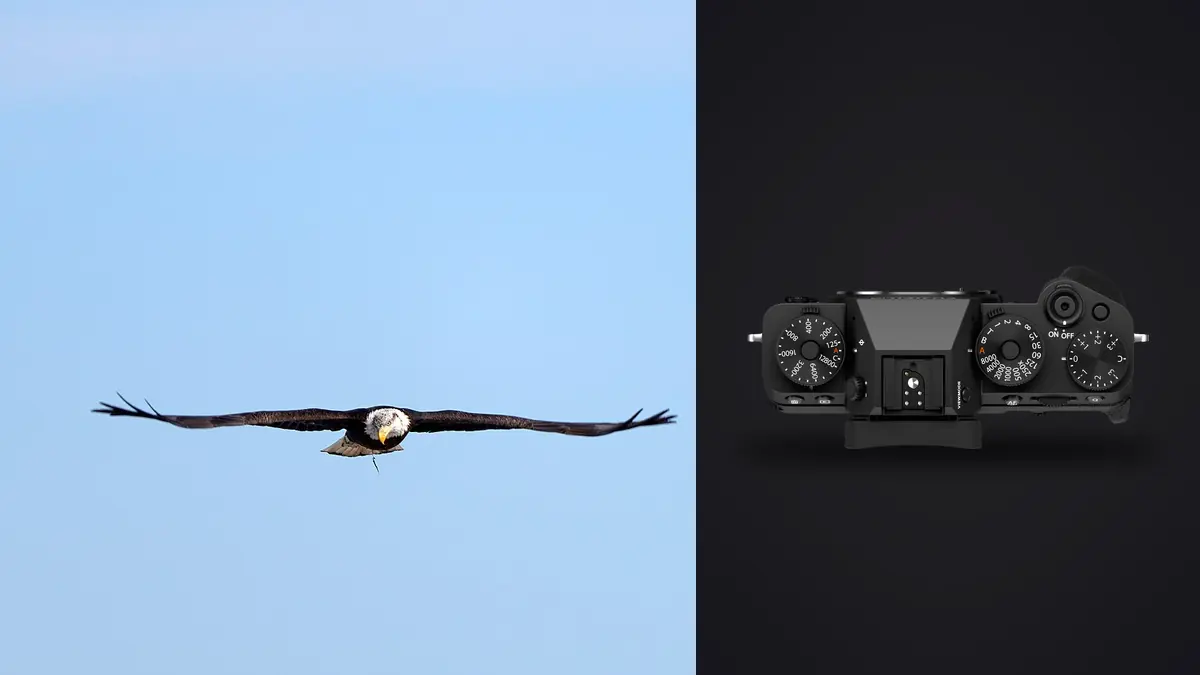
I spent four mornings in a hide on the edge of a reservoir this spring with a Fujifilm X-T5 and the XF150-600mm, trying to settle one question before I recommended the camera to anyone else who shoots birds: does a 40 megapixel APS-C body without a stacked sensor actually hold up against ospreys, terns and the occasional heron doing something interesting mid-air. The short answer is yes, with caveats that matter more in practice than anything on the spec sheet. The X-T5 was never marketed as Fujifilm's wildlife flagship. That title belongs to the X-H2S, with its stacked sensor and faster readout. The X-T5 shares almost everything else with the X-H2S and X-H2 (the autofocus algorithm, the body size class, most of the menu system) but trades the stacked sensor for more resolution. For a lot of wildlife work that trade is a genuinely reasonable one. For birds in flight specifically, it changes how you have to shoot rather than whether you can shoot at all.
The Sensor Trade-Off Nobody Explains Properly
The X-T5 uses the 40.2MP X-Trans CMOS 5 HR sensor, the same resolution as the X-H2 but without the stacked, back-side-illuminated readout that the X-H2S and X-T5's own faster sibling use. In plain terms, the sensor reads out slower, which means the electronic shutter is more prone to rolling shutter skew on fast-moving subjects. A heron gliding past at a steady pace is fine. A tern folding its wings mid-dive and cutting across the frame at speed is where you start to see the smear. That's the honest downside. The upside is 40 megapixels of detail on an APS-C sensor, which combined with the built-in 1.5x crop factor gives you more reach for a given lens than you'd get on full frame, and more room to crop after the fact when the bird is smaller in the frame than you'd like (which, with birds in flight, is most of the time). The XF150-600mm at 600mm already frames like roughly a 900mm lens would on full frame. Switch into the camera's 1.29x electronic crop mode and you're framing closer to what a 1,150-1,200mm full-frame lens would show, at the cost of dropping resolution into the low twenty-megapixel range and accepting a higher chance of that rolling shutter skew I mentioned. I ended up using the crop mode less than I expected going in. It's genuinely useful when a bird is distant and static enough (a raptor circling a thermal, say), but for close, fast, erratic flight I found the extra reach wasn't worth the skew risk, and I'd rather shoot at full resolution and crop in post where I have full control.
Autofocus for Something That Won't Sit Still
Fujifilm's subject detection AF, including the bird-specific mode, is shared across the X-T5, X-H2 and X-H2S through firmware, so you're getting the same underlying detection model regardless of which body you buy. What differs is how reliably the camera can keep that detection locked as the sensor reads out frame after frame, and that's where the non-stacked sensor shows its limits a little more than Fujifilm's marketing suggests.
Perched Birds Are Easy. Airborne Ones Test the System.
Against a clean background (open sky, still water, a plain gravel bank) the bird detection locks fast and holds. I'd estimate my keeper rate for a bird taking off from a perch, isolated against sky, at somewhere around 70-80% of frames in focus across a burst. Once that same bird is airborne and crossing in front of trees, reeds, or a busy shoreline, the detection starts hunting between the bird and whatever high-contrast clutter is behind it. My keeper rate on those sequences dropped closer to 30-40%, and that's with a properly configured AF-C custom set, not out of the box.
Small, Erratic Fliers Are the Real Test
Swallows and terns, which change direction constantly and don't move in a predictable arc, were consistently the hardest subjects. The camera does a good job of finding the bird initially but struggles to anticipate the next position the way a stacked-sensor body with faster processing can. For anything that flies in a straight, predictable line (geese, herons, most raptors gliding rather than diving) the X-T5 tracks confidently enough that I stopped worrying about it after the first morning.
Shutter Modes: The Trade-Off Table I Wish Someone Had Shown Me
This is the part that actually decides your settings in the field, and it's specific enough to the X-T5's non-stacked sensor that generic "which shutter mode is best" advice doesn't really apply. Here's how I ended up splitting my shooting between the three options after a few weeks with the camera.
| Shutter Mode | Max Burst Rate | Effective Resolution | Rolling Shutter Risk | Where I Actually Used It |
|---|---|---|---|---|
| Mechanical | 15 fps | 40.2MP | Minimal, no skew even on fast wingbeats | Raptors, herons, egrets, anything with a slower wingbeat where I wanted full resolution to crop later |
| Electronic, full sensor | ~8 fps | 40.2MP | Noticeable on fast-flapping small birds against a moving background | Rarely. Only when I needed silence close to a nest and speed wasn't the priority |
| Electronic, 1.29x crop | 20 fps | ~24MP | Highest, visible skew on swallows and terns cutting across the frame | Distant, slower-moving subjects where I wanted extra reach and could accept losing a few frames to skew |
The pattern that emerged: mechanical shutter at 15fps was my default for almost everything, which surprised me since I went in assuming I'd live in the 20fps crop mode. The full-resolution files, lower skew risk, and honestly not a huge practical difference between 15 and 20fps for most bird behavior made mechanical the better everyday choice.
Lenses Worth Actually Pairing With It
Fujifilm's native telephoto options for X mount are thinner than Sony's or Canon's, but what exists works well with the X-T5. The XF150-600mm f/5.6-8 is the one I used for most of this testing and it's the practical choice for most birders: reasonably priced for what it does, image-stabilized, and the variable aperture isn't the handicap you'd expect once you're shooting in decent light. At 600mm and f/8 on an overcast morning, though, ISO climbs fast, and that's worth planning for. The XF100-400mm is lighter and faster to swing onto a bird that appears suddenly close, which matters more than people expect when you're working from a hide or a kayak rather than a fixed blind. I'd pick it over the 150-600 for anyone who shoots more general wildlife alongside birding and doesn't want to carry two lenses. A 1.4x teleconverter on either lens costs you close to a stop and noticeably slows autofocus acquisition, especially in the crop mode where the system is already working harder. I used one for a single session on the 150-600 and went back to shooting native the next day. The extra reach wasn't worth what it did to my keeper rate on moving subjects.
Field Settings That Changed My Keeper Rate
A few adjustments made a bigger difference than any menu deep-dive would suggest: Back-button focus, separated from the shutter release, let me hold tracking through a bird's launch without accidentally releasing focus lock mid-burst. Basic, but worth stating because the default setup ties focus to a half-press that's easy to fumble when you're also trying to pan. For the AF-C custom sets, I moved away from the default balanced preset toward one with tracking sensitivity turned down (so the camera doesn't jump to a branch that suddenly enters frame) and speed tracking sensitivity turned up for predictable fliers, then flipped that back for erratic small birds where I wanted the opposite behavior. Fujifilm gives you enough custom AF-C slots that keeping two dedicated presets, one for predictable raptors and one for erratic small birds, saved me from digging through menus mid-session. Shutter speed I kept at 1/2000s minimum for anything smaller than a heron, and up around 1/3200s for swallows and terns, which on the variable aperture 150-600 at 600mm often meant ISO 1600-3200 on a grey morning. The 40MP sensor's per-pixel noise at those ISOs is visible at 100% but resolves fine once you're cropping the frame down for the final export anyway, since you're throwing away the noisiest edge pixels along with the empty sky.
The Part That Actually Slows You Down
None of the above is the real bottleneck of a birding session with this camera, and I think this gets skipped in most reviews. A single three-hour morning shooting at 15fps mechanical produces somewhere between 4,000 and 6,000 frames once you count every burst. Most of those are near-duplicate sequences of the same bird mid-flight, and the sharp frame in a 40-shot burst is rarely the one you'd guess without checking. AF sometimes locks the eye, sometimes locks the near wing, sometimes locks a branch behind the bird for two frames before correcting. Sitting down with Photo Mechanic or Lightroom and manually scrubbing through 5,000 frames from one morning is a genuinely miserable way to spend an evening, and it's the reason I ended up running these sessions through imagic instead of culling by hand. The sharpness scoring runs locally on the actual pixel data rather than relying on metadata or a quick preview, which matters here specifically because focus can shift within a single burst in ways EXIF tags won't tell you about. The duplicate and burst clustering groups each flight sequence together so I'm reviewing one representative frame per cluster rather than forty near-identical shots of the same tern, which took a three-hour cull down to something closer to twenty minutes. And because it runs offline, I've actually done a first pass on the laptop from the hide itself, with no signal and nothing uploaded anywhere, which matters more when you're shooting somewhere remote than it does back at a desk. Once the culling is done, I've also been using the apply_my_style preset on the keepers, since I settled on a specific grade for these reservoir shots (slightly punchier greens, warmer shadows) after the first session and wanted it applied consistently across every subsequent one without rebuilding the look from scratch each time. If you're setting up a similar workflow, it's worth reading through how AI photo culling actually works before you commit to a tool, since not every approach handles burst-heavy wildlife shooting the same way. There's also a broader rundown of workflow shortcuts in these workflow tips that's relevant if bird photography is only part of what fills your card each week.
Frequently Asked Questions
Does the Fujifilm X-T5 focus fast enough for birds in flight?
For predictable fliers against a clean background, yes, comfortably. For small, erratic birds crossing cluttered foliage, it's usable but noticeably behind a stacked-sensor body like the X-H2S in how quickly it recovers from a lost lock. Budget for a lower keeper rate on the hardest subjects rather than expecting every burst to nail focus.
Is the X-T5 or the X-H2S the better choice for birding?
If birds in flight are the majority of what you shoot and budget allows it, the X-H2S's stacked sensor and reduced rolling shutter make it the more forgiving tool. The X-T5 is the better choice if you split your time between birding, landscapes, and general work where the extra resolution pays off, and you're willing to lean on mechanical shutter and tighter technique to manage its limits.
Do I need the 1.29x crop mode for birding?
Not as a default. It's useful for distant, slower subjects where extra reach outweighs the increased skew risk, but for most flight shooting I found mechanical shutter at full resolution gave better usable results overall.
What lens should I actually pair with the X-T5 for birds?
The XF150-600mm covers the most ground for dedicated birding and is the one I'd default to. The XF100-400mm is the better all-rounder if birds are one part of a broader wildlife or travel kit rather than the whole focus.