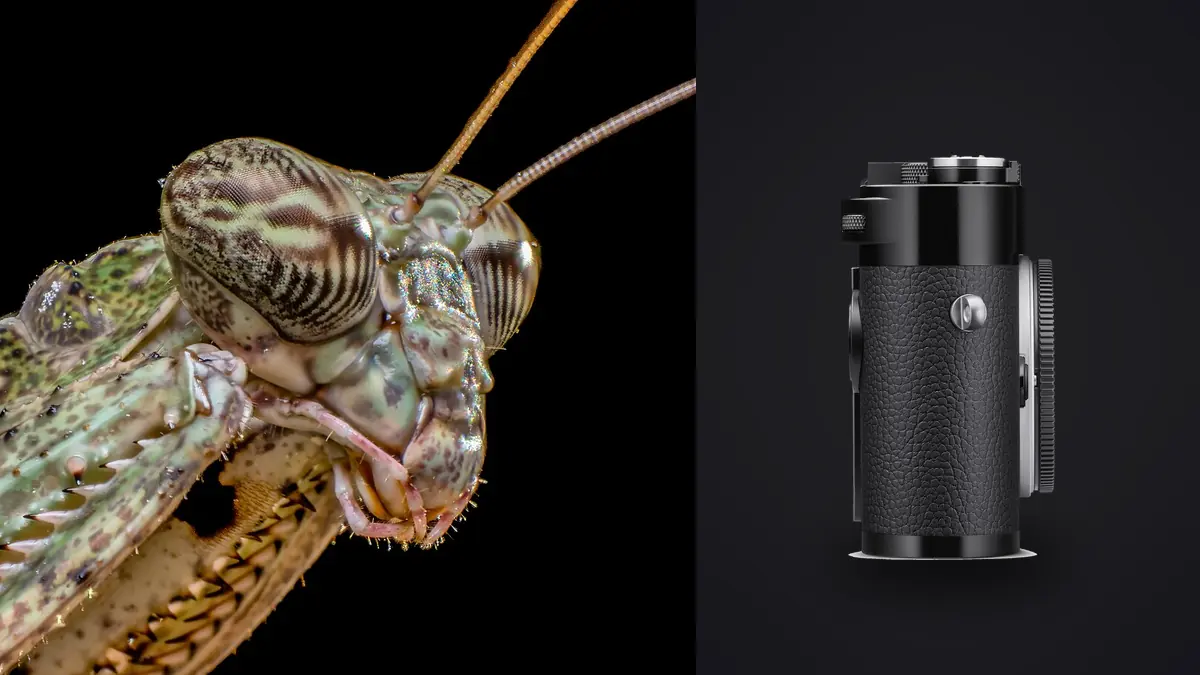
The Leica M11 was not built with insects in mind. Its coupled rangefinder, the mechanism that lets you focus by lining up two overlapping images in the viewfinder, was designed for street distances and portrait distances, not for the few centimeters between a lens and a damselfly's wing. Push most M-mount lenses past roughly 0.7 meters and the rangefinder patch simply runs out of travel; it stops telling you anything useful. And yet a fair number of macro and insect photographers use the M11 anyway, not because it makes the work easier, but because the 60-megapixel sensor and the option to shoot with genuinely excellent older glass produce results that are hard to match elsewhere. This is a look at what actually works: which lenses get you close enough, how to focus once the rangefinder gives up on you, and how to get through a day's worth of manual-focus misses once you're back at the computer.
Why the Rangefinder Runs Out Before the Insect Does
Rangefinder focusing works by triangulation. Two small windows on the front of the body, set a fixed distance apart, send slightly different views of the same subject to a mechanism behind the viewfinder. As you turn the lens's focus ring, a cam inside the mount shifts a mirror, and the two images slide until they overlap. At normal shooting distances this is fast and precise, arguably still one of the best manual-focus systems ever built for a handheld camera. At macro distances it falls apart for a simple geometric reason: the triangulation angle between the two windows gets so shallow that a millimeter of true focus shift barely moves the rangefinder patch at all. The system that is razor-precise at three meters becomes nearly useless at thirty centimeters.
This isn't a defect Leica overlooked. The focus cams on M-mount lenses are physically machined to stop translating helicoid movement into rangefinder movement once you pass the coupled minimum, which on most current M lenses lands right around 0.7m. Turn the ring past that point and the barrel keeps moving, but the rangefinder patch stays put. You're now focusing blind unless you have another way to confirm sharpness, which is the whole problem this article is about.
The Macro-Adapter-M and Live View Aren't Optional
Leica's own answer to this is the Macro-Elmar-M 90mm f/4 paired with the dedicated Macro-Adapter-M, a small helical unit that clips onto the lens and extends its close-focus range to roughly 1:3 magnification. But it does this by mechanically decoupling the lens from the rangefinder cam past a certain point, which means you lose rangefinder confirmation at exactly the moment you need focus accuracy the most. Leica's manual is honest about this: once the adapter is engaged, you compose and focus using live view, not the rangefinder window.
That's where the M11's rear screen and the clip-on Visoflex 2 electronic viewfinder earn their keep. Live view with focus peaking and 5x or 10x magnification turns the M11, for the duration of a macro session, into something closer to an old manual-focus mirrorless setup than the rangefinder it is the rest of the time. It works, but it comes with a real cost: there's no in-body stabilization on the M11, so a 10x magnified live view image on a handheld camera swims around constantly. For anything on a tripod or a focusing rail (dew-covered subjects at rest, mounted specimens, controlled setups) this is manageable. For a bee working a lavender spike in a breeze, it's a genuine fight, and you will burn through frames finding the handful that land.
Which M-Mount Lenses Actually Get You Close
Most Leica M glass was never intended for close-up work, and the difference in usable magnification between lenses that look similar on paper is bigger than most buyers expect. This is what you're actually working with, based on standard rangefinder-coupled minimum focus and the practical reach once you switch to live view or a macro adapter:
| Lens | Rangefinder-coupled min. focus | Approx. magnification at min. focus | Live view / adapter reach |
|---|---|---|---|
| Summilux-M 35mm f/1.4 ASPH | 0.7m | ~1:14 | No dedicated macro option; wide angle makes close work impractical anyway |
| APO-Summicron-M 50mm f/2 ASPH | 0.7m | ~1:10 | Live view helps confirm focus but doesn't extend reach |
| APO-Summicron-M 90mm f/2 ASPH | 1.0m | ~1:9 | No adapter available for this lens |
| Macro-Elmar-M 90mm f/4 | 0.77m (~1:8) | ~1:8 without adapter | Down to ~1:3 with Macro-Adapter-M, live view only past coupled range |
| APO-Telyt-M 135mm f/3.4 | 1.5m | ~1:11 | No adapter; used instead for working distance, not magnification |
Read that table plainly and the takeaway is uncomfortable: outside of the 90mm Macro-Elmar with its adapter, nothing in the current M catalog gets past roughly 1:8 to 1:10 magnification. Compare that to a modern mirrorless macro lens hitting native 1:1, and the M system is giving up a lot of reproduction ratio. What closes some of that gap is the sensor. At 60 megapixels, an M11 frame shot at 1:9 magnification and cropped down to 30 percent of its area still leaves roughly 18 usable megapixels, more than enough for a web gallery or a modest print, and you get there without closing the working distance so much that you spook whatever you're photographing. The M11's triple-resolution DNG option (60, 36, or 18 megapixels) is worth shooting at full resolution here specifically so you have that cropping headroom later; there's no reason to throw away pixels you might need to manufacture magnification you don't otherwise have.
Hunting Something That Doesn't Sit Still
Once you accept the magnification limits, the bigger problem is that insects move and the M11 has no autofocus at all, not even a contrast-detect fallback. The technique that actually works, and it predates autofocus macro by decades, is pre-focus and rock: set the lens to your intended close distance by feel, then physically move your body forward and back until the subject snaps into the live view patch, and fire the moment it does. It sounds primitive because it is, but it's also the only method that reliably works when there's no motor to do the job for you.
Depth of field at these distances is unforgiving regardless of technique. At 1:8 magnification and f/4, you might have two or three millimeters of usable sharpness on a subject's face, which on a dragonfly means the compound eyes are sharp and the wings are already softening. Stopping down to f/8 or f/11 buys you a more forgiving plane but costs shutter speed, and a slow shutter on a moving insect just trades one kind of blur for another. Most serious M11 macro shooters end up leaning on either a diffused flash (which lets you stop down without losing shutter speed) or the camera's electronic shutter, which on the M11's Maestro III processor runs as fast as 1/16000s. The catch with the electronic shutter is rolling-shutter skew on fast-moving subjects; a bee's wingbeat can visibly warp at very high electronic shutter speeds because the sensor isn't read out all at once. For static or slow subjects it's not an issue. For anything airborne, it's a tradeoff worth knowing about before you rely on it.
Field Settings by Subject Type
What actually changes session to session isn't the camera, it's what you're pointing it at. A resting, dew-covered insect at dawn and a bee working flowers at noon call for almost opposite approaches:
| Subject type | Support | Aperture | Shutter | Typical keeper rate |
|---|---|---|---|---|
| Resting/dew-covered (dawn) | Tripod or rail | f/8 to f/11 | Mechanical, 1/125s or slower | High, most frames usable |
| Foraging on flowers | Handheld, braced | f/5.6 to f/8 | Electronic, 1/1000 to 1/2000s | Moderate, roughly 1 in 5 to 8 |
| Flying/erratic (dragonflies, hoverflies) | Handheld, pre-focused zone | f/4 to f/5.6 | Electronic, 1/4000s+ | Low, often under 1 in 20 |
That last row is the honest number most reviews skip. Chasing a hoverfly with a manual-focus rangefinder is a volume game: you shoot far more frames than you keep, and the point isn't to nail focus on every attempt, it's to fire often enough that a few attempts land.
Getting Through a Day's Worth of Manual-Focus Misses
This is where the workflow after the shoot matters as much as anything you did in the field. A single insect session on the M11 routinely produces long runs of near-identical frames from the pre-focus-and-rock method, where maybe one in eight or ten is actually critically sharp on the subject's eyes. It's effectively focus bracketing done by hand, since the M11 has no automated bracketing of any kind, and sorting that by eye at 100 percent on a 60-megapixel DNG, frame by frame, is slow enough that most people either rush it or skip half their card.
This is a case where imagic's local sharpness and focus scoring earns its place rather than being a nice-to-have; it flags which frame in a run of a dozen near-identical macro shots is actually the sharp one, without you pixel-peeping every DNG by hand. See how AI photo culling works for the mechanics behind that scoring. It runs locally, which matters here specifically because a day's worth of 60-megapixel DNGs from a macro outing is a lot of data to be routing through anyone's upload pipeline just to find out which three frames are sharp.
The same applies to bursts. Using the electronic shutter to chase a bee mid-flight tends to leave you with fifteen or twenty nearly identical frames per attempt, and imagic's duplicate and burst clustering groups those together so you're comparing the handful of genuinely different compositions instead of scrolling through near-duplicates one at a time. And because macro sessions under leaf canopy or diffused flash tend to need the same white balance and color correction over and over (the same greenish cast, the same slight warmth from a diffuser), the apply_my_style preset, trained on how you've already edited your own past macro sets, applies that same treatment to a fresh batch instead of you rebuilding it from scratch each time. None of that changes what happened in the field, but it's the difference between a two-hour insect outing turning into a twenty-minute edit or a three-hour one. If manual-focus macro work is new territory for you, these general workflow habits are worth pairing with the culling steps above.
Is It Worth the Friction?
Honestly, not for everyone. If you want a high hit rate on flying insects with minimal effort, a mirrorless body with a native macro lens and eye-detect autofocus will outperform the M11 in almost every practical sense, and it will do it faster. The M11 makes sense for a narrower group: photographers who already shoot manual macro on other systems and want the M-mount rendering and sensor quality, or who are working primarily with static and slow-moving subjects (resting insects, plants, textures) where the pre-focus method isn't fighting against a moving target. It's a deliberate, patient way to work, not a faster one. If your priority is a high keeper rate on erratic subjects with the least fuss, this isn't that camera, and being honest about that up front will save a frustrating first few outings.
Frequently Asked Questions
Can the Leica M11 autofocus for macro insect photography?
No. The M11 has no autofocus system of any kind, contrast-detect or otherwise. All focusing is manual, either through the coupled rangefinder at normal distances or through live view (on the rear screen or the Visoflex 2) once you're past the rangefinder's close-focus limit.
Do I need a Visoflex to shoot macro on the M11?
It's not strictly required, since the rear screen also offers live view with focus peaking, but the Visoflex 2 makes eye-level composition and magnified focus checking far more practical outdoors, especially in bright daylight where the rear screen is hard to judge critical sharpness on.
What's the maximum magnification I can get with M-mount lenses?
Around 1:3 with the Macro-Elmar-M 90mm f/4 and its dedicated Macro-Adapter-M. Without that specific combination, most M lenses top out between roughly 1:8 and 1:14 at their closest coupled focus distance, well short of the 1:1 magnification common on dedicated macro lenses for other systems.
Is the M11 a good first camera for insect photography?
Probably not. The lack of autofocus, image stabilization, and any form of focus bracketing means the learning curve is steep even for photographers already comfortable with manual focus. It suits someone who already shoots manual macro elsewhere and wants the M-mount rendering, more than it suits someone picking up macro photography for the first time.