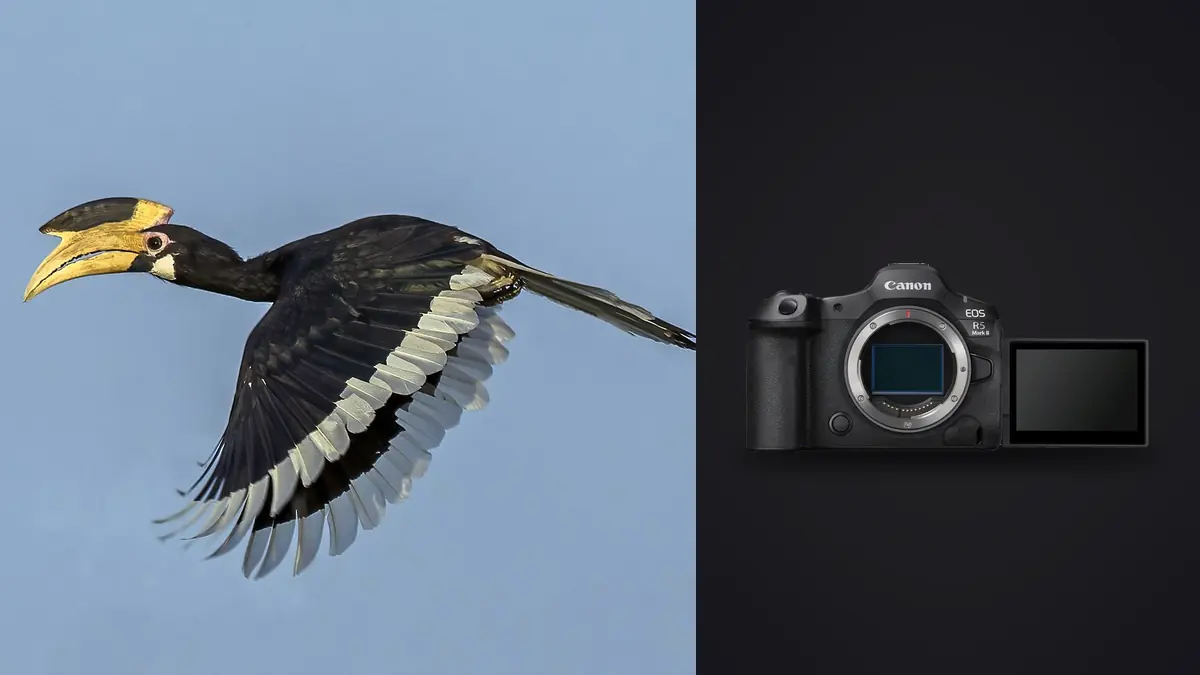
I got my hands on the Canon EOS R5 Mark II the week a friend was chasing ospreys at a reservoir forty minutes from my house, and I spent most of that first month there instead of anywhere more exotic. Ospreys are a decent stress test for a camera's autofocus: they hover, stall, drop, and then commit to a dive that lasts under two seconds. If a body can't lock a small, contrasty bird against moving water while it's changing direction faster than the lens can rack focus, it shows up immediately as a folder full of soft frames. The R5 Mark II held onto birds in that scenario more consistently than any Canon body I'd used before it, including the original R5, and that's really the whole story of why it matters for this kind of shooting.
What Canon actually fixed, not just added
The headline spec sheet for the R5 Mark II reads like a laundry list: 45 megapixels, up to 30 frames per second electronic, in-body stabilization rated to 8.5 stops with certain lenses, Eye Control AF carried over and refined from the R3. But for birders specifically, the part that matters most is boring and easy to miss: the sensor is stacked. The original R5 was a phenomenal stills camera that happened to have a fairly slow sensor readout, and at anything past about 12 to 15 frames per second in electronic shutter, fast wingbeats and quick pans would skew into that rubbery, leaning-tower look known as rolling shutter distortion. It was bad enough that a lot of bird photographers just left the original R5 on mechanical shutter for anything with wings, which capped them at 12fps and reintroduced shutter noise and vibration.
A stacked sensor reads the whole frame much faster, so the R5 Mark II can run at 30fps electronic with rolling shutter distortion that's genuinely hard to spot even on a bird crossing the frame at speed. That single change is the difference between "usable at high burst rates" and "technically capable of high burst rates." I shot the same osprey dive sequence at 20fps and 30fps electronic on consecutive days and the propeller-blade warp that used to show up on the original R5's wingtips at fast pan speeds simply wasn't there.
Autofocus settings that actually hold on to a bird
Out of the box, the R5 Mark II's subject detection defaults to "Auto," which tries to guess what kind of subject is in frame. For birding I turn that off immediately and set it explicitly to the Animals category with the priority set to detect eyes, then heads, then bodies as fallback. Auto-detect is fine for mixed shooting days, but when you know you're aiming at a heron rookery or a raptor nest, forcing the category removes a half-second of guessing the camera has to do every time a bird turns broadside or drops behind a branch.
For AF case, I don't use any of Canon's stock presets unmodified. I start from Case 2 (ignore obstacles, continue tracking the subject) and push tracking sensitivity toward the subject-locked end, with acceleration/deceleration tracking set high, around +2. Birds in flight rarely change speed smoothly; they stall, flap hard, glide, then stall again, and a camera tuned for smooth vehicle-style tracking will hunt every time the bird's velocity changes abruptly. I keep the AF point fully wide (whole area) for birds against open sky and switch to a smaller zone when there's any clutter, reeds, branches, chain-link at a zoo enclosure, anything the camera might mistake for a closer subject.
Eye Control AF deserves a specific mention because it behaves differently on birds than it does on people. Canon's calibration is clearly tuned first for human portrait and event work, and on a small, fast-moving bird against a bright sky it's less precise than the subject-detection AF is on its own. Where it actually helps is picking which of several birds in frame to prioritize, glance toward the one you want and the AF point snaps to it faster than toggling with the joystick. I use it as a subject-selection tool more than a fine-focus tool for anything smaller than a heron.
Camera comparison: what changes for birds in flight
| Spec | EOS R5 (original) | EOS R5 Mark II | EOS R3 |
|---|---|---|---|
| Sensor readout | Non-stacked, visible skew above ~15fps electronic | Stacked, minimal skew even at 30fps | Stacked, minimal skew |
| Max electronic burst | 20fps (rolling shutter limited) | 30fps (usable at full rate) | 30fps |
| Max mechanical burst | 12fps | 12fps | 12fps |
| Subject detect for birds | Animal category, slower to acquire | Animal category, faster acquisition, eye priority | Animal category, similar generation to R5 II |
| Eye Control AF | Not available | Yes, second-generation calibration | Yes, first-generation calibration |
| Pre-capture buffer | Not available | Roughly half a second before full shutter press | Roughly half a second before full shutter press |
| Resolution | 45MP | 45MP | 24MP |
| Approx. body price (2026, new) | Discontinued, used market only | ~$4,300 | ~$4,500 (discounted from launch) |
The 24-megapixel R3 crops a lot more gracefully in a pinch because the pixels are larger and noisier files clean up more forgivingly, but you lose the ability to crop a distant bird down hard after the fact, which for birding is often the whole game. The R5 Mark II's 45MP files let you frame a bit loose to avoid clipping a wingtip mid-flap and still crop to a tight composition afterward without the image falling apart.
Pre-capture actually matters more than the fps number
The feature I underrated before using it is the pre-continuous shooting buffer. Half-press the shutter and the camera is already buffering frames in the background; the moment you fully press, it hands you roughly the previous half-second along with everything after. For a launch shot, a bird pushing off a perch, wings still coiled, that half-second is usually exactly the frame you'd otherwise miss by reacting a beat too late. I've gotten more clean launch and landing frames from pre-capture in three months with this body than I got in two years of trying to time the original R5 by ear.
Matching glass to the body
A 30fps stacked sensor is wasted on a lens that can't keep up optically or focus quickly enough to use it. Here's what I've actually run on the R5 Mark II for birding, with rough current pricing and where each one earns its keep.
| Lens | Effective reach with extender | Best use case | Rough price |
|---|---|---|---|
| RF 100-500mm f/4.5-7.1L IS USM | 140-700mm f/6.3-10 with 1.4x | All-around hide and boat work, still autofocuses reliably wide open | ~$2,700 |
| RF 200-800mm f/6.3-9 IS USM | N/A, already at 800mm native | Distant, slow-moving subjects in good light; heavy for handholding all day | ~$1,900 |
| RF 600mm f/11 IS STM | 840mm f/16 with 1.4x (AF struggles here) | Perched birds, static subjects, budget reach; single-shot AF is safer than servo | ~$770 |
| RF 100-300mm f/2.8L + RF 2x | 200-600mm f/5.6 with 2x | Low-light BIF, dawn and dusk raptor activity, fastest AF of this group | ~$8,500 + $1,000 |
| RF 600mm f/4L IS III + 1.4x | 840mm f/5.6 | Serious raptor and eagle work at distance, gold standard but heavy and expensive | ~$12,000 |
My honest recommendation for most people getting into BIF with this body is the RF 100-500mm. It focuses fast enough to keep up with the R5 Mark II's tracking, it's light enough to handhold through a four-hour morning at a wetland, and the 1.4x combination covers most raptor and shorebird work without needing a second mortgage. The RF 600mm and 800mm f/11 primes are tempting for the price, but their narrow aperture means the camera's autofocus system, however good, is working with less light to find contrast on a bird's eye, and it shows on overcast days or anything backlit.
What 30fps does to your card and your evening
Here's the part nobody puts on the box: a single four-second burst of a tern diving at 30fps is 120 frames. A good afternoon at a colony can easily produce four or five thousand RAW files, most of them nearly identical, wings in slightly different positions, background barely shifted. That volume used to mean either skipping culling entirely (and losing track of your actual best shots in a pile of near-duplicates) or spending your evening scrubbing through a folder frame by frame after a full day in a hide.
This is where I stopped fighting the volume and started using imagic to sort it instead. It runs its sharpness and focus scoring locally on the machine, so a folder of five thousand RAW files from a day with spotty campsite wifi doesn't need to go anywhere before you can start ranking it, which matters more than it sounds like it should when you're shooting somewhere remote enough to actually see the birds you're after. It also groups burst sequences and near-duplicate frames together automatically, so instead of clicking through a hundred and twenty nearly identical wingbeats one at a time, you get the cluster and can pick the one or two frames where the eye is sharp and the wing position is actually flattering. If you're coming from a manual culling process, our piece on how AI photo culling actually works goes into more detail on how that sharpness scoring holds up against a human doing the same job by eye.
Once the keepers are picked, I lean on the apply_my_style preset for the first pass of color and exposure work. It's trained on my own past edits rather than some generic preset pack, so a batch of forty keeper frames from a morning shoot gets a consistent starting treatment that already looks like my usual output instead of a flat factory default I'd have to nudge on every single image. It's not a substitute for individually finishing a hero shot you're going to print large, but for the bulk of a session it cuts the evening editing time down to something that doesn't eat into the next morning's shoot.
Field notes from an actual dive sequence
The best sequence I got that first month was an osprey stooping from about sixty feet up into maybe eighteen inches of water, talons first, full spray on impact. I was on the RF 100-500mm at 500mm, 1/3200s, f/7.1, ISO floating on auto because the light was shifting fast under broken cloud. Servo AF, animal detect, zone AF sized to about a third of the frame because there was a shoreline of reeds behind the bird that I didn't want the camera locking onto by mistake.
What actually happened: I picked the bird up mid-hover, held the shutter half down while it stalled and adjusted its wings twice, then it committed to the dive and I pressed fully. The pre-capture buffer meant the frames from the stall, the ones with wings fully extended and the bird's head locked on target, were already in hand even though my own reaction time to the actual dive was probably two or three frames late. Out of that one sequence, maybe six frames were genuinely sharp on the eye through the whole dive and impact. Without pre-capture I'd have started my burst after the commitment, missing the setup entirely, which for an osprey is honestly the more dramatic part of the sequence.
The one place the R5 Mark II still struggles is small, erratic fliers in dense cover, think warblers moving through branches rather than raptors over open water. Subject detection needs enough contrast and a clean enough silhouette to lock on, and a sparrow-sized bird flicking between twigs at close range asks a lot of any current AF system, this one included. I still miss more of those than I keep, and I don't think any body on the market right now changes that math much.
Frequently Asked Questions
Is the R5 Mark II fast enough for small, erratic birds like swallows or hummingbirds?
It's better than the original R5 but it's not magic. Swallows feeding over water and hummingbirds at a feeder are two different problems: swallows are fast but predictable in their flight lines, and the R5 Mark II tracks them well once you widen the AF zone and give the system a clean sky background. Hummingbirds are a different problem entirely, their wingbeats are too fast for any current stills AF to freeze meaningfully without flash, so that's more about shutter speed and light than autofocus generation.
Do I actually need the RF 200-800mm, or is the RF 100-500mm enough?
For most birding I'd start with the RF 100-500mm and a 1.4x. The 200-800mm gets you more reach without an extender, but it's a slower, heavier lens that asks more of the AF system in anything but good light, and I've found the 100-500mm's faster aperture actually keeps the R5 Mark II's tracking more confident on overcast mornings, which in most temperate climates is most mornings.
Does Eye Control AF work well on birds, or is it mostly for people and pets?
Its calibration is clearly built around human portraiture first. On birds I use it to jump between multiple subjects in frame quickly rather than for pixel-level focus precision, the subject-detection AF is doing the actual fine work on the bird's eye once you've pointed it in the right direction.
How do you deal with the sheer number of files a day of BIF shooting produces?
Honestly, this was the biggest workflow change for me going into 30fps shooting. I stopped trying to review everything manually and now run each day's folder through imagic first, which handles the duplicate and burst clustering and sharpness ranking locally before I ever touch a full edit. If your current process is still a flat folder and a lot of scrolling, our tips for a faster photo workflow cover a few habits worth building even before you add software into the mix.