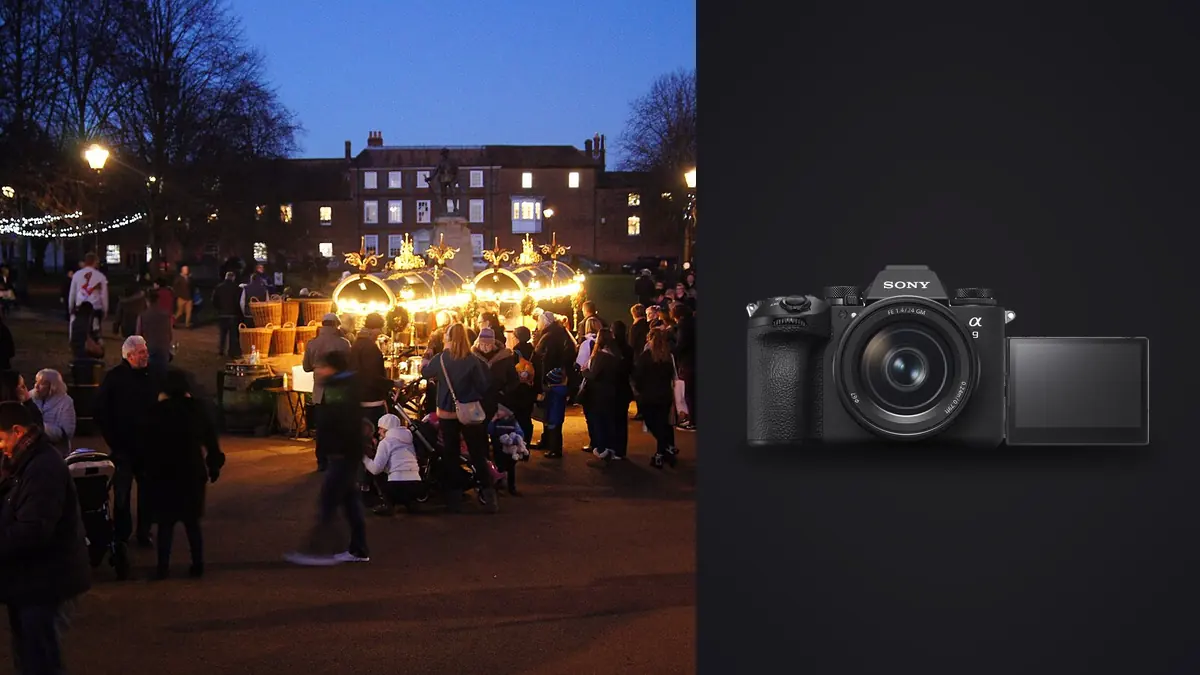
I did not buy the Sony A9 III for street work. I bought it for a two-day motocross weekend last spring, when I wanted stills that matched the cadence of slow-motion video pulls, and the global shutter was the only way to get clean pans without the jello-warp you get from a rolling shutter at that speed. It sat in the bag afterward, and out of curiosity I started carrying it on a documentary project I had been shooting on and off for eight months, a series on a fish market that opens at 4am. That is the lens this article comes through: not a spec sheet read cold, but six weeks of actually walking with the thing before dawn, in bad light, next to people who never signed a release.
The global shutter isn't a gimmick here, but it's not the headline either
Everyone who writes about the A9 III leads with the global shutter because it is genuinely new: a stacked sensor that reads every pixel at once instead of scanning line by line, which kills rolling shutter distortion completely and lets you sync flash at any shutter speed, including 1/80,000s. For sports and motorsport that is transformative. For street and documentary work, the honest answer is that it helps in three specific situations and does nothing for you in the rest.
Where it actually mattered on the fish market project: shooting under the sodium-vapor lights at the loading dock, where older sensors would band or flicker in bursts because the light source cycles faster than the shutter can sample it evenly. The A9 III just does not have that problem, because there is no rolling readout to interact with the flicker. I stopped checking my LCD for banding entirely, which sounds small until you have burned a whole sequence of a genuinely good moment to a strip of green and magenta bands across the frame.
Where it did not matter: candid portraits of vendors setting up stalls, walking shots, anything under 1/2000s. Rolling shutter distortion only shows up at fast shutter speeds combined with fast subject or camera motion, which is not most of what documentary photography actually is. If you are shooting a person's face while they talk, a five-year-old A7 III sensor handles that identically.
The ISO floor is the trade-off nobody puts on the box
Global shutter sensors need extra circuitry at every pixel to store the charge before readout, and that circuitry eats into the photodiode's light-gathering area. Sony's answer was a native ISO floor of 250, not 100, and you feel it. Shooting at f/2.8 in open shade at midday, I was routinely a stop and a half brighter than I wanted to be before I even touched the dial, because the camera would not go below 250 without switching to an extended low setting that clips highlights faster than I like.
At night, the floor works the other direction against you. Noise at ISO 6400 and 12800 on the A9 III is close to what I remember from the original A9, not the cleaner files I was getting out of an A7R V at the same settings. For street photographers who lean on ambient light after dark, that matters more than the burst rate or the shutter mechanism ever will. I ended up shooting the market work at ISO 3200 to 5000 and accepting more noise reduction in post than I wanted, rather than push into territory where skin tones started looking waxy.
120fps creates a problem the camera doesn't solve for you
The A9 III shoots up to 120 frames per second in full raw with continuous autofocus, which is a number built for a different job than documentary photography. I never intentionally fired a 120fps burst on the street, it is too aggressive and too obviously mechanical-feeling even with a silent shutter, but the pre-capture buffer changed how I worked. Half-press the shutter and the camera is already holding up to a second of frames before you fully press it, so a reaction you catch half a beat late is still recoverable. That is a real gain for a decisive-moment style of shooting.
The problem is what it does to your card and your evening. A single hesitant burst at even 20fps produces forty, fifty, sixty nearly identical frames of a vendor laughing, and across six weeks that adds up to a card full of duplicates that all look the same at a glance and are not the same when you pixel-peep for the one where the eyes are sharp and the hand gesture reads clearly. This is the exact problem I built imagic to solve for myself: it runs local sharpness and focus scoring on the whole take and clusters near-duplicate bursts together so I am picking the best frame out of a group of six instead of scrolling past fifty thumbnails that all look identical at a glance. Everything runs on the machine, nothing gets uploaded, which matters to me on this particular project since some of the market vendors did not want their faces going anywhere near a server they had not agreed to.
What actually makes it comfortable, or doesn't, for a full day of walking
Body weight is 703g without a lens, battery and card included, which puts it closer to a small DSLR than to the compact rangefinder-style bodies most documentary shooters gravitate toward. Paired with the FE 24mm f/2.8 G or the 40mm f/2.5 G, both of which weigh under 200g, the whole kit stays under a kilo and hangs comfortably on a strap for a twelve-hour day. Paired with the 24-70mm f/2.8 GM II, which I tried for exactly one morning, it stopped feeling like a street camera and started feeling like a work camera you carry because you have to.
The grip is deep enough that one-handed shooting at odd angles, crouched near a stall, arm extended over a crowd, stays stable in a way smaller bodies do not manage. The trade-off is that it does not disappear the way an X100-series body does. People notice a camera that size. On a documentary project where trust with subjects matters more than pure discretion, I found that was not actually a disadvantage: several vendors asked what I was shooting with, which opened a conversation I would not have had with a camera small enough to look like a phone accessory.
Autofocus behavior worth knowing before you rely on it
Subject recognition covers humans, animals, birds, insects, cars, trains and planes as selectable categories, and the human-detection mode tracks eyes reliably even when a subject turns their head away and back within a burst. What surprised me was how well it held focus through partial occlusion, someone walking behind a stall post or a hanging tarp for a beat, then reappearing. Older Sony bodies would occasionally snap to the foreground obstruction; the A9 III mostly did not, though it is not perfect in low light with heavy backlighting, where I still saw it hunt for half a second on faces lit only from behind by a single bulb.
For documentary work specifically, I left it on Human priority almost the entire time rather than switching between modes, and it caused fewer missed frames than I expected walking into the project. The one habit I had to break was trusting it completely in crowd scenes with multiple faces at different distances; it will sometimes lock onto the nearest face rather than the one you actually composed for, so a quick check of the focus box before firing is still worth the half second it costs you.
Sony A9 III against the cameras people actually cross-shop it with for this kind of work
| Camera | Body weight | Native ISO floor | Max continuous (AF/AE tracking) | Shutter type | Approx. launch price (body) |
|---|---|---|---|---|---|
| Sony A9 III | 703g | ISO 250 | 120fps | Global (fully electronic) | $5,999 |
| Sony A7C II | 514g | ISO 100 | 10fps | Mechanical + electronic | $2,199 |
| Fujifilm X100VI | 521g | ISO 125 | 8fps | Leaf + electronic | $1,599 |
| Leica Q3 | 743g | ISO 50 | 15fps | Electronic | $5,995 |
Read the table for what it actually says rather than for a winner: the A9 III is the only body here built around a fundamentally different sensor architecture, and it charges you a full stop of dynamic range headroom at the bottom end to get it. The X100VI and A7C II both go lower on native ISO, which for available-light street work is arguably more useful day to day than a burst rate you will rarely need outside of very specific flicker-prone or fast-motion scenes.
Who I'd actually tell to buy this for documentary work
Photographers already inside the Sony system shooting sports, events or weddings who want one body that also handles a personal documentary project on the side. You are not buying the A9 III for street photography as a primary purpose, you are buying a camera that happens to be excellent at street and documentary work as a side benefit of being built for something faster and more demanding. If your only work is quiet, patient street photography and you are starting from nothing, I would put the money toward a compact prime-based kit instead and save close to four thousand dollars for lenses, travel, or printing.
Where it earned its place in my bag permanently: days that mix documentary coverage with a fast-moving component, such as a public event that turns into a march, or a reception that turns into a dance floor under bad LED lighting. The flicker immunity and the pre-capture buffer solve real problems there in a way no amount of technique compensates for.
The workflow tax, and what I do about it
Whatever body you shoot street work on, the culling problem does not go away, it just changes shape. With the A9 III specifically, the temptation to lean on a fast burst even when you know better means I come home with roughly forty percent more frames per outing than I did shooting a single-shot-per-moment habit on older bodies. Sorting that manually was costing me two to three hours per week before I started running the take through imagic first: it scores sharpness locally on the machine, groups the burst duplicates so I am comparing six frames of the same moment instead of scrolling past all of them individually, and once I have picked winners I apply imagic's "apply my style" preset, trained on my own past edits, rather than rebuilding a look from scratch every session. None of that happens in the cloud, which matters when a chunk of your frames are of people who did not agree to have their faces processed on someone else's server. If you want the mechanics of how that kind of automated first pass actually works, I wrote about it separately at how AI photo culling works, and there are a few more habits worth stealing in 10 tips for a faster photo workflow.
Frequently Asked Questions
Is the Sony A9 III too conspicuous for candid street photography?
It is not small, and it does not pretend to be. At 703g with a compact prime it is still lighter and less obtrusive than a pro body with a battery grip, but it will never disappear into a pocket the way an X100-series camera does. In practice, being visibly "a real camera" did not hurt me on a documentary project built on trust with subjects; it simply meant fewer purely candid, unnoticed frames and more moments where people clocked me and reacted anyway, which is a different but still usable kind of documentary image.
Does the higher base ISO actually hurt low-light street shooting?
Yes, measurably. The 250 ISO floor removes headroom you would otherwise have at the bottom end, and high-ISO noise from roughly 6400 up is closer to a five-year-old sensor than to Sony's best current full-frame chips. If most of your street work happens after dark or in dim interiors, a camera with a lower native floor and cleaner high-ISO files, like the A7C II or an A7R V, will likely serve you better than the A9 III's speed advantages.
Is the pre-capture buffer actually useful for decisive-moment shooting, or just marketing?
It is genuinely useful, and it is the feature I missed most when I went back to an older body for a week. Half-pressing the shutter buffers up to roughly a second of frames before your full press registers, so a gesture, an expression, a hand catching light, that happens a beat before you consciously react is still there when you check the take. It will not save a moment you never anticipated at all, but it forgives the normal human lag between seeing something and pressing the button.
What lenses make the most sense for documentary work with this body?
The FE 24mm f/2.8 G and 40mm f/2.5 G are the two I reach for most, both because they keep total kit weight reasonable and because their focal lengths suit close, engaged documentary work better than a standard 50mm does. If you need reach for market or crowd scenes without getting physically closer, the 50mm f/2.5 G fills that gap without adding meaningful bulk. I would avoid pairing this body with the heavier GM zooms for anything you plan to carry all day; the camera is already on the heavy side for the genre, and a 24-70mm f/2.8 pushes the whole rig into a different category of kit.