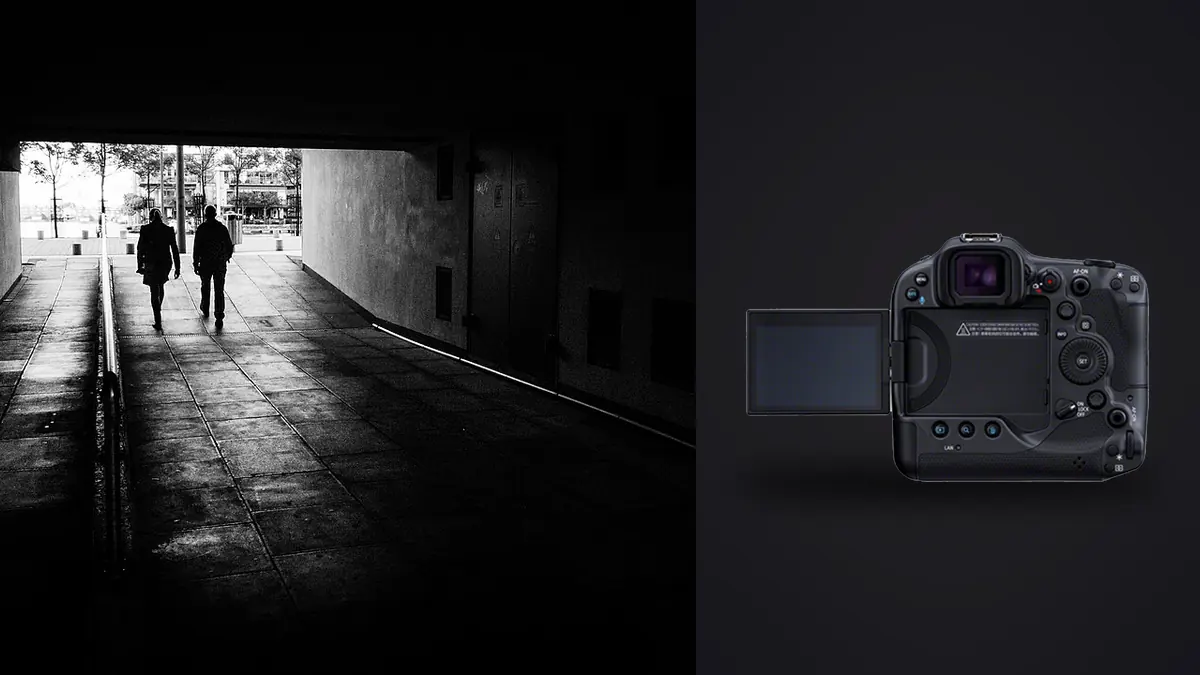
The first time I carried a Canon EOS R3 into a crowd, I remember thinking it felt less like a street camera and more like a small appliance strapped to my hand. It has a built-in vertical grip, a body that tips the scale past a kilogram before you add glass, and a shutter button that sits under your thumb like it belongs on something bigger. None of that screams "discreet." And yet by the end of that week, shooting a mix of market scenes and a slow-moving local protest, I understood why photojournalists kept buying it anyway. The R3 was never built to disappear into a crowd. It was built to survive one, keep shooting through it, and hand you the frame you actually needed afterward.
That distinction matters if you're deciding whether this camera fits your own documentary work. Street photography and photojournalism get lumped together constantly, but they ask for different things from a body. A classic street shooter wants something small enough to vanish, the way a Leica or a Fuji does. A documentary or news shooter wants a camera that won't quit on hour nine of a demonstration, that tracks a moving face through a scrum of people, and that keeps shooting when the light drops to nothing. The R3 is built for the second job. It's worth being honest about that before you spend the money.
Size Is the First Decision You Make
At around 1015 grams body-only, the R3 sits closer to a 1D X Mark III than to anything most street photographers are used to carrying all day. The integrated grip means there's no removable battery pack bolted on for verticals, which is genuinely nice for one-handed shooting from low angles or over a crowd, but it also means the body never gets smaller. You can't strip it down for a lighter kit the way you can with an R6 and a grip you leave at home.
In practice this changes how you shoot on the street. You're not casually lifting this camera to your eye and lowering it again a hundred times an hour without your shoulder noticing. I found myself pre-planning shots more, staying in position longer instead of roaming, and leaning on the camera's tracking to get the moment right the first time rather than firing off casual test frames. That's not a knock on the camera. It's just a different rhythm than a compact rangefinder gives you, and it's worth trying before you commit to it for a multi-day assignment.
Eye Control AF Changes How You Frame a Scene
The feature everyone talks about, and the one that actually earns its keep on the street, is Eye Control AF. Once it's calibrated to your eye (and it does need calibrating, ideally in the lighting conditions you'll actually shoot in, not just once in a bright room), the camera watches where your eye lands inside the viewfinder and moves the focus point there. On paper it sounds gimmicky. In a moving crowd, it stops being a gimmick fast.
The use case that sold me on it was reframing mid-sequence. You're tracking a subject weaving through foot traffic, a second person steps into frame, and you need focus to jump to a new face without taking your eye off the viewfinder to nudge a joystick. Eye Control gets you there quicker than any manual point selection can, because your eye was already looking at the new subject before your thumb could react. It's not perfect. It drifts if you shift your eyebox position on the eyecup, and it can lag behind very fast, erratic motion. But for the specific problem of documentary shooting, following unpredictable human movement in real time, it's the single feature that changes how the camera behaves in your hands rather than just what spec sheet it wins.
Deep Learning Tracking and What 30fps Actually Buys You
Canon's subject detection on the R3 recognizes people, and specifically prioritizes eyes and faces even through partial obstruction, which matters constantly on a crowded street where someone's shoulder or a lamppost is always half in the way. Combined with the electronic shutter's 30fps top speed, you get a lot of chances at a fleeting expression. But 30fps street photography is a double-edged tool. It solves the problem of missing a decisive moment by brute force, and it creates a new problem: reviewing hundreds of nearly-identical frames from a single ten-second burst to find the one where the hand gesture and the background element actually lined up.
I rarely shoot at the full 30fps for street work. Something in the 8 to 12fps range, using the mechanical or first-curtain electronic shutter, gives enough coverage of a moment without turning every outing into an hour of frame-by-frame review that night. This is where a lot of R3 buyers get surprised: the camera is exceptional at capturing the moment, and then it dumps a genuinely large problem in your lap afterward. More on that later, because it's not a minor footnote, it's the actual bottleneck of shooting this body seriously.
Sensor Performance in the Light Documentary Work Actually Happens In
The 24.1MP stacked BSI sensor isn't chasing resolution records, and for street and documentary work that's the right call. Smaller files mean faster buffer clearing, faster culling, and less strain on a laptop you might be editing from in a hotel room at midnight. What the sensor does prioritize is speed and low-light behavior, and both hold up. Usable ISO for me tops out around 6400 to 12800 depending on how much noise reduction you're willing to apply and how much the shot needs to hold up at full size versus web resolution. Past that, into the 25600+ range, it's there for emergencies (a dim interior, a night market with almost no ambient light) but I wouldn't plan a shoot around it.
The stacked sensor's real gift for documentary work is minimal rolling shutter distortion with the electronic shutter, which matters when you're panning with a fast-moving subject, a cyclist, a running kid, a car passing through frame, and don't want a skewed, jello-like warp on vertical lines. Combined with a genuinely silent shutter mode, this is where the R3 earns real street credibility despite its size: you can shoot completely silently in a quiet interior, a courtroom, a memorial, anywhere a mechanical clack would be intrusive, without the image artifacts that used to make electronic-only shutters a compromise.
How It Actually Compares for This Kind of Work
Spec sheets rank cameras on megapixels and burst speed, but none of that tells you what matters for street and documentary shooting specifically: can you carry it all day, can you shoot unnoticed when you need to, and can you keep working when the batteries or cards run low. Here's how the R3 stacks up against three cameras that regularly come up in the same conversation.
| Camera | Body weight | Max silent (e-shutter) fps | RAW buffer depth | CIPA battery life (EVF) | Street discretion |
|---|---|---|---|---|---|
| Canon EOS R3 | ~1015g | 30fps | ~150 frames (CFexpress) | ~860 shots | Low (integrated grip, large body) |
| Canon EOS R6 Mark II | ~588g | 40fps | ~190 frames (fast SD) | ~760 shots | Medium |
| Fujifilm X100VI | ~521g | 20fps (1.29x crop) | ~20 RAW frames | ~450 shots | Very high (fixed lens, rangefinder styling) |
| Leica Q3 | ~743g | 15fps | ~15 RAW frames | ~350 shots | High (quiet shutter, compact body) |
What jumps out looking at it this way: the R3 doesn't win on discretion or even on raw burst speed against its own cheaper sibling, the R6 Mark II. What it wins on is sustained battery life and buffer depth under sustained bursts, which is exactly what a full day of documentary coverage demands and a casual street outing usually doesn't. If your work is mostly solo wandering and observational street photography, the X100VI or a Q3 will serve you better and cost you less in shoulder strain. If your work involves assignments where you can't afford to miss the moment because your battery died or your buffer choked, the R3's advantages stop being theoretical.
Buffer Depth and Card Strategy for a Long Shooting Day
Running CFexpress Type B in the primary slot is not optional if you actually intend to use the higher frame rates. Drop to a fast SD card in that slot and the buffer depth collapses noticeably, which defeats the point of buying a camera built around sustained bursts. I run CFexpress in the primary slot and a UHS-II SD card in the second slot set to backup recording rather than overflow, since losing a card mid-assignment with no redundancy is the kind of mistake you only make once.
The practical effect of a 150-frame RAW buffer at full burst speed is that you genuinely stop worrying about the camera locking up mid-sequence, which used to be a real anxiety with earlier mirrorless bodies during a long protest march or a fast-breaking scene. What it doesn't solve is the human side of the problem: a five-hour shoot at even a conservative 8 to 10fps average produces thousands of frames, and CFexpress cards fill up fast enough that carrying two or three is standard, not excessive.
Battery, Weather Sealing, and Staying Out All Day
The LP-E19 battery (shared with the 1D X Mark III) is the other quiet reason documentary shooters gravitate to this body. Rated around 860 shots through the viewfinder, but in practice I've gotten well past a thousand exposures on a single charge doing typical street shooting with intermittent review, because CIPA numbers assume more chimping than most working photographers actually do. For a full day away from a car or hotel room, one spare battery is comfortable rather than essential, which is not something I'd say about most mirrorless bodies in this class.
Weather sealing is rated to the same standard as Canon's professional 1-series bodies, and it held up through a genuinely miserable afternoon of sleet during an outdoor event without a single hiccup. If your documentary work regularly puts you outside in weather that would make you think twice with a Leica or a Fuji, that durability is a real, not marketing-only, advantage.
Lenses That Actually Suit This Body on the Street
The R3's size means pairing it with a compact lens matters more than it would on a smaller body, or you end up with a rig that's simply unpleasant to carry for hours. The RF 28mm f/2.8 STM is small, cheap, and honestly underrated for documentary work, wide enough to include context, light enough that it doesn't fight the body's heft. For tighter street portraits and environmental documentary framing, the RF 35mm f/1.8 Macro IS STM is close to ideal: fast enough for low light, sharp wide open, and small enough to keep the whole kit from feeling top-heavy.
If your work leans more photojournalistic and you need one lens to cover a whole event, the RF 24-70mm f/2.8L is the obvious choice, but be honest with yourself about the added weight before you commit to carrying that combination for a twelve-hour shoot. I've done it, and by hour eight I was wishing for the 35mm prime instead.
What Happens After the Shutter Stops
This is the part that doesn't show up in camera reviews but matters enormously in practice. A single afternoon shooting bursts on the R3 can easily leave you with two or three thousand frames, most of them near-duplicates from the same sequence with only marginal differences in expression or hand position. Going through that manually in Lightroom, frame by frame, is genuinely the biggest time cost of owning this camera, bigger than the learning curve on Eye Control AF or the weight of the body itself.
That volume problem is exactly why I moved my culling workflow to imagic. It runs entirely on the machine, no cloud upload, which matters when you're working with identifiable people in documentary contexts and don't want files leaving your laptop before you've reviewed them. It clusters burst sequences and near-duplicate frames automatically so you're comparing the five real candidates from a thirty-frame burst instead of scrolling through all thirty, and it scores sharpness and focus locally so the frames where your subject's eyes are actually in focus surface first instead of getting buried. After a heavy shooting day with the R3, that's the difference between a two-hour edit session and a six-hour one. If you want the mechanics of how that kind of local scoring works, we've written about it in more detail in how AI photo culling actually works.
Once you've narrowed a shoot down to the keepers, the R3's 24MP files are forgiving to grade quickly, and imagic's apply_my_style feature (trained on your own past edits rather than a generic preset) speeds up the second half of that workflow too, since a documentary edit usually needs consistent tone across a whole set rather than one hero image polished to death. If volume is the thing slowing you down across your whole workflow, not just culling, it's worth reading through our broader notes on building a faster photo workflow.
Frequently Asked Questions
Is the Canon EOS R3 too big for street photography?
For classic, solo, unobtrusive street photography, yes, it's bigger and heavier than what most people reach for. It's not built to disappear the way a compact rangefinder-style camera does. Where it makes sense is documentary and photojournalistic work where you need durability, tracking accuracy, and battery life more than you need to be invisible.
Does Eye Control AF actually work for candid, fast-moving subjects?
Yes, once properly calibrated, and it's genuinely useful for reassigning focus quickly as people move through a frame. It does need recalibration if lighting changes drastically or if the eyecup position shifts, and it can lag behind very erratic motion, but for typical street and event pacing it holds up well.
How many photos does a typical day of street shooting with the R3 produce?
Shooting bursts at even a moderate 8 to 10fps for several hours easily produces two to three thousand frames in a single outing. That volume is the camera's biggest practical drawback and the main reason most R3 owners end up automating some part of their culling process rather than reviewing everything by hand.
What's the best lens to pair with the R3 for documentary work?
For most documentary and street shooting, a compact prime like the RF 28mm f/2.8 STM or RF 35mm f/1.8 keeps the overall kit manageable given how heavy the body already is. A 24-70mm f/2.8L makes sense for varied assignment work, but expect the added weight to matter over a long day.