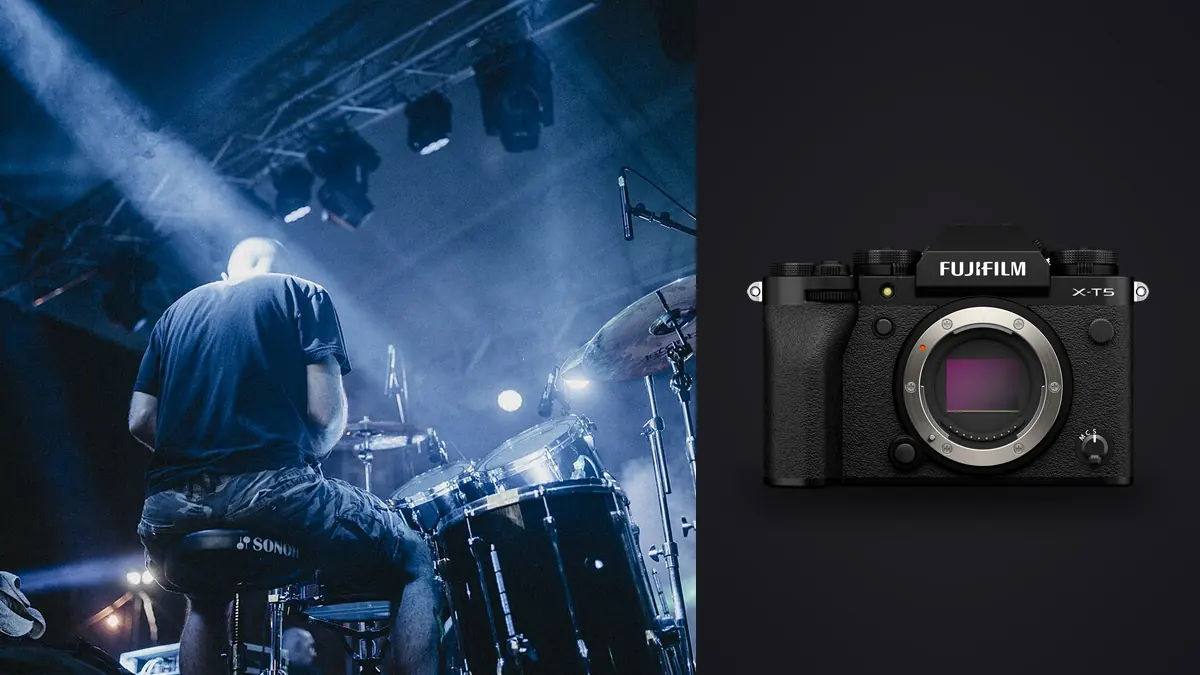
Three songs, no flash, and a lighting rig that swings from pitch black to blown-out white in the space of a chorus. That's the brief every photo pit hands you, and it's the environment I've been shooting the Fujifilm X-T5 in for the better part of a year now, everything from 200-capacity basement shows to a couple of theater-sized package tours. The X-T5 was never marketed as a sports or action body. Fujifilm built it as a stills-first, high-resolution APS-C camera for landscape and portrait shooters, and on paper that sounds like the wrong tool for a mosh pit. In practice it's a genuinely capable concert camera, just one that needs its settings deliberately tuned for the job rather than left on whatever the menu defaults to.
The sensor is the whole story
The X-T5 uses Fujifilm's 40.2-megapixel X-Trans 5 HR sensor, and that resolution number is what most reviews lead with. For concert work it's almost the wrong headline. What actually matters in a room with a single moving spotlight and three colored washes fighting each other is how the sensor behaves from ISO 3200 upward, because that's where you'll be living for most of a set. In my experience the X-T5 stays clean and usable through about ISO 6400, gets noticeably grainier but still printable at 8000 to 12800, and past that you're relying on noise reduction doing real work in post rather than the sensor giving you clean data. That's a stop or so behind what you'd get from a good full-frame body, which is the honest tradeoff of shooting APS-C in a dark room. The 40 megapixels do pay off in an unexpected way though: cropping into a wide shot after the fact, when the singer walks off your intended frame and into a better one, is far more forgiving than it would be on a 24-megapixel sensor.
The other side of that resolution is file size. A full night of shooting three or four support acts plus a headliner easily produces 1,500 to 2,500 RAW files, and at 40 megapixels each those add up fast on both card space and hard drive space. I started shooting compressed RAW instead of lossless compressed specifically for gig work, and I haven't noticed a meaningful quality hit worth the extra gigabytes.
Mechanical shutter, electronic shutter, and the banding problem nobody warns you about
Most stage lighting rigs, especially the LED wash and moving-head fixtures that have replaced incandescent stage lights almost everywhere, flicker at a frequency your eye can't see but your sensor absolutely can. Shoot electronic shutter under that lighting and you'll get horizontal banding across a chunk of your frames, sometimes subtle, sometimes a hard stripe right through someone's face. The X-T5's mechanical shutter avoids this almost entirely, so for anything with stage lighting I default to mechanical even though it caps me at 15 fps instead of the 20 fps electronic option offers, and even though it's audible.
That audibility matters more than people expect. For a metal show at 110 decibels, nobody will ever hear your shutter. For the quiet acoustic opener, or the moment between songs when a singer is talking to the crowd, a clattering mechanical shutter is genuinely rude and noticeable from the front rows. I switch to electronic shutter for those specific moments and accept the small risk of banding under a static, non-flickering wash, checking the LCD after a burst to confirm nothing came out striped.
Lens choices for three different room sizes
The X-T5's crop factor (1.5x) changes how you think about focal length compared to full frame, and the venue size changes which lens actually earns its place in the bag. I've settled on three go-to setups depending on how close I'll realistically get to the stage.
| Venue type | Lens I reach for | Effective full-frame equivalent | Why it works there |
|---|---|---|---|
| Small club, front-row pit access | Fujinon XF 33mm f/1.4 | ~50mm | Wide enough to include the whole performer and some crowd energy, fast enough for dark stages, and light enough to shoot handheld for a whole set without arm fatigue |
| Mid-size venue, barrier 15-20 feet back | Fujinon XF 56mm f/1.2 (or the newer WR version) | ~85mm | Tight headshots and expressive close crops without needing to physically get closer than security allows; the f/1.2 aperture buys real separation from a busy LED backdrop |
| Theater or arena, photo pit only, no stage access | Fujinon XF 50-140mm f/2.8 | ~75-210mm | The only realistic option when you're shooting from 30+ feet away and the barrier photo pass only covers the first three songs |
If I had to keep exactly one lens in the bag for general club-level work, it's the 33mm f/1.4. It's the one that comes out most nights, and it forces you to actually move around the pit rather than standing in one spot zooming, which tends to make for more interesting frames anyway.
Autofocus in a room designed to confuse it
Stage lighting is, by design, meant to look dramatic to the human eye, which means it's often the opposite of what a contrast-detection or phase-detection system wants to see: hard shadows, blown highlights, colored gels that shift the apparent contrast on a face from one second to the next. The X-T5's autofocus is genuinely good in daylight and improved a lot over the X-T4's, but under a single moving spotlight it can still hunt, especially in low-contrast red or blue lighting.
What's worked for me is abandoning the wide/tracking AF area in favor of a single point or small zone, set to the AF-C custom preset tuned for erratic subject movement (preset 4 or 5 in the AF-C custom settings, depending on how much the performer is jumping around versus swaying). Face and eye detection helps when a singer is close and facing you, but it falls apart the moment they turn toward the drummer or duck into a crowd-surf, so I keep it on but don't rely on it exclusively. Back-button focus is close to mandatory here: with focus-and-recompose off the back button, you can pre-focus on a spot the singer is about to move into (a mic stand, a monitor wedge) and just wait for them to walk into that plane, which beats chasing focus in real time under bad light almost every time.
Buffer, cards, and the three-song reality
Most photo passes give you the first three songs and then you're out, which sounds limiting until you realize it also limits how much your buffer needs to hold. The X-T5 has two card slots, one CFexpress Type A and one UHS-II SD, and the difference between them shows up exactly when you need it most: mid-song, mid-burst, ISO cranked up, shooting compressed RAW at 15 fps mechanical.
| Card in slot 1 | Approx. buffer before slowdown (compressed RAW, mechanical 15fps) | Practical effect during a 3-song set |
|---|---|---|
| Fast CFexpress Type A | Roughly 20+ seconds of continuous bursts before any throttling | You can chase a whole chorus of jumps and crowd moments without the camera stalling |
| UHS-II SD (even a fast one) | Buffer fills within a few seconds of sustained high-speed bursts, then the camera slows to card write speed | You'll miss the second half of a jump shot right when you need the frame, usually without realizing it until you review the take |
I shoot CFexpress in slot 1 as the primary and mirror to the SD card in slot 2 as backup rather than relying on the SD card for active shooting. CFexpress Type A cards are genuinely expensive compared to SD, and it stung the first time I bought one, but for anyone doing this regularly it's the single upgrade that changes how the camera feels under pressure.
In-body stabilization matters more than you'd think for a "sharp" job
IBIS doesn't freeze a moving performer, obviously, subject motion blur is a shutter speed problem, not a stabilization problem. But it does let you handhold the 50-140mm at slower shutter speeds during quieter, less frantic moments (a guitarist noodling between songs, a keyboard player mid-solo) without camera shake stacking on top of everything else working against you in low light. The X-T5's in-body stabilization is rated up to 7 stops depending on the lens, and while I don't trust that number literally in a dark room where I'm also fighting subject movement, it's given me a real margin at 1/60s and even 1/30s on the longer lens for static shots where I'd otherwise need a stop or two more ISO.
What happens after the last song
The unglamorous part of concert photography is what happens at 1 a.m. after load-out, staring down 2,000 nearly identical burst frames of the same chorus, trying to find the three or four that are actually sharp, well-timed, and don't have a security guard's head in frame. This is where I've stopped trying to eyeball every RAW file and instead run the night's card through imagic before I touch Lightroom. It scores focus and sharpness locally on the machine, which matters a lot for gig work specifically, since a lot of these files look sharp at thumbnail size and are actually a hair soft once you're at 100% because the AF grabbed the mic stand instead of the singer's eye. It also clusters the burst sequences so I'm comparing the six frames of one jump against each other instead of scrolling past all of them individually, which on a 2,000-frame night is the difference between an hour of culling and four hours of it.
Because none of that processing goes anywhere near the cloud, it's also just simpler to use on a laptop backstage or in a green room with no reliable wifi, which is most green rooms I've been in. And since imagic is a one-time purchase rather than another monthly subscription stacked on top of gear costs, it fits how most working gig photographers actually budget software. Once I've picked the keepers, I run them through a preset trained on my own past edits (imagic's apply_my_style feature) rather than starting a color grade from scratch for every single show, which keeps a consistent look across a tour without me manually rebuilding the same curves and split-tone every night. If you're new to building that kind of repeatable process, our guide to a faster photo workflow covers the culling-to-edit pipeline in more general terms; the concert-specific version of it is basically that same pipeline compressed into a much smaller time window between one show ending and the next one starting.
Where the X-T5 actually falls short
I don't want to oversell this. The rear screen is a tilt-only design, not a fully articulating one, which is a real limitation when you're shooting overhead into a crowd or down low from a barrier and need to see your composition at an odd angle. The single UHS-II slot as a backup, rather than a second CFexpress slot, is a cost-driven decision I understand but don't love. And battery life under sustained high-fps mechanical bursts in cold outdoor festival conditions is noticeably worse than the rated figures, I carry three batteries to anything longer than a two-hour set and have run all three down at winter outdoor shows. None of these are dealbreakers, but if you're coming from a body built specifically for sports or events, expect a small adjustment period rather than a straight upgrade in every category.
Frequently Asked Questions
Is 40 megapixels actually useful for concert photography, or just extra file weight?
Both, honestly. The extra resolution gives real cropping headroom when a performer moves out of your intended frame mid-burst, which happens constantly. But at 2,000+ frames a night, those files add up fast on storage and on culling time, so it's worth deciding upfront whether you actually need every burst at full resolution or whether you're comfortable letting a culling pass thin the herd before you start editing.
Does the X-T5 handle flickering LED stage lights without banding?
On mechanical shutter, banding from flickering LED and moving-head fixtures is rare in my experience. Switch to electronic shutter, which most photographers reach for to stay quiet during acoustic sets or intros, and banding becomes a real risk under fixtures with a fast flicker rate. I treat electronic shutter as a situational tool for quiet moments rather than a full-set default.
What's the single best lens to start with for club-level shows on the X-T5?
The XF 33mm f/1.4 is the one I'd tell someone to buy first. It covers front-row pit distances at most small and mid-size clubs, handles low light well, and is light enough to shoot a full set handheld without your arm giving out by song three.
Is the X-T5 fast enough for jump shots and crowd-surfing moments?
With a CFexpress card in slot 1 and the AF-C custom settings tuned for erratic movement, yes, for the vast majority of club and theater shows. Where it can struggle is a single strobing spotlight combined with fast, unpredictable subject motion, which is a tough scenario for almost any autofocus system, not just Fujifilm's. Pre-focusing on a fixed point the performer is about to move into, rather than relying purely on tracking, still saves more shots than any AF setting change.