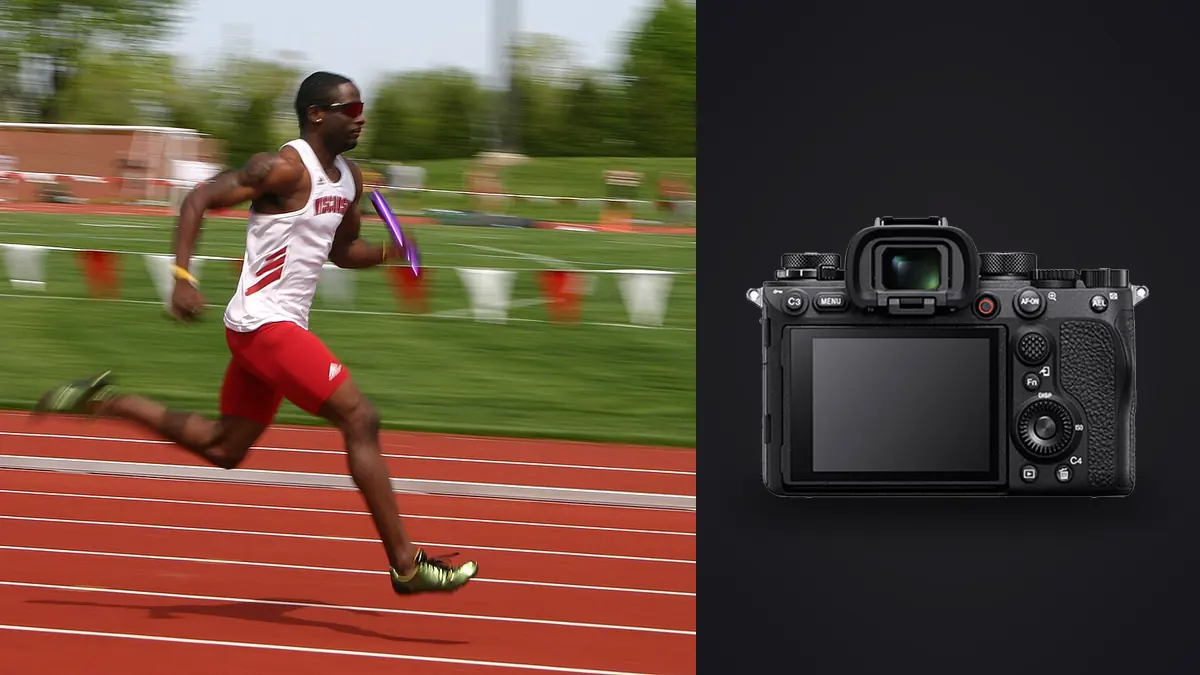
Why the A1 Feels Different at a Track Meet
Most cameras that claim to be "sports bodies" are really built around a single sport in mind, usually something with a ball and a predictable rhythm. Track and field is messier than that. In the span of two hours you might be panning a 100m final at close to peak sprint speed, holding focus on a pole vaulter through a vertical arc, then racking out to catch a discus release from across the infield. The Sony A1 was never marketed as a track-specific camera, but its 50.1-megapixel stacked Exmor RS sensor and 30fps electronic shutter happen to suit exactly this kind of event switching, because you get resolution to crop hard on distant field events and speed to not miss the moment when someone breaks from the blocks.
I've shot three outdoor conference championships and one indoor invitational with an A1 body, mostly on my own time, trying to get usable images out fast. What follows is what actually mattered in practice: shutter mode choices, autofocus behavior with runners versus jumpers, how the sensor handles stadium lighting, and what happens to your evening once you've got a memory card full of 50-megapixel bursts.
Shutter Modes: What 30fps Actually Costs You
The headline spec is 30fps with full AF/AE tracking, but that number only applies under specific conditions, and dropping down a tier changes more than just frame rate. The electronic shutter at full speed requires a compatible lens and generally caps out around f/22, which is rarely a problem for daylight track work but matters if you're stopping down heavily for a wide depth of field on a relay handoff. Mechanical shutter tops out at 10fps, which sounds slow next to 30fps but is still enough to catch a clean push-off phase if your timing is decent, and it sidesteps rolling shutter risk entirely.
| Shutter Mode | Max Rate | Rolling Shutter Risk | Best Track Use |
|---|---|---|---|
| Mechanical | 10fps | None | Field events, pole vault bar clearance, flash-lit indoor meets |
| Electronic (Hi) | 20fps | Low, minor skew on fast pans | Sprint finals with heavy panning, hurdles |
| Electronic (Hi+) | 30fps | Present but minor on stacked sensor | 100m/200m starts, baton exchanges, long jump takeoff |
| Electronic (Lo/Mid) | 5-15fps | Minimal at lower rates | Distance races, warmups, general coverage to save card space |
The stacked sensor's fast readout genuinely does reduce the skewed-picket-fence look you get from rolling shutter on slower electronic shutters, but it doesn't eliminate it. On a hard horizontal pan of a sprinter at full stride, straight vertical elements like lane lines or a stadium railing in the background can show slight lean if you're shooting wide and the panning speed is aggressive. It's subtle enough that I only noticed it pixel-peeping afterward, not something a sponsor recap or a local paper would ever flag, but if you're delivering large prints it's worth knowing the electronic shutter isn't distortion-free even on this sensor.
Autofocus: Sprinters Behave Differently Than Jumpers
The A1's 759-point phase-detection array and real-time tracking are excellent at locking onto a single moving subject, but track and field gives you three distinct autofocus problems in one meet. Sprinters move in a straight, mostly predictable line, so wide-area tracking with Eye AF works reliably as long as you commit to one lane and don't try to jump between runners mid-burst. Distance races are actually easier on the AF system because the pace is slower, but you're often shooting through a pack of runners where the system has to decide who to track, and it will sometimes lock onto the wrong shoulder if two athletes overlap in frame.
Field events are where the A1's tracking earns its keep. Pole vault in particular asks the camera to hold focus on a subject moving vertically at increasing speed while the background changes from stadium seating to open sky, and I found Zone AF with a narrower tracking box more reliable there than the full-frame wide tracking mode, which occasionally snaged on the crossbar. For long jump and triple jump, I switched to a fixed focus point locked just past the takeoff board rather than relying on tracking at all, since the athlete's approach is fast but the actual moment you want (foot on the board, body extended) happens in a predictable spot.
One AF setting that's easy to overlook: the AF-C "sensitivity" or tracking persistence setting matters a lot for hurdles, where a competitor's silhouette briefly disappears behind a hurdle bar during clearance. Set the tracking to hold rather than immediately hunt for a new subject, or you'll get a soft frame right at the peak of the jump, which is usually the frame you actually wanted.
Stadium Lighting and the Flicker Problem
Most outdoor track meets are lit by the sun and this section doesn't apply, but indoor invitationals and evening finals under stadium lights are a different story. A lot of newer indoor tracks and stadium banks use LED fixtures that flicker at a frequency invisible to the eye but very visible as banding across a burst shot with a fast electronic shutter. The A1 has an anti-flicker shooting mode that times the exposure to the light source's peak brightness, and it genuinely helps, but it only works reliably when you've let the camera scan the light source first (there's a manual flicker scan option buried in the menu that's worth binding to a custom button if you shoot a lot of indoor meets).
What I didn't expect the first time: banding shows up worse in electronic shutter mode at 30fps than at 10fps mechanical, because the mechanical shutter's exposure timing happens to average out differently against the LED refresh cycle. If you're at an indoor meet under lighting you haven't shot before, it's worth burning a test burst at both shutter modes and checking the backs of a few frames at 100% before committing to a full session at 30fps electronic.
Lens Reach From the Infield, the Stands, and the Backstretch
Where you're allowed to stand changes everything about lens choice, and track meet credentialing varies wildly by level. At a high school meet you might get infield access; at a university championship you're often locked to a photographer's box on the backstretch or confined to the stands entirely.
From the infield, a 70-200mm f/2.8 covers sprints on the near straight and most field events comfortably, and its speed matters for evening meets. From the stands or a fixed photo position, you need real reach: a 200-600mm G lens handles distance events and far-side sprints, and paired with the A1's resolution you can crop in post without the file falling apart, since 50 megapixels gives you room to punch in on a runner who's a third of the frame width away. For dedicated sprint work at longer range, a prime like a 400mm f/2.8 with a 1.4x teleconverter is the combination I'd reach for if budget allowed it, since the extra stop of light matters once the sun drops behind the stadium roof in late-afternoon finals.
A detail that surprised me: at 50 megapixels, cropping a 200-600mm frame down to a tight portrait of a distant discus thrower still leaves enough resolution for a half-page print, which isn't true on lower-resolution bodies. That's the real practical payoff of the sensor's resolution for track work, more than any single burst-rate number.
The Storage Problem: 50 Megapixels at 30 Frames a Second
This is the part nobody warns you about before you buy into a 50MP stacked-sensor body for sports. A compressed RAW file off the A1 runs somewhere around 55 to 65MB depending on scene detail. At 30fps, an eight-second burst, which is roughly what you'd fire off through a full 100m race from the gun to the finish, generates well over 200 frames and something close to 13 to 14GB of data before the runner has even crossed the line. Multiply that across heats, semis, and finals for sprints alone, plus relays, hurdles, and every field event you're covering, and a single day at a track meet with an A1 can easily produce 400GB to 700GB of RAW files.
Buffer depth matters here too. Sony rates the A1 for roughly 230-plus frames of compressed RAW before the buffer fills at full speed, which is around eight seconds of continuous 30fps shooting, but that number assumes you're on a CFexpress Type A card. Drop to a UHS-II SD card and both the effective buffer depth and, more painfully, the clearing time between bursts get noticeably worse, which matters a lot at a meet where you're firing repeated short bursts every few minutes across an entire afternoon and need the buffer clear before the next race starts.
| Card Type | Approx. Buffer at 30fps | Buffer Clear Time | Meet-Day Impact |
|---|---|---|---|
| CFexpress Type A | ~230+ compressed RAW frames | Fast, ready for next burst within seconds | Reliable for back-to-back heats |
| UHS-II SD (fast) | Noticeably reduced | Slower, can lag into the next event | Usable for slower events, risky for sprint finals |
| UHS-I SD | Significantly reduced | Very slow | Not recommended for 30fps track work |
Also worth knowing if you're coming from an A9 III or expecting a newer Sony body's tricks: the A1 has no pre-capture buffer function, so if you're a half-second late on the trigger for a false start or a surprise photo finish, that frame is simply gone. It's a limitation, not a flaw, but it's the kind of thing you plan around by starting your burst a fraction early rather than trying to react to the gun.
Getting Through the Files Without Losing the Evening
Here's the part that actually determines whether shooting a track meet on an A1 is sustainable: what happens after the meet, when you're staring at a card (or three) full of 50-megapixel bursts and a sponsor deadline the next morning. A 30fps sequence of a hurdles race doesn't give you thirty different photos, it gives you thirty near-identical frames of the same clearance with one or two that are actually sharp and well-timed. Culling that by eye, frame by frame at full resolution, is the part of sports photography nobody enjoys and the part that eats the most time.
This is where I've leaned on imagic for the post-meet sort. It runs entirely on the laptop, which matters at a track meet more than it sounds like it should, since stadium wifi is usually terrible or nonexistent and I don't want to be waiting on a cloud upload to start reviewing frames from the car. It scores focus and sharpness locally across the folder, which is the single biggest time-saver on a burst-heavy shoot, because it flags which frame in a thirty-shot hurdle sequence is actually the sharp one instead of making me zoom into each frame individually. It also clusters those burst sequences together as groups rather than showing me two hundred separate thumbnails that all look the same at a glance, which is the difference between a twenty-minute first pass and a two-hour one. If you want the mechanics of how that scoring and clustering actually works under the hood, how AI photo culling works covers it in more depth.
Once the picks are down to a manageable set, I use imagic's apply_my_style feature, which is trained on my own previously edited sports work rather than a generic preset pack, to get a fast first pass on color and contrast across the selects before I do any final manual adjustment. It's not a substitute for finishing an image, but it gets a batch of forty picks from flat RAW files to something client-presentable in minutes instead of an hour of individually matching white balance under mixed stadium lighting. For anyone trying to shave time out of a similarly burst-heavy workflow, 10 tips for a faster photo workflow has a few habits that pair well with this kind of local-first culling setup, particularly around folder structure and how you name bursts on import.
What I'd Tell Someone Buying an A1 Specifically for Track
The A1 is not a cheap way to solve a track photography problem, and if your only sport is track and field, there are less expensive bodies that will get you similar keeper rates for less money. What the A1 buys you is flexibility: enough resolution to shoot loose and crop tight on distant field events, enough speed to not miss a baton exchange, and autofocus tracking that adapts reasonably well across sprints, distance, and jumps without swapping bodies mid-meet. Where it costs you is in file management discipline. Buy the CFexpress Type A cards, don't try to run 30fps bursts off SD alone, and go into meet day with a plan for getting through the volume of RAW files afterward, because the camera will happily generate more data than most people are prepared to sort by hand in a single evening.
Frequently Asked Questions
Do I need CFexpress Type A cards to get the full 30fps burst on a Sony A1 at a track meet?
Not strictly, the A1 will still shoot 30fps on a fast UHS-II SD card, but the buffer fills sooner and clears slower between bursts, which matters when you're firing repeated short bursts across heats and finals all afternoon. If you're shooting a full day of sprints and relays, CFexpress Type A removes a real bottleneck rather than being a nice-to-have upgrade.
Will the electronic shutter cause banding under indoor stadium lights?
It can, particularly under LED fixtures common in newer indoor facilities. The A1's anti-flicker and flicker scan functions help significantly, but they work best when you've let the camera register the light source first. Testing a short burst at the venue before your first real sequence is worth the thirty seconds it costs.
What lens should I bring if I only get stands access, not infield?
A 200-600mm gives you the reach for both distance events and far-side sprints from a fixed position, and the A1's 50-megapixel files give you enough room to crop in further without the image falling apart. If you can only bring one lens for stands-only credentialing, that focal range covers more of a track meet than a shorter zoom will.
How much storage should I plan for a full day of A1 track coverage?
Between 400GB and 700GB is realistic for a full meet covering sprints, relays, distance, and field events at mixed shutter speeds, more if you shoot every heat at 30fps rather than reserving the top burst rate for finals. Plan your card capacity and backup drives around that range rather than the smaller numbers you'd expect from a lower-resolution body.
Does the A1's autofocus handle pack running (distance events) as well as sprints?
Reasonably well, but differently. Sprints are easier for tracking because the subject stays isolated in a lane, while distance races put multiple runners close together, where the system can occasionally shift lock to the wrong athlete if bodies overlap. Narrowing the tracking area rather than using full wide-area tracking tends to help in pack situations.