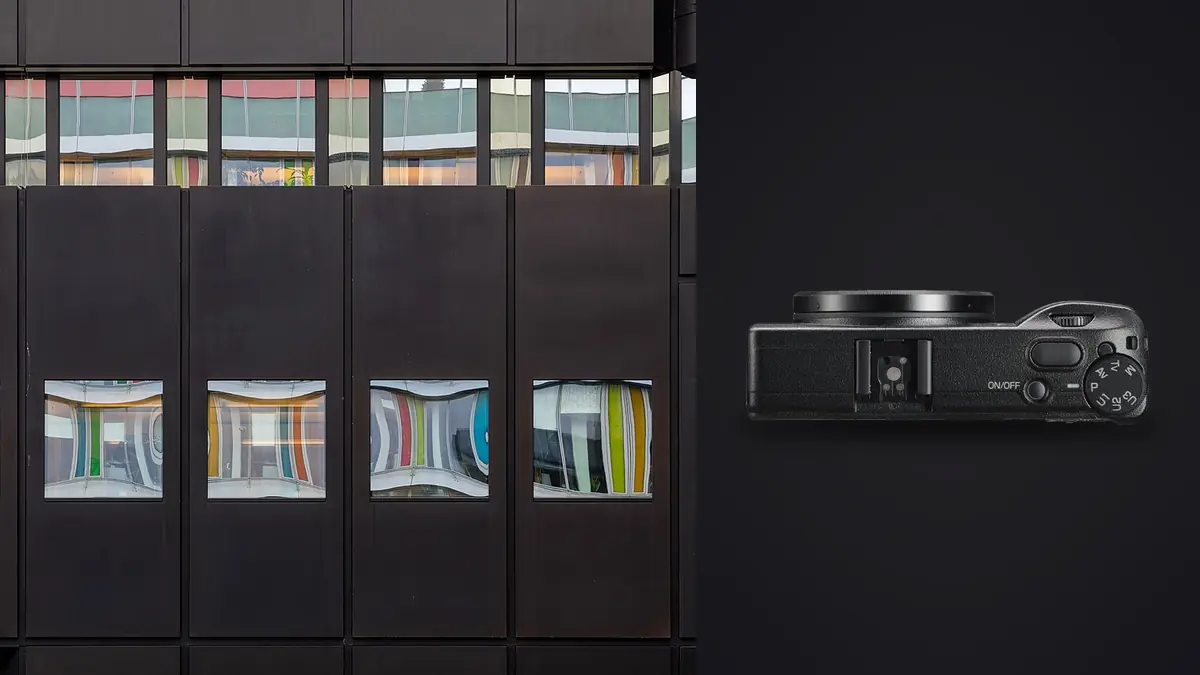
A Ricoh GR IIIx can end up on interior design shoots almost by accident. Picture it in a jacket pocket on a site visit for a kitchen renovation, the main gear still in the car, and the client wanting to show you a detail on the cabinetry before a tripod has even been unloaded. It earns a permanent place in that pocket on every job, but not for the reason most people assume when they hear "compact camera for architecture." It doesn't shoot the room. It shoots what the room is made of.
That distinction matters more than any spec sheet, and it's the whole reason to think carefully before you bring a GR IIIx onto a paid interior or architectural job expecting it to do what a 16-24mm zoom or a tilt-shift lens does.
The focal length is the whole story
The GR IIIx exists because Ricoh took the original GR III's 28mm equivalent lens and swapped it for a 40mm equivalent. On paper that's a small change. In practice, for interior work, it changes what the camera is even for. A 28mm lens (closer to the wide end that real estate and architecture photographers actually rely on) will still get most of a small room in frame if you back into a corner. A 40mm lens will not. Stand in the same corner of the same room with the IIIx and you're framing a third of what a 24mm shot would show.
I've seen photographers buy the IIIx expecting a pocketable alternative to their wide zoom and then feel cheated by it. That's a mismatch of expectations, not a flaw in the camera. The 40mm field of view is close to what your eye actually resolves as "normal" attention, which is exactly why it's a poor fit for establishing shots and a genuinely good fit for something else: showing how materials meet, how light falls across a single wall, how a chair sits against a window without the rest of the room competing for attention.
If your job is producing the wide, corrected, evenly lit shots that go on a listing page or in a portfolio hero image, the IIIx is not that tool and I wouldn't try to make it one. If part of your job is documenting texture, joinery, hardware, and the quieter compositional moments a client's space offers, it's one of the better tools I own for it, specifically because it isn't wide.
Where it actually earns a place in the bag
On a residential interior shoot I'll typically bring a wider lens on the main body for the room-level coverage, and the GR IIIx stays in a jacket or bag pocket for everything in between. That "everything in between" ends up being a meaningful chunk of what a designer or client actually wants to see afterward:
- Material and finish detail: the grain on a walnut island, the texture of plaster, the weave on an upholstered headboard. The IIIx focuses down close enough for this without a dedicated macro lens, and the APS-C sensor with no optical low-pass filter renders fine texture with more bite than most compacts.
- Doorway and hallway framing: shooting through an open door into the next room, using the frame itself as a compositional device. A 40mm equivalent flatters this kind of shot because it doesn't stretch the foreground doorframe the way a wide lens does.
- Fixtures and hardware: cabinet pulls, tap fittings, light switches, the small specified details a designer has opinions about and that never make it into the wide shots.
- Quick walkthrough documentation before a formal shoot: the leaf shutter is close to silent, the body is small enough that clients stop noticing you're carrying it, and you can move through a house shooting reference frames without setting up anything.
None of that is a substitute for the wide, corrected coverage a client is paying for. It's the layer of images that makes a delivered set feel complete instead of like ten identical wide shots from slightly different angles.
Settings that actually change indoors
Interiors are a harder lighting problem than most people give them credit for, and a fixed f/2.8 lens with no flash forces you to think about it directly instead of solving it with gear. A few things I've settled on after a lot of trial and error on real jobs:
Snap focus is the single most useful feature on this camera for interior work and it's easy to ignore because it's buried in the menu. Set it to something like 2.5 to 3 meters for hallway and doorway shots, half that for detail and material work, and you stop waiting on autofocus hunting in low contrast, evenly lit rooms, which is exactly where contrast-detect systems struggle most.
The built-in ND filter is not just a bright-daylight tool. In a room with a large uncovered window, an ND2 or ND4 pull lets you keep the aperture open for a detail shot without blowing the window highlights any further than they already will be, and it's a two-button toggle instead of digging a filter out of a bag.
White balance in real interiors is rarely one thing. A living room with a tungsten lamp, a north-facing window, and an LED downlight strip is three color temperatures in one frame, and no in-camera auto white balance setting resolves that cleanly. I shoot DNG on every interior job for exactly this reason and don't fight it in camera.
ISO ceiling depends more on the room than any general rule. I'll go to 3200 without much concern on the GR IIIx's sensor for detail shots where noise reads as texture, but I pull that down closer to 800 for anything with large flat painted surfaces, where noise becomes obvious and unflattering fast.
| Scenario | Aperture | ISO ceiling | Focus approach |
|---|---|---|---|
| Window-lit living space, midday | f/5.6 to f/8 | 200 to 400 | Autofocus, single point |
| Material or texture close-up | f/2.8 to f/4 | up to 1600 | Snap focus, short distance |
| Dim hallway or stairwell | f/2.8 | up to 3200 | Snap focus, preset distance |
| Framing through a doorway | f/4 to f/5.6 | 400 to 800 | Autofocus on far subject |
| Evening interior, mixed artificial light | f/2.8 | 1600 to 3200 (DNG) | Snap focus, manual override |
What it genuinely can't do
I want to be blunt about the limits, because I've watched people spend money expecting this camera to replace gear it was never built to replace. There's no viewfinder unless you buy the separate optical finder accessory, and even then it's not through-the-lens, so composing precise vertical lines against a doorframe is done on the rear screen, in daylight, at arm's length, which is workable but not fun. There's no in-camera perspective or keystone correction, so if you're shooting up at a ceiling or across a room at an angle, you're fixing convergence in post rather than getting it right in camera the way a shift lens allows. Battery life is genuinely short, I get somewhere around 180 to 220 frames on a charge with the screen on most of the time, which is fine for a detail-shooting second camera and not fine as your only body on an eight-room house. And there's no weather sealing to speak of, which rarely matters indoors but is worth knowing if a job includes a covered porch or an unfinished space with dust in the air.
None of this is a knock on the camera doing its actual job badly. It's a compact prime built around a specific focal length and a specific philosophy of getting out of your way. Asking it to also be a tilt-shift architecture rig is asking it to be a different product.
Fitting it into an actual delivery workflow
The practical problem with running two cameras on one interior job isn't the shooting, it's what happens after. A single house walkthrough with a wide body and the GR IIIx running alongside it can easily produce six or seven hundred frames once you count bracket sets and the handheld detail bursts you shoot to make sure at least one is critically sharp at close focus distance. Sorting that by eye at the end of a long day is where most of the actual time on a job disappears.
This is the part of my workflow where imagic does the unglamorous work. It runs entirely on your machine, so client files from a house that isn't public yet, or a commercial space under an NDA, never leave your drive for a cloud pass, which matters more on interior design work than most other genres because you're often inside someone's home before it's finished or listed. The sharpness scoring is genuinely useful specifically for the close-focus detail shots off the GR IIIx, where depth of field is thin enough that a small handheld sway between two nearly identical frames is the difference between usable and soft, and I'd rather trust a measurement than my own eyes at frame four hundred. The burst and duplicate clustering handles the inevitable run of five or six near-identical doorway compositions I shoot to get the framing right, grouping them so I'm picking the best of one cluster instead of scrolling past duplicates one at a time.
Once the culling pass is done, I lean on imagic's apply_my_style preset, trained on my own past edits, to get a consistent starting grade across files that came from two different cameras shooting in three different color temperatures in the same house. It doesn't replace room-by-room adjustment, but it removes the flat, mismatched-white-balance starting point that otherwise eats the first twenty minutes of every edit session. If you're building out a culling routine for a shoot like this from scratch, it's worth reading through how AI photo culling actually works before you commit to a specific pass order, and the general pacing advice in tips for a faster photo workflow holds up well for mixed-camera interior sets specifically because the bottleneck is almost always sorting volume, not editing skill.
Frequently Asked Questions
Is the GR IIIx wide enough to shoot a full room for a listing photo?
Generally no, not on its own. At a 40mm equivalent you're seeing roughly a third less width than a 28mm lens from the same spot, and interior spaces are almost always tighter than people expect once a lens stops being genuinely wide. For full-room coverage on a real estate or portfolio job, bring something in the 16-24mm equivalent range as your primary lens and treat the GR IIIx as the camera for everything that lens can't do well: detail, texture, and framed compositions through doorways.
Does the built-in ND filter actually help on interior shoots, or is that a daylight-only feature?
It helps indoors more than the marketing suggests. Rooms with a large window during the day create a huge dynamic range problem, and dropping in an ND stop or two lets you keep the aperture wide for a detail shot without pushing the window highlights further past recoverable. It's not a long-exposure tool here, it's a quick way to buy back a stop or two of highlight headroom without digging through a bag.
Can I use the GR IIIx to keep vertical lines straight the way I would with a shift lens?
No, and I wouldn't try. There's no perspective control mechanism on a fixed compact body, so any keystoning from shooting up at a ceiling or across a wide wall gets corrected in post, the same as it would on most standard zoom lenses. Keeping the camera level and shooting further back when you can reduces how much correction you need, but the camera itself isn't doing anything a wide zoom wouldn't also require in post.
How many rooms can I realistically shoot before the battery runs out?
In practice I get somewhere around 180 to 220 frames per charge with typical screen-on shooting, which usually covers a small to mid-size house if you're using it selectively for detail work alongside a main camera. If it's your only body for a full-day shoot across a larger property, carry a spare battery. It charges over USB-C in the body, which at least means one cable covers your laptop, your phone, and the camera on a long shoot day.