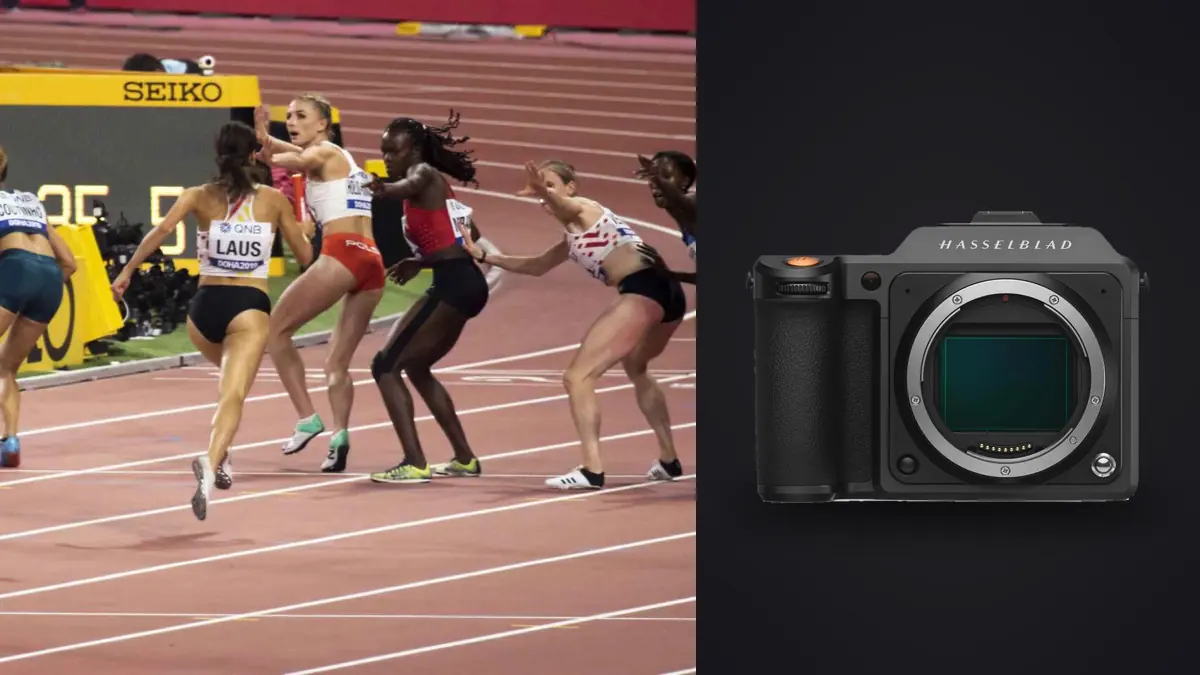
The Hasselblad X2D 100C is an unusual sports camera. Its large sensor, detailed files, in-body stabilization, and leaf-shutter lens system can produce polished action portraits, but its pace is very different from a body designed around long high-speed bursts. That does not rule it out for every sporting assignment. It means the photographer has to choose the right type of action and configure the camera for deliberate timing instead of volume.
This setup guide is aimed at track starts, field events, training portraits, motorsport paddocks, equestrian details, and other situations where movement follows a readable path. It is less suitable for erratic birds, close indoor court action, or any job where a missed instant cannot be repeated. The most productive setup begins with that distinction, then assigns each control to one clear task.
Choose action the X2D can follow
Before changing a button, divide the assignment into predictable and reactive moments. A runner entering a marked bend, a long jumper reaching the board, a cyclist passing a fixed apex, and an athlete pausing after a finish all give you a known distance and composition. Those are strong X2D opportunities. A collision in a crowded penalty area or a player changing direction at arm's length gives you neither. No control layout can remove that basic mismatch.
Build a short shot list around repeatable positions. For a track session, that might include a head-on frame out of the blocks, a side view at the bend, a wider environmental frame, and a portrait after the effort. Walk to each position before the event and identify the exact line where the subject should be sharp. This turns an open-ended tracking problem into a set of timed photographs.
The high-resolution sensor also changes framing discipline. Leave modest space around a moving athlete so a small timing or panning error does not cut off hands, feet, wheels, or equipment. Cropping later is useful, but it should protect composition rather than excuse a distant viewpoint. A clean background and a clear subject remain more important than filling every pixel.
Make the main controls do one job each
Set one user mode for action and keep the normal camera setup untouched. The action mode should recall the exposure mode, autofocus choice, drive setting, and Auto ISO behavior you intend to use. A saved starting point prevents a portrait setting from following you to the first race and makes it easier to recover after experimenting.
Assign the rear focus control to autofocus activation if that separation suits your timing. With focus removed from the shutter release, one press can establish the distance while the shutter waits for the athlete's stride or expression. For a fixed crossing point, focus once, release the focus control, and fire when the subject reaches the mark. For slower movement toward the camera, keep focus active until the decisive instant.
Keep exposure compensation available without opening a menu. Bright uniforms, white lane markings, reflective helmets, and dark grandstands can all pull an automatic exposure away from the subject. The correction should be easy to make while looking through the finder. Resist assigning every available gesture or button. Under pressure, three reliable controls beat a dense map that has to be remembered.
Set exposure for motion, not sensor prestige
Use manual exposure with Auto ISO when light changes but the kind of motion does not. Choose the shutter speed that describes the action and the aperture that gives enough depth around the focus plane, then let sensitivity absorb smaller variations. Watch the preview and histogram for clipped highlights, especially on white clothing and sunlit faces. A detailed file cannot restore a highlight that received no usable tonal information.
For a crisp running stride, begin with a fast shutter and adjust after checking actual limb detail. For a controlled pan, start slower and follow through beyond the exposure. Exact values depend on speed, distance, focal length, and viewing size, so a rehearsal pass is more useful than a universal number. The aim is to decide whether the image should freeze the athlete or show movement, not drift between the two.
Do not stop the lens down merely because the sensor has high resolution. A smaller aperture adds depth, but it also pushes ISO upward and can make the background busier. Focused action portraits often work better with enough depth for the face and torso while the setting falls away. A side-on group or a staggered start needs more depth than one athlete isolated in a lane.
Use pre-focus as a primary technique
Pre-focus is not a fallback on this camera. It is often the most dependable way to photograph a known crossing point. Place an assistant, bag, hurdle, or painted line where the subject will pass. Magnify the view if needed, focus precisely, then avoid touching the focusing ring. If nothing can occupy the spot, focus on a nearby surface at the same distance and verify with a test frame.
Give the subject room to enter the focus plane. Shooting wide open at close distance can make that plane too thin for a sprinting torso. Closing the aperture slightly provides a practical margin without making the entire venue sharp. Take the picture just before the visual peak if shutter and human reaction introduce a delay. A few rehearsal passes will reveal the timing.
When continuous autofocus is used, simplify what the camera sees. Start with a focus area that covers the athlete without including adjacent competitors, rails, or signs. Keep contrasty obstructions out of the foreground. If the system repeatedly chooses a number bib instead of a face, that is not necessarily a ruined frame, but it is a warning that depth of field must cover both. For truly erratic action, acknowledge the limitation and use a more specialized body.
Match the lens and shutter to the venue
XCD lenses with leaf shutters offer a useful option when the assignment combines action portraits and flash. The shutter is in the lens, so flash synchronization is available across a broad range of shutter speeds within the lens specification. That can help balance daylight for a posed athlete or freeze a controlled movement. It does not turn a monoblock into a safe trackside tool, and flash should never distract competitors or violate venue rules.
Choose focal length from access, not from the desire for maximum compression. A medium telephoto works for lane-side portraits and fixed crossing points. A normal lens can include starting blocks, track texture, or the paddock around a vehicle. If the required frame demands a very long lens and rapid subject acquisition, the system is outside its comfortable role. Renting the appropriate camera is cheaper than forcing the X2D through an assignment it cannot cover reliably.
Stabilization helps steady composition and reduce camera movement, but it does not stop a runner. Treat it as framing support, particularly with longer lenses, while shutter speed handles the subject. Turn it off only when a support system or a specific technique produces inconsistent results, and confirm that choice with magnified test frames.
Place yourself before the action begins
Position is the strongest performance setting available. Stand where the subject's distance changes slowly, such as outside a bend for a side view, rather than where the athlete rushes directly through the focus range. Look for a background that stays simple over the full path. A clean wall twenty meters away is easier to manage than spectators immediately behind the lane.
Mark safe limits and respect officials, barriers, animals, vehicles, and other photographers. The X2D encourages careful composition, which can narrow situational awareness. Keep both eyes open when action approaches and never step backward while looking only through the finder. If kneeling, choose a place where the subject cannot enter your space.
Arrive early enough to make exposure and focus checks under the actual light. A test using a walking assistant can reveal finder lag, depth of field, and background problems without risking the real attempt. Save the corrected setup again after the rehearsal so an accidental dial movement does not become the new baseline.
Review for timing and focus without chasing volume
Check one short sequence at useful magnification, then return attention to the event. Confirm the eye or intended detail, motion treatment, and edge framing. Do not judge sharpness from the full image alone; a 100-megapixel file can look convincing when reduced and disappointing when inspected. At the same time, avoid rejecting a strong photograph because an irrelevant edge is not perfect.
After the shoot, ingest the complete folder before moving or renaming individual files. A local desktop workflow such as imagic for Windows and macOS can score sharpness, exposure, closed eyes, and composition, then group related frames and bursts. Use those results as a review aid, not as a replacement for selecting the best gesture and story. The originals remain local and edits are non-destructive.
For broader field and post-production guidance, the workflow and editing guides cover repeatable handoff practices. Keep the final sports set tight: establish the venue, show peak action, include human response, and remove frames that repeat the same instant without adding information.
Write a compact event setup card
Reduce the complete configuration to a card that can be checked before leaving home: charged batteries, formatted media, action user mode, focus activation, shutter type, Auto ISO ceiling, lens choice, and the first planned position. Add the organizer's contact and the venue restrictions. This is not busywork. It prevents a carefully designed setup from failing because one ordinary dependency was missed.
At the venue, add three observations: current light direction, the cleanest background, and the point of predictable action. Make one test file, enlarge the intended focus detail, and inspect the brightest uniform or reflective surface. If that test passes, stop changing settings without a visible reason. Stability leaves more attention for timing and safety.
After the assignment, note one setting that helped and one that caused friction. A repeated personal record is more valuable than copying a generic sports menu from another camera. It gradually turns the X2D into a familiar specialist tool while preserving an honest boundary around the assignments it should not be asked to cover.
Frequently asked questions
Is the Hasselblad X2D 100C a good general sports camera?
No. It is best for predictable action, staged athletic work, and moments where precise timing can replace a long burst. Fast, erratic, unrepeatable sport is better served by a camera designed for continuous tracking and rapid frame rates.
Should stabilization replace a fast shutter for runners?
No. Stabilization reduces movement from the photographer, while a suitable shutter speed controls blur from the athlete. Use both for their separate purposes.
What is the safest focus method for a fixed finish-line frame?
Focus on the exact crossing distance before the race, use enough depth of field for a small timing error, and release the shutter as the athlete enters that zone. Verify the method during a rehearsal whenever possible.