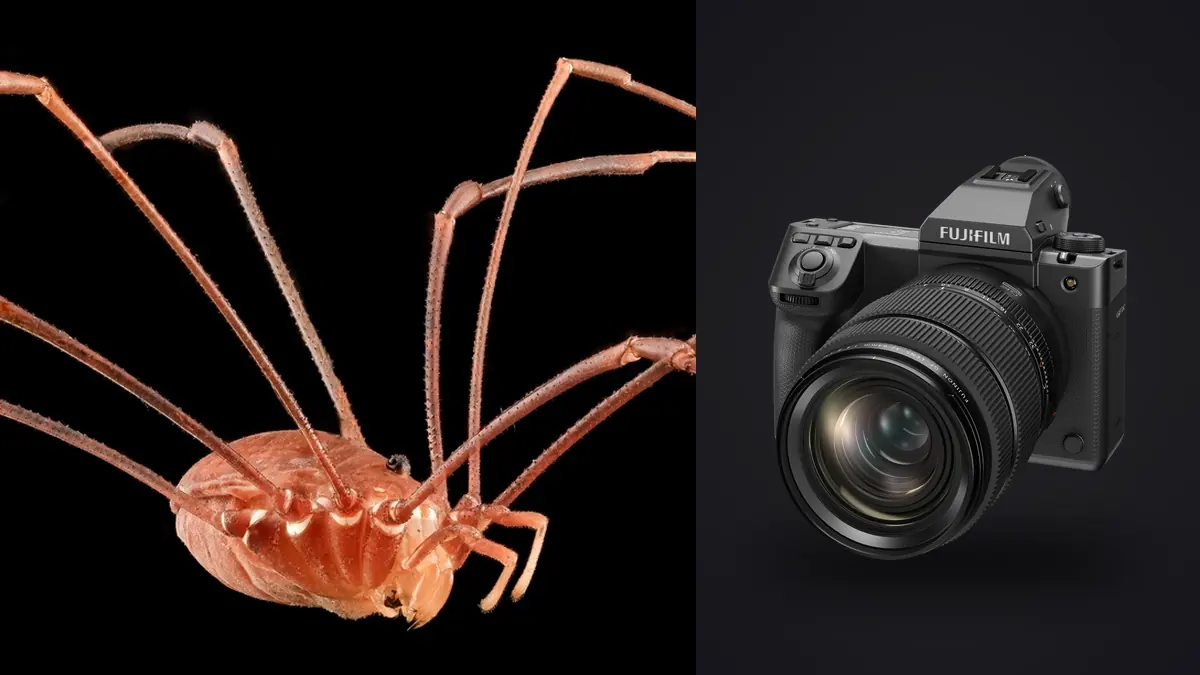
Most people who buy into the GFX system are chasing landscapes, studio portraits, or architecture, the stuff medium format has always been good at. Pointing a 102-megapixel medium format body at a jumping spider or a hoverfly sounds like a mismatch, and in some ways it is. I spent most of a spring and summer running the GFX 100 II on damselflies, weevils, and garden spiders around a pond near my house, and the honest verdict is that it's a fantastic sensor bolted to a genuinely thin lens lineup for this specific job. If you already own the system and want to point it at bugs, here's what actually happens once you try.
The sensor is not the bottleneck, the lens mount is
The 102MP sensor in the GFX 100 II resolves an astonishing amount of texture on a fly's compound eye or the scales on a moth's wing, more than any APS-C or full-frame macro rig I've used at the same working distance. That part lives up to the hype. The problem is that Fujifilm has exactly one purpose-built macro lens for the GF mount: the GF120mm F4 Macro R LM OIS WR. It's a genuinely good lens, sharp wide open, with useful optical stabilization, but it tops out at 0.5x (1:2) magnification. Compare that to the glut of 1:1 and 2:1 macro options available for Sony E, Canon RF, and even Nikon Z mounts, and you start to feel the gap. There is no native 1:1 GF macro lens, no native extension tube system from Fujifilm itself, and third-party support for GF mount is thin because the image circle needed to cover a 43.8x32.9mm sensor rules out most of the popular full-frame macro probe lenses without heavy vignetting.
In practice this means most GFX shooters doing serious insect work either live with 0.5x and crop in post (which the 102MP files tolerate well) or step down to the GF30mm F3.5 R WR with a set of third-party extension tubes for wider environmental macro shots that show the insect in its habitat rather than filling the frame. Both are workable. Neither replicates the true 1:1-and-beyond reach that a dedicated APS-C or full-frame macro system gives you for the same money.
Autofocus finds the frog, not the fly
The GFX 100 II's subject detection covers animals and birds reasonably well, but insects aren't a distinct recognition category the way they are starting to appear on some flagship full-frame bodies. In the field this means you're mostly back to single-point AF or manual focus with focus peaking, especially once you're inside 30cm of the subject where depth of field collapses to a couple of millimeters. I ended up shooting manual focus for probably 80% of my macro sessions, using the focus ring and my own body sway to find the eye rather than trusting the autofocus system to lock onto something that small and fast. This isn't a knock exclusive to Fujifilm, medium format AF systems generally lag behind full-frame flagships for erratic small subjects, but it's worth knowing before you plan a session around continuous AF tracking a damselfly in flight. You will mostly be photographing insects that are perched, not airborne.
Diffraction shows up earlier than you'd like
This is the part that surprised me most. Macro photography almost always wants you stopped down for depth of field, but a 102MP sensor packs its pixels tightly enough that diffraction blur becomes visible at apertures that would look perfectly fine on a 24MP body. I ran a rough test with a dead leaf beetle pinned under controlled light, shooting the same framing from f/5.6 through f/22, and the falloff in per-pixel sharpness past f/11 was obvious even before pixel-peeping.
| Aperture | Approx. diffraction blur (airy disk) | What I saw at 100% | When I'd actually use it |
|---|---|---|---|
| f/5.6 | ~7.4 µm | Tack sharp on the focus plane, razor-thin DOF | Single facet or eye detail shots, always stacked |
| f/8 | ~10.7 µm | Excellent detail, DOF still very shallow | Larger subjects like dragonflies shot single-frame |
| f/11 | ~14.7 µm | Best balance I found for this sensor | Default aperture for most single shots |
| f/16 | ~21.5 µm | Softening visible at 100%, fine after resizing | Stacking sequences where DOF matters more than per-frame sharpness |
| f/22 | ~29.5 µm | Noticeably soft at native resolution | Only as a last resort when stacking isn't possible |
The practical upshot: on the GFX 100 II, f/11 is where I stopped fighting the sensor. If I needed more depth of field than f/11 gives at these magnifications, I stacked frames instead of stopping down further, because a soft f/22 single frame downsized still lost detail a stack at f/11 didn't.
Focus stacking a live subject is a different game than stacking a pinned one
The GFX 100 II has in-camera focus bracketing, and it works well for cooperative subjects: a moth that's settled for the night, a beetle that's slow-moving, anything that will hold still through a 20 to 40 frame sequence. For anything genuinely alive and alert, jumping spiders especially, the insect moves between frames often enough that a chunk of the stack becomes unusable. My workaround was shooting shorter bursts of 8 to 12 frames with a slightly wider step size, accepting a rougher stack rather than a technically perfect one that never finishes because the subject walked off mid-sequence. Flash helped enormously here, both for freezing motion and for letting me shoot at f/11 to f/16 without ISO climbing into territory where the 102MP sensor's read noise becomes visible in shadow detail. A small twin-flash bracket mounted around the lens hood, diffused with a shoot-through panel, is close to mandatory gear for this kind of work regardless of camera brand, and it's doubly useful here because it buys you the aperture you need for depth of field without a slow shutter dragging in ambient light and doubling up on motion blur.
What a session actually produces
A single insect subject, shot as a bracketed stack at 102MP compressed raw, generates somewhere around 80 to 100MB per frame. A 30-frame stack for one dragonfly is close to 3GB. Multiply that across a two-hour session chasing six or seven different subjects, several of which needed two or three stack attempts because the insect moved, and you can end up with 40-plus gigabytes and several hundred frames before lunch. Most of those frames are near-duplicates of each other within a stack, plus the inevitable handful of completely blown attempts where the subject bolted mid-sequence.
This is where the culling step stops being optional. I run these sessions through imagic afterward specifically because it clusters near-duplicate burst and stack frames automatically and scores sharpness locally, so I can pull the two or three genuinely sharp frames per stack (or confirm the stack is worth blending) without scrubbing through 300 nearly identical macro shots by eye. Everything runs on the machine with no upload step, which matters more than it sounds like it should when you're dealing with 100MB raw files and a field laptop on a slow connection. If you haven't thought hard about how a culling pass actually works under the hood, how AI photo culling works covers the mechanics in more depth than I will here.
Once I've got a shortlist of usable frames, I lean on imagic's apply_my_style preset to carry a consistent color and contrast treatment across a whole session of, say, damselfly shots taken under shifting cloud cover, since the preset is trained on my own past edits rather than a generic macro look. It's not a substitute for individual adjustment on the best two or three images that will actually get published, but it saves real time getting the other forty from "raw" to "presentable" without redoing the same curve and white balance tweak by hand forty separate times.
Handheld versus tripod, and why it's not obvious
The 8-stop IBIS in the GFX 100 II is genuinely impressive for handheld work at moderate distances, but at 0.5x magnification, stabilization matters less than you'd think because the dominant blur source isn't camera shake, it's the insect swaying on a leaf in the breeze or simply walking while you're trying to focus. I found a monopod with a small focusing rail more useful than a full tripod for live subjects, since it let me chase small repositioning moves without losing time to leg adjustments, while still giving enough stability that IBIS could clean up the residual shake. For genuinely static subjects (a spider guarding an egg sac, a beetle that's gone still in the cold morning), a full tripod and geared focus rail with a proper stacking sequence is worth the setup time and produces the best files the system is capable of.
Is this actually the right camera for the job
If insect macro is your primary genre and you're choosing a system from scratch, I wouldn't start with GFX. The lens selection alone (one native macro lens, capped at 0.5x, versus a deep bench of 1:1 and 2:1 options on smaller formats) makes this a harder path than it needs to be, and the autofocus isn't built with tiny erratic subjects in mind. Where the GFX 100 II earns its place is for photographers who already shoot the system for other work (landscapes, portraiture, product) and want to fold macro into a session without carrying a second body. The files are extraordinary when everything lines up: lighting controlled, subject cooperative, aperture held at f/11 or tighter with a stack. You're just going to work harder for those files, and shoot fewer keepers per hour, than you would on a purpose-built macro setup. Knowing that going in changes how you plan a session, and if speed through a shoot matters to you as much as it does to me, it's worth reading through practical ways to speed up the rest of your workflow so the camera's slower pace doesn't compound with a slow edit pass afterward.
Frequently Asked Questions
Can the GF120mm Macro reach true 1:1 magnification with extension tubes?
Stacking third-party extension tubes behind the GF120mm gets you closer to 1:1, but you lose autofocus entirely and working distance shrinks fast, which is a problem with live insects that flee anything getting close. I found tubes more useful on the GF30mm for wider habitat shots than as a way to push the 120mm past its native 0.5x for tight insect portraits.
Is 102 megapixels actually useful for a subject this small, or is it wasted resolution?
It's genuinely useful, mostly because it gives you cropping headroom you don't have on lower-resolution sensors. Since the native lens only reaches 0.5x, cropping into a 102MP file to simulate tighter magnification still leaves you with a 20 to 30MP final image, which holds up for print in a way a similar crop from a 24MP file wouldn't.
Does the in-body stabilization make handheld macro shooting realistic?
For moderate magnifications and cooperative subjects, yes, the IBIS is strong enough that handheld single shots are viable in decent light. Once you're stacking multiple frames or working near 0.5x magnification, subject movement outpaces what stabilization can compensate for, and a monopod or rail becomes the bigger factor in keeping frames aligned.
What's the minimum kit to try this without overspending on a body you might not keep for macro?
If you already own a GFX 100 II for other work, the GF120mm Macro plus a basic twin-flash bracket and diffuser is enough to find out whether you enjoy this kind of shooting before investing in a geared focus rail or specialized stacking gear. If you're buying into GFX specifically for insect macro, I'd think hard about whether a smaller-sensor system with a deeper native macro lens lineup solves the actual problem faster.