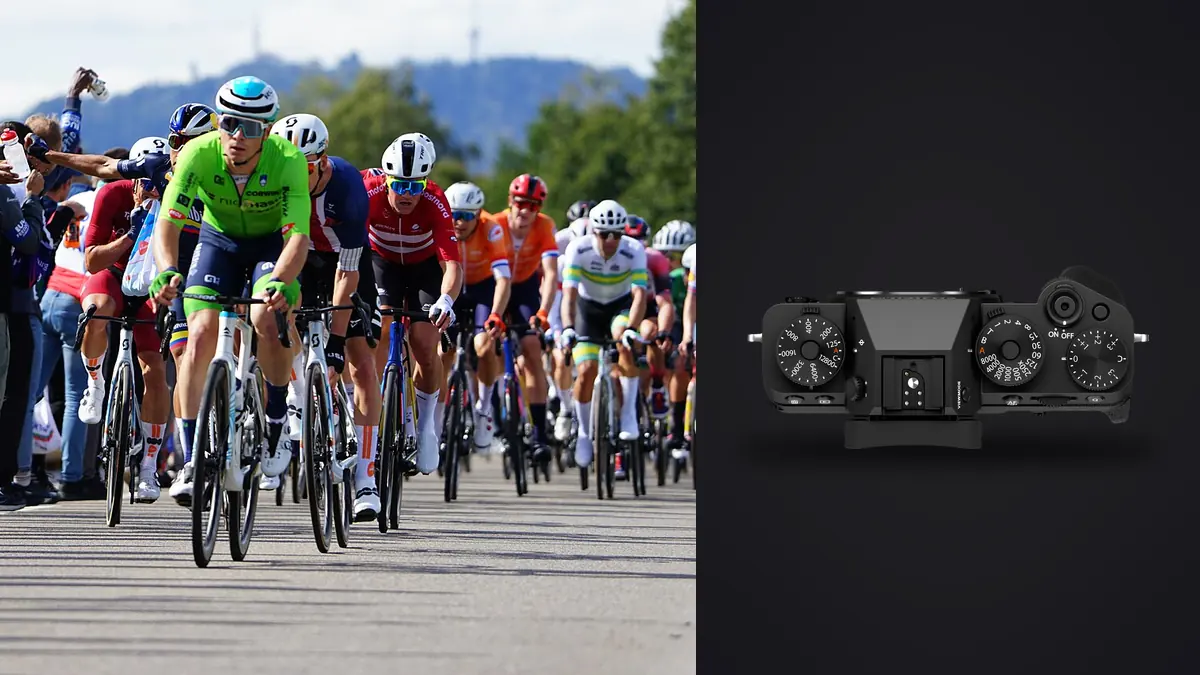
I shot my first track meet with a Fujifilm X-T5 because it was the camera I already owned, not because anyone recommended it for the job. Three seasons of high school and club meets later, I still use it, but I've made peace with what it is and isn't. It's a 40-megapixel stills camera with a very good sensor and a buffer that was clearly not the first thing Fuji's engineers were optimizing for. If you're weighing the X-T5 against something like an X-H2S or a used Nikon Z9 for track and field, this is the honest version of that conversation, not the marketing one.
The X-T5 was not built with sprinters in mind
Fuji built the X-H2S for speed. Stacked sensor, dual card slots including CFexpress Type B, 40fps electronic shutter with almost no rolling shutter penalty. The X-T5 shares the same body shape and control layout but under the hood it's a different animal: a 40MP non-stacked X-Trans HR sensor tuned for resolution and dynamic range, and only dual UHS-II SD slots, no CFexpress option at all. That single spec difference shapes almost everything else about shooting track with this camera.
The practical result is a sensor that reads out slower than a stacked chip, which means electronic shutter rolling shutter is real and visible once a subject is moving fast across the frame, which describes basically every event on a track except the discus circle. A 400m runner cutting through your frame at 20fps electronic can come out with a subtly skewed lean, verticals like lane lines bending slightly. It's not dramatic, but if you pixel-peep a panned shot of a sprinter's torso against a straight lane line, you'll see it.
None of this means the X-T5 can't do the job. It means you have to shoot around its weaknesses instead of assuming the camera will cover for you the way a stacked-sensor body might.
Autofocus: there's no "human" detection mode, and that matters
This trips up people coming from newer mirrorless systems. Fuji's subject detection AF on the X-T5 covers Animal, Bird, Car, Motorcycle & Bike, Airplane, and Train. There is no dedicated Human or Athlete detection mode the way Sony, Canon, and even some of Fuji's own X-H2 firmware paths eventually got. Face and Eye detection AF exists and works fine for portraits, but at 80-200 pixels of a runner's face from the infield, eye detection isn't reliably grabbing anything useful.
What actually works is Zone AF with a deliberately sized zone, paired with one of the AF-C custom settings tuned to how your subject moves. I run Set 3 (accelerating/decelerating subjects) for sprints and hurdles, and Set 4 (subject may momentarily leave the AF area) for pole vault and long jump, where the athlete's body angle changes fast and can briefly duck out of a fixed zone during takeoff. For relay handoffs I actually drop to single-point or a small zone and pre-focus on the exchange box, because two runners moving at different speeds through the same zone will confuse any tracking algorithm, Fuji's included.
Tracking sensitivity and speed tracking sensitivity are both worth dialing in per event rather than leaving on a generic middle setting. For sprints I push tracking sensitivity toward the "locked on" end so the AF doesn't jump to a competitor in an adjacent lane. For field events with more unpredictable motion (long jump especially) I back it off slightly so focus can re-acquire faster if it does drift.
Back-button focus is not optional here
If you're still using shutter-button AF for track, switch it now. Back-button focus lets you release the AF-C engine and refocus on demand between bursts, which matters a lot at a meet where you're often re-acquiring focus on a new heat every 90 seconds. It also lets you rack focus manually between the runway and the bar in high jump without the camera fighting you.
Mechanical or electronic: pick per event, not once for the whole meet
I used to leave the X-T5 on electronic shutter for everything because 20fps sounds better than 15fps on paper. I don't anymore. Mechanical shutter tops out at 15fps but has no rolling shutter distortion and no risk of banding under the metal-halide or LED lighting common in indoor facilities. Electronic shutter gets you the extra 5fps and total silence, useful if you're shooting close to the infield during a moment that calls for quiet, but you're trading image integrity for it on fast lateral motion.
My rule of thumb: mechanical for anything moving across my frame at speed (sprints, hurdles, relays, the runway phase of long jump and triple jump). Electronic for anything largely static or moving toward/away from the camera without much lateral speed (shot put, discus, high jump takeoff, pole vault plant). It's a small mental habit to build but it saves you from finding out in post that half your sprint sequence has a faint lean to it.
Matching camera settings to the event
Every event on a track and field card behaves differently enough that a single "sports mode" setting is a compromise everywhere. Here's roughly where I land for each, after enough meets of trial and error:
| Event | Shutter type | AF-C custom set | Shutter speed | Notes |
|---|---|---|---|---|
| 100m / 200m sprint | Mechanical, 15fps | Set 3 | 1/2000-1/2500 | Shoot from the side, not head-on, or rolling shutter risk goes up further |
| 400m / relays | Mechanical, 15fps | Set 3, single-point at handoff | 1/1600-1/2000 | Pre-focus the exchange zone, don't chase two runners with one zone |
| Hurdles | Mechanical, 15fps | Set 4 | 1/2000+ | Body angle changes fast over each barrier, wider zone helps |
| Long / triple jump | Mechanical on runway, electronic in the pit | Set 4 | 1/1600 runway, 1/1000 landing | Switch shutter mode mid-event, it's worth the fumble |
| High jump / pole vault | Electronic, 20fps | Set 5 or manual/back-button single | 1/1000-1/1250 | Mostly vertical motion, rolling shutter risk is low |
| Shot put / discus / javelin | Electronic, 20fps | Zone, standard | 1/1600-1/2000 | Watch the crop factor on electronic (1.29x) if you're already tight on a long lens |
That crop factor note matters more than it looks. Electronic shutter on the X-T5 at 20fps applies a 1.29x crop, which effectively turns a 300mm lens into roughly 390mm equivalent reach. Sometimes that's a gift when you're stuck behind a rope line at the far turn. Other times it means you're suddenly too tight and clipping limbs you had room for a second ago on mechanical shutter.
Glass that actually reaches the infield
Fuji's XF 70-300mm f/4-5.6 is the workhorse I'd point most people toward first. It's light enough to hand-hold for a full meet, has genuinely useful reach on APS-C (105-450mm full-frame equivalent), and its AF motor keeps up fine with Set 3 and Set 4 tracking. It's not a fast lens, so under the fluorescent haze of an indoor facility you'll be pushing ISO 3200-6400 more often than you'd like, but outdoors on a sunny afternoon it's plenty.
If budget and shoulder allow it, the XF 150-600mm changes what's shootable from a normal spectator position, particularly for field events happening on the far side of the infield like javelin or discus where you physically cannot get closer. It's noticeably heavier and slower to reposition between events, so I only bring it to meets where I know I'll be parked in one spot for a while, not ones where I'm bouncing between the track and four different field event stations.
For anyone shooting from the infield itself with credentialed access, a fast prime like the XF 90mm f/2 or even the 56mm f/1.2 gets you shallow, punchy frames for finish-line moments and medal presentations that a zoom just can't match stopped down.
Card choice and buffer reality
Because the X-T5 has no CFexpress slot, your buffer clearing speed lives and dies by your SD card. A cheap UHS-I card will bottleneck the camera badly, sometimes worse than the buffer number on the spec sheet suggests, because write speed can't keep pace with 15fps bursts of 40MP raw files. A proper UHS-II card rated V90 makes a real difference here, both in how many frames you get before slowdown and, more importantly, how fast the buffer drains so you're ready for the next heat instead of staring at a "busy" indicator while a race finishes without you.
In practice, shooting lossless compressed raw at 15fps mechanical, I get somewhere in the range of 20-25 frames before the buffer noticeably slows, which is roughly a second and a half of continuous shooting. That sounds thin next to a stacked-sensor body, but a 100m final only lasts 10-13 seconds anyway, and I'm not holding the shutter the whole time. I fire in shorter bursts around the start, mid-race stride, and the lean at the tape rather than holding down 15fps from gun to finish.
What a real meet day does to your card, and what happens after
A single afternoon of a club meet with six to eight events on my card easily produces 3,000 to 5,000 frames once you count every burst across every heat. That's the part nobody warns you about when they're only talking about camera settings. You come home from a meet with a card full of near-duplicate frames from the same three-second burst, and picking the one where the athlete's foot is planted and eyes are open takes longer than the meet itself if you're doing it by hand in a folder view.
This is where I stopped fighting my own workflow and started using imagic to sort the take before I ever open an editor. It runs entirely on my laptop, no upload queue, no waiting on a connection at a facility where wifi is either nonexistent or locked to event staff, which matters when you want to hand a coach a shortlist before you've even left the parking lot. It groups each burst automatically so the fifteen near-identical frames from one stride cycle sit together instead of scattered across a folder, and it scores focus sharpness locally so I can sort straight to the frame where the eyes or the extending leg is actually in focus rather than eyeballing a raw histogram at 1:1 zoom for twenty minutes per event.
The other piece I lean on is imagic's apply_my_style preset feature, which I trained on a season's worth of my own edited track photos rather than a generic sports preset pack. Track lighting swings wildly between a bright afternoon 100m and a shadowed indoor 800m under sodium-vapor lights, and having a starting point that already reflects how I personally handle skin tones and track surface color under those conditions saves a real chunk of time compared to building a look from scratch on every gallery. It's a starting point, not a final answer, but it gets me to "close enough to fine-tune" in one click instead of ten.
If you're trying to figure out where your own workflow is bleeding time on meet days, it's worth reading through how AI photo culling actually works before you assume the bottleneck is your camera and not your sorting process. A lot of the frustration people blame on the X-T5's buffer is really frustration with spending two hours after the meet clicking through duplicate frames one at a time.
A realistic bag for a meet
I don't bring everything I own to a track meet, because you're on your feet moving between the track and infield stations for three or four hours straight. My actual bag: the X-T5 body, the 70-300mm as the primary lens, a 16-55mm f/2.8 for wide shots of the start line and crowd context, two spare UHS-II V90 cards (128GB each, so a full one doesn't end my day), and one spare battery. Battery life on the X-T5 is decent for stills but 15fps bursts and constant AF-C tracking chew through it faster than casual shooting, and I've watched it die mid-final more than once when I got complacent.
A monopod is worth the annoyance of carrying it if you're running the 150-600mm for any stretch of the day. It's not strictly necessary with the 70-300mm, which is light enough to hand-hold for hours without your arm giving out, but the longer lens changes that calculation fast.
Frequently Asked Questions
Is the Fujifilm X-T5 fast enough for sprint finishes?
Yes, with caveats. 15fps mechanical shutter is enough to catch a clean lean at the tape if you time your burst to start a stride or two before the line rather than trying to react to the moment itself. What it won't do is give you the margin for error a 30fps or 40fps stacked-sensor body offers if your timing is off by half a second.
Should I shoot electronic shutter for the whole meet to get 20fps?
I'd avoid it for anything with strong lateral motion across your frame, meaning sprints, hurdles, and relays. The non-stacked sensor's rolling shutter shows up as a subtle lean or skew on fast-moving subjects at that shutter type. Save electronic shutter for events with more vertical or towards-camera motion, like pole vault, high jump, or the throwing events.
Does the X-T5 have eye tracking that works on runners?
It has Face/Eye detection AF, but there's no dedicated human or athlete subject-detection mode like the animal, bird, and vehicle modes Fuji added in later firmware. At typical track shooting distances a runner's face is too small in frame for eye detection to lock reliably, so Zone AF with a tuned AF-C custom set is the more dependable approach.
What card should I use to avoid buffer slowdowns?
A UHS-II SD card rated V90 is close to mandatory if you're shooting raw bursts at 15fps. The X-T5 has no CFexpress slot, so unlike the X-H2S, your card is the ceiling on buffer clearing speed, not just buffer depth. A slower card will bottleneck you worse than the camera's own spec sheet numbers suggest.