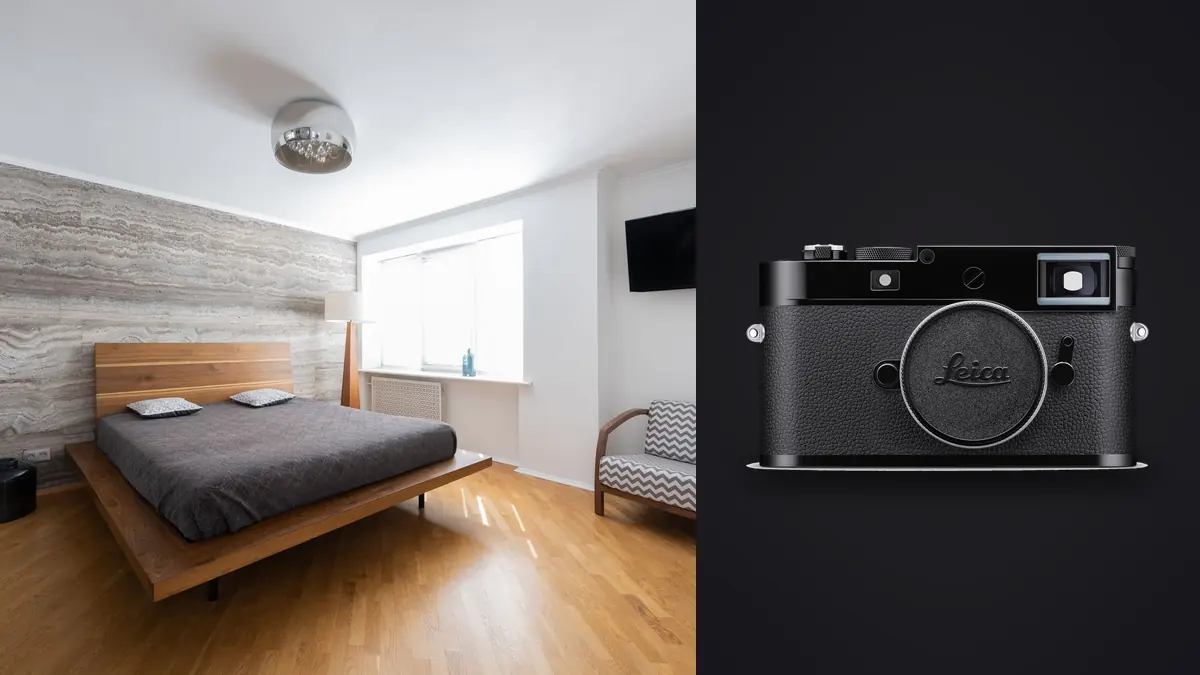
Picture bringing a Leica M11 into a boudoir session, and not for the file quality. A mirrorless kit could match it on paper. The reason is that the subject had done this once before with another photographer, using a full-frame body with a battery grip and a lens the size of a soup can, and she said flat out that the camera made her feel like she was being interviewed. That kind of comment sticks. Boudoir work lives or dies on whether the person in front of the lens can relax, and the M11 is, before anything else, a small, quiet, unintimidating object to have pointed at you in a bedroom.
A Rangefinder in a Bedroom Is a Different Kind of Tool
Most of what gets written about the M11 focuses on street and documentary work, which makes sense given the camera's lineage. But a lot of what makes it good for a stranger with a camera on a sidewalk also makes it good for an intimate portrait session in someone's home. There's no mirror slap, no viewfinder blackout, and the shutter on the M11 in its quietest mode is genuinely unobtrusive, closer to a soft click than the clack most DSLR shutters produce. In a small bedroom with soft light coming through a sheer curtain, that matters more than people expect. A loud shutter breaks the mood between frames. A quiet one lets the moment continue.
The body itself helps too. At roughly 640 grams with a lens attached, it's light enough to hold one-handed while you adjust a reflector or move a lamp with the other. And because you're composing through an optical rangefinder rather than an electronic viewfinder, you're not staring at a screen that shows the subject exactly how self-conscious they might feel in that moment. You're looking at the frame lines, guessing at focus by feel and practice, and glancing over the top of the camera at the actual person more often than you would with an EVF glued to your eye. Clients pick up on that. It reads as attention rather than surveillance.
What the Sensor Actually Buys You on Skin
The 60-megapixel BSI sensor in the M11 is capable, but the feature that actually matters for boudoir work day to day is Triple Resolution Technology, Leica's system for shooting natively at 60, 36, or 18 megapixels without cropping the frame. This isn't a downsampled JPEG option. Each mode reads the sensor differently at the pixel level, and the file size and noise characteristics change with it. For boudoir specifically, where a large share of usable frames get shot at ISO 800 to ISO 3200 in low, warm bedroom or hotel-room light, that choice matters more than it does for a studio session lit to ISO 100.
| Resolution mode | File size (DNG) | Best use in a boudoir session | Trade-off |
|---|---|---|---|
| 60 MP | ~80-90 MB | Hero images for print, tight crops on hands or fabric detail | Slower buffer clearing, heavier culling and editing load |
| 36 MP | ~50-55 MB | General coverage, most of a working session | Best balance of detail and file weight for delivery-sized galleries |
| 18 MP | ~20-25 MB | Available-light frames above ISO 3200, fast-moving sequences | Fine for web and social delivery, thin margin for heavy crops |
In practice the 36-megapixel mode suits most boudoir sessions, and 60 is only worth switching to when large prints are planned. The 18-megapixel mode earns its keep in dim, moody rooms where I'd rather have a cleaner low-noise file than another twenty megapixels of detail I'll never use. Skin rendering on the M11 leans warm and a touch less contrasty straight out of camera than what I get from my Sony bodies, which suits boudoir better than a punchier color profile would. Less midtone contrast means less obvious retouching later, especially around the collarbone and shoulder, areas that show harsh contrast quickly under directional light.
Glass That Actually Earns Its Keep in a Small Room
Boudoir sessions happen in bedrooms, not on soundstages, and bedrooms are small. A 200mm lens is useless when your back is against the wardrobe. The M-mount lineup is built for exactly this kind of constrained working distance, and three lenses cover almost everything I need.
| Lens | Approx. close focus | Character in this genre | When I reach for it |
|---|---|---|---|
| Summicron-M 35mm f/2 ASPH | 0.7m | Environmental, shows the room and the light, forgiving of small rangefinder focus error | Wide shots that include window light, sheets, the whole scene |
| Summilux-M 50mm f/1.4 ASPH | 0.7m | The workhorse. Natural perspective, creamy falloff at f/1.4, still holds detail wide open | Most of the session, especially half-length and three-quarter poses |
| APO-Summicron-M 75mm f/2 ASPH | ~0.9m | Compresses the background nicely, flattering for close portraits, less forgiving of a cramped room | Tight face and shoulder frames when there's enough space to back up |
The 75mm is the one people underestimate for boudoir. It's not a long lens by most standards, but in a bedroom that's four meters wide, backing up almost a full meter and a half to hit minimum focus with it means you're often shooting from the doorway. It's a beautiful lens optically, but I only bring it out for sessions in larger rooms or when I know I'll be working across a bigger suite. The 50mm does the bulk of the real work precisely because its close focus distance and field of view match what a bedroom actually gives you.
Manual Focus Wide Open Changes Your Whole Workflow
Here's the part nobody selling you on rangefinder romance wants to dwell on: shooting a Summilux at f/1.4 through an optical rangefinder, on a moving, breathing subject, at fairly close distances, produces a real miss rate. It's not a small one. On a session where I'm working close with the 50mm wide open, I'd estimate somewhere between a fifth and a third of frames land with focus slightly off the eye, sometimes onto a cheekbone or an earring instead. That's simply the physics of rangefinder coupling versus continuous autofocus tracking, and no amount of practice erases it entirely, though it does get better with reps.
What that means practically is that a boudoir shoot on the M11 produces a lot of near-duplicate frames of the same pose where only one or two are actually sharp where it counts. Going through those manually, frame by frame, zoomed in on the eye at 100 percent, is exactly the kind of task that eats an evening. This is where I lean on imagic to do the first pass. It scores focus and sharpness locally on the machine, so I can sort a take of forty near-identical frames from one pose down to the two or three that are genuinely sharp on the eye before I ever open a raw editor. It also clusters the repeated poses together, since a boudoir session naturally produces small bursts of similar frames as you and the client work through a setup, and untangling that by eye is tedious at 60 megapixels a frame.
Privacy Isn't a Nice-to-Have Here
I want to be direct about something that doesn't get discussed enough in gear reviews: boudoir clients are trusting you with images they would not want anywhere near the open internet, and that trust extends to your entire workflow, not just your final delivery. A lot of culling and editing tools now push everything through a cloud pipeline for AI-assisted sorting or syncing, and for most genres of photography that's a minor convenience trade-off. For boudoir it's a genuine liability. You should not want a client's raw files touching a server you don't control, even briefly, even with a vendor's privacy policy attached.
That's the specific reason imagic stays in my kit for this kind of work rather than some of the more heavily marketed AI culling tools. Everything runs locally, on the machine in front of me, with nothing uploaded during culling. For a genre where the whole premise is discretion, that's not a minor technical detail, it's close to a non-negotiable requirement, and it's worth checking before you commit any tool to a boudoir workflow. If you're comparing options for this specifically, it's worth reading through what photo culling actually involves before assuming every tool handles your files the same way.
Getting a Consistent Look Across the Gallery
The M11's color science out of camera is pleasant but not the final word, and most boudoir photographers I know, myself included, have a specific edit they reach for on skin: a warm, slightly lifted shadow, restrained clarity, and a consistent white balance shift regardless of what the actual light temperature was in the room. Getting forty or fifty images from a session to match that look one by one in Lightroom is slow, and slight inconsistencies between images are easy to miss individually but obvious once a client scrolls through the whole gallery.
I built out my own edit on a handful of representative frames and then used imagic's apply_my_style feature, which trains a preset off your own past edits rather than a generic filter, to carry that look across the rest of the take automatically. It's not perfect on every frame, particularly ones with unusual mixed lighting, but it gets the bulk of a session to a consistent starting point fast, and I only need to hand-correct the outliers instead of every single image. If color consistency across a delivered gallery is something you're still figuring out, the general principles in this guide to photo color grading apply directly to boudoir work even though it wasn't written with the genre in mind.
Where the M11 Genuinely Falls Short
I don't want to oversell this camera for a genre it wasn't designed around. There's no image stabilization in the body, so anything below roughly 1/60th of a second handheld with the 75mm gets risky unless your technique is solid. There's no autofocus at all, obviously, which means a client who moves unpredictably between poses, and some do, will cost you frames you'd have kept on a modern mirrorless body with eye tracking. Battery life is mediocre by 2026 standards, and I always carry two spares for a full session plus a quick change of location. And at this price point, a body alone runs well past what most working photographers would spend on an entire secondary kit, which makes it a hard recommendation unless the rangefinder shooting experience itself is something you actually want, not just a spec sheet you're chasing.
The rear screen review experience is also not great for showing a client their images on the spot, something that comes up constantly in boudoir work when a nervous client wants reassurance mid-session. The screen is fine for checking exposure and rough focus, but it's small and not particularly bright, so it helps to keep a tablet nearby for anything the client actually wants to look at closely between setups.
Frequently Asked Questions
Is the Leica M11's manual focus really workable for a moving subject in boudoir sessions?
Workable, yes, but it takes deliberate technique. Focus on a fixed point, like the edge of a pillow or a specific spot on the bed, and direct the subject to that spot rather than chasing focus as they move. Pre-focusing on a static reference and having the subject settle into it produces a far higher keeper rate than trying to track a moving person through the rangefinder patch in real time.
Do I need the 60-megapixel mode for boudoir prints, or is a lower resolution mode enough?
For standard print sizes up to around 16x20 inches, the 36-megapixel mode holds up fine and is noticeably easier to manage across a full session's worth of files. Reserve the full 60-megapixel mode for shots destined for large wall prints or heavy crops, since the extra resolution mostly pays off there rather than in a typical delivered gallery.
How does the M11 compare to a mirrorless body with autofocus for this kind of work?
A modern mirrorless body with reliable eye autofocus will get you a higher raw keeper rate with less effort, full stop. The M11's advantage isn't technical accuracy, it's the physical presence of the camera in the room and the discipline the manual workflow imposes on your shooting pace. Some photographers find that discipline produces more considered, less rapid-fire images. Others just find it slower. Neither answer is wrong, it depends on how you like to shoot.
What's the biggest workflow mistake photographers make bringing the M11 into boudoir work for the first time?
Shooting exactly like they would with an autofocus body, meaning a high volume of rapid frames per pose expecting the camera to sort out focus after the fact. That approach produces a huge take with a low hit rate and a painful cull. Slowing down, taking fewer, more deliberate frames per pose, and trusting the pre-focus technique produces a smaller, cleaner take that's actually faster to work through afterward.