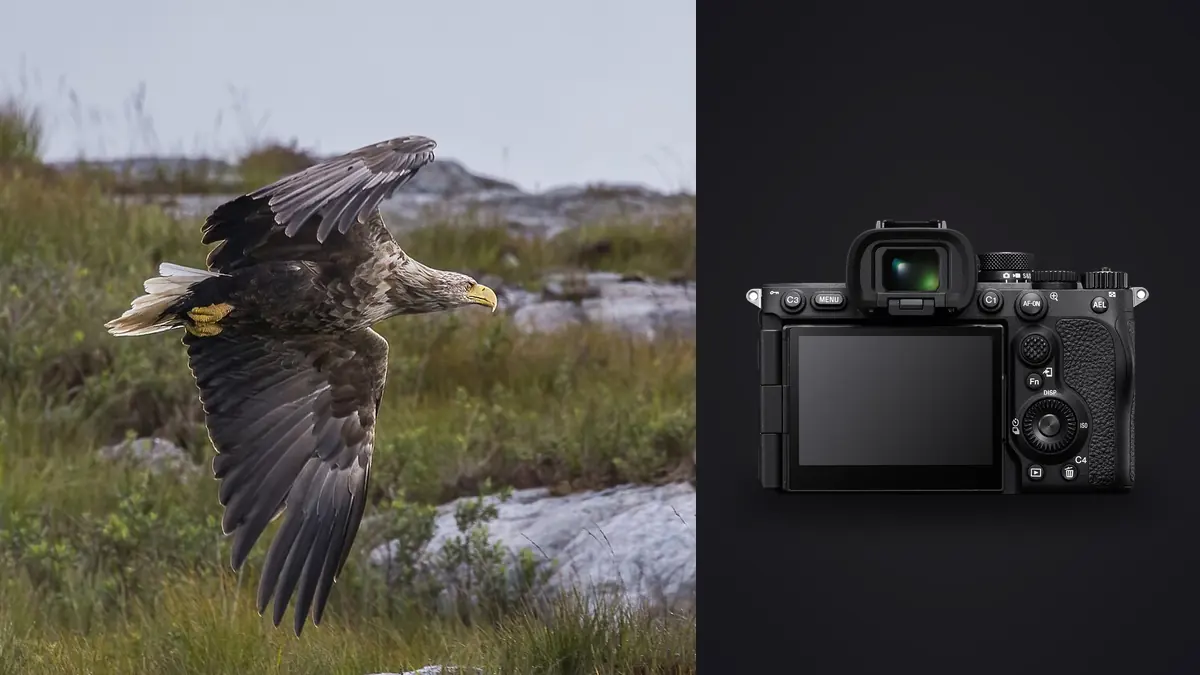
A 61-megapixel sensor and a bird crossing the frame at 40 miles an hour are not natural allies. The Sony A7R V asks you to reconcile the two anyway, and after a season and a half of pairing it with a 200-600mm lens on ospreys, terns and the occasional lucky peregrine stoop, I've landed on a working relationship with the camera rather than a simple verdict. It is not the fastest body Sony makes for birds in flight. It is, for a specific kind of shooter, the one that changes what "in flight" photography can even look like once you get home and start cropping.
Resolution as a Substitute for Reach
The honest starting point with the A7R V for birding is that its 10fps ceiling is not competitive with an A9 II or an A1 on paper, and it never will be. What the extra resolution buys you instead is cropping headroom that changes how you think about lens choice. A bird that fills a quarter of the frame at 600mm on a 24-megapixel body is still a usable 15-megapixel image after you crop it tight on the A7R V. That math matters more than it sounds like it should, because it means a 600mm lens starts behaving like something closer to 900mm at the editing stage, without a teleconverter's light loss or the extra AF hunting that comes with one.
This only works if the base file is sharp to begin with. Crop-happy resolution is unforgiving of soft glass, camera shake, or a focus point that landed on a wingtip instead of an eye, because all of those flaws get magnified along with the bird. I shoot noticeably more critically with this body than I did with my old A7 III for exactly this reason. A frame that would have passed as "good enough" uncropped now shows every flaw the moment you push in.
Worth saying plainly: the Pixel Shift Multi Shooting mode that gets so much attention in landscape and studio reviews of this camera is not a birding feature. It needs a static subject and a tripod across several exposures, so it never comes up on a day spent chasing anything with wings. It is one of the few headline specs on the sheet I have genuinely never used in two seasons of wildlife work with this body.
Autofocus in the Field
Sony built the A7R V around a dedicated AI processing unit, separate from the main image processor, and for birds specifically that shows up as a genuine improvement over the tracking on the A7R IV. The camera recognizes a bird's head and eye even when the body is angled away from you, which is the situation that used to cause older Sony bodies to lock onto a wing or a patch of contrasting feathers instead. Set to Bird in the subject recognition menu, it holds onto a tern diving at speed noticeably better than I expected going in.
Where it still struggles: small, fast, erratically moving birds against cluttered backgrounds. Swallows over water, warblers moving through branches, that kind of subject still causes hunting, and I have had more success switching to a wide Zone or Expand Flexible Spot and letting Real-time Tracking do the work rather than trusting subject recognition alone in dense clutter. AF sensitivity set toward the "locked on" end also helps here, since birds in flight tend to move in a fairly continuous arc rather than darting unpredictably, so you want the camera to stay committed rather than jump to a passing branch.
Shutter Mode Matters More Than People Expect
The A7R V's sensor is not stacked, and its readout speed shows up as rolling shutter distortion on fast-moving subjects when you shoot silently in electronic shutter mode. On a bird with fast wingbeats, that distortion looks like bent or wavy wing edges, especially near the top or bottom of a downstroke. I default to the mechanical shutter for anything with real wing motion and save electronic shutter for slower glides, soaring raptors, or situations where the shutter sound itself would flush the subject. It costs nothing in frame rate since both modes top out at 10fps on this body, so there is rarely a reason to accept the rolling shutter risk unless silence is the priority.
Buffer Depth and RAW Format Choices
At 61 megapixels, file size becomes a workflow decision, not just a storage line item. The format you shoot in directly determines how long a burst you can hold before the buffer forces you to wait, and for something like a hunting osprey where the actual strike lasts under two seconds, buffer depth decides whether you get the moment at all. These numbers are from my own testing with a fast CFexpress Type A card, not manufacturer specs, and they will vary with card and scene detail, but they hold up as a planning guide.
| RAW Format | Approx. File Size | Frames Before Buffer Slows (10fps) | Usable Burst Length |
|---|---|---|---|
| Uncompressed RAW | ~120MB | ~65-70 frames | under 7 seconds |
| Lossless Compressed RAW | ~65MB | ~85-95 frames | about 9 seconds |
| Compressed RAW | ~55MB | ~170-190 frames | about 17-18 seconds |
| JPEG Extra Fine only | ~25MB | 400+ frames | rarely the limiting factor |
For most birding sessions I shoot Compressed RAW rather than Lossless Compressed, which goes against the instinct to always shoot the highest-fidelity option. The difference in editing latitude is small enough that it rarely matters for a bird in flight shot at a reasonable ISO, and the extra buffer depth has saved sequences that Lossless Compressed would have choked on. Uncompressed RAW I reserve for static perched portraits where I want every bit of tonal information and know I am not chasing a fast-moving subject.
Lens Pairings and Effective Reach
The 200-600mm f/5.6-6.3 G OSS is the lens I reach for most often on this body, partly because its AF motor keeps pace with the A7R V's tracking without the added hunting that heavier teleconverter stacks introduce. Here is how a few common combinations have actually performed for me in the field, not as a spec sheet comparison but as a practical account of what stays usable for birds in flight versus what starts fighting you.
| Lens Setup | Effective Focal Length | Max Aperture | Field Notes |
|---|---|---|---|
| 200-600mm G OSS (native) | 600mm | f/6.3 | fastest, most reliable AF for erratic flight paths |
| 600mm F4 GM + 1.4x TC | 840mm | f/5.6 | AF stays quick in good light, my choice for distant shorebirds |
| 100-400mm GM II + 2.0x TC | 800mm | f/8 | usable only in bright sun, AF noticeably slower to commit |
| 70-200mm F2.8 GM II, APS-C crop | ~300mm equiv. (26MP) | f/2.8 | good for flight practice and close passes, not for distant subjects |
The 2.0x teleconverter combination is the one I use least for actual birds in flight, since the AF hesitation at f/8 becomes a real liability the moment a bird changes direction. It has its place for a stationary bird at extreme range, but I would not build a birding kit around it.
Weight, Balance and Battery Life on Long Days
Body alone, the A7R V is around 723 grams, which is light enough to matter after six or seven hours on a boardwalk waiting for a tide to turn. Paired with the 200-600mm, which is close to 2.1 kilograms on its own, the balance sits well enough for handheld shooting but I still bring a monopod for anything past a couple of hours, less to steady the shot and more to give my shoulder a rest between flurries of activity. The 4-axis multi-angle screen turns out to be more useful than I expected for low-angle shots of shorebirds without lying flat in wet sand, which is a small thing that ends up mattering a lot on a muddy estuary.
Battery life runs around 530 shots per charge under CIPA testing, but a birding day rarely resembles that rating. Long stretches of tracking a bird through the viewfinder without firing a frame, plus chimping through a 61-megapixel burst on the rear screen, both drain the battery faster than the number suggests. I carry two spares for a full day out and have run through all three on the longest sessions, particularly in cold weather where the drain accelerates.
From Card to Keeper Folder
Here is where the resolution and burst-shooting math catches up with you. A single afternoon chasing terns at a nesting colony can easily produce 15 to 20 gigabytes of Compressed RAW files, most of it near-duplicate frames from the same three-second burst as a bird banked through a turn. Scrolling that manually, at full resolution, on a laptop screen is exactly the kind of task that turns an enjoyable shoot into an evening you dread.
This is the part of the workflow where I actually use imagic rather than working through folders by hand. It runs its sharpness and focus scoring locally on the machine, so a folder of 61-megapixel files never has to leave the drive to get sorted, which matters when a single burst can be several gigabytes on its own. More usefully for birds in flight specifically, its duplicate and burst clustering groups those near-identical wingbeat sequences together automatically, so instead of comparing frame 214 against frame 215 by eye, I am comparing the best three or four frames from each cluster against each other. If you have not used a scoring-based culling tool before, how AI photo culling works covers the mechanics in more depth than I will here.
The sharpness scoring in particular earns its keep on this body, because at 61 megapixels the difference between a genuinely in-focus eye and a near-miss on the wing is often invisible at thumbnail size and completely obvious at 100 percent. Having that flagged automatically before I start reviewing, rather than discovering it three minutes into inspecting a frame I'd already mentally shortlisted, saves real time across a shoot this size. It also fits the rest of the day's math: if you are already thinking in terms of a faster overall photo workflow, the culling pass is usually the biggest single time sink for a burst-heavy genre like this one.
Color and Feather Detail in the Edit
Backlit wings and water reflections are where a lot of bird photography either sings or falls apart in post. I settled on a fairly restrained color treatment for flight shots, pulled highlights down enough to hold detail in white feathers without flattening them, warmed shadows slightly to counter the blue cast off open water. Once I had that look dialed in across a set of edited images, I used imagic's apply_my_style feature, which trains on your own previously edited photos rather than a generic preset, to carry that same treatment across a new batch of osprey shots from a different session without redoing the color work frame by frame. It is not a substitute for judgment on outlier frames, backlighting varies too much for that, but for the bulk of a consistent shoot it holds up well.
Frequently Asked Questions
Is the Sony A7R V fast enough for birds in flight compared to the A9 II or A1?
For sheer frame rate, no, both of those bodies shoot meaningfully faster and read their sensors quicker, which matters for rolling shutter on fast wingbeats. Where the A7R V pulls ahead is resolution for distant or small subjects, since the extra megapixels give you cropping room those bodies cannot match. If your birding is mostly close, fast action like raptors on the hunt, the A9 II or A1 will frustrate you less. If it is mostly distant shorebirds and songbirds where you are cropping heavily anyway, the A7R V's files hold up better after the crop.
Should I shoot mechanical or electronic shutter for birds in flight on the A7R V?
Mechanical, for anything with visible wing motion. The sensor's readout speed is slow enough that electronic shutter introduces rolling shutter distortion on fast wingbeats, and since both modes cap out at 10fps on this body, there is no frame rate penalty for choosing mechanical. Save electronic shutter for slow soaring subjects or situations where shutter noise would disturb the bird.
Does the A7R V's bird eye AF actually track small, fast birds like swallows?
It does reasonably well against a clean background but struggles more with small, erratic subjects against clutter, branches, reeds, water texture, than it does with larger birds against open sky. In those cluttered situations I get better results switching from subject recognition to a tighter Zone or Expand Flexible Spot with Real-time Tracking rather than relying on bird detection alone.
What memory card avoids buffer clogs when shooting bursts of birds in flight?
A fast CFexpress Type A card is worth the cost difference over SD UHS-II if you shoot bursts regularly. The write speed difference determines how quickly the buffer clears between bursts, not just how deep it is, and on a body producing 55 to 120MB RAW files per frame, a slow card turns a brief pause into a genuinely missed sequence while you wait for the buffer counter to drop.
None of this solves the part that happens after the card comes out of the camera, which for a 61-megapixel body shooting all-day bursts is genuinely the bigger time cost of the two. I lean on imagic for that stage on multi-day trips precisely because it processes everything on the machine itself, nothing gets uploaded anywhere, which matters when a single day's take can run past 20 gigabytes and a hotel room's upload speed is not something I want to depend on halfway through a birding trip.