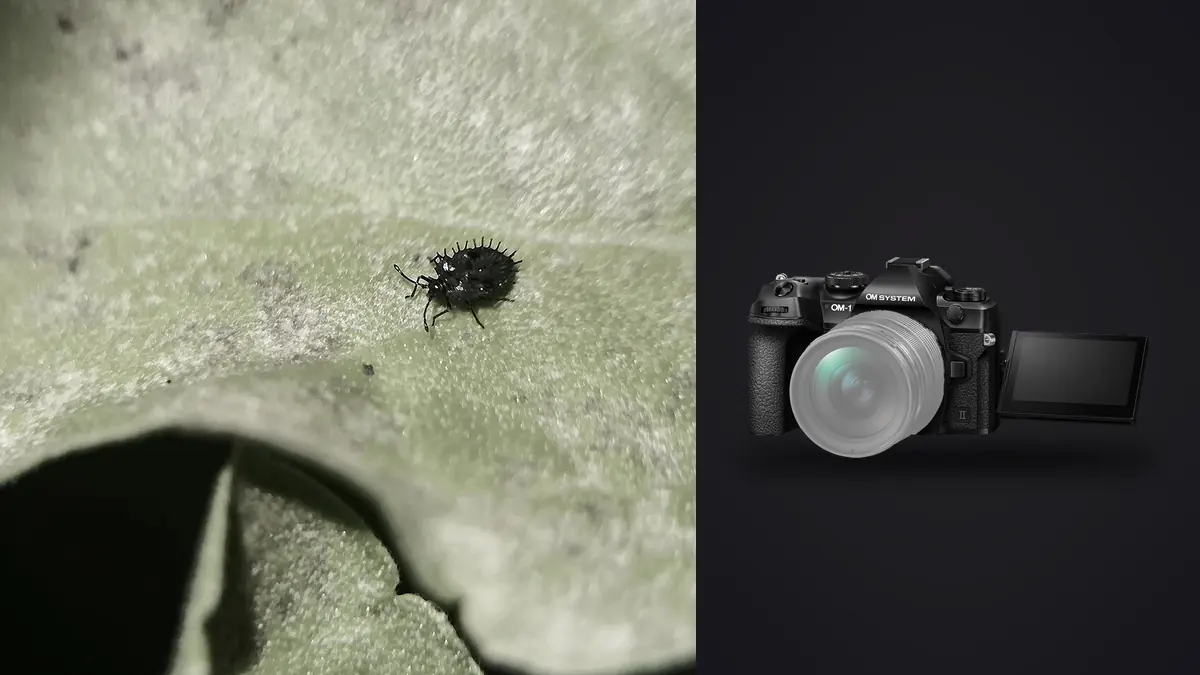
Insects do not cooperate. They fly off when your shadow crosses them, they groom themselves the instant you achieve focus, and half the interesting ones are active at dawn when the light under a hedge is barely enough to meter. I have spent three summers running the OM System OM-1 Mark II specifically for this kind of work, mostly dragonflies at a reservoir near where I live and jumping spiders in the compost heap, and it has changed how I think about what a camera body actually needs to do for macro rather than what the spec sheet promises.
This is not a spec dump. It is a rundown of the parts of this camera that actually matter when your subject is eight millimeters long and unwilling to hold still, and the parts that get marketed hard but end up being situational at best.
Why the Small Sensor Is Not the Handicap People Assume
The OM-1 Mark II keeps the same 20.4-megapixel stacked BSI sensor as the original OM-1, and macro shooters coming from full-frame systems tend to assume that a Four Thirds sensor is a compromise here. In practice, for close-up work it is closer to an advantage. Depth of field at high magnification is punishingly shallow regardless of sensor size once you are working at or near 1:1, and the smaller sensor means you reach a given angle of view at a shorter actual focal length, which in turn means more usable depth of field at the same aperture compared to a full-frame body shooting the equivalent framing. Put a 60mm macro lens on this body and you get roughly a 120mm full-frame field of view, but the depth of field behaves like a 60mm lens, not a 120mm one. When you are trying to keep a beetle's eyes and the leading edge of its wing case both in focus at f/8, that difference is not academic.
The tradeoff is diffraction. Because the individual photosites are smaller than on an APS-C or full-frame sensor of similar resolution, you start seeing softening from diffraction earlier as you stop down. On this body I treat f/8 as the practical ceiling for a single exposure and rarely go past f/11 even when I want more depth, because by then the resolution loss outweighs the depth of field gain. That is one of the reasons in-camera focus stacking matters so much more here than it would on a body where you could just stop down to f/16 without penalty, which I will get to.
The Autofocus Reality: No Insect-Specific Detection
OM System's AI subject detection covers birds, human faces and eyes, several vehicle categories, dogs and cats. It does not have a dedicated insect mode, and I want to say that plainly because it gets glossed over in a lot of coverage of this camera. If you switch the subject detection setting to Bird and point it at a dragonfly, sometimes it tracks reasonably well because dragonflies have a somewhat bird-like silhouette in flight, but it is not reliable and I would not build a technique around it.
What actually works is going back to basics: a small, single AF point (I run the smallest target size available) placed manually over the compound eye, back-button focus so the shutter release does not re-trigger a hunt, and the focus limiter switch on the 90mm PRO lens set to restrict the range near your working distance so the lens is not racing through its entire focus throw every time you half-press. It is more deliberate and slower than tracking autofocus, but it is also more accurate for a subject the size of an insect eye. The continuous AF tracking on this body is genuinely strong for birds and mammals, and the Mark II's refined subject-recognition algorithm noticeably reduced the false-positive locks that used to plague the original OM-1 in cluttered foliage, but none of that specifically helps you nail focus on a jumping spider's front eyes. That part is still on you.
Pro Capture for the Ones That Will Not Sit Still
Where the camera earns its keep is Pro Capture. Dragonflies taking off from a reed, a bee backing out of a flower, a mantis striking, these all happen faster than human reaction time, and Pro Capture buffers frames continuously from the moment you half-press so that when you fully press the shutter, the camera has already captured the half-second before you reacted. SH2 mode gets you up to 120 frames per second with focus and exposure locked from the first frame, which is enormous for a subject in flight but only useful if the insect is staying in roughly the same focal plane. SH1 mode caps out lower, around 50fps in my experience, but keeps continuous autofocus running, which is the mode I actually use for anything more erratic than a straight flight path.
The catch nobody mentions in the marketing copy is what this does to your card and your editing time. A three-second Pro Capture burst at 120fps is 360 frames of nearly identical wing positions, and doing that a dozen times in a morning session leaves you with several thousand frames to sort through for the one where the wings are in the right place and the eyes are sharp. This is genuinely where I lean on imagic now. It clusters near-duplicate burst frames together and runs a local sharpness score across them, so instead of scrubbing through 360 frames by eye I can jump straight to the handful the software flagged as sharpest on the subject, and everything runs on my own laptop with no upload step, which matters when I am doing this from a tent with no signal.
In-Camera Focus Stacking, and When It Actually Helps
The OM-1 Mark II can shoot a focus bracket of up to 999 frames and, with a compatible lens like the 60mm f/2.8 Macro or the 90mm f/3.5 Macro IS PRO, combine up to 15 of those frames into a single stacked JPEG in-camera. I use this constantly for stationary subjects: dew-covered orb weavers at first light, a moth that has settled for the night, a mantis egg case. It is close to useless for a live insect that is actively moving, because focus stacking needs the subject to hold still across the whole bracket sequence, and even a slight breeze moving a leaf between frames introduces ghosting at the stack edges. My actual workflow is to shoot the bracket in raw rather than trust the in-camera JPEG composite, because the in-camera engine sometimes leaves a visible seam around fine structures like antennae or leg hairs. I bring the raw sequence home and stack it manually in dedicated stacking software, which gives me control over the blending radius. But the bracket itself, the actual mechanics of stepping focus by a controlled amount between frames, is something the camera does far better and more consistently than I could manage racking focus by hand. That part alone is worth the feature.
Stabilization at High Magnification
In-body stabilization rated up to 8.5 stops with Sync IS on a compatible PRO lens sounds abstract until you are handholding at 2x magnification, where even breathing shows up as frame-filling movement. In practice I get usable stabilization for framing and for video-assisted focus checking, but at true macro magnifications I still do not trust IS alone to give me a sharp handheld still at anything under 1/125s, because stabilization corrects camera shake, not subject sway from wind, and it does nothing for the fact that at 2x magnification your own depth of field is measured in millimeters. What it actually buys me is a steadier live view while I am hunting for focus by rocking slightly forward and back, which used to be a much shakier process on my older gear.
For anything truly static, a small macro rail on a low tripod still beats handholding, IS or not. I only shoot handheld when the subject is mobile enough that setting up a tripod would mean losing it entirely.
Dawn, Dew, and the IP53 Rating
Most of the best insect activity happens in the first two hours after sunrise, when nocturnal-feeding species are still sluggish from the cold and dew has pinned moths and spiders in place long enough to actually compose a shot. That also means shooting in genuinely wet conditions most mornings, kneeling in soaked grass with condensation on every surface. The OM-1 Mark II's IP53 splash and dust resistance rating has held up fine through two full summers of this treatment for me, including one session where I dropped the body into damp leaf litter reaching for a subject. I would not submerge it, and I still wipe it down and let it dry properly afterward, but I have not babied it and it has not let me down.
Lens Choice Actually Matters More Than the Body
Whichever camera you land on, the macro lens does most of the work for insect photography, and OM System's three current options land at genuinely different points on the working-distance and magnification spectrum.
| Lens | Max Magnification | Approx. Working Distance | Weight | In-Camera Stacking | Street Price (approx.) |
|---|---|---|---|---|---|
| M.Zuiko 30mm f/3.5 Macro | 1.25x | ~4cm | 128g | Yes | $300 |
| M.Zuiko 60mm f/2.8 Macro | 1:1 (1x) | ~19cm | 185g | Yes | $500 |
| M.Zuiko 90mm f/3.5 Macro IS PRO | 2x (4x with 2x teleconverter) | ~15-25cm | 453g | Yes | $1,300 |
The 30mm is cheap and sharp but the working distance is so short you will spook anything with a nervous system before you get the shot, and your own shadow becomes a problem. I use it mostly for flowers and static subjects. The 60mm is the honest workhorse: enough working distance to approach most insects without startling them, light enough to handhold all day, and the one I would tell someone starting out to buy first. The 90mm PRO is the one that actually changes what subjects are accessible, because 2x native magnification with a real working distance means you can photograph something the size of a gnat and still be far enough away that it does not register you as a threat. It is also the only one of the three with built-in optical stabilization that pairs with the body's Sync IS for the full 8.5-stop figure. It is expensive and heavier than the other two, and I only reach for it when the 60mm genuinely will not get close enough.
Flash and the Light Problem
Under a shaded hedge at f/8 you are often at shutter speeds too slow for handheld work even with stabilization, and this is where dedicated macro flash earns its cost. I run the STF-8 twin flash system on the 90mm PRO for anything requiring real depth of field, with both flash heads set to unequal output so the shadow side of the insect does not go completely black, which is the single most common failure I see in beginner macro flash work: even, flat lighting from symmetric flash output that kills all dimensionality. Natural light with a small reflector still wins for texture and mood when the subject allows a slower approach, but it is not viable for anything skittish or for anything shot in the first hour after sunrise when ambient light is simply too low.
Where the Editing Workflow Fits
A single productive morning of insect macro with this camera routinely produces two or three thousand frames once you count Pro Capture bursts and focus brackets, and almost none of that volume is intentional overshooting, it is just what the tools require to get one or two usable frames per subject. I stopped trying to cull that manually a while back. I run everything through imagic first, which handles the duplicate and burst clustering from Pro Capture sequences and gives each frame a local sharpness score based on the actual focus point rather than a global blur estimate, so it does not penalize a frame just because the background is soft, which is the whole point of a macro shot. Because it processes everything on the machine itself rather than through a cloud upload, I can run the cull in the field on a laptop the same evening, before I have any signal to speak of. Once I have the shortlist, I built an apply_my_style preset trained on my own previously edited macro images, which gets color and contrast into the right neighborhood before I do the manual selective work stacking software cannot touch, like cleaning up a distracting stem or dialing back a hot spot from the flash. If you are trying to speed up a similarly bloated raw folder, our breakdown of how AI photo culling actually works covers the sharpness-scoring approach in more detail, and the faster workflow tips piece has some habits that transfer well beyond macro specifically.
Frequently Asked Questions
Does the OM-1 Mark II's autofocus recognize insects the way it recognizes birds?
No. The subject detection modes cover birds, humans, several vehicle types, and dogs and cats, but there is no insect-specific recognition mode. For bugs you are better served by a small manual AF point placed directly over the eyes than by relying on any of the AI detection presets.
Is 20 megapixels enough resolution for cropping into small subjects?
It is workable but not generous. Because the sensor is Four Thirds, a given crop percentage costs you more absolute pixels than it would on a higher-resolution full-frame body, so I try to get magnification right in-camera with the lens rather than planning to crop in later. The handheld high-resolution mode (50MP handheld, 80MP on a tripod) helps for static subjects where you have time to compose precisely, but it is not usable for a moving insect since the sensor-shift capture takes multiple exposures over roughly a second.
Should I buy the 90mm PRO macro or is the 60mm enough to start?
If you are new to insect macro, start with the 60mm. It is lighter, cheaper, and the working distance is forgiving enough to learn approach technique without immediately spending PRO-lens money. Move to the 90mm once you find yourself specifically wanting to photograph smaller, more easily startled subjects like jumping spiders or small native bees where the extra working distance and 2x magnification actually change what is reachable.
Does in-camera focus stacking work for live insects?
Rarely. Focus stacking depends on the subject holding still across the entire bracket sequence, and even minor movement between frames, like an antenna twitching or a breeze moving the perch, introduces visible ghosting at the stack boundaries. It is genuinely useful for dew-covered or torpid subjects at dawn, and for anything that has already died or settled for the night, but treat it as a static-subject tool rather than a general insect solution.