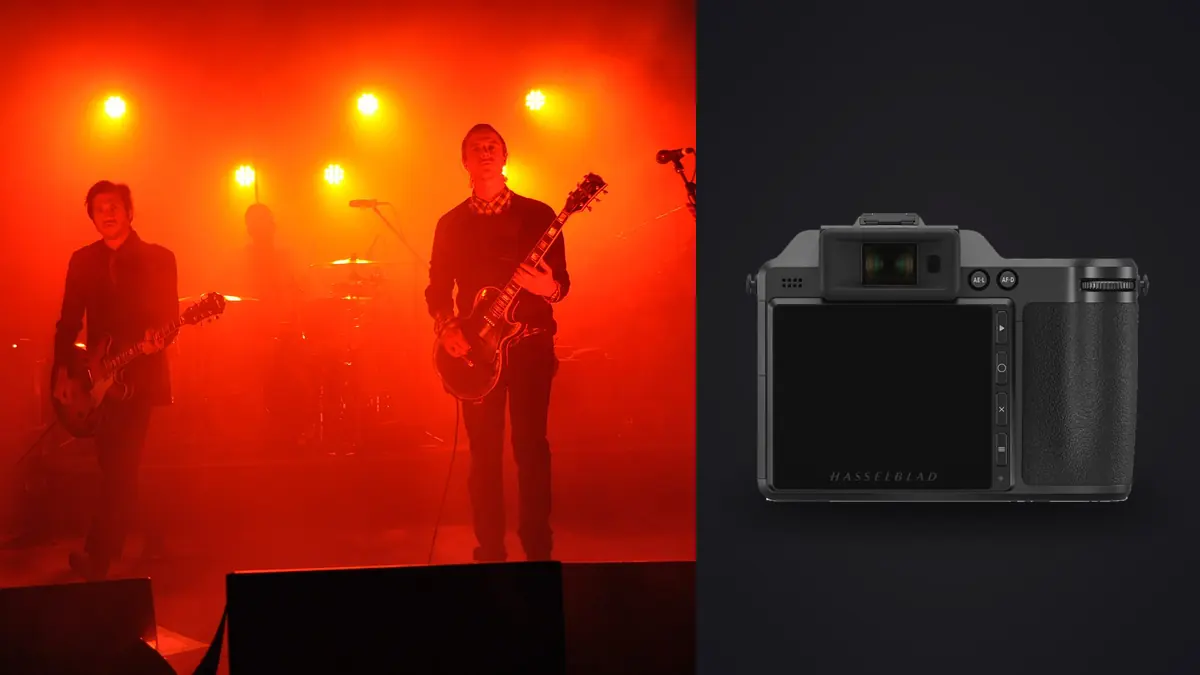
A tour manager once handed me a laminate that said "PHOTO PIT: FIRST THREE SONGS, NO FLASH" and I was standing there with a Hasselblad X2D 100C hanging off my shoulder instead of the usual Nikon Z9. Everyone around me had fast mirrorless bodies with 20fps bursts and eye-tracking autofocus locked onto the singer's face. I had a 100 megapixel medium format camera with a top continuous rate that barely clears three frames a second. It was, by any sane pit-shooting standard, the wrong tool. It also produced the best single frame I took that whole tour: a wide shot of the singer backlit by a single amber wash, every strand of hair and every fold of the jacket resolved in a way none of my other cameras could touch.
That contradiction is basically the whole story of using the X2D 100C for live music work, and it's worth unpacking properly rather than just saying "medium format isn't for concerts" and moving on, because that's not quite true either.
Why a medium format body even shows up in a photo pit
Nobody is buying an X2D 100C as their primary concert camera. It's a studio and landscape tool that some working photographers, myself included, started sneaking into pit rotations for specific songs or specific artists where the lighting is calm enough to actually use it. The appeal isn't speed, it's the sensor: a 100MP, 44x33mm chip with 16-bit color depth that pulls detail and tonal separation out of stage lighting that would turn a full-frame file muddy at the same exposure. Arena rigs throw brutal contrast, a performer lit hot on one side and falling into near-black on the other, and the X2D's dynamic range holds both ends without the crushed blacks or blown highlights I get from my Z9 at the same settings. The other reason it shows up: some tour photographers are hired for something closer to portraiture than photojournalism. If your job is one killer frame per show for the artist's socials or a tour book, rather than a full take covering every song, frame rate stops mattering nearly as much as it does for a wire photographer filing five images before the encore.
What the sensor actually buys you on stage
Dynamic range under mismatched stage lighting
Concert lighting rigs almost never expose evenly across a performer's face and body, especially with modern LED walls throwing colored spill from behind while a single key light hits from the front. On the X2D I can recover shadow detail from roughly three stops under without the color noise that shows up on smaller sensors at the same push. That matters because a lot of the moodiest, most usable frames from a show come from exactly that kind of lighting, a performer half in silhouette, and those are the frames where a lesser sensor falls apart in post.
Color separation under saturated gels
Deep red and magenta gels are the bane of digital cameras generally. Most sensors clip red channel detail and everything turns into a flat, noisy blob. The X2D's color depth keeps skin tone gradation visible even under heavy red wash, which is the difference between a usable frame and one you quietly delete. I've had shows where every other camera in the pit came back with unusable red-channel mush and the Hasselblad files still had recoverable detail.
Where it genuinely falls apart
I won't pretend this is a secret weapon nobody else has figured out. There are specific, real reasons working concert photographers don't carry this as a primary body, and I ran into every one of them.
| Concert-relevant factor | Hasselblad X2D 100C | Sony A9 III | Nikon Z9 | Canon EOS R6 Mark II |
|---|---|---|---|---|
| Continuous shooting | ~3.3 fps mechanical-free electronic | up to 120 fps global shutter | 20 fps RAW, up to 30 fps JPEG | 12 fps mechanical, 40 fps electronic |
| Usable high ISO ceiling for a dark venue | ISO 3200 to 6400 comfortably | 25600 with clean detail | 12800 to 25600 | 12800 |
| AF tracking of a moving performer under strobes | Hunts noticeably, best treated as single-point | Locks and holds through most flicker | Very strong, holds through backlighting | Reliable but occasionally drops in near-black |
| RAW file size per shot | roughly 100 to 220MB (3FR) | ~25MB compressed RAW | ~25 to 50MB depending on mode | ~25MB |
| Body + typical lens weight | around 1.9 to 2.3kg with an XCD prime | ~1.4kg with a 24-70 f/2.8 | ~1.6kg with a 24-70 f/2.8 | ~1.2kg with a 24-105 f/4 |
| Realistic pit role | one or two hero frames per song, static or slow-moving subjects | full-take primary body, fast action | full-take primary body, fast action | secondary or budget-conscious primary body |
The autofocus is the part that trips people up the most. It's genuinely good in still or slow-moving light, portrait sessions, product work, landscapes. Point it at a singer who's pacing the stage under a strobing follow-spot and it hunts, sometimes visibly, sometimes just enough that you get a soft frame you don't notice until you're back at the laptop at 2am. I've learned to treat it almost like a manual-focus camera with assistance rather than something I trust to track a moving face through a chorus.
Then there's the three-song rule, which is standard at almost every touring show with major-label acts. You get the first three songs, no flash, then you're out of the pit for the rest of the set. A camera that shoots 3.3 fps and occasionally needs a half second to lock focus is not well suited to squeezing maximum coverage out of nine minutes of stage time. I've missed frames on the X2D that I would have nailed without thinking twice on a Z9, simply because the buffer or the AF needed a beat longer than the moment allowed.
Weight is the other honest complaint. An X2D with an XCD 38V or 80mm hanging around your neck for three songs of aggressive shoulder-pushing in a photo pit is noticeably more fatiguing than a mirrorless body with a fast zoom, and if you're also carrying a second camera as backup (which you should be, always), the combined load adds up fast over a multi-night run.
The lens question
Hasselblad's XCD lineup is not built for concert speed. Most of the lineup sits at f/3.2 to f/4.5, with only a handful of faster options. The 38V (roughly a 30mm full-frame equivalent) at f/2.5 and the 80mm at f/1.9 are the two I actually reach for in a pit, because they're fast enough to keep shutter speeds workable without pushing ISO into territory where the sensor starts losing its advantage over smaller-format bodies. The 55V is a nice middle ground for half-body performer shots from a moderate pit distance, but past 100mm the lens options get slow and the system stops making sense for anything requiring reach, which rules out most festival stages where you're shooting from thirty feet back.
A workflow that actually makes this usable
The way I've made this work isn't by replacing my normal kit, it's by running the X2D as a third camera dedicated to a handful of specific shots: the opening wide frame before the lights fully come up, one or two portraits during a slower song where the performer holds still at a mic stand, and crowd or venue establishing shots between sets when nobody's paying attention to frame rate. Everything fast, everything requiring tracking, still goes to the Z9. That still leaves a real problem: coming home from a three-night run with a mixed card of 100MP medium format files and full-frame files from two other bodies, all needing to get culled fast before an early-morning deadline. This is where I lean on imagic. Because it scores sharpness locally on the actual files rather than relying on embedded JPEG previews, it catches the AF-hunt softness on X2D frames that looks fine at thumbnail size but falls apart at 100% (which matters a lot more on a 100MP file than it does at 24MP, since soft frames are far less forgiving when you're printing or cropping in tight). It also clusters near-duplicate frames from the slower burst sequences, which matters because with a 3.3fps camera you end up firing repeated near-identical exposures trying to catch a specific expression, and sorting through those by eye at full 100MP resolution is slow enough to eat an entire evening. If you've never had to think about how AI photo culling actually decides what's sharp versus soft, a mixed-format night like this is exactly where the difference between eyeballing thumbnails and scoring actual pixel data becomes obvious. The other piece that's saved me time on hybrid-kit nights like these is imagic's apply_my_style preset. Stage lighting swings wildly between an amber-heavy opener and a cold blue-white encore, and having a preset trained on my own past edits (rather than a generic film-look LUT) means the X2D files and the Z9 files land in a consistent tonal place without me manually matching them shot by shot at midnight. Everything in imagic runs locally too, no cloud upload, which matters more than people expect on tour photography specifically, since a lot of artist teams have strict rules about unreleased images never touching a server they don't control before approval goes out.
When I'd actually tell someone to bring it
Seated venues and theaters with controlled, relatively static lighting are the best case. Jazz clubs, acoustic sets, orchestral pit work, anything where the performer isn't sprinting across a stage under chaotic strobes. Corporate and private event gigs with live music as a background element rather than the main event also suit it well, since you have more control over positioning and more time per shot. Arena tours with pyrotechnics and a lead singer doing laps of the stage are the worst case, and I'd never suggest anyone show up to one of those with only medium format in the bag. If you already own an X2D for other paid work (portrait or product photography, say) and you're occasionally asked to cover a lower-tempo live set, bringing it as a second or third body for specific frames is genuinely worth it. Buying one purely to shoot concerts would be an expensive mistake for almost everyone. One habit worth stealing regardless of which camera you shoot: don't wait until you're home to think about your cull. Deciding in the pit which of the three songs you're actually going to work hardest for, and which body you're reaching for on each one, saves you from the worst version of this problem, a laptop full of 100MP files at 1am with a delivery deadline in six hours. A few of the general habits in our faster photo workflow piece apply just as well to a hybrid medium-format kit as they do to a standard two-body setup, even though none of it was written with the X2D specifically in mind.
Frequently Asked Questions
Can the Hasselblad X2D 100C keep up with fast stage lighting changes and strobes?
Not reliably. The autofocus system is tuned for accuracy over speed, and rapid strobing or flicker-heavy LED rigs will cause visible hunting more often than a phase-detect system built for sports and action, like what you'd find in the Z9 or A9 III. Static or slow-moving subjects under continuous lighting are where it performs closest to its full-frame competitors.
Is 100 megapixels overkill for live music photography?
For most delivery use cases (web galleries, social media, tour books at normal print sizes) yes, it's more resolution than the output needs. Where it earns its keep is heavy cropping, large-format prints for merchandise or venue displays, and situations where you genuinely can't get physically closer to the stage and need to crop in significantly after the fact.
What ISO range is realistic for the X2D 100C in a dark venue?
I stay comfortable up to about ISO 3200, usable but noticeably softer in fine detail up to 6400, and treat anything past that as an emergency setting rather than something I'd deliver without heavy noise work. That's meaningfully more conservative than a stacked-sensor body like the A9 III, which stays clean well past 12800.
Does file size become a real problem shooting a full show on the X2D?
Yes, faster than people expect. A 3FR raw file typically lands between 100 and 220MB depending on compression settings, so even a modest 200-frame take from a show can push toward 30 to 40GB of storage before you've touched a single edit. Culling fast matters even more here than with a typical full-frame kit, since every unnecessary frame you keep costs disproportionately more drive space and backup time.