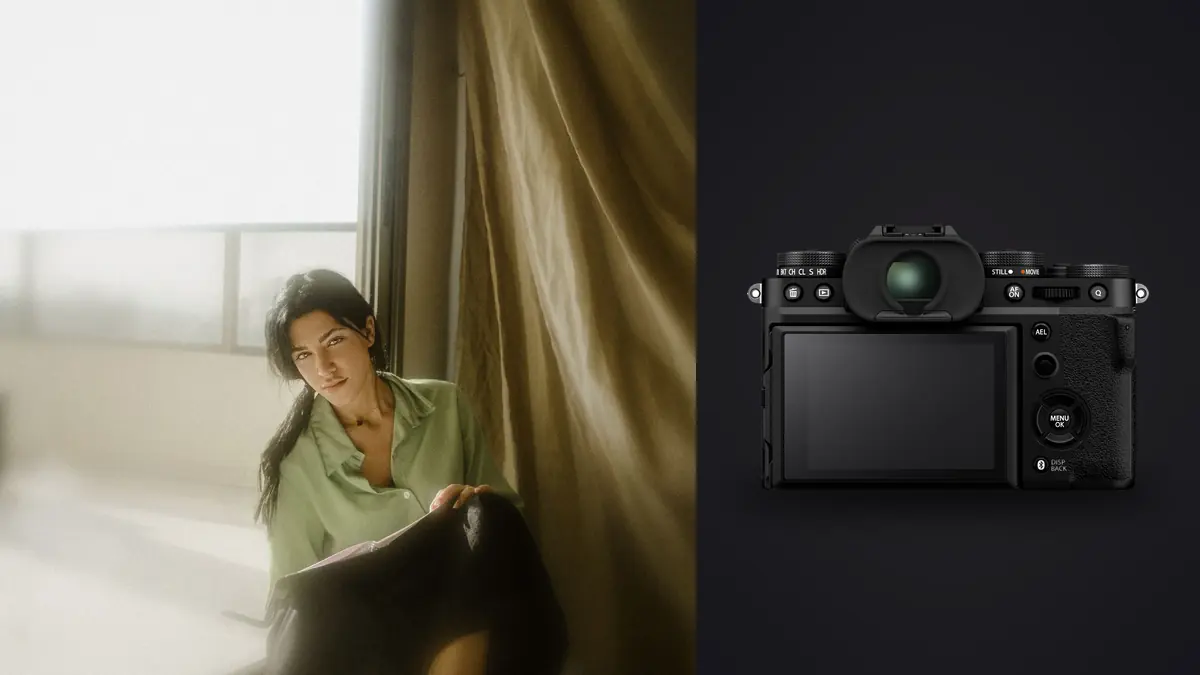
My first boudoir session with the X-T5 was in a rented Airbnb with terrible overhead lighting and one decent window facing north. I'd been shooting the genre for about four years by then, mostly on a full-frame DSLR that made the subject visibly tense every time I raised it to my eye. The switch to the X-T5 wasn't really about pixels or dynamic range charts. It was about the subject relaxing enough to give me a real expression instead of a held-breath one. That's the part nobody puts in a spec sheet, and it's the part that actually matters in this kind of work.
This isn't a camera built specifically for boudoir. Fujifilm designed it as a general-purpose stills body with video capability tacked on as a concession to the market. But a handful of its design choices happen to line up unusually well with what intimate portraiture actually demands: quiet, small, fast to focus in low light, and forgiving of the fact that you're often shooting handheld at f/1.2 in a bedroom with one lamp on.
The body itself changes how the session feels
At 557g body-only, the X-T5 is roughly half the weight of the DSLR bodies most boudoir photographers cut their teeth on. Paired with something like the XF 33mm f/1.4, the whole rig sits under a kilogram. That matters less for your arms and more for the subject's nervous system. A smaller camera reads as less clinical, less like a medical exam, more like someone's friend with a nice camera. A subject might well say almost exactly that in a post-shoot message, unprompted.
The dial-based control layout also lets me make exposure changes without visibly fumbling. Boudoir sessions live and die on momentum: a client who's finally settled into a pose and expression will tense right back up if you spend fifteen seconds staring at a menu to bump your ISO. With the X-T5's dedicated ISO dial and shutter speed dial, I can make a two-stop adjustment by feel, without breaking eye contact with the person I'm photographing. That's a genuinely different shooting rhythm than a mode-dial camera buried in submenus.
Sensor and stabilization for rooms with bad light
The 40.2MP X-Trans CMOS 5 HR sensor is more resolution than boudoir usually needs, and I say that as someone who prints large. What it buys you instead is cropping room: a session shot a little wide because you didn't want to hover the lens six inches from someone's face can still be reframed hard in post without falling apart. I routinely crop 30-40% into a frame for a tighter final composition and the file still holds up at 16x20.
The in-body stabilization is the bigger deal for this genre specifically. Fujifilm rates it up to 7 stops depending on the lens, and while I don't trust that number literally, I do trust that I can shoot handheld at 1/30s with the 56mm f/1.2 in a dim bedroom and get a sharp frame more often than not. That matters because tripods are a mood killer in intimate work. Setting one up signals "this is a production," and a lot of what makes boudoir portraits feel authentic instead of staged comes from moving freely around the client, shooting fast, reacting to small shifts in posture or light.
ISO performance is honest rather than spectacular. I keep things at 3200 as my practical ceiling for portrait work; past that the X-Trans color response starts to degrade in a way that's more noticeable on skin than on, say, a landscape. Below 3200, noise is fine-grained and doesn't fight the film simulations.
Film simulations and why I stopped fighting them
I used to shoot everything flat and grade it entirely in post, out of habit from years on other systems. The X-T5 changed that for me, mostly because Astia and Nostalgic Neg both do something with skin tone that I was previously spending real time trying to recreate manually. Astia keeps highlights soft without crushing them, which is useful when you're working with window light that blows out a curtain edge but needs to hold detail on skin two feet away. Nostalgic Neg leans warmer and slightly desaturated in a way that reads as intimate rather than commercial, which is exactly the tone most boudoir clients are after when they book the session in the first place.
A firmware update later in the X-T5's life added Reala Ace, which I now use as a starting point more than either of the above for anything shot under mixed lighting (window plus a warm lamp, say). It handles that color temperature conflict more gracefully than Provia does out of the box.
None of this replaces retouching. But shooting a simulation you like in-camera means your RAW files already sit closer to the final look, which shortens every edit that follows. I run a custom recipe (modified white balance shift, slightly pulled highlights, +1 color) baked onto a function button so I can toggle between "clean commercial" and "warm intimate" mid-session depending on what the subject responds to.
The screen is a real problem, not a nitpick
I'll be direct about this because most reviews gloss over it: the X-T5's tilt-only screen is a step backward for this kind of work compared to the X-T4's fully articulating one. Boudoir involves a lot of low-angle work: shooting from floor level up at a client seated on a bed edge, or from above looking down at someone lying across sheets. The X-T4's flip-out screen handled both. The X-T5's three-way tilt screen handles the floor-level shot fine but is nearly useless for a straight-down overhead composition, because it doesn't rotate to face you when the camera itself is angled downward and rotated.
I've adapted by relying on the viewfinder more for those angles and eyeballing framing on faith for true overhead shots, checking the result after and adjusting. It works, but it's a genuine downgrade if you shot boudoir on an X-T4 before switching, and I'd rather say that plainly than pretend the change was a wash.
Lens pairings that actually earn their keep
The lens you put on the X-T5 shapes the session more than any camera setting does. Here's how I actually use the common options, not a generic spec comparison:
| Lens | Max Aperture | Working Distance | Where It Actually Works Best | Typical Used Price |
|---|---|---|---|---|
| XF 33mm f/1.4 R LM WR | f/1.4 | Close, conversational | Full-room storytelling shots, getting-ready moments, environments with the bed or window in frame | ~€600 |
| XF 56mm f/1.2 R WR | f/1.2 | Arm's length to 2m | Classic three-quarter and close portraits, softest background separation of the set | ~€850 |
| XF 90mm f/2 R LM WR | f/2 | 3m or more | Flattering compression for full-length poses, works when the room is too small for the client to feel comfortable with a lens close in | ~€800 |
| XF 80mm f/2.8 Macro WR | f/2.8 | Extreme close-up capable | Detail shots: lace, jewelry, hands, texture inserts for the final gallery sequence | ~€950 |
| XF 50mm f/1.0 R WR | f/1.0 | Close, heavy in hand | Single-light, near-dark setups where you need every stop; least forgiving focus margin of the group | ~€1,350 |
The 56mm f/1.2 is my default and probably the default for most people shooting this genre on Fuji glass, but I switch to the 90mm the moment a room feels cramped, because people relax when the lens isn't hovering close to their face. The 80mm macro rarely comes out until the last fifteen minutes of a shoot, once the subject is fully comfortable, for the detail frames that round out a gallery.
What a session actually produces, and the cull that follows
A two-hour boudoir session on the X-T5, shot the way I shoot it, generates somewhere between 900 and 1,400 frames. A meaningful chunk of that is burst sequences chasing a specific expression across five or six near-identical frames, because at f/1.2 the difference between "in focus" and "the eyelashes are sharp but the iris isn't" is the difference between a keeper and a delete. Going through that by eye at full resolution, frame by frame, used to eat half a day per shoot.
This is where imagic actually changed my workflow rather than just adding a feature I liked in theory. It scores sharpness locally, per frame, and groups burst sequences so I'm choosing between five visually similar shots instead of scrolling past all nine hundred looking for them. For a genre where focus can drift by a few millimeters between one frame and the next in the same burst, that sharpness scoring catches misses I'd occasionally wave through myself at 2am on a deadline.
The bigger reason I stuck with it for this specific genre, though, is that all of it runs on my machine. Boudoir files are among the most sensitive images a person will ever hand a photographer, and the idea of routing them through a cloud culling service, even a reputable one, isn't something I'm willing to risk on their behalf. imagic never uploads anything; the culling and the scoring happen locally, which was the deciding factor over a couple of cloud-based tools I trialed first. If you haven't looked at how AI photo culling actually works under the hood, it's worth understanding what "local" versus "cloud" means for image sensitivity before you pick a tool for this kind of shoot.
Once the cull is done, I lean on imagic's apply_my_style feature to carry my established retouch and color grade across the surviving frames automatically, since it's trained on my own past edits rather than a generic preset pack. It doesn't finish the edit for me, faces still need individual attention, but it gets skin tone and exposure consistency handled across a hundred-plus selects before I open a single file in my editor, which used to be the most tedious part of the post-production stretch.
Battery life and the practical rhythm of a shoot
The NP-W235 battery gets me through a two-hour session with 800-1,000 frames and still has a comfortable buffer left, though I always carry a spare because shoots run long more often than they run short. Dual UHS-II card slots mean I shoot RAW to one card and a JPEG backup to the other, which has saved me exactly once when a card failed mid-session and I didn't lose the morning.
Frequently Asked Questions
Is the X-T5's crop sensor a real disadvantage for boudoir compared to full frame?
Less than you'd think. The look people associate with "boudoir bokeh" comes mostly from the fast primes (f/1.2, f/1.4) rather than sensor size, and the 1.5x crop actually helps with the 90mm, turning it into a 135mm-equivalent field of view that's genuinely useful for full-length compression in a normal-sized bedroom where a true full-frame 135mm would put you standing in the hallway.
Do I need the 56mm f/1.2, or is the 33mm f/1.4 enough on its own?
If you can only own one lens, the 33mm is more versatile because it can also cover environmental and getting-ready shots that the 56mm is too tight for. But most working boudoir photographers end up owning both within their first year, because the 56mm's separation at f/1.2 is difficult to replicate by cropping the 33mm in post.
How loud is the shutter, and does it matter for this kind of session?
The mechanical shutter is audible but soft, closer to a camera-shop click than a DSLR's slap. Switching to the fully electronic shutter mode drops it to silent, which I use during the quieter, more vulnerable moments of a session when even a small mechanical sound can pull someone out of the mood. The tradeoff is a higher risk of banding under certain artificial lights, so I only use electronic mode near windows or with continuous LED panels.
Is 40 megapixels overkill for a genre that mostly gets delivered as web galleries?
For delivery, yes, largely. Where it earns its keep is in the shoot itself: you can frame a little looser to give the client room to move without worrying about recomposing every second, then crop in confidently during selects. The tradeoff is file size and cull time, which is exactly why I now do a first-pass sharpness and duplicate cull with software before touching a single frame in my editor.