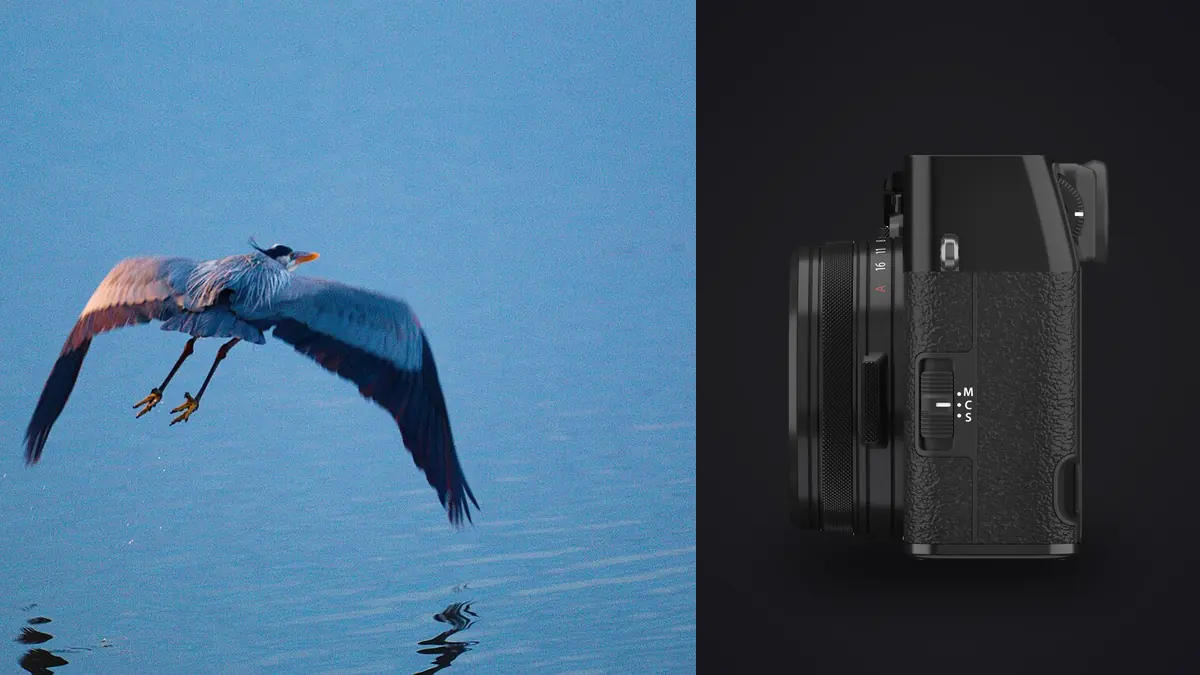
The Honest Answer First
I get some version of this question every few months, usually from someone who just bought an X100VI because it's the camera everyone's talking about, and is now wondering whether it can double as a birding rig for an upcoming trip. The honest answer is no, not in the way a dedicated super-telephoto does it. Fujifilm did not design this camera to chase gulls off a cliff face or track a kestrel hovering over a hedgerow. It has a fixed 23mm f/2 lens bolted to the front, and no amount of firmware cleverness changes what a 35mm-equivalent field of view can and can't reach.
But "no" isn't a very useful answer on its own, so I took mine to a red kite feeding station in Wales and to a harbour full of squabbling gulls to work out exactly where the line sits. There's a narrow, specific set of situations where this camera produces genuine flight shots, and a much larger set where it simply can't, and the difference comes down to distance more than anything else. Worth doing the actual math before you decide whether to bring it.
Do the Lens Math First
The X100VI's lens is a fixed 23mm f/2, and on the APS-C X-Trans sensor (1.5x crop) that works out to roughly a 35mm equivalent field of view. That's a wide-normal focal length, the kind you'd reach for on a street corner or at a dinner table, not the kind anyone associates with wildlife. A dedicated birder is typically running 400mm, 500mm, or 600mm glass, sometimes with a teleconverter stacked on top pushing past 800mm. That's somewhere between twelve and twenty times more reach than the X100VI gives you natively.
Where the X100VI claws some of that back is resolution. The sensor is 40.2 megapixels, and files come out around 7,728 pixels wide, so there's real headroom to crop hard after the fact and still end up with something usable for a screen or a small print. That's the one genuine advantage this camera has over an older, lower-resolution body: you can afford to crop away 80% of the frame and still have a few thousand pixels of width left over.
To make the reach problem concrete, I worked out roughly how much of the frame a red kite (wingspan around 1.8m) fills at typical birding distances, comparing the native lens, both digital teleconverter crops, and a 600mm-equivalent lens as a reference point.
| Distance | 23mm native (35mm-e) | Digital tele, 50mm-e | Digital tele, 70mm-e | 600mm-e tele (reference) |
|---|---|---|---|---|
| 15m (a close feeding-station pass) | ~12% of frame width | ~17% of frame width | ~23% of frame width | overfills the frame, far too close for this lens |
| 30m (a typical close flyby) | ~6% of frame width | ~8% of frame width | ~12% of frame width | ~100% of frame width |
| 60m (a normal reserve or hide distance) | ~3% of frame width | ~4% of frame width | ~6% of frame width | ~50% of frame width |
At 30m, which is a completely ordinary distance for a bird crossing a reserve or a stretch of coastline, even the longest digital tele setting on the X100VI gives you a kite that's roughly 12% of the frame width. That's a speck with wings, not a photograph. At 15m, close enough that most birds would already be spooked, it starts to look like an actual flight shot. The whole exercise really just confirms what the focal length already tells you: this camera works at feeding-station distances and nowhere else.
The Digital Teleconverter Isn't a Zoom
Fujifilm has offered a digital teleconverter on the X100 line since the X100F, and the X100VI carries it forward with 50mm and 70mm equivalent crop options. It's worth being clear about what's actually happening: there's no moving glass, no optical zoom, just an in-camera crop of the same 23mm image circle, output at a reduced resolution (roughly 20 megapixels at 50mm-e, roughly 10 megapixels at 70mm-e, from memory of testing mine against the full file).
Here's the part that surprised me when I actually ran the numbers: because it's purely a crop, the pixel dimensions of the bird itself barely change between the native frame and either digital tele setting. You're not resolving any more detail on the subject, you're just changing how much empty sky and hedge gets thrown away around it. Functionally, using the 70mm-e digital tele mode is close to shooting the full 40MP frame and cropping it yourself afterward, minus a bit of file size. The one real benefit is compositional: you can see the tighter framing live in the viewfinder rather than guessing how much you'll need to trim later. If you shoot RAW and plan to crop anyway, I'd honestly just leave it on the native focal length and keep the full sensor data to work with.
Autofocus and Shutter Speed for Things That Don't Hold Still
Fujifilm rolled subject detection autofocus, including a bird mode, out across the X-Trans V generation, and the X100VI has it. In practice it's genuinely good at locking onto a bird's head or eye once the subject is large enough in frame for the algorithm to have something to grab onto. What it can't do is make the subject bigger. Tracking accuracy solves the "is it in focus" problem, not the "can you actually see it" problem, and at 30m-plus those are two completely different issues.
The lens shutter is a leaf shutter built into the barrel rather than a focal-plane shutter in the body, which is one of the quieter advantages of the X100 line generally: fast, near-silent operation and clean flash sync. Mechanical continuous shooting tops out around 8 frames per second, which sounds modest next to a mirrorless sports body but is usually enough for a single close pass, since a kite crossing at 15m is only in a useful position for a second or two anyway. The mechanical shutter's top speed is 1/4000s, plenty to freeze a wingbeat, and given the limited reach here you're rarely fighting for extra speed the way you would with a heavy 600mm lens at f/6.3 in flat light.
In-body stabilization is new to this generation of the X100 (rated around 6 stops) and it's a real help for handheld habitat shots at slower shutter speeds. It does nothing for a moving subject though. Freezing a wing in motion is entirely down to shutter speed, not stabilization, and it's an easy distinction to lose track of when a spec sheet lists both features together.
Where the X100VI Actually Pulls Weight in a Birding Kit
Feeding Stations and Hides
This is the one scenario where the numbers actually work. Programmed red kite feeding stations, like the one at Gigrin Farm, exist specifically because the birds learn to swoop within 10 to 20m of a fixed viewing area at a predictable time each day. That's exactly the distance band where the table above stops being embarrassing. I came home from an afternoon there with a handful of frames at the 70mm-e digital tele setting that hold up as real flight shots, not just documentary evidence that a bird was nearby. Outside of a setup like that, on an ordinary walk along open coastline or moorland, I wouldn't bother trying.
Garden and Urban Birds
Robins on a garden fence three metres away, gulls working a harbour wall for chips, pigeons in a city square, feeder birds through a hide window. None of that requires reach, it requires patience and a camera that's quiet and quick to bring up, which is exactly what the X100VI is built for. This is closer to street photography with feathers than it is to wildlife photography in the traditional sense, and it's genuinely one of the more enjoyable ways to use this camera.
Habitat and Environmental Frames
This is the shot most telephoto-only wildlife photographers never get around to taking: the bird small in frame, with the reedbed or the coastline or the woodland it actually lives in properly visible around it. Nobody wants to shoot a wide environmental scene on a 600mm lens, and most people don't carry a second wide body for it. The X100VI, at 23mm and 40 megapixels, is a genuinely good tool for that specific frame, and it's one I now shoot deliberately on every outing rather than treating as an afterthought.
A Second Body on a Long Day
It's light, it's quiet, and it doesn't need its own bag. On a long day at a reserve I keep it round my neck while the telephoto rig stays on a strap or in a sling, and it comes out for the walk between hides, for scouting a new spot before committing to hauling the tripod out, and for the moments that happen too fast or too close for a long lens to even focus.
Settings I'd Actually Dial In
These are the combinations I've settled on after a few outings, not theoretical numbers pulled from a manual.
| Scenario | Shutter | Aperture | ISO | AF | Drive |
|---|---|---|---|---|---|
| Feeding-station pass, 10-20m | 1/2000 to 1/3200s | f/4 to f/5.6 | Auto, 200-6400 | AF-C, bird detection, zone | Mechanical, continuous high |
| Garden or feeder bird, perched, 2-4m | 1/500 to 1/1000s | f/2 to f/2.8 | Auto, 200-3200 | AF-S or AF-C, single point | Single frame or low burst |
| Habitat or environmental wide | 1/250s or slower, IBIS on | f/5.6 to f/8 | Auto, base ISO where light allows | AF-S, wide or zone | Single frame |
Stopping down to f/4 or f/5.6 for the flight passes gives a bit more forgiving depth of field than shooting wide open at f/2, since focus tracking on a bird that's banking and turning has less margin for error than one flying a straight line. And it's worth remembering the X100VI isn't weather sealed out of the box: it only picks up a proper WR rating once you've fitted the optional AR-X100 adapter ring and a protection filter. Worth having both in the bag before a morning at a wetland reserve in drizzle, because without them a sudden shower is a genuine problem, not a minor inconvenience.
Sorting a Day's Takings
A day that mixes a burst-heavy telephoto rig with the X100VI produces a lot of frames that look nearly identical: five or six shots from the same kite pass, half a dozen frames spanning one wingbeat cycle, a run of near-misses where the shutter fired a fraction before or after the wing hit full extension. Sorting that by eye at the end of a long day is the part that eats an evening, and it's exactly the kind of grunt work I don't want to do after standing in a field for six hours.
This is where I actually lean on imagic rather than scrolling through everything manually. It runs its sharpness and focus scoring locally on the machine, no upload involved, which matters given that a lot of these outings happen somewhere with no signal at all, and I'd rather not have a card's worth of unedited images anywhere near someone else's server regardless. It also clusters burst and near-duplicate frames automatically, so instead of clicking through eight nearly identical wingbeat frames one at a time, it surfaces the sharpest one from the group and lets me move on. If you want the mechanics behind how that scoring actually works, I went into more detail in how AI photo culling works.
The other place it earns its keep on a day like this is matching the look across a genuinely mixed set: a wide habitat frame off the X100VI sitting next to a tight telephoto portrait from a completely different lens, both needing to read as part of the same set rather than two separate shoots. Imagic's apply_my_style feature trains on edits you've already made and applies that same look across the batch, which saves matching white balance and contrast by hand frame by frame at the end of the day. Between the culling and the batch styling, what used to be a full evening at the desk is closer to twenty minutes, and there's a broader rundown of that kind of time saving in 10 tips for a faster photo workflow.
Frequently Asked Questions
Will the digital teleconverter get me close enough for real flight shots?
Only at close range, realistically inside 20m, which in practice means a feeding station or a very tame, habituated bird. At the 30 to 60m distances that make up most ordinary birding, even the 70mm-equivalent crop leaves the bird as a small fraction of the frame, and no amount of AI subject tracking changes that math.
Is the X100VI weather sealed for a morning at a wetland reserve?
Not by default. Weather resistance on this camera only kicks in once you've fitted the optional AR-X100 adapter ring along with a 49mm protection filter. Without both attached, treat it as an unsealed camera and plan accordingly if rain is a possibility.
What frame rate does the X100VI actually shoot for a flight sequence?
Around 8 frames per second on the mechanical shutter, which has been enough in my experience for a single close pass since the bird is usually only in a useful position for a second or two. The electronic shutter can go faster with an additional sensor crop, but I stick to mechanical for anything with fast wing motion.
Should this replace a telephoto lens for wildlife work?
No, and I don't think that's really the right question to ask about it. Treat it as a complementary body for habitat context, close-range or urban birds, and the walk between hides, while a long lens handles the frame-filling portraits. Trying to make it your only wildlife camera means giving up on distance entirely, and most birding doesn't happen at 15m.