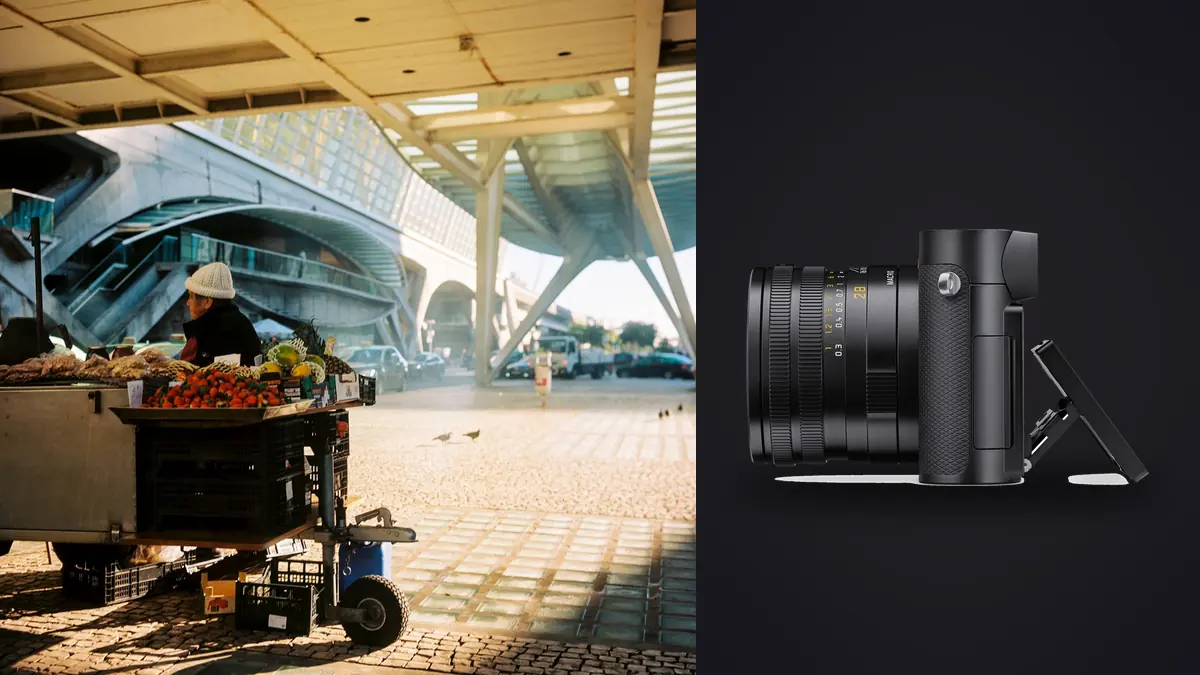
I spent three weeks in Naples last spring with a Leica Q3 as my only camera, no backup body, no second lens, just the 28mm Summilux and whatever light showed up. That kind of constraint either breaks a camera's usefulness for documentary work or proves it. The Q3 mostly proved it, though not for the reasons the marketing copy leads with. It wasn't the 60-megapixel sensor that mattered on the ground. It was the shutter sound, the autofocus finally trusting itself, and the fact that a fixed lens stops you from second-guessing your distance to the subject.
Why a Fixed 28mm Rangefinder-Style Body Suits Documentary Work
Street and documentary shooters argue endlessly about 28mm versus 35mm versus 50mm, and I'm not going to settle that here. What I'll say is that 28mm forces a specific kind of discipline: you either get close enough that the frame has a subject and a story, or you end up with wide, empty pavement and a caption doing all the work. There's no zoom to bail you out and no telephoto compression to fake intimacy from across the street. You walk in.
The rangefinder-style body helps with that too. It's not an actual rangefinder (the Q3 focuses through the lens like any mirrorless camera), but the proportions, the top-plate dial layout, and the way it sits against your chest rather than blocking your face all read as less confrontational than a DSLR-shaped body with a big zoom hanging off the front. People clock a camera regardless, but a compact fixed-lens body reads more like "photographer with one lens" and less like "photographer here to take something from you." That distinction matters more in documentary work than most gear reviews admit.
What Actually Changed From the Q2, and Why It Matters on the Street
I owned a Q2 before this and sold it once the Q3 came out, and the difference that actually changes how you work isn't the resolution bump from 47.3 to 60.3 megapixels. It's the autofocus. The Q2 used contrast-detect AF exclusively, and it hunted, especially in low light or against low-contrast subjects like a person in a dark coat against a dark doorway, which is exactly the kind of shot a documentary photographer wants. The Q3 adds phase-detect points across most of the frame, and the hunting is genuinely rare now. Faces lock fast, and the eye-detect tracking holds through a person turning their head mid-stride, which the Q2 would frequently lose.
The second change that matters more than it should is the tilting rear screen. The Q line never had one before the Q3. Shooting from waist height, screen tilted up, camera held low and unobtrusive, is a real technique for candid documentary work, and it simply wasn't available on the Q2 without buying an accessory viewfinder workaround. Now it's built in.
USB-C charging is a small thing until you're on your third day of a shoot with no outlet in sight and a battery bank in your bag. The Q3 charges off any USB-C source, including a phone charger, which the Q2's proprietary charger did not allow.
The Macro Clutch and Crop Modes
One feature that doesn't get talked about enough is the manual clutch ring near the base of the lens barrel. Twist it and the focus range switches into macro mode, letting you focus down to roughly 17cm. For documentary work this shows up in odd, useful moments: a market vendor's hands counting change, a torn poster, a detail on a doorframe that tells you more about a neighborhood than a wide establishing shot would. You don't carry a second lens for this. You twist a ring.
The in-camera crop modes (35mm, 50mm, 75mm, 90mm) are the other workaround for not having interchangeable lenses. Because the sensor is 60 megapixels, cropping to a 90mm-equivalent frame still leaves you with roughly 6 megapixels, and a 50mm crop leaves close to 19 megapixels, both usable for web galleries, prints up to a reasonable size, and certainly for a documentary series that will mostly live online or in a photobook run. It's not the same as an actual 50mm lens (the depth of field and compression stay locked to a 28mm perspective) but it buys you framing flexibility without breaking your one-lens discipline mid-shoot.
How the Q3 Stacks Up Against Other Street Cameras
None of this happens in a vacuum. If you're deciding between the Q3 and something cheaper or lighter for documentary work, here's how the realistic alternatives compare on the specs that actually change a shooting day, not just the ones that sell magazines.
| Camera | Lens | Sensor | Autofocus | Stabilization | Body weight | Launch price (USD) |
|---|---|---|---|---|---|---|
| Leica Q3 | 28mm f/1.7 (fixed) | 60.3MP full-frame | Hybrid phase + contrast | Optical (lens-based) | 743g | $5,995 |
| Leica Q2 | 28mm f/1.7 (fixed) | 47.3MP full-frame | Contrast-detect only | Optical (lens-based) | 734g | $4,995 (discontinued) |
| Fujifilm X100VI | 23mm f/2, 35mm equiv (fixed) | 40.2MP APS-C | Hybrid phase + contrast | In-body (IBIS) | 521g | $1,599 |
| Ricoh GR IIIx | 26.1mm f/2.8, 40mm equiv (fixed) | 24.2MP APS-C | Contrast-detect only | None | 262g | $999 |
What jumps out isn't that the Q3 wins on every line, because it doesn't. The GR IIIx is genuinely pocketable in a way none of these others are, and for pure street candids where disappearing matters more than image quality, that weight difference is not trivial. The X100VI at a third of the price gets you IBIS, a comparable autofocus system, and a focal length (35mm equivalent) that a lot of documentary shooters actually prefer to 28mm. What you're paying the Q3 premium for is full-frame low-light performance, the faster f/1.7 aperture, build quality that survives years of daily carry, and files with enough resolution to crop hard after the fact without falling apart.
Shooting Discreetly: the Shutter and the EVF
The leaf shutter is the unsung hero of this camera for documentary work. It's genuinely quiet, quieter than a focal-plane shutter DSLR by a wide margin, and there's also a fully silent electronic shutter mode for moments where even the leaf shutter's soft click would draw attention (inside a church, a courtroom hallway, a quiet apartment during an interview). I used electronic shutter almost exclusively during a hospital documentary project two years ago with the Q2, and nobody in the room ever registered that I was shooting.
The one caution with electronic shutter on any camera, Q3 included, is rolling shutter distortion on fast-moving subjects, like a cyclist crossing the frame or someone swinging their arm quickly. It's rare enough that I don't avoid electronic shutter, but I switch back to the mechanical leaf shutter for anything with real motion.
The EVF blackout during a burst is short but present. If you're chasing a fast-developing gesture, a hand reaching for a door, a kid mid-jump, you'll feel a flicker of blackout between frames. It's not disruptive, but shooters coming from an optical rangefinder like an M-series body will notice it immediately.
Handling 60-Megapixel Files From a Full Day of Shooting
The resolution that makes the Q3's crop modes usable also creates a real problem at the end of a shooting day: DNG files at 60 megapixels run 70 to 90MB each, and a documentary session easily produces 800 to 1,500 frames once you count the bursts you fire to catch a fleeting expression. That's 70 to 130GB of raw files before you've touched a single edit, and most of those frames are near-duplicates from the same three-second burst.
This is where I stopped trying to cull manually. I run everything through imagic before I open a single frame in an editor. It scores focus and sharpness locally, on the machine, with nothing uploaded anywhere, which matters to me on documentary work where some subjects have asked not to have their images touch a cloud service before publication. It also clusters burst sequences and near-duplicate frames automatically, so instead of scrolling through nine nearly identical shots of someone crossing a street, I'm looking at the one or two that are actually sharp and well-timed. On a 60MP body that habit alone probably saves two or three hours a week. If you want the mechanics of how that scoring actually works, this breakdown of AI photo culling covers it in more depth than I will here.
The other piece I've leaned on is imagic's apply_my_style preset, which trains itself on edits you've already made rather than shipping a generic filter pack. For a documentary series shot over months, keeping the black-and-white contrast curve or the color temperature consistent across sessions matters more than people expect. Editing 400 images from a single day is one thing; keeping 3,000 images from a six-month project looking like they belong together is a different problem, and having a preset trained on your own prior decisions instead of someone else's preset pack solves a real chunk of it. There's a broader set of habits around this in this workflow guide, most of which apply regardless of which camera shot the files.
Where the Q3 Falls Short
I want to be direct about the limitations because most coverage of this camera glosses past them. Battery life is mediocre, roughly 350 shots per charge in real use, which for a full day of documentary shooting means carrying at least one spare and probably two. The single SD card slot is a real risk on documentary work you cannot reshoot; backing up cards constantly is the workaround, and the Q3 gives you no redundancy. Weather resistance is limited, Leica rates it for light splash protection but not the kind of sustained rain or dust you'd want for genuine photojournalism in rough conditions. And at $5,995, a lost or stolen body on a street shoot is a financial hit that a $999 Ricoh simply isn't.
The fixed lens is also a real constraint, not just a stylistic one. If your documentary work regularly needs a longer reach, a protest from across a barricade, a subject who won't let you close the distance, the Q3 can't help you. The 90mm crop mode gets you there in a pinch but it's a crop, not a lens, and the depth of field never changes.
Frequently Asked Questions
Will people notice you're shooting with a $6,000 camera?
Less than you'd think from a distance, more than you'd like up close. The body's proportions read as unassuming to most passersby, closer to a compact than a professional rig, but anyone who actually knows cameras will spot the red dot immediately. On assignments in wealthier neighborhoods that's a non-issue. In some documentary contexts, informal settlements, active protests, situations where visible wealth changes how people react to you, it's worth thinking through before you bring it.
Is 28mm too wide for documentary portraits?
It's wide enough that you need to get physically close, often closer than feels comfortable at first, to fill the frame with a face. That's a feature for documentary work in my experience, since it forces genuine proximity and usually a brief exchange with the subject rather than a long-lens grab from across the street. If you want a tighter, more compressed portrait look without moving, the 90mm crop mode gets you there, just remember it's still a 28mm lens's depth of field and perspective underneath the crop.
How much does the improved autofocus actually change the keeper rate?
Meaningfully. Shooting the same kind of fast, unpredictable street scenes with a Q2 and then a Q3 back to back, my in-focus rate on moving subjects went from something I'd estimate around 60 to 70 percent up to somewhere in the 90s. The phase-detect points are the reason. It's the single biggest practical upgrade in this camera for anyone shooting people in motion.
Should you buy a used Q2 instead to save money?
If budget is the deciding factor, yes, seriously consider it. A used Q2 runs $3,800 to $4,200 depending on condition, a significant gap from the Q3's price, and it delivers the same lens, the same body feel, and files that are still plenty sharp for documentary work. You give up the phase-detect autofocus, the tilt screen, and roughly a third of the resolution. For most street and documentary shooters, the Q2's autofocus limitations are the real tradeoff to weigh, not the missing megapixels.