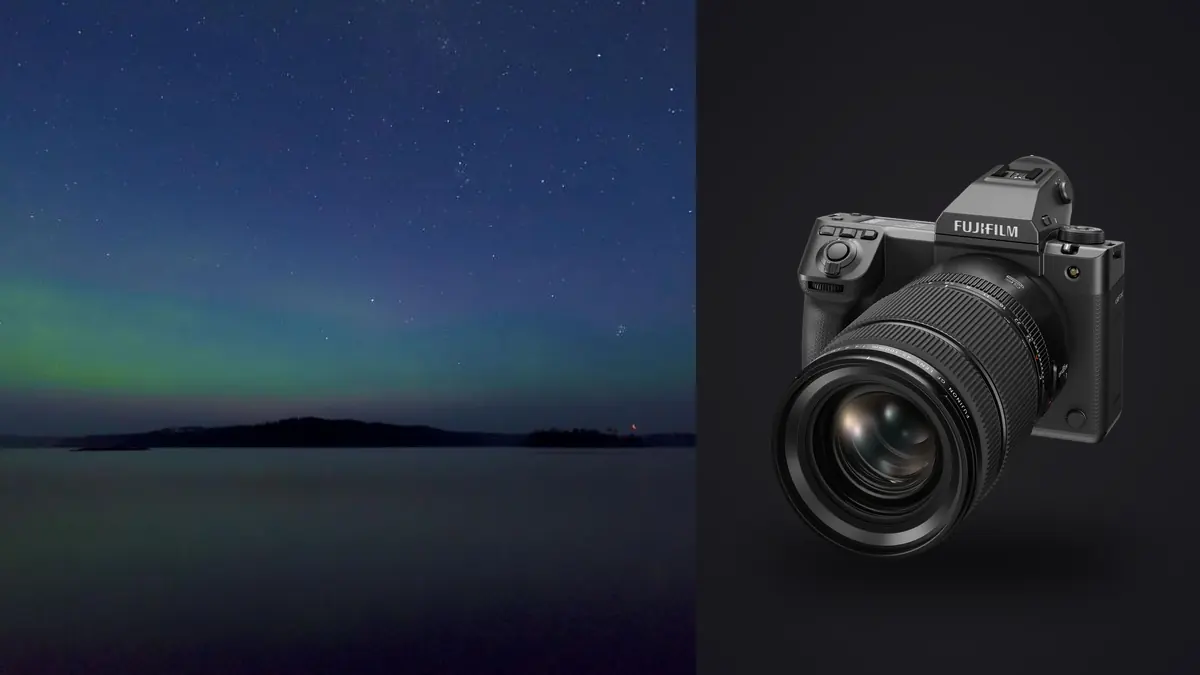
I spent three nights on a hillside above the Picos de Europa before I trusted my own exposure notes enough to write any of this down. The GFX 100 II is not a camera anyone designs for astrophotography, Fujifilm builds it for studio and landscape work, and that shows the moment you point it at a dark sky. It also does some genuinely surprising things once you stop treating it like a bigger, better full-frame body and start treating it like what it actually is: a 102-megapixel sensor with its own math.
The sensor is bigger, but the pixels aren't
This is the part that catches people out. The GFX 100 II sensor measures 43.8mm by 32.9mm, noticeably larger than full frame's 36mm by 24mm, and it's easy to assume that extra area buys you some slack on star trailing. It doesn't, not in the way people expect.
Do the arithmetic on pixel pitch and the GFX 100 II works out to roughly 3.76 microns between photosites. That number will look familiar to anyone who has shot a 61-megapixel full-frame body, because it's almost identical. Fujifilm packed enough resolution into that larger sensor that the individual pixels are just as demanding about star movement as a high-resolution full-frame sensor is. A star that would register as a clean point on a 24-megapixel body can already show elongation on the GFX 100 II at an exposure length that would have been completely safe on lower-resolution gear.
The other number worth knowing is the crop factor, about 0.79 relative to full frame. A 23mm GF lens frames roughly like an 18mm on full frame. But that equivalence is about field of view, not about trailing. Star drift across the sensor is a function of actual focal length and actual pixel pitch, not the "full-frame equivalent" number printed on marketing copy. I made this mistake on my first outing, treated the 23mm GF like an 18mm for exposure timing, and got soft points across a third of the frame that I didn't catch until I was back at my desk pixel-peeping at 100%.
GF glass wasn't built for this, and you feel it
Fujifilm's GF lens lineup is optically excellent and almost uniformly slow. Look through the catalog for something in the f/1.4 to f/2 range that also goes wide, the kind of lens that full-frame astro shooters lean on, and there isn't one. The widest rectilinear option most people reach for is the GF20-35mm F4, and f/4 on a still sensor is f/4, no amount of resolution offsets the light-gathering deficit against a 14mm f/1.8 on a mirrorless full-frame body.
What that means in practice is longer exposures, higher ISO, or both, to hit the same total light on the sensor. It's a real tradeoff and I don't think it gets talked about enough in gear reviews that focus on daytime landscape and studio use. Here's how the options I've actually used or tested against each other break down for night work specifically.
| Lens | Full-frame equivalent | Max aperture | Approx. weight | Coma at edges | Night-use notes |
|---|---|---|---|---|---|
| GF23mm F4 R LM WR | ~18mm | f/4 | 580g | Well controlled by f/5.6 | Sharp corners, but needs 15-20s minimum at f/4 to gather enough light for a Milky Way core exposure at ISO 3200 |
| GF20-35mm F4 R WR | ~16-28mm | f/4 | 980g | Visible coma wide open at 20mm | My default for wide nightscapes purely for the flexibility, but I stop hunting for f/2.8 performance that doesn't exist on this glass |
| GF30mm F3.5 R WR | ~24mm | f/3.5 | 510g | Mild, cleans up by f/5.6 | The closest thing to a fast wide prime in the native lineup, genuinely useful for star fields |
| GF45mm F2.8 R WR | ~36mm | f/2.8 | 490g | Noticeable coma at f/2.8 | Tighter field of view but the fastest usable aperture, works well for a Milky Way arch pieced together as a panorama |
| GF110mm F2 R LM WR | ~87mm | f/2 | 1010g | Not really relevant at this focal length | Too tight for wide sky work, but excellent for tracked close-ups of star fields or the galactic core region |
The practical takeaway from that table, for me, is that the GF30mm F3.5 does more real work per gram than anything else in the bag, and the 110mm F2 earns its keep only once you're tracking and cropping in on a specific patch of sky rather than trying to frame the whole arch.
Settings that actually held up in the field
I stopped trying to import exposure formulas wholesale from full-frame astro guides after the soft-corner mistake mentioned earlier. What I use now is closer to a set of starting points I adjust per lens and per night, based on actual histogram checks rather than a rule memorized from someone else's camera.
For an untracked Milky Way shot with the GF20-35mm at 20mm, I start at f/4, ISO 3200, and 10 seconds, then chimp the result at 100% zoom on the rear screen before committing to a longer session. That 10 seconds is noticeably shorter than the "500 rule divided by focal length" answer would suggest, precisely because of that finer pixel pitch. If I'm tracking, the calculus changes completely and exposure length stops being about trailing at all, it becomes about how much total integration time I want and how many subs I'm willing to manage in post.
| Shooting mode | ISO | Single exposure | Sub count target | Total integration |
|---|---|---|---|---|
| Untracked wide (20-23mm) | 3200-5000 | 8-12s | 40-60 subs | 6-12 minutes of stacked signal |
| Tracked wide (30-45mm) | 800-1600 | 60-120s | 20-30 subs | 20-60 minutes |
| Tracked, tighter field (110mm) | 800-1250 | 90-180s | 15-25 subs | 25-75 minutes |
| Star trails (any wide lens) | 800-1600 | 30-60s each | 90-180+ subs | 45-180 minutes real time |
A few settings decisions matter more than usual on this body. I always shoot the mechanical shutter for astro rather than electronic, because I've seen faint banding creep into deep shadow areas on electronic-shutter long exposures that mechanical doesn't show. I also turn long exposure noise reduction off entirely. It's tempting to leave it on since it's a genuinely effective dark-frame subtraction, but it doubles the time of every single exposure, and across 60 subs that adds up to an entire extra hour standing in the cold. I shoot a handful of dedicated dark frames at the end of the session instead and let the stacking software handle calibration, which gets the same noise benefit without the per-shot tax.
Buffer matters more than I expected too. Compressed RAF files off this sensor land around 100-120MB each, and if you're running an interval timer for a star trail sequence, a slow SD card will start to throttle your interval before you're a third of the way through. I run CFexpress Type B in the primary slot for anything interval-based and only use the SD slot as backup.
Tracking hardware and the weight problem nobody mentions
A lot of star tracker mounts marketed to enthusiasts, the small ball-head-style units built for mirrorless bodies with a compact prime, list payload capacities in the 2 to 3kg range. That sounds like plenty until you actually weigh a GFX 100 II with a GF lens attached. The body alone is a little over a kilogram before you add a battery or card. Pair it with the GF20-35mm at nearly a kilogram of its own, and you're already close to 2kg before adding a plate, an L-bracket, or a ball head on top of the tracker.
I run a mid-weight tracker rated closer to 5kg payload now, specifically because a smaller unit was showing periodic error and slight sag partway through a 90-second tracked exposure with this combo. If you already own a lightweight tracker bought for a full-frame mirrorless setup, don't assume it will carry the GFX comfortably. Check the actual rated payload against actual combined weight, not against what "feels" light when you pick the body up in a shop.
On stabilization: I turn IBIS off for every tracked exposure. With the camera locked to a solid tripod and the tracker doing the actual motion compensation, in-body stabilization has nothing real to correct and occasionally introduces a very slight frame drift of its own over long single exposures. For untracked handheld twilight shots before it's fully dark, leave it on, the 8-stop-rated system genuinely helps there.
What happens after the shutter closes
A single serious night of star stacking on this camera produces an uncomfortable number of large files. Sixty subs at 110MB apiece, plus darks, plus test frames while you dial in focus and framing, plus whatever terrestrial foreground shots you took at blue hour, and you're looking at 8-10GB before you've stacked anything. Managing that volume is its own task, separate from the astro technique itself.
This is where I've actually leaned on imagic more than I expected to when I first picked it up for regular shoot culling. Dialing in focus on a star field by eye on a 3-inch rear screen at night is genuinely hard, and I end up shooting far more test frames than I need, small focus adjustments, framing tweaks, checking for dew on the front element. imagic's local sharpness scoring flags the genuinely sharp frames out of that pile, and its burst clustering groups the near-duplicate test shots together so I'm not scrolling through forty nearly identical frames of the same patch of sky trying to remember which one I actually nailed focus on. None of that touches the stars themselves, star fields don't have the kind of contrast edges a sharpness algorithm reads well, but it does the job on every terrestrial and twilight frame from the same session, which is most of the culling work anyway.
For the actual stacking, I run calibrated subs through Siril for the deep sky and Milky Way work and Sequator for quicker foreground-plus-sky composites when I don't need full calibration frame rigor. Both handle the RAF files fine once they're converted, though I'd recommend batch-converting to a DNG or TIFF intermediate first if you're on a machine with less than 32GB of RAM, because stacking sixty 100MB-plus files natively has choked more than one laptop I've tested this on.
Once the stack is flattened and I've got a final composite, plus usually a handful of companion wide shots from the same night that didn't need stacking, I run the whole batch through imagic's apply_my_style preset, trained on my own past edits, to get consistent color and contrast across the set without manually matching white balance and tone curve on every single frame by hand. That consistency matters more for a multi-image nightscape series than it does for a single hero shot, since inconsistent color temperature between frames shot the same night is one of the fastest ways to make a gallery post look amateurish. And because everything runs locally with no cloud upload required, it's not an issue that most of the dark sky sites worth shooting have no signal at all. The processing happens on the laptop in the car, not over a connection that isn't there.
Frequently Asked Questions
Does Pixel Shift Multi-Shot work for star fields on the GFX 100 II?
No, and it's worth knowing why before you waste a night trying. Pixel Shift Multi-Shot captures sixteen frames with tiny sensor offsets between them to build a single high-resolution composite, which works beautifully for static subjects like architecture or studio product work. Stars move relative to the sensor between those sixteen captures, even over the fraction of a second the sequence takes, and the alignment algorithm isn't built to compensate for that kind of motion. You'll get color fringing and misregistration around every point source in the frame. Use conventional stacking software on separate full exposures instead.
Is ISO 3200 actually usable on this sensor for astro work?
Yes, more comfortably than I expected going in. The back-illuminated sensor design in the GFX 100 II handles ISO 3200 to 5000 with noise that's fine grained rather than blotchy, and it responds well to stacking, which is the entire point of shooting multiple subs rather than one long exposure. I wouldn't push past ISO 6400 for anything I planned to stack seriously, past that point read noise starts dominating over signal in a way that stacking can't fully recover, but there's no dedicated cooling on this body and you shouldn't expect dedicated astro-camera performance from it.
How many subs do I actually need for a clean Milky Way stack?
For untracked wide shots at 8-12 seconds each, I don't see meaningful improvement in the final noise floor much past 60 subs, the returns flatten out well before that on a resolution this high because you're also dealing with per-pixel read noise that stacking reduces on a square-root curve rather than linearly. Tracked exposures need fewer subs for the same total integration time since each one is longer, 20 to 30 subs at 60-120 seconds gets you a genuinely clean core.
Should I shoot compressed or uncompressed RAF for star stacking?
Compressed, without hesitation. Fujifilm's compression on the GFX 100 II is lossless, not the lossy compression some older bodies used, so you're not giving up any actual image data. Uncompressed RAF files on this sensor run close to double the size, and when you're already managing 8-10GB per session, doubling that for zero practical benefit is not a tradeoff worth making.