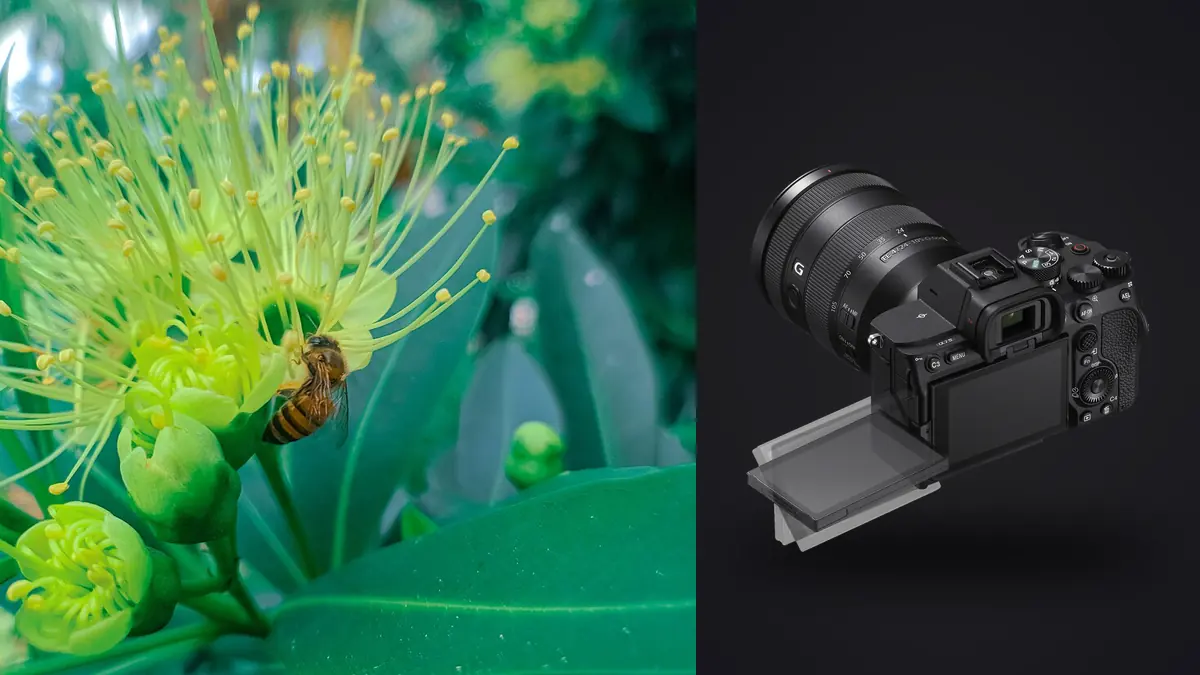
The Sony A7 IV was never marketed as a macro camera. It's a 33-megapixel hybrid body built to do everything reasonably well, from weddings to wildlife to run-and-gun video. But hand it a dedicated macro lens and point it at a dragonfly perched on a reed at 6am, and it turns out the sensor resolution, the focus peaking implementation, and the in-body stabilization add up to something genuinely useful for insect work. It's not the camera Sony would build if macro were the only brief. It's still a very good tool for it, with a few habits you need to unlearn from shooting anything else.
Why 33 megapixels matters more here than almost anywhere else
Insect macro is one of the only genres where you actively want extra resolution, because you're going to crop. A lot. Even with a true 1:1 macro lens, a damselfly's head might occupy a tenth of the frame if you're not willing to get within a few centimeters of it (and most skittish subjects won't let you). The A7 IV's 7008 x 4672 pixel files give you real room to crop to the compound eyes or the wing venation in post and still have enough pixels left for a decent print or a sharp web image. Shoot the same subject on an older 24-megapixel body and that same crop starts looking soft fast.
The tradeoff is file size and rolling shutter on video, neither of which matters much for stills-only macro work. What does matter is that higher pixel density is less forgiving of focus error. A tiny miss that would be invisible at 24 megapixels becomes obvious at 33, especially once you crop in. That single fact changes how you should approach focus on this body more than any menu setting does.
Lens choice: the decision that actually matters
The camera body is maybe 20% of what determines whether your insect macro shots are sharp. The lens, and how you use it, is the rest. For E-mount, there are four lenses worth taking seriously, and they behave differently enough that "just get a macro lens" isn't useful advice.
The Sony FE 90mm f/2.8 Macro G OSS is the obvious first pick because it autofocuses reliably and has genuinely effective optical stabilization, which matters when you're handholding at 1:1 magnification and any shake gets multiplied along with the subject. Its autofocus hunts less than you'd expect on static insects like resting butterflies, but it still struggles the moment something moves, which is most of the time with anything that isn't cold or freshly emerged. The Sigma 105mm f/2.8 DG DN Macro is sharper wide open in my experience and a bit more contrasty, but its AF is built for general use, not chasing a hoverfly, so I mostly treat it as a manual-focus lens with autofocus as a coarse-focus convenience.
Then there's the Laowa 100mm f/2.8 2X Ultra Macro, fully manual, no electronic contacts, and the only one of the four that gets you to 2:1 magnification without a teleconverter or extension tubes. If you shoot jumping spiders or springtails where 1:1 still isn't enough, this is the lens, but understand you're giving up autofocus and aperture readout entirely, which is a real workflow cost when you're trying to track a subject that won't sit still. The Tamron 90mm f/2.8 Macro rounds things out as the budget option, softer in the corners at 1:1 but genuinely usable stopped down, and a reasonable way to find out if macro is a genre you'll stick with before spending Sigma or Sony money.
| Lens | Max magnification | Autofocus for moving insects | Handheld usability | Street price (check current) |
|---|---|---|---|---|
| Sony FE 90mm f/2.8 Macro G OSS | 1:1 | Usable on stationary subjects, hunts on erratic movers | Best of the group, OSS is real | ~1,000 EUR |
| Sigma 105mm f/2.8 DG DN Macro | 1:1 | Slower, better treated as manual | Good, no stabilization built in | ~700 EUR |
| Laowa 100mm f/2.8 2X Ultra Macro | 2:1 | None (fully manual) | Demanding, needs a stable stance or rail | ~500 EUR |
| Tamron 90mm f/2.8 Di III Macro | 1:1 | Usable, softer in corners | Good, lighter than the Sony | ~550 EUR |
Getting focus right when the subject won't cooperate
At 1:1 magnification your depth of field at f/8 is measured in single millimeters. A resting dragonfly with its wings angled even slightly toward or away from the sensor plane will have part of its body sharp and part of it mush, no matter how good your lens is. This is the actual skill in insect macro, and it has almost nothing to do with the camera brand.
A few things that consistently work on the A7 IV specifically. Focus peaking (set to a high sensitivity, red or yellow depending on the subject's color, since peaking on a green mantis is nearly invisible in red) is more reliable than trusting autofocus once you're past about 0.7x magnification. Back-button focus lets you nail focus once on a static insect, then recompose slightly without the camera hunting again the instant you touch the shutter. And I shoot in manual focus with the focus ring doing fine adjustment while my whole body sways slightly forward and back, essentially using my own balance as the focus rail, because a tripod-mounted rail is too slow for anything that might fly off in a second.
Eye-AF with animal detection does work on larger, cooperative subjects like dragonflies and larger moths perched still in morning cool, and it's worth turning on as a safety net even when you plan to focus manually, because it'll occasionally grab a shot you'd have otherwise missed while adjusting your stance. It essentially never locks onto anything smaller than a bee, and it gets confused by compound eyes that don't look like the mammal eyes the algorithm was trained to expect. Don't rely on it below that size.
Aperture, diffraction, and the flash question
Diffraction softening becomes visible past roughly f/11 on this sensor, earlier than most people expect, because the pixel pitch is small enough that diffraction blur competes directly with individual pixels. That puts you in an uncomfortable spot: you need f/11 to f/16 for enough depth of field to get a whole insect in focus at close magnification, but that same aperture is already costing you resolution to diffraction. There's no way around this with a single frame. Either you accept a partially soft insect, stop down and accept some diffraction softening, or you focus stack.
Flash solves the exposure problem that stopping down creates (f/16 at 1:1 magnification eats a lot of light) but it introduces its own issues. A bare flash on a macro subject produces a hard, unflattering shadow and a specular hotspot on anything with a shiny exoskeleton, which is most beetles. A diffuser, even something improvised like a piece of white plastic bent around the lens hood, softens that dramatically. I use flash for maybe a third of my insect shots, mainly deep-shade subjects or anything active enough that a slow shutter would blur it. For everything else, natural light with a reflector card is more forgiving and produces more natural-looking results, at the cost of needing to shoot earlier or later in the day when insects are cold and slow enough to approach.
Focus stacking in the field (and when it's not worth trying)
The A7 IV doesn't have in-camera focus bracketing the way some Sony bodies do, so stacking means manually racking focus between shots, either with the focus ring or a macro rail. For a truly still subject (a dew-covered spider at dawn, before the sun warms it up) this works well: five to ten frames at slightly different focus points, stacked afterward, gets you a whole insect sharp at an aperture wide enough to avoid diffraction. For anything active, don't bother. By the time you've taken the third frame the insect has repositioned, and a stack from misaligned frames looks worse than a single well-focused shot ever would.
My rule of thumb: if the subject has been motionless for more than ten seconds, it's probably cold enough or settled enough to hold still for a stack. If it just landed and is grooming or scanning around, take single frames and expect to lose most of them to partial focus.
What a real morning of shooting looks like, and the culling problem nobody warns you about
A productive dew-hunting session (the term macro shooters use for early mornings when cold insects are too sluggish to fly) can produce eight hundred to fifteen hundred frames in two or three hours, because you're bracketing focus on every promising subject and firing several frames per attempt since a single gust of wind ruins the shot. Almost none of those frames differ from their neighbors in any way a normal camera-roll thumbnail would show you. The differences are in focus placement on a compound eye, or on which of six legs is sharp.
This is where I stopped trying to cull macro sessions by eye. Scrolling through twelve hundred nearly-identical frames of the same jumping spider on a phone screen, at thumbnail size, is exactly how you end up publishing the one with the mediocre eye focus because you were tired by frame nine hundred. I run these sessions through imagic, which scores sharpness locally per frame and groups the burst variations together, so instead of scrolling a folder in file order I'm looking at, say, fourteen clusters of the fourteen subjects I actually photographed, each with its sharpest frames surfaced first. It runs the scoring on my machine, nothing gets uploaded anywhere, which matters to me mostly because a macro session's raw folder is enormous and I don't want to wait on an upload before I can start picking. For a genre this frame-heavy, a workflow like automated culling earns its keep faster than it does on, say, a portrait session with eighty total frames.
Color and the editing pass
Insect macro files respond well to fairly aggressive local contrast and clarity, because a lot of the appeal is texture: the fuzz on a bee's thorax, the faceting of an eye, the powder on a moth's wing. I push local contrast harder here than I would on a landscape file, and I'm more careful with color, since green and iridescent insects shift hue easily under heavy saturation adjustments and start looking artificial fast. Once I've settled on a look for a season's worth of insect shots (usually cooler shadows, slightly desaturated greens so foliage doesn't fight the subject for attention, and a warm highlight on the insect itself) I save that as a style in imagic using apply_my_style, which is trained on edits I've actually made rather than a generic macro preset pulled off a marketplace. It gets me through the backlog of a big shoot without re-deciding the same color choices four hundred times, though I still hand-adjust the handful of frames going into a portfolio or a print.
Practical settings that hold up across most insect subjects
- Shutter speed: 1/500s minimum for anything that might twitch, 1/1000s or faster for active fliers you're trying to freeze mid-motion.
- Aperture: f/8 to f/11 as a starting point, accepting some depth-of-field compromise rather than chasing f/16 and eating the diffraction penalty.
- ISO: let it float, even into the 1600 to 3200 range in shade. The A7 IV's noise at those values is far less damaging to a final image than motion blur or missed focus, and noise reduction in post has gotten good enough that it's the easier problem to fix.
- Drive mode: continuous high, but in short bursts of three to five frames rather than holding the shutter down, since a two-second burst on a subject that's actually still just gives you five copies of the same frame to sort through later.
None of these are exotic. What's exotic is how often insect subjects break the assumption behind them: a "still" dragonfly that's actually vibrating its wings at a frequency your shutter speed doesn't freeze, or a beetle that looks stationary but is slowly rotating on its perch enough to throw off a manual focus pull between frames.
Frequently Asked Questions
Is the Sony A7 IV good enough for serious insect macro, or do I need a dedicated macro body?
There's no such thing as a dedicated macro camera body, only macro lenses paired with general-purpose bodies. The A7 IV's resolution and focus peaking make it a solid choice, arguably better suited to this than Sony's higher-frame-rate sports bodies, which trade resolution for speed you don't need when your subject is a stationary spider.
Do I need extension tubes if I already own a 1:1 macro lens?
Only if you're chasing subjects smaller than roughly 10mm, like springtails or very small beetles, where even 1:1 doesn't fill the frame. For dragonflies, most butterflies, bees, and spiders, native 1:1 magnification is plenty, and extension tubes just cost you light and working distance you'll want for skittish subjects.
Why do my insect macro shots look sharp on the camera's screen but soft when I zoom in later?
The rear LCD and EVF don't have enough resolution to show true pixel-level focus error, especially at the reduced brightness and contrast most people shoot with outdoors. Zoom in fully on the EVF during the shot itself (not just after) rather than trusting the at-a-glance preview, and treat any shot you didn't check at full zoom as unverified until you're back at a real screen.
How many frames should I expect to keep from a typical macro outing?
Somewhere between two and eight percent of what you shoot, depending on how aggressively you bracket focus and how active the subjects are. That ratio is normal for this genre and not a sign you're doing something wrong; it's a direct consequence of how thin the depth of field is at high magnification.