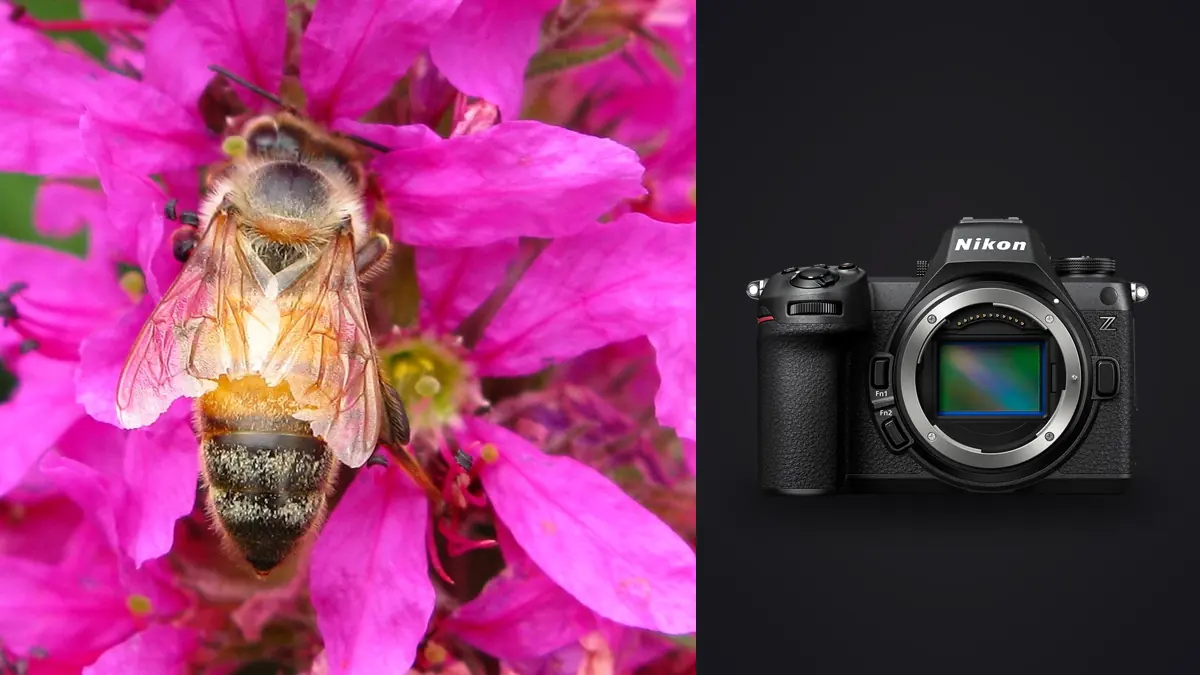
I picked up the Z6 III mostly for general shooting and video, but it ended up becoming my main macro body almost by accident. A friend needed help photographing an insect collection for a natural history project, and rather than borrow a dedicated macro setup I just mounted the Z MC 105mm I already owned and went to work. Six months and a few hundred field hours later (mostly chasing damselflies at a pond near my house and jumping spiders on a neighbor's fence), I have a pretty clear picture of where this body earns its keep for bugs and where it just gets in the way.
This isn't a spec sheet regurgitation. It's what changed in my actual shooting once I started treating the Z6 III as a macro tool instead of a hybrid stills/video body, plus the settings and lens pairings that made the biggest difference between a keeper rate I could live with and a card full of near misses.
The sensor and shutter matter more than the megapixel count
The Z6 III uses a 24.5MP partially stacked sensor, which is the detail that actually affects insect work, not the resolution figure everyone quotes. Partially stacked means the readout is meaningfully faster than a standard BSI sensor but still not in Z9 territory, so rolling shutter is present but manageable. For static insects (something perched, cold, or feeding) it's a non-issue. For anything moving fast across the frame, like a dragonfly banking mid-flight, you can still get some skew if you're panning hard in electronic shutter mode.
What I use daily is the silent electronic shutter for anything skittish. Jumping spiders and hoverflies notice a mechanical shutter clacking six inches from their face, and they bail. Switching to full silent mode with the mechanical shutter disabled entirely let me get noticeably closer before a subject spooked, especially on overcast mornings when insects are already sluggish and easy to disturb. The tradeoff is you lose the physical shutter's protection against dust settling on the sensor during lens changes in the field, which matters if you're swapping between a macro lens and a longer lens for habitat shots.
Autofocus: the honest version, not the marketing version
Nikon's subject detection on the Z6 III covers people, dogs, cats, birds, and a handful of vehicle categories. It does not have an insect-specific detection mode, and I want to be upfront about that because I see this claimed online and it isn't accurate. At high macro magnification the camera's face/eye detection sometimes locks onto compound eyes by accident, which is a happy coincidence rather than a designed feature, and it's unreliable enough that I don't plan a shoot around it.
What actually works is pinpoint AF or single-point AF with a small box, paired with manual focus override on the lens ring for fine adjustment. Past about 1:1 magnification, autofocus hunting becomes the biggest time sink in the field, so my workflow shifted to focusing manually and using body movement (rocking forward and back slightly) to find critical focus rather than relying on the AF motor to chase it. Focus peaking helps here, though I keep the sensitivity on the lowest setting since at high magnification everything in the thin focal plane will light up otherwise. For genuinely static subjects, cold insects early in the morning or specimens on a copy stand, I use the built-in focus shift shooting to run a stack of 20 to 40 frames at small focus increments and blend them later. That single feature has done more for my insect image quality than any autofocus improvement would.
In-body stabilization changes how you shoot handheld macro
The IBIS rating on paper (up to 8 stops with compatible lenses) sounds like a video spec, but it directly affects handheld macro shooting speed. Before this body I mostly worked off a focusing rail on a tripod because handheld macro at 1:1 or higher magnification amplifies every tremor into visible blur. With the Z6 III's stabilization, I can handhold at 1/125s at f/11 for a static subject and get a sharp frame more often than not, which lets me chase a moving insect around a leaf instead of setting up a rail and waiting for it to wander into position. It doesn't replace a tripod for stacking work, and I still use one for anything requiring more than a few stacked frames since IBIS can't fix subject movement between exposures. But for opportunistic single-frame shots of live insects, it's the single biggest reason my keeper rate on handheld work went up.
Lens pairing and working distance
The lens matters as much as the body here, arguably more. I run the Z MC 105mm f/2.8 VR S for most insect work because the extra working distance over a 50mm macro means less chance of a shadow falling across the subject and less chance of scaring it off before you're in position. The tradeoff is a narrower field of view makes handheld framing slightly harder when something is moving erratically.
| Setup | Max magnification | Working distance at 1:1 | Best for |
|---|---|---|---|
| Z MC 50mm f/2.8 | 1:1 | ~4.5 cm from front element | Static subjects, flowers, patient shooting, tight spaces |
| Z MC 105mm f/2.8 VR S | 1:1 | ~14 cm from front element | Live insects, anything that spooks easily |
| 105mm + 20mm extension tube | ~1.35:1 | ~10 cm | Small subjects (ants, small flies) needing more magnification without a diopter |
| 105mm + close-up diopter | 1:1 to ~1.8:1 depending on strength | Varies, generally shorter than tube setup | Occasional extra reach without losing infinity focus capability |
Extension tubes cost you light and working distance but keep the optical quality of the lens intact, unlike cheap diopters which can soften corners. I keep a 20mm tube in the bag for the rare occasion I want to go past native 1:1 on something genuinely tiny, like a small ant or a springtail, but for 90 percent of insect subjects the 105mm alone at 1:1 is plenty of magnification.
Lighting: flash almost always wins
Natural light macro looks nice in theory and terrible in practice once you're shooting at f/11 to f/16 for depth of field. At those apertures, ambient light forces shutter speeds too slow to freeze insect movement or handhold reliably, so I run a small twin flash bracket almost every session. Diffusion matters more than flash power here since bare flash on a shiny beetle carapace or a translucent wing creates blown highlights that no amount of editing recovers cleanly. A cheap diffuser made from a translucent plastic container works as well as anything I've bought commercially. I set flash output manually rather than trusting TTL, since TTL tends to overexpose at these close working distances where the flash-to-subject distance is inconsistent between frames.
A typical field settings breakdown
| Scenario | Shutter mode | Aperture | Shutter speed | AF approach |
|---|---|---|---|---|
| Live, active insect (dragonfly, bee) | Silent electronic, continuous high | f/8 to f/11 | 1/500s+ with flash as fill | Single-point AF, back-button, manual fine tune |
| Sluggish/cold insect, early morning | Mechanical or silent, single shot | f/11 to f/16 | 1/125s to 1/200s, flash as key light | Manual focus, focus peaking on |
| Static specimen, copy stand | Focus shift shooting | f/8 (stack handles DOF) | 1/60s or flash-synced | Manual focus start point, automated stepping |
What the sessions actually produce (and why culling became the bottleneck)
Here's the part nobody warns you about before you get into insect macro seriously: a productive two-hour session at f/11 with a twin flash rig and continuous shooting easily produces 600 to 900 frames. Most of them are near-duplicates of the same pose with focus shifted a few millimeters, because that's the only way to reliably nail critical focus on a compound eye without a rail. A single dragonfly perched for thirty seconds can generate 40 frames that all look nearly identical at a glance but differ by which exact plane is sharp. Going through that manually in Lightroom used to eat more of my evening than the shoot itself took. I started running these sessions through imagic before I ever open a full editor, mostly because the local sharpness scoring is genuinely useful when the difference between a keeper and a reject is which of thirty near-identical frames actually has the eye tack sharp rather than the wing edge or a leg. It's doing the scoring on-device, so there's no upload step for a folder of RAW files that's already pushing several gigabytes after a good session. The burst and duplicate clustering in imagic also matters more here than it did for my event work, since insect bursts genuinely are mostly duplicates rather than a sequence of meaningfully different moments. Grouping those clusters automatically instead of scrolling through them one by one cut a real chunk of time out of a workflow that used to be the least enjoyable part of the hobby. Once I've got a folder trimmed down to actual keepers, I run imagic's apply_my_style preset, which I trained on a batch of macro edits I did manually last year (slightly warmer color temp, a specific highlight rolloff for translucent wings), so the first pass on a new batch already looks close to how I'd have edited it by hand instead of starting from a flat baseline every time.
If you're new to the idea of software doing a first pass before you touch anything, this piece on how AI photo culling actually works covers the mechanics in more depth than I'm going to here. And if 900 frames from a two-hour session sounds like a workflow problem rather than a bug count, these workflow tips are worth a read regardless of what camera you're shooting.
Frequently Asked Questions
Does the Z6 III's subject detection actually recognize insects?
No, not as a dedicated category. Nikon's detection modes cover people, dogs, cats, birds, and vehicles. You'll occasionally see it lock onto a large insect's eyes by coincidence, especially something with prominent compound eyes like a dragonfly, but it's not reliable enough to build a shooting approach around. Single-point AF with manual override does the actual work.
Is the 105mm macro necessary, or can I get away with extension tubes on a regular lens?
Extension tubes on a non-macro lens will get you closer focusing, but you lose infinity focus and image quality often suffers compared to a purpose-built macro lens, especially wide open. For occasional close-up work they're fine and cheap. For serious insect photography where working distance and optical quality both matter, the dedicated macro lens is worth the cost.
How do I stop insects from flying off before I get the shot?
Working distance and shutter noise are the two biggest factors you control. The 105mm over the 50mm buys you real distance. Beyond that, silent electronic shutter, moving slowly, and shooting in cooler morning hours when insects are less active all help more than any camera setting will.
What should I actually expect for keeper rate from a macro insect session?
Even with good technique, expect somewhere between 5 and 15 percent of frames to be genuine keepers once you account for near-duplicate focus brackets and missed critical focus. That's normal for the genre, not a sign you're doing something wrong. It's also exactly why a fast first-pass cull matters more here than in most other photography styles, since the raw frame count per session is so much higher relative to the number of distinct compositions you actually captured.