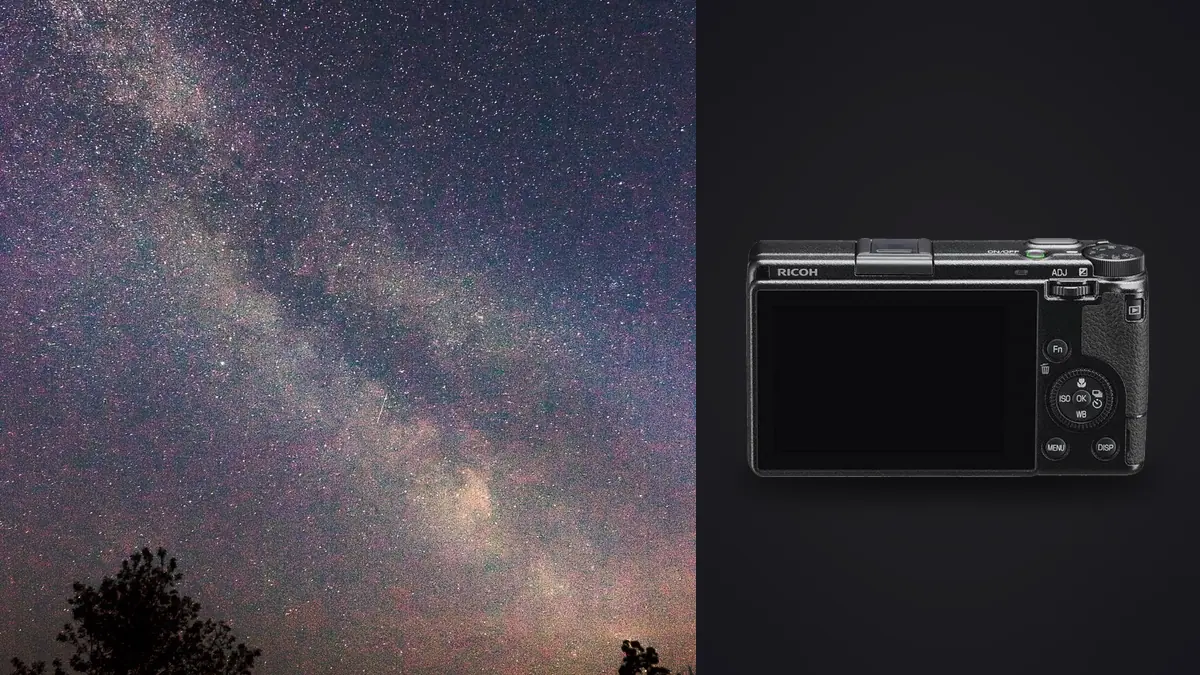
The Ricoh GR IIIx was never designed with astrophotography in mind. It has a fixed 26.3mm lens (roughly 40mm full-frame equivalent), an f/2.8 maximum aperture, and a marketing story built entirely around street photography: fast, quiet, pocketable, ready in under a second. None of that reads like a night sky camera. And yet I've taken mine to three different dark sky sites over the past year, mostly because it's the camera that's actually in my jacket when I decide, at 11pm, that the sky looks worth shooting. This piece is about what that camera can and can't do once you point it upward, and specifically how star stacking works when your only lens is a 40mm equivalent prime you can't swap out.
If you came here expecting a camera that rivals a tracked full-frame rig with a 14mm f/1.8, it doesn't, and I'd rather say that up front than bury it in a closing paragraph. What the GR IIIx does well is nightscapes: foreground plus sky, a person or a tree or a ridge line anchoring a frame that also happens to have the Milky Way in it. That's a narrower use case than "astrophotography" as a category, but it's a real one, and the camera is surprisingly capable inside it.
The 40mm field of view changes your whole plan
Most astro guides assume you're shooting somewhere between 14mm and 24mm, wide enough to fit a horizon-to-zenith slice of sky with room for foreground. The GR IIIx's 40mm equivalent framing is roughly half that width. You lose the sweeping Milky Way arch entirely unless you're stitching a panorama, and even a single galactic core shot crops in tighter than most people expect from a "wide angle" astro image.
In practice this pushes you toward compositions that are more about a subject silhouetted against stars than a landscape dominated by sky. A single pine tree, a tent, a person standing on a ridge, a lighthouse. The GR IIIx's classic street-shooter framing habits (fill the frame, get close, simplify) translate surprisingly well to this. I've had more luck treating the camera as a "portrait of a place at night" tool than trying to force it into wide vista astro shots it was never built to take.
If you do want the wider view, panorama stacking is the workaround. Shoot a row of 4 to 6 overlapping frames at the same exposure settings, sweeping the camera left to right on a tripod (or handheld with practice, since there's no interchangeable panorama head to buy for this body), then stitch afterward. It adds a step, but it's the only way to get GR IIIx files into genuinely wide night sky compositions.
Settings that hold up once it's actually dark
The GR IIIx's manual mode gives you shutter speeds down to 30 seconds and ISO up to 102400, though usable ISO for astro is a lot lower than that ceiling suggests. On the APS-C sensor, I stop trusting noise performance somewhere around ISO 3200 to 6400 for anything I plan to stack or print large. Past that, the files get usable for a quick share but not for serious editing.
Aperture isn't really a decision here since the lens is fixed at f/2.8 wide open. That's respectable for a compact but a stop or more behind the f/1.4 to f/1.8 primes serious astro shooters reach for on interchangeable-lens bodies. It means you lean harder on shutter speed and ISO to compensate, which is exactly why star stacking (shooting several exposures instead of one heroic long one) matters more on this camera than on a faster lens.
Focus is the part that trips people up first. There's no dedicated infinity focus lock button, so I set focus manually via the touchscreen, zoom in digitally on a bright star using the magnified live view, and nudge the focus ring control (the front dial in manual focus mode) until the point looks as tight as it's going to get. Autofocus in near-total darkness on this camera is not reliable enough to trust for a whole session, even with the AF assist light, because there's rarely a high-contrast edge for it to grab onto in a starfield.
A few settings worth locking in before the session starts:
- Shake reduction off once the camera is on a tripod (leaving it on can introduce a very faint blur on long stationary exposures on some bodies, and it does nothing useful when the camera isn't moving)
- Self-timer or the smartphone app as your shutter release, since pressing the shutter button by hand on a body this light and small transmits enough vibration to soften a 20-second exposure
- Long exposure noise reduction turned off for stacking work, since it doubles your time between frames (a dark frame equal to your exposure length runs after every shot) and you're going to handle noise reduction in the stack itself
In-camera Interval Composite versus shooting a stack yourself
This is where the GR IIIx actually offers something distinctive. Buried in the shooting mode menu is Interval Composite, which fires a sequence of exposures at settings you define and blends them in-camera using a lighten-mode composite, essentially building a star trail image without ever touching a computer. It's genuinely useful for star trail work in the field when you don't want to carry a laptop, and I've used it for quick trail shots where I just wanted a result before packing up.
The tradeoff is that Interval Composite bakes the blend in at capture time. You get a JPEG-first result with limited room to reprocess individual frames afterward, and it's built for trails (streaking stars) rather than the pinpoint-star stacking most people mean when they say "star stacking" for noise reduction. For that second kind of stacking, where you want stars to stay as points and just want a cleaner, lower-noise sky, you're better off shooting a raw sequence manually and combining it in dedicated software later.
| Approach | Typical settings on GR IIIx | Frame count | Best for | Main limitation |
|---|---|---|---|---|
| Single long exposure | 25-30s, f/2.8, ISO 3200-6400 | 1 | Quick documentation, low effort | Noisiest result, no recovery from a bad frame |
| In-camera Interval Composite | 15-20s per frame, f/2.8, ISO 1600-3200 | 60-200 (30-90 min session) | Star trails without a laptop | Blend is baked in; stars streak, not point sources |
| Manual raw sequence for stacking | 10-15s per frame, f/2.8, ISO 1600-3200 | 15-30 | Low-noise nightscape with point stars | Requires desktop stacking software and more editing time |
| Panorama sweep | 15-20s per frame, f/2.8, ISO 3200 | 4-6 per row | Wider field than the 40mm lens allows natively | Stitching errors near the horizon if the tripod isn't level |
Why 10 to 15 seconds is the sweet spot for the raw sequence method
At 40mm equivalent, star trailing (the streaking caused by Earth's rotation during a long exposure) becomes visible sooner than it would on a wider lens, since a longer focal length magnifies apparent motion across the frame. I keep individual sub-exposures under 15 seconds when I want stars as clean points rather than short arcs, which is shorter than the 20-25 second rule of thumb people quote for 14-20mm lenses. Shooting more, shorter frames and stacking them gets you the same total light gathering as one long exposure, but without the trailing and with a real noise reduction benefit once they're combined.
What actually happens after the shoot: culling and stacking the files
A 20-30 frame stacking sequence, plus a couple of test shots and a panorama sweep or two, adds up fast. One night at a dark site near me produced just under 400 raw files by the time I packed up, and a meaningful chunk of those were near-duplicate frames from the interval sequence where nothing changed except which pixels the sensor noise landed on. Sorting that by hand, at 1am, with cold fingers, is exactly the kind of task I've stopped doing manually. I run the folder through imagic first, which clusters the interval burst as a group and scores each frame's sharpness so I can see at a glance which ones actually nailed focus on the stars before I bother opening a stacking tool. It's local processing with no upload step, which matters more than it sounds like it should when you're standing somewhere with no signal at all, which describes most good dark sky spots by definition.
For the actual stacking, I use dedicated astro stacking software rather than anything general-purpose. DeepSkyStacker and Sequator both handle star alignment (correcting for the fact that stars drift slightly between frames) and Starry Landscape Stacker is built specifically for nightscapes where you have a static foreground and a moving sky, which is the exact situation a GR IIIx shot with a person or tree in frame usually produces. These tools align on the stars, average out the sensor noise across your stack, and hand you back a single frame that's meaningfully cleaner than any one exposure in the set.
Once I have a stacked result I like, I bring it back into imagic for the actual edit and apply the apply_my_style preset I trained on my own past night edits, so the color balance and contrast treatment stay consistent across a season's worth of dark sky trips instead of me re-inventing a look every time. It's a small thing but it's saved me from a folder of astro shots that all look like they were graded by five different people. If your culling habits generally feel slower than they should be at 1am with cold hands, the workflow tips in 10 tips for a faster photo workflow apply just as much to a night session as they do to a wedding take.
Battery life and the practical stuff nobody mentions in spec sheets
The GR IIIx's battery is small, rated for roughly 200 shots per charge under CIPA testing, and long exposure sequences chew through that faster than the number suggests because the screen stays active and the sensor is working continuously through an interval sequence. Cold nights make it worse. I've watched a fully charged battery drop to a warning icon after 90 minutes of interval shooting at 8°C.
I now carry two spare batteries and, more usefully, charge the camera in place via USB-C from a small power bank clipped to the tripod leg during long sequences. The GR IIIx supports charging while powered on, which effectively removes the battery ceiling for anything short of an all-night trail sequence, as long as you remember the cable and don't mind the tether.
Card speed matters less here than people assume, since you're not shooting continuous high-speed bursts, but card capacity does. A night of raw files plus test shots plus a panorama or two will comfortably clear 15-20GB, and I've filled a 64GB card on a single long session more than once.
Where this camera earns its place and where it doesn't
I wouldn't buy a GR IIIx specifically for astrophotography, and I don't think anyone should. If deep sky or wide Milky Way work is the goal, a fast wide prime on an interchangeable-lens body, ideally with a star tracker, does a better job and does it with less friction. But that's not really the comparison that matters to me. The comparison that matters is: this is the camera I already own, already carry, and already trust for everything else I shoot, and it turns out to be a genuinely good tool for a specific kind of night shot, the tight, subject-anchored nightscape rather than the sweeping observatory-style panorama.
For anyone weighing whether to buy dedicated astro gear or work with what's already in their bag, I'd say try the raw-sequence stacking method with whatever camera you have before spending money. It taught me more about exposure discipline and focus technique at night than any wide-lens setup would have, mostly because the GR IIIx doesn't forgive sloppy focus the way a genuinely wide lens does.
Frequently Asked Questions
Can the Ricoh GR IIIx shoot the Milky Way at all with its fixed 40mm lens?
Yes, but expect a cropped-in view of the galactic core rather than a wide arch across the sky. For a wider field, shoot a panorama sweep of 4 to 6 overlapping frames and stitch them afterward. A single frame works fine for a tighter composition where the core sits behind a specific foreground subject.
Is the built-in Interval Composite mode the same as star stacking for noise reduction?
No. Interval Composite blends frames to build star trails (streaks), and the blend is baked in at capture. Stacking for noise reduction with point-source stars requires shooting a raw sequence manually and combining the files afterward in software like Sequator or Starry Landscape Stacker.
What's the longest exposure I can use before stars start to trail on this camera?
Because the 40mm equivalent focal length magnifies apparent star movement more than a wider lens would, I keep individual exposures under 15 seconds if I want stars to stay as clean points rather than short streaks. Wider lenses can typically push closer to 20-25 seconds before trailing becomes obvious.
Does the lack of interchangeable lenses rule the GR IIIx out for serious night photography?
It rules it out for deep sky and wide-vista Milky Way work where a fast, ultra-wide prime is the standard tool. It doesn't rule it out for nightscape and star-trail work, which is a narrower but still legitimate corner of astrophotography that the camera handles well given its size and the fact that most people already have it with them.