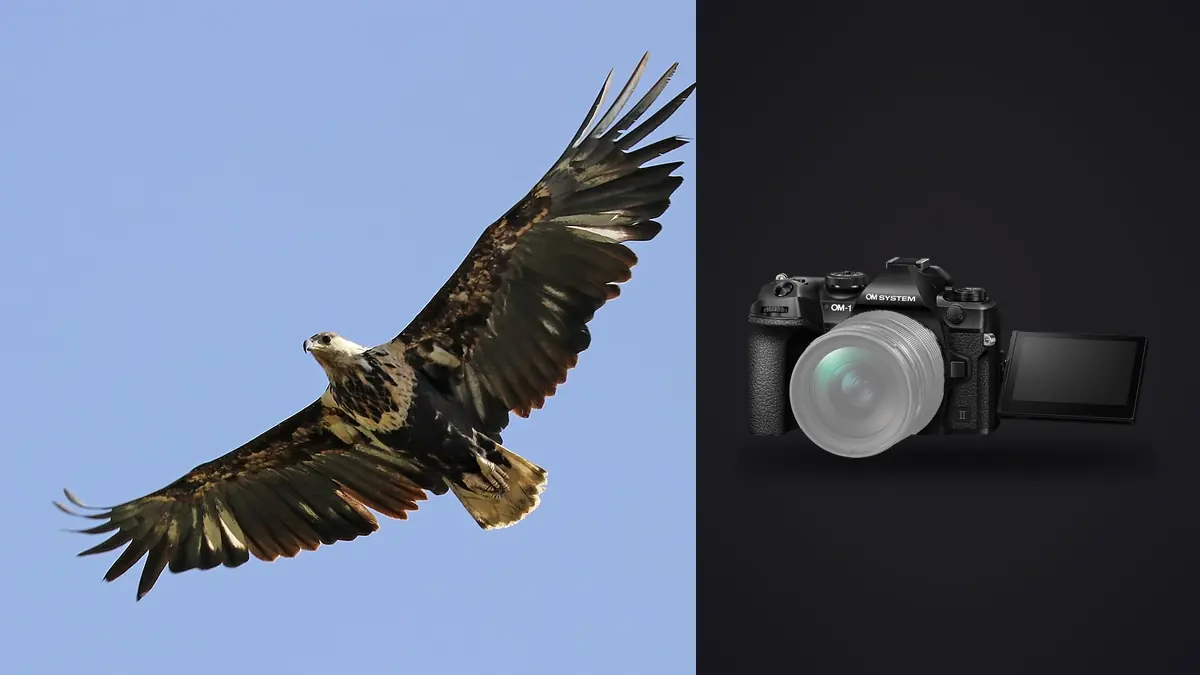
Why This Body Ended Up in My Bird Bag
I switched to the OM-1 Mark II after two seasons of shooting ospreys and gulls with a full-frame body strapped to a 500mm f4, and the thing that finally sold me wasn't a spec sheet, it was my shoulder. Micro Four Thirds gets dismissed a lot in wildlife forums, usually by people who haven't hauled a 600mm prime up a dune at 5am. The Mark II doesn't out-resolve a modern full-frame sensor, and I'm not going to pretend it does. What it does is put a genuinely fast, genuinely weather-sealed body in front of a lens system that stays light enough to hand-hold all day, and that trade-off matters more for birds in flight than almost any other genre of photography, because the difference between getting the shot and missing it usually comes down to how quickly you can get the camera up and tracking.
This isn't a spec dump. I've had the Mark II in the field since spring, mostly on the coast working terns, gulls, and the occasional osprey dive, plus a few trips inland for buzzards and kestrels. What follows is what actually changed from the original OM-1, what still frustrates me, and how I've adjusted my RAW workflow now that a single afternoon of Pro Capture bursts can leave me with more files than a full week used to.
The Sensor Question: Does 20.4MP and a 2x Crop Actually Help
The Mark II keeps the same 20.4MP stacked BSI sensor as the original OM-1, not a new sensor, which annoyed some people at launch. For birds in flight, though, the number that matters more than resolution is the 2x crop factor. A 300mm f4 PRO becomes a 600mm f4 equivalent in terms of framing. Add the MC-20 teleconverter and you're at a 1200mm equivalent field of view for the weight of a lens that a single person can carry on a shoulder strap for six hours without needing a break. On a full-frame system, getting equivalent reach means either a much heavier super-telephoto or cropping hard in post, and cropping hard in post is exactly where a 20MP sensor starts to hurt. I've had shots of a hovering kestrel where I still cropped another 20-30%, and the files hold up fine for web and even modest print sizes, but I wouldn't push much further than that for anything larger than a 16x20.
The practical upshot: if your subject is already filling a good portion of the frame because of the crop factor advantage, you need less aggressive cropping afterward, and that's where the format earns its keep. If you're the kind of shooter who likes to shoot wide and crop to the bird later, a full-frame 45MP+ body will give you more room to work with. I've made peace with framing tighter in camera instead.
Autofocus in the Real World: Bird Detection, Not Bird Magic
OM System's bird-detection AI is genuinely good at what it's designed for, which is finding a bird-shaped object against a reasonably separated background and locking onto the eye or head. Point it at a tern against open sky and it grabs the eye almost instantly, holds it through banking turns, and rarely lets go unless the bird crosses in front of something with similar contrast. Point it at a heron picking through reeds at the edge of a marsh and it gets confused more often, sometimes snapping to a reflection or a patch of reed that isn't the bird at all. That's not a knock specific to OM System, every subject-detection system I've used struggles with cluttered backgrounds, but it's worth knowing going in: this camera is at its best against sky, water, or anything that gives the algorithm clean separation.
One thing that did improve meaningfully over the original OM-1 is how the Mark II holds onto a subject after a brief occlusion, like a bird passing behind a branch or another bird crossing the frame. The original would sometimes hunt and lose the plot; the Mark II tends to pick the subject back up faster. It's not perfect and I still lose the odd sequence, but the failure rate dropped enough that I stopped mentally budgeting for it.
Menu settings I actually use
I run AF subject detection set specifically to Bird (not the generic Animal setting, which is tuned more for mammals and misses a surprising number of flight shots), C-AF with a small to medium target size, and I keep AF limiter off unless I'm working a known distance range, like a nest box or a fixed perch, where limiting the focus range stops the lens from hunting out to infinity when a bird momentarily leaves the frame. I also shoot almost entirely with back-button focus, which matters more here than on some other systems because it lets me disengage subject tracking instantly if the AI locks onto the wrong thing, like a wave crest instead of a diving gannet.
Pro Capture Mode and Drive Speeds
Pro Capture is the single feature that changed how I photograph birds taking off. The camera buffers frames continuously while you half-press the shutter, so when a perched osprey finally commits to launching, a bird whose exact takeoff moment you can never predict, you get frames from before your finger physically reacted. I used to miss that first wingbeat constantly on other systems. Now I rarely do.
The table below is how I actually think about drive mode selection in the field, not the marketing framing:
| Drive Mode | Max Frame Rate | AF/AE Behavior | Where I use it |
|---|---|---|---|
| Mechanical shutter | 10 fps | Full continuous AF/AE | Backlit or low-light scenes where I want to avoid electronic shutter banding |
| Sequential Low (electronic) | Adjustable, up to ~20 fps | Full continuous AF/AE | Slow gliders like herons or vultures riding thermals |
| Sequential High 1 (SH1) | 25 fps | Full continuous AF/AE | Standard flight sequences, most gulls and terns |
| Sequential High 2 (SH2) | Up to 50 fps | Continuous AF/AE tracking (a real jump from 25 fps on the original OM-1) | Erratic fliers, swifts and swallows changing direction fast |
| Pro Capture SH | Up to 120 fps | Focus/exposure locked from the first buffered frame | Unpredictable launch moments, perched-bird takeoff |
The SH2 improvement is the one veteran OM-1 shooters will actually feel. On the original body, pushing past 25fps meant giving up continuous autofocus, which was a real limitation for anything darting or changing direction mid-flight. The Mark II holds tracking all the way to 50fps, and that's the setting I reach for with swallows working a hedgerow, where the flight path changes three times a second and locked focus from the first frame just isn't good enough.
The tradeoff nobody advertises loudly: the camera still writes to dual UHS-II SD cards, not CFexpress. Run a long SH2 burst with RAW+JPEG enabled and you'll feel the buffer clear more slowly than you'd like, especially with a slower card in the second slot. I now shoot RAW-only during active flight sequences and reserve RAW+JPEG for slower perched work, purely to keep the buffer from choking mid-sequence.
Stabilization for Panning and Handheld Long Lenses
OM System quotes up to 8.5 stops of in-body stabilization with certain lenses, and while I don't shoot static subjects handheld at absurdly slow shutter speeds often (birds in flight need shutter speed regardless of how stable the sensor is), the stabilization pays off in a different way: it steadies the viewfinder image while panning at 1/2000s and faster, which makes it easier to keep a fast-moving bird centered in the frame through the EVF. That sounds like a small thing until you've tried panning a diving gannet through a shaky viewfinder at 400mm equivalent versus a stabilized one. The difference in how many frames land with the eye in focus, rather than the wingtip, is real.
Lens Pairings That Make Sense
Three lenses cover almost everything I shoot birds in flight with on this body. The 150-400mm f4.5 TC1.25x PRO is the one I reach for when reach matters most, since the built-in 1.25x teleconverter gets you to 500mm f5.6 without swapping glass, a 1000mm full-frame equivalent, and the autofocus stays fast even with the converter engaged. It's not a lens you forget you're carrying, though. For days where I'm hiking rather than posting up at a hide, the 100-400mm f5-6.3 IS II is the one that actually comes with me, light enough to hand-hold for hours and sharp enough that I don't feel like I'm compromising for the weight savings. The 300mm f4 PRO with the MC-20 teleconverter is my budget-conscious middle ground: a stop slower at 1200mm equivalent, autofocus that hunts a little more in low light with the converter attached, but a combination that costs meaningfully less than the 150-400mm while still reaching birds that won't let you get close.
Weather Sealing and a Week on a Boat
I spent five days on a small boat off the coast this year, salt spray on the body more or less constantly, no chance to wipe things down properly between shots. The IP53 rating on the OM-1 Mark II isn't a marketing number in that context, it's the reason the camera still works. I rinsed the body with fresh water at the end of each day (following OM System's own guidance, not something I'd improvise on a non-sealed camera) and had zero issues. That kind of sealing matters more for wildlife work than almost any other spec on the sheet, because the best bird activity so often happens in exactly the conditions that kill unsealed gear: rain, sea spray, dust kicked up by a raptor's wingbeats over dry ground.
What Happens After the Shutter: RAW Volume and Culling
Nobody warns you about this part going in. A single Pro Capture burst at 120fps run for even two seconds is nearly 240 ORF files, and I might trigger that burst a dozen times chasing one good takeoff sequence. Multiply that across a full day of terns working a jetty and I've come back from shoots with over 4,000 RAW files that all need sorting before I can even start actual editing. That volume is the real cost of this camera's speed, and it's the part that never shows up in a review focused on autofocus and frame rates.
I run those files through imagic before I open anything in an editor. The local sharpness scoring is what actually saves time here, because across a 30-frame burst of one takeoff, maybe four frames have the eye critically sharp and the rest are motion-blurred wingtips or slightly soft heads, and I don't want to judge that by eye at 100% zoom on four thousand images. The duplicate and burst clustering groups each Pro Capture sequence together automatically instead of leaving me to scroll through a flat unsorted folder, which on a big shoot day is the difference between an evening of culling and a week of it. Because it runs entirely on my laptop with no upload step, I can do this culling pass on the boat or in a hide with no signal, which matters more than it sounds like it should when you're three days from the nearest reliable connection.
Once I've got the keepers narrowed down, I lean on imagic's apply_my_style preset, trained on my own past edits rather than a generic look, to get a consistent starting point across a shoot that might span five different lighting conditions in one afternoon (overcast morning, harsh midday glare, backlit golden hour). It's not a replacement for finishing the edit by hand, but it means twenty keeper frames from a scattered day start from roughly the same place instead of me manually matching white balance and contrast across each one. If you're curious how the culling side of this actually works under the hood, I wrote more about the process in how AI photo culling works.
Battery and Card Management for Full Days in the Field
The Mark II keeps the same BLX-1 battery as the original, and burst-heavy days with the EVF running at the high refresh setting will drain it faster than the quoted CIPA numbers suggest, closer to 300-400 shots per charge in my actual use rather than the more generous lab figures. I carry three batteries for a full field day and charge via USB-C in camera overnight, which is convenient on multi-day trips where I'm not near a dedicated charger. On the card side, given the dual UHS-II SD slots rather than CFexpress, I've settled on matched fast V90 cards in both slots set to overflow rather than backup, since backup mode halves your effective buffer headroom during long bursts and I'd rather have the speed and back up to a laptop at the end of the day.
For context beyond the mastering om system om 1 mark ii for wildlife birding in flight guide focus in entry 55, continue with photography guide library. These resources connect the subject to a practical local review process.
Frequently Asked Questions
Is the smaller Four Thirds sensor really a disadvantage for birds in flight?
It's a tradeoff, not a straightforward disadvantage. You get less dynamic range and noisier high-ISO files than a modern full-frame sensor, noticeable if you're pushing ISO 6400 and above in low light. In exchange, the 2x crop factor means smaller, lighter lenses get you the same field of view as much larger full-frame super-telephotos, and lighter gear means longer handheld sessions and faster reaction time when a bird takes off unexpectedly. For flight photography specifically, where reach and reaction speed usually matter more than clean ISO 12800 files, I think the tradeoff favors this system more than it does for, say, low-light landscape work.
What's the realistic keeper rate from a Pro Capture burst?
From a typical launch sequence, I'd say somewhere between 10 and 20 percent of frames are genuinely usable, meaning sharp eye, good wing position, clean background separation. The rest are transitional frames, mid-wingbeat blur, or moments where the AI briefly lost the eye. That sounds low, but the alternative is missing the sequence entirely by reacting a half-second too late, which is what Pro Capture solves.
Which lens should I buy first if I'm building a birding kit around this body?
If budget allows one lens, the 100-400mm f5-6.3 IS II is the more sensible starting point over the flagship 150-400mm. It's light enough that you'll actually carry it on hikes rather than leaving it in the car, autofocus is fast enough for most flight work, and the price difference lets you put money toward extra batteries, cards, and a decent monopod instead.
How do I stop the RAW files from a big shoot day from becoming unmanageable?
Cull in passes rather than trying to judge everything at once. First pass, let software group your bursts and flag the sharpest frame per sequence rather than scrolling a flat folder of thousands of near-identical shots. Second pass, do your own eye check on just the flagged frames for wing position and composition, since sharpness alone doesn't tell you if the pose is any good. I run this two-pass approach through imagic specifically because it works offline, which matters when the shoot happens somewhere without reliable signal, and because it never uploads the files anywhere before I've decided what's worth keeping.
Where This Leaves Me
The OM-1 Mark II isn't the camera that will win a pixel-peeping contest against a 45MP full-frame body, and I don't think OM System is trying to win that fight. What it does well is let me carry serious reach without a serious back injury, keep tracking a bird through erratic flight at frame rates that actually hold focus, and survive conditions that would put an unsealed camera out of commission. The real cost isn't in the images, it's in the sheer volume of files a fast, weather-sealed body with Pro Capture generates, and building a culling workflow that can keep up with that volume matters just as much as the camera specs themselves.