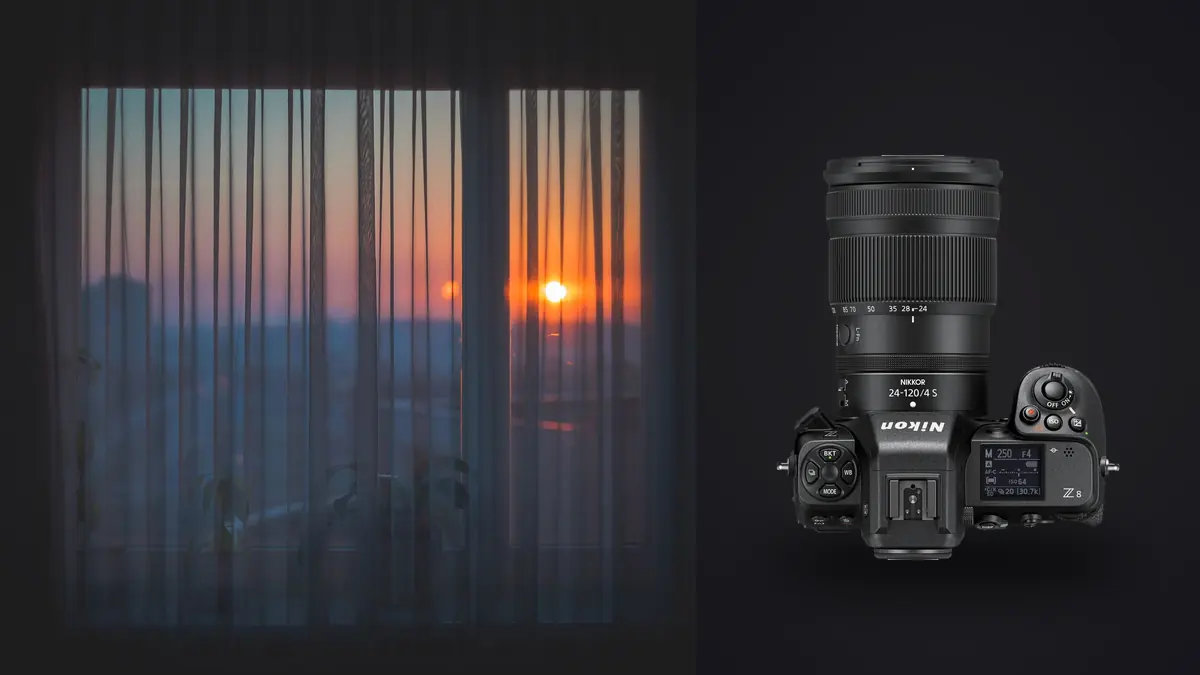
I picked up a Z8 with boudoir-style portraits in mind and honestly bought it for the wrong reason at first. I wanted the Z9's autofocus in a body that didn't look like a brick when I carried it into a bedroom or a rented hotel suite. What I didn't expect was how much the shutter itself would change the mood of a session. There's a specific kind of nervousness that comes with being photographed in lingerie or nothing at all, and a camera that clacks and whirs every time you press the button keeps reminding the client of that fact. The Z8 doesn't do that. It's quiet enough that after the first ten frames, most subjects stop flinching.
This isn't a spec sheet rundown. It's what actually matters when the subject is a real person in a vulnerable position, in a room that's usually smaller and darker than a proper studio, and where you don't get do-overs on trust once you've lost it.
The sensor and shutter matter more than the megapixel count
The Z8 uses the same 45.7MP stacked BSI sensor as the Z9, and the part of that spec sheet that actually changes how a boudoir session feels is the fully electronic shutter. There's no mechanical curtain to fire, no mirror to slap, nothing mechanical happening at all when you press the button. In a quiet bedroom at 2pm with soft window light, a DSLR shutter sounds like a gunshot by comparison. Clients notice. First-timers especially notice, and the ones who are already nervous about the whole idea of a boudoir shoot will visibly relax once they realize the camera isn't announcing every frame to the room.
The stacked sensor also all but eliminates rolling shutter skew, which matters more than people think for boudoir because so much of the work involves a subject shifting weight, turning a shoulder, or moving fabric mid-frame while you're shooting a burst. On a slower sensor you'll occasionally get a warped edge on a moving arm or a curtain in the background. I've never caught it on the Z8.
45.7 megapixels is a genuine double-edged sword here. It's fantastic for the tight detail crops clients often want (collarbone, hands, the curve of a shoulder against sheets), but it means a two-hour session can easily produce 1,200 to 1,800 RAW files once you count every burst. Nobody culls that by eye efficiently, and I'll get into how I handle it further down.
The lenses I actually reach for
Boudoir glass needs to do two contradictory things: render skin smoothly without turning it waxy, and stay sharp enough on the eyes that the client doesn't look soft everywhere. I rotate through four lenses depending on the room and the subject's comfort level with proximity.
| Lens | Typical use | Working distance in a small bedroom | What I'd flag |
|---|---|---|---|
| Nikkor Z 35mm f/1.4 | Environmental frames, full-length in tight rooms | 1.5-2.5m, works even in cramped hotel rooms | Needs care near the edges at f/1.4 or hips and thighs distort |
| Nikkor Z 50mm f/1.2 S | Half-length, the "default" lens for most of a session | 2-3m | Heavy on a small body for a long handheld session, but the falloff is the best of the four |
| Nikkor Z 85mm f/1.2 S | Tight portraits, face and upper body | 3-4.5m, awkward in small rooms | Needs real distance; I mostly use this one in larger suites or outdoors |
| Nikkor Z MC 105mm f/2.8 | Detail shots: hands, jewelry, garter clips, texture on fabric | 0.3m macro to normal portrait range | Doubles as a portrait lens in a pinch, genuinely versatile |
If I had to keep exactly one, it's the 50mm f/1.2 S. It's not the lightest option and the front element is enormous, but the way it renders skin at f/1.8 to f/2.2 (I rarely shoot it wide open for full-body work) is the closest thing to the look people ask for when they bring a Pinterest board and say "like this, but soft." The 85mm gets more use outdoors or in genuinely spacious suites where I can back up. In a standard hotel room you'll be shooting from the doorway or standing on the bed to get an 85mm frame, which isn't practical.
Working in rooms that weren't built for photography
Most boudoir sessions I shoot happen in bedrooms, hotel suites, or small home studios, not in a proper 20-foot studio with room to move lights. That constraint shapes the whole approach, and it's where the Z8's autofocus and stabilization earn their keep.
Subject detection that doesn't need babysitting
I run 3D-tracking with human subject detection and let eye-detect handle the rest. In low, warm bedroom lighting (think a single lamp and a sheer curtain over a window) the Z8's AF still locks reliably where older Nikon bodies would hunt. I keep it on the near eye by default and switch manually when a pose has the subject looking away or down, which happens a lot in boudoir because it reads as more intimate than direct eye contact.
In-body stabilization instead of a second light
A lot of boudoir photographers lean on a single continuous light or window light rather than flash, specifically because a strobe firing repeatedly in someone's bedroom breaks the mood the same way a loud shutter does. That means you're often shooting handheld at slower shutter speeds than you'd like. The Z8's in-body stabilization buys real room here. I'll comfortably handhold the 50mm at 1/60s and still get sharp files, which lets me keep ISO around 800-1600 instead of pushing to 3200+ just to freeze motion. That difference shows up directly in how clean skin tones look before any noise reduction.
Getting skin tones right in mixed light
Boudoir subjects are unusually sensitive to how their skin looks in the final images, more than almost any other genre I've shot. Nobody wants to look orange, green from a bad ceiling fixture, or blotchy from noise. A few habits that have saved me repeatedly:
I shoot a custom white balance off a gray card the moment I walk into a new room rather than trusting auto white balance, because most bedrooms and hotel suites mix warm lamp light with cooler window light, and the Z8's auto WB will split the difference in a way that flatters neither. I also keep Picture Control on a flat, low-contrast profile for the shoot itself (not for delivery, just for reviewing on the rear screen) so I'm not fooled by an in-camera contrast boost into thinking a frame is more usable than it is.
Native ISO on the Z8 runs 64 to 25600, and I treat anything past ISO 3200 as a last resort for boudoir specifically, because skin noise reads as texture problems in a way that landscape or street noise doesn't bother people about. If a room genuinely can't support 1600 or lower without a tripod, I'll add a single small LED panel bounced off a wall or ceiling rather than pushing ISO further.
Camera setup I actually use, session to session
I keep a dedicated custom bank (U1 on the mode dial) configured specifically for boudoir work, separate from my general portrait bank:
- Electronic front-curtain off, fully electronic shutter on, silent mode confirmed
- Continuous low, roughly 5-8fps rather than the full 20fps burst, because boudoir poses shift slowly and I don't need 40 near-identical frames of a single held pose
- Back-button AF-on, shutter button release only, so I can recompose without losing focus lock between poses
- Auto-ISO capped at 3200 with a minimum shutter speed floor tied to focal length
- Dual card slots set to RAW on the CFexpress card only, JPEG backup off, since I don't need a second copy slowing down the write buffer mid-session
That continuous-low choice is deliberate and it's the one setting I'd tell someone new to this genre to change first. The instinct coming from sports or events is to hold the shutter down and let the buffer catch everything. In boudoir, that habit just multiplies your culling workload for no real benefit, because the pose isn't changing fast enough to need 20 frames a second.
What happens after the shutter closes
Even with a disciplined burst rate, a full session still lands somewhere between 600 and 1,000 RAW files once you count wardrobe changes and location moves. This is the part of boudoir work that doesn't get talked about enough: the culling is genuinely harder than the shooting, because so many frames look almost identical at a glance and the difference between "keeper" and "delete" is a fraction of a stop of eye sharpness or a slightly better hand position.
I moved my culling pass over to imagic mainly because of how it handles burst clusters. Even at 5-8fps, three or four poses held for two or three seconds each still produce runs of near-duplicate frames, and imagic's local burst clustering groups those automatically instead of making me scrub through them one by one in a flat filmstrip. Within each cluster it runs local sharpness scoring, which for boudoir specifically means catching the one frame where the near eye is actually crisp rather than the one where the composition looks fine at thumbnail size but the focus drifted half an inch onto the eyebrow.
The other reason I stuck with it for this genre specifically is that all of it runs locally on the machine, nothing gets uploaded anywhere during the cull. That matters more here than in almost any other photography I shoot. Subjects may sign model releases and usage agreements, but they're still trusting the photographer with images they'd never want floating through some third-party server, even briefly. Not having to explain to anyone where their files are being processed is worth something. If your workflow guide skips over culling entirely, it's worth reading how AI photo culling actually works before assuming any tool handles bursts the same way.
For the edit itself, I built an imagic style preset from about 40 of my own previously delivered boudoir edits (the apply_my_style feature trains on your own past work rather than a generic filter), and it gets my culled selects to roughly 80% of a finished look before I go in by hand on skin retouching and dodge-and-burn. It's not a replacement for that hand work, but it means I'm not resetting white balance and tone curves from scratch on 200 selects every single time, which used to be the slowest part of my week.
Frequently Asked Questions
Is the Z8 actually quiet enough for a boudoir session, or is "silent shutter" marketing talk?
It's genuinely quiet. There's no mechanical shutter to fire at all, so what you hear is whatever fake shutter sound you've left turned on in the menu, and I switch that off entirely for boudoir work. The only sound left is the very faint click of the shutter button itself under your finger. Clients who've been photographed with a DSLR before usually comment on the difference within the first few frames.
Do I need the 85mm f/1.2 S, or can I get by without it?
You can get by without it if most of your sessions happen in small bedrooms or hotel rooms, because you often won't have the physical distance to use it properly. It earns its keep in larger suites, outdoor boudoir, or studio spaces with real depth. If you're shooting mostly in clients' homes, I'd put the budget toward the 50mm f/1.2 S first.
How many images should a client actually expect from a two-hour boudoir session?
I deliver 35-50 final edited images from a two-hour session, culled down from 700-900 RAW files. That ratio surprises new clients, who sometimes assume more captured frames means more final images, but a tight, consistent-looking gallery beats a bloated one every time in this genre specifically, since clients are already anxious about how many "bad" versions of themselves exist somewhere.
Is the Z8 overkill for boudoir compared to a cheaper Nikon body?
The resolution and burst speed genuinely are more than boudoir strictly requires, a Z6III would cover the technical needs for most sessions. What you're paying the premium for is the shutter, the autofocus reliability in dim mixed lighting, and the stabilization that lets you skip a second light source. Those three things are exactly the ones that affect how a session feels to the client, which is why I think the upgrade is worth it for this genre specifically even though the megapixel count is arguably wasted.