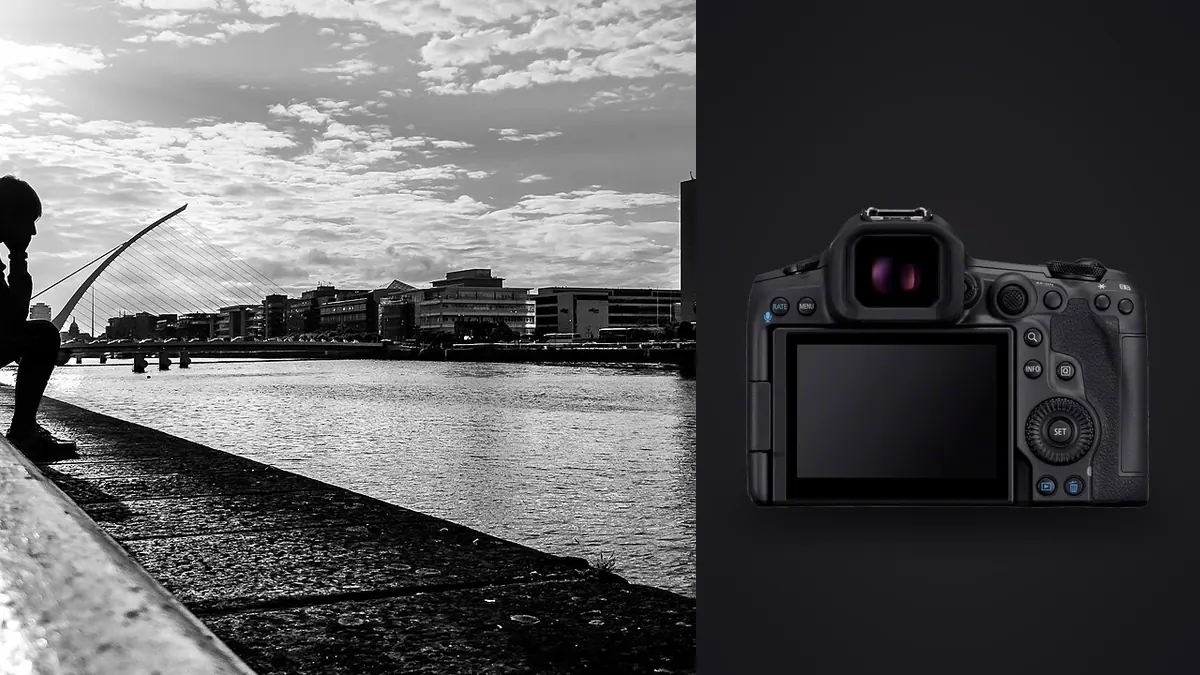
I put the R5 Mark II through six weeks of actual street work before I let myself write anything about it: a covered market in Palermo, three overcast afternoons in Glasgow, a street festival in Oaxaca where I was shooting purely for myself. That's the only way I trust a camera review, mine included. Spec sheets tell you what a body can theoretically do. A market stall owner waving you off, a kid darting between legs, low light under a market awning at 4pm in November, that's what tells you what a camera actually does.
Street and documentary work punishes cameras differently than most genres. You don't get to compose slowly. You don't get a second take. The camera either gets out of your way or it becomes the thing you're fighting instead of the moment in front of you. So this isn't a spec dump. It's what changed in my actual shooting once I switched from an R6 Mark II to the R5 Mark II for this kind of work, and where I think Canon still left something on the table.
The sensor and the shutter are the real story
The 45-megapixel stacked sensor is the headline number, but for street work the stacking matters more than the resolution. Rolling shutter on the original R5 was noticeable if you panned fast under electronic shutter, enough that verticals in architecture would visibly skew. On the Mark II, I've shot fast pans of cyclists and market carts at full 30fps electronic and the distortion is close to a non-issue. That's the actual unlock: you can leave the camera in fully silent electronic shutter mode all day, in a place where a mechanical clack draws eyes, and not worry about warped frames when someone crosses your composition quickly.
45 megapixels is more resolution than most street work needs, honestly. I crop maybe one frame in twenty tightly enough to use it. What the extra data buys you instead is room to correct a composition after the fact when you didn't have time to recompose in the moment, which happens constantly when you're working a crowd. I've saved frames by cropping a stray elbow out of the corner that I'd have deleted outright on a 24-megapixel body.
Pre-capture is the feature I didn't expect to lean on
Canon's Raw burst with pre-capture buffers roughly half a second of frames before you fully press the shutter, as long as you've half-pressed to wake focus first. I was skeptical. In practice, on a narrow street in Palermo where a woman stepped out of a doorway carrying a birdcage, this is the only reason I have that frame at all. My reaction time to "that's the shot" is not fast enough to catch the peak moment on a normal shutter press. The buffer catches what my brain hadn't finished processing yet. It only works in Raw burst mode though, which locks you into 12-bit raw and a slightly different file handling workflow, so I don't run it as a default. I turn it on when I'm somewhere with unpredictable foot traffic and off when I'm doing slower documentary sequences where I want full manual control over exposure per frame.
Autofocus and eye control, separating the useful part from the gimmick
Eye Control AF gets a lot of attention and I want to be straight about it: it works, but it is not the street photography superpower some early coverage suggested. Calibration drifts if you shoot with and without glasses, or if lighting on your face changes dramatically, which happens constantly when you're moving in and out of shade. I recalibrate more than I'd like. When it's dialed in, though, it is genuinely faster than joystick or touch AF for picking a specific face out of a crowd scene, because you're already looking at the person you want in focus. For a static portrait-adjacent documentary frame, that's a real advantage. Where the R5 Mark II actually earns its keep for this genre is subject detection reliability at awkward angles. Faces turned three-quarters away, partially obscured by a hand or a scarf, backlit against a bright doorway: the hit rate on continuous eye AF in those conditions is noticeably better than what I got out of the R6 Mark II, and far better than the original R5. I stopped thinking about focus for a lot of situations where I used to be actively managing it, which frees up attention for framing and timing, which is the part of street photography that actually matters.
Camera comparison for this specific use case
People ask me to compare the R5 Mark II against the obvious street cameras rather than against other Canon bodies, so here's the table I wish existed when I was deciding what to carry for a two-week documentary trip.
| Camera | Silent shooting | Max continuous (silent) | Body weight | Typical carry weight w/ one prime | Best fit for street work |
|---|---|---|---|---|---|
| Canon EOS R5 Mark II | Full electronic, low rolling shutter | 30fps | 646g | ~950g (RF 35mm f/1.8) | Fast-moving crowds, unpredictable subjects, low light |
| Fujifilm X100VI | Leaf shutter, near silent | 20fps (crop) | 478g | 478g (fixed lens) | All-day carry, discretion, single-focal-length discipline |
| Leica Q3 | Electronic, silent | 15fps | 743g | 743g (fixed lens) | Slower, deliberate documentary sequences |
| Sony A7CR | Full electronic, mild rolling shutter | 8fps (uncropped) | 515g | ~820g (Sony 35mm f/1.8) | Compact travel documentary, less action-heavy |
| Ricoh GR IIIx | Fully silent, no mechanical option | 4fps | 262g | 262g (fixed lens) | Pocket carry, quick candid grabs, not for fast sequences |
The honest read of that table: if your street work is mostly slow, patient, single-frame documentary storytelling, the R5 Mark II is more camera than you need, and something like a Q3 or an X100VI will get you closer to invisible while you work. If your subjects move unpredictably (kids, markets, protests, transit), the buffer depth and burst speed of the R5 Mark II earns its weight and its price. I carry the R5 Mark II when I know a shoot involves motion I can't schedule, and I carry something smaller when I know it doesn't.
Lens pairings that actually make sense
The RF 35mm f/1.8 Macro IS STM is the lens I reach for most on this body for documentary work. It's small enough that the whole rig doesn't scream "professional camera," which matters more than people admit when you're trying to photograph someone without changing how they behave. The RF 28mm f/2.8 STM is even smaller and cheaper, and I use it when I want to get physically close and let wide-angle distortion do some of the storytelling work, doorway scenes and market stalls especially.
For longer documentary sequences where I need to hang back, the RF 24-105mm f/4L is the compromise lens. It's not fast enough for dim interiors, but paired with the R5 Mark II's in-body stabilization (rated to 8.5 stops with compatible lenses) I've handheld usable frames at a quarter second, which covers a surprising amount of the low-light range I actually encounter. I don't reach for the RF 50mm f/1.2L for street work. It's beautiful glass but it's heavy enough to change how long I'm willing to carry the camera on my shoulder, and on a body already pushing 650 grams that adds up over an eight-hour day.
What a real shoot day does to your card, and why culling stops being optional
Here's the part camera reviews skip. A single afternoon of market shooting with pre-capture and 30fps bursts on this body routinely leaves me with 2,000 to 3,000 frames. Most of those are near-duplicates: five or six frames of the same gesture a fraction of a second apart, one of which has the eyes open and in focus and the rest of which don't. Scrolling that manually in a Lightroom catalog at the end of a twelve-hour shooting day is how good frames get missed, not because they're hard to find but because you're tired and your judgment about "sharp enough" degrades by frame two thousand. This is the actual reason I run everything through imagic before I touch a raw file in an editor. It runs sharpness and focus scoring locally on the machine, no upload, which matters to me because a lot of this work involves people who didn't sign a release and I'm not comfortable routing their faces through someone else's cloud pipeline. It also clusters burst sequences and near-duplicates automatically, so instead of six versions of the same doorway frame I'm looking at one representative image with the best-focused pick already flagged. On a 3,000-frame day that's the difference between a two-hour cull and a twenty-minute one.
The editing pass, once the pile is smaller
Once I've got the real shortlist, maybe 150 to 200 frames out of that afternoon, the editing part is where consistency matters for a documentary series. I built a custom preset in imagic using apply_my_style, trained off a batch of edits I'd already done by hand on a previous project in a similar light. It doesn't replace judgment on a frame-by-frame basis, contrast and skin tones still need individual attention depending on the light in each scene, but it gets every frame in the batch to a consistent starting point that matches how I actually edit, instead of a generic preset that guesses at what "street documentary" should look like. For a body of work meant to run as a sequence rather than single hero shots, that starting-point consistency saves more time than any single editing shortcut I've found.
Where the camera falls short for this genre
I want to be fair about the downsides because most coverage of this camera skims past them. Battery life under heavy electronic shutter and pre-capture use is worse than Canon's stated numbers suggest, at least in my experience. I carry two spares for a full documentary day and have burned through all three on a long festival shoot. The menu system, while improved from earlier Canon bodies, still buries some of the settings I adjust most often for street work (specifically the pre-capture buffer length and the eye control calibration) two or three levels deeper than I'd like, which costs real seconds when a moment is developing in front of you. The body is also simply bigger than it needs to be for a genre that rewards being unnoticed. Next to the X100VI or a Ricoh GR, there's no pretending the R5 Mark II reads as anything other than "photographer with serious gear," and in some documentary contexts, particularly ones involving vulnerable subjects or sensitive situations, that visibility works against you. I've had subjects visibly change posture when they clocked the camera, something that essentially never happens with the smaller fixed-lens options.
Who this camera actually makes sense for
If you're shooting documentary work that involves fast, unpredictable subjects, kids, markets, transit, anything with real motion, the autofocus reliability and burst depth of the R5 Mark II genuinely change your hit rate compared to a body one tier down. If your documentary work is slower and more observational, where you're waiting for a scene to compose itself rather than chasing motion, you're paying for capability you won't use, and a smaller, quieter camera will serve the actual work better. I still carry both, and which one comes out of the bag depends entirely on what the day's subject is doing, not on which camera I'd rather be seen with.
Frequently Asked Questions
Is the Canon EOS R5 Mark II too loud or conspicuous for candid street photography?
In fully electronic shutter mode it's silent, no mechanical clack at all. The physical size and the lens you pair it with matter more for how noticeable you are than the shutter sound does. With a small prime like the RF 35mm f/1.8 it's manageable; with anything from the L-series lineup it reads as obviously professional gear.
Does the extra resolution over the R6 Mark II actually help documentary work?
Sometimes, mostly for after-the-fact cropping when you didn't have time to recompose, which happens often in street work. It's not the reason to choose this body over the R6 Mark II though. The autofocus reliability and buffer depth for pre-capture are the bigger practical gains for this genre specifically.
How should I handle culling after a high-volume burst shooting session?
Don't try to do it manually at full resolution in your editor of choice, it's slow and your judgment degrades over a large take. Running a first pass through dedicated culling software that scores sharpness and groups near-duplicate bursts locally, before you open anything in an editor, cuts the review time dramatically and catches the best frame in a sequence more consistently than tired eyes scrolling a filmstrip. Our workflow guide covers a few other habits that compound with this.
What lens should I start with if I'm buying this body specifically for street documentary work?
The RF 35mm f/1.8 Macro IS STM is the sensible default: small, fast enough for most available light, and versatile across environmental portraits and wider scene-setting frames. If you already know you shoot tight and close, the RF 28mm f/2.8 STM is cheaper and even less conspicuous, though you'll be working harder to avoid unwanted elements at the frame edges.