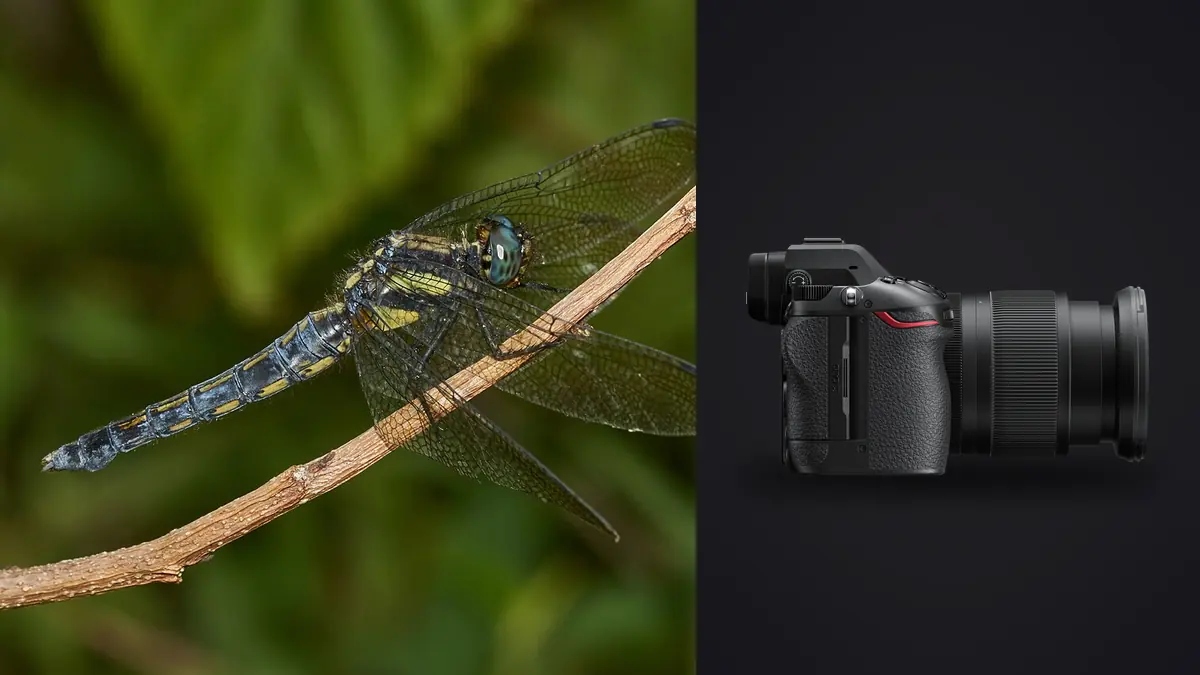
I spent most of last June and July on my knees in a reed bed with a Nikon Z6 III, chasing damselflies that would not sit still and jumping spiders that absolutely would. Macro insect work is a different game from anything else you shoot with this body: the depth of field is measured in millimeters, the subject can leave the frame in a tenth of a second, and you are usually doing all of this while also trying not to fall into a drainage ditch. This is what actually held up over a season of that, and what I'd tell someone before they buy the 105mm macro and head out at dawn expecting magic.
The sensor and autofocus, and what they don't solve for you
The Z6 III uses a partially stacked 24.5MP sensor, and the practical benefit for insect work is faster sensor readout than the older Z6 II, which cuts down on the rolling shutter skew you'd otherwise get from a dragonfly's wings blurring into a banana shape in electronic shutter mode. That matters more than the resolution bump. At 1:1 magnification you are not cropping in hard enough for 24.5MP to feel limiting, and honestly I'd rather have the readout speed and the buffer depth than another ten megapixels I'd just have to store.
Where people overestimate this camera is the autofocus. Nikon's subject-detection AF on the Z6 III is genuinely good at eyes on birds, dogs, and cats, but it is not tuned to lock onto a 12mm robber fly sitting sideways on a stem. At true macro distances I turn subject detection off entirely and shoot single-point AF-S with the smallest pinpoint box, or I focus manually and rock my body forward and back a centimeter at a time to walk the plane of focus onto the eyes. The camera's low-light AF rating down to -10 EV is more useful than any detection mode here, because it means the AF still locks in the shade under foliage where a lot of insects actually sit, rather than only in open sun.
The one autofocus feature that earns its keep is pre-release capture, available in the C30/C60 high-speed frame modes. It buffers up to a second of frames before you fully press the shutter, so when a bee finally takes off from a flower head you have a real shot at catching the wing position you wanted instead of reacting a beat too late. I leave it on for anything that might fly.
Glass matters more than the body here
I've run three different macro options on this camera over the season, and they are not interchangeable tools even though they all claim "macro" on the barrel. Working distance is the number that decides whether you get the shot or watch the insect bolt.
| Lens | Max magnification | Working distance at max mag | Stabilization | Weight | Best for |
|---|---|---|---|---|---|
| Nikkor Z MC 50mm f/2.8 | 1:1 | ~4.5cm from front element | None (relies on IBIS) | 260g | Flowers, stationary subjects, tight budgets |
| Nikkor Z MC 105mm f/2.8 VR S | 1:1 | ~14cm from front element | Lens VR + IBIS combined | 630g | Skittish insects, dragonflies, general field work |
| Laowa 100mm f/2.8 2x Macro APO | 2:1 | ~15cm at 1:1, closer past that | None, manual focus only | 638g | Extreme close-ups of mites, ant faces, compound eyes |
The 50mm is the one I recommend to anyone starting out, but it will teach you fast that four and a half centimeters of working distance is nothing. Anything with a nervous system will fly off before you're in position. I use it for spiderwebs, seed heads, and things that genuinely cannot run away. The 105mm S is what actually lives on the camera most days: fourteen centimeters doesn't sound like much until you're the one crawling toward a basking dragonfly, and the difference between spooking it and not is often exactly that gap. The Laowa is manual focus only, no electronic contacts at all, and it's a specialist tool. I bring it out maybe once a week when I specifically want 2:1 detail on something like a jumping spider's face, and I accept that I'll miss more shots than I keep because there's no AF assist and the depth of field at 2:1 is closer to a sheet of paper than a slice.
Settings that held up across a season of trial and error
Shutter speed and light change by the hour, not just the day
Cold mornings, roughly 6 to 8am in early summer where I shoot, insects are sluggish because they haven't warmed up yet. That's when I can work at 1/250s and f/11 without worrying about a subject bolting mid-frame. By 10am the same dragonflies are patrolling territory at speed and I'm at 1/2000s just to freeze a hover, which pushes ISO up fast on an overcast day. I stopped fighting this and now plan two separate outings: an early "portrait" session for static detail shots, and a later "action" session accepting more noise for flight shots. Trying to do both in one window means compromising on both.
Focus stacking works, but the camera won't finish the job for you
The Z6 III's Focus Shift Shooting mode will fire off a sequence of frames walking the focus point through a range you set, up to 300 shots with adjustable step width. For a beetle or a still damselfly this is genuinely useful, I typically run 25-40 frames at the second-narrowest step width and get enough overlap to stack cleanly later. What it does not do is blend those frames into a finished image in-camera. You're walking away from a stack of 30-plus RAW files per subject that still need to go through stacking software afterward, and if you shoot ten subjects in a session that's 300+ files just from stacking sequences, on top of your regular bursts.
Working distance discipline beats gear
The single biggest improvement in my keeper rate this season wasn't a setting, it was learning to approach at an angle instead of head-on, and to move on the exhale like you would stalking anything wary. Jumping spiders in particular seem to register a shadow crossing them as a threat faster than they register slow lateral movement. The vari-angle screen on the Z6 III actually matters here in a way I didn't expect, because it lets me shoot from ground level without putting my face down into the grass, which is one less big movement to spook a subject that's already primed to jump.
What a real field day does to your card, and what happens after
A decent insect morning with pre-release capture on, a few focus-stacked sequences, and normal bursts on anything that moves will put 600 to 1,000 RAW files on the card before lunch. Most of those are near-duplicates: five frames of the same damselfly with the wings in slightly different positions, a 30-frame stack that's only useful as a set, bursts where two out of fifteen frames actually have the eyes sharp. Sorting that by eye on a laptop screen at a campsite, squinting at focus peaking on tiny compound eyes, is genuinely the worst part of this whole hobby.
This is the point where I stopped doing it by hand. I run the day's card through imagic before I do anything else, entirely offline since there's rarely usable signal where I've been shooting these sessions. Its duplicate and burst clustering groups the flight sequences and focus-stacking sets automatically instead of me scrolling through them one at a time, and the local sharpness scoring is what actually matters for macro: it's checking focus at the pixel level rather than going by exposure or a thumbnail, which is the only way to catch that the antennae are tack sharp but the compound eye two millimeters back is just barely soft. That distinction is invisible on a laptop preview and it's the difference between a shot I keep and one I don't. If you haven't looked at how automated culling actually separates sharp frames from near-misses, this breakdown of how AI photo culling works covers the mechanics better than I can in a paragraph here.
Once the stack is thinned down to the frames actually worth editing, I lean on the apply_my_style preset in imagic, trained on my own past edits rather than a generic macro or nature preset, to get a fast first pass across the batch, since a lot of these subjects share the same greens and the same harsh midday contrast and I've already worked out how I want that handled. It gets me to a consistent starting point across sixty or seventy keepers in the time it used to take to grade eight of them by hand. If your current workflow is still built around dragging every RAW into a folder and eyeballing thumbnails, these workflow tips are a reasonable place to start tightening that up before you're standing in a field generating a thousand files a day.
Battery, cards, and the unglamorous logistics
The EN-EL15c is CIPA-rated around 380 shots through the viewfinder, and in practice on a cold dawn session with VR running constantly and the screen active for live view framing, I get noticeably less than that, more like 250-300 real exposures before the first battery taps out. I carry three now and swap without thinking about it. Dual card slots (CFexpress Type B and UHS-II SD) matter more here than they do for most other genres, not for backup so much as overflow: a morning of stacking sequences and pre-release bursts fills a card faster than you'd expect, and having a second slot to fall back to mid-session means I'm not stopping to offload cards while a damselfly finally sits still on a reed I've been waiting twenty minutes for.
Weather sealing is worth mentioning too, mostly because macro shooting means getting low into wet grass and dewy ground cover every single morning. The Z6 III has held up fine through a season of that, though I still keep a rain sleeve in the bag for anything heavier than dew.
Frequently Asked Questions
Do I need the 105mm S-line macro, or will a cheaper option work for insects?
It depends entirely on what you're photographing. Flowers, fungi, and anything that can't move don't care about working distance, so the 50mm f/2.8 MC is fine and saves real money. Anything with legs or wings that can perceive you approaching benefits enormously from the 105mm's extra distance. If insects specifically are the goal rather than macro in general, spend the money on the 105mm first.
Does the Z6 III's autofocus actually track insects, or is manual focus still necessary?
Subject detection is built and trained around birds, mammals, and pets, not insects, so it won't reliably recognize or lock onto something like a beetle or a fly. At true macro magnifications I use manual focus or single-point pinpoint AF almost exclusively, walking the focus plane with body movement rather than relying on the camera to find the subject on its own.
How many shots should I expect from a battery on a cold dawn macro session?
Officially the EN-EL15c is rated near 380 frames through the viewfinder, but that figure assumes normal shooting patterns. With VR active continuously, cold morning temperatures, and heavy live-view use for framing low-angle shots, expect closer to 250-300 real exposures per battery. Carrying two or three spares for a full field day isn't excessive, it's necessary.
Is 24.5 megapixels enough resolution to crop into small insects after the shot?
For most subjects yes, especially if you're using a true macro lens at or near 1:1 rather than trying to crop your way to magnification. Where it gets tight is with very small subjects like mites or gnats photographed at less than 1:1 and cropped hard afterward; that's exactly the situation where the Laowa's 2:1 magnification earns its place in the bag, because it gets you the detail optically instead of asking the sensor to manufacture it.