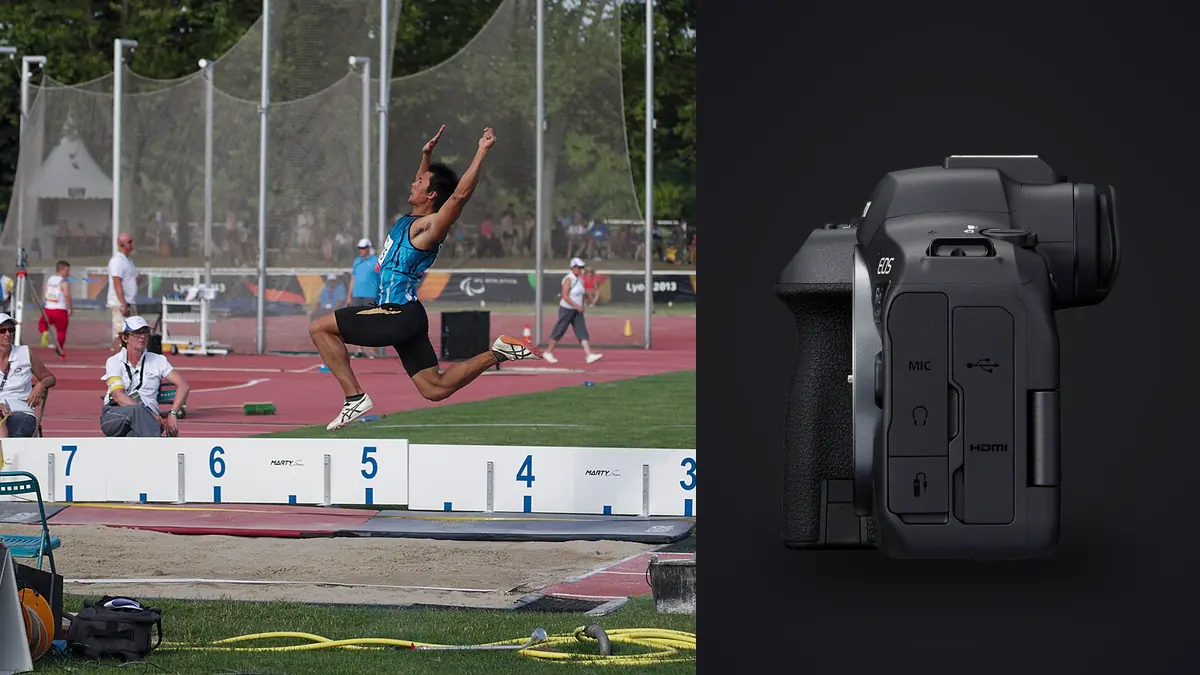
Why the R6 Mark II Ends Up in So Many Sports Bags
I picked up the Canon EOS R6 Mark II specifically to shoot a county track circuit and, as a side job, the Friday night football schedule at two local high schools. Neither pays enough to justify an R3, and an R5 II felt like overkill for files that mostly end up as 8x10 prints for parents and small web galleries for team pages. The R6 Mark II sits in a useful spot: fast enough to catch a foot strike at the line, cheap enough that I am not sweating a body getting knocked off a beanbag during a long jump sequence, and light enough to hold one-handed with a 70-200mm for three hours without my shoulder filing a complaint.
None of this is a lab review. It is what changed in how I shoot a meet once this camera replaced an older DSLR, and where it still falls short of what a track or field job actually demands.
The previous body was a 1D-series hand-me-down that could rip off frames all day but hunted badly under the mixed sodium-and-LED lighting most of our indoor venues still run. The R6 Mark II is not a perfect fix for that, stadium lighting is still stadium lighting, but the jump in low-light AF confidence and the sensor's cleaner high-ISO output meant I stopped avoiding the evening finals slot the way I used to.
Autofocus That Keeps Up With Lane Eight
The headline feature for sports work is Dual Pixel CMOS AF II with the subject-detection modes carried down from the R3. Set to "People," it tracks a runner's torso and head reliably even when three athletes cross lanes during a relay handoff. What surprised me coming from an older body is how well it holds focus through a partial occlusion, a hurdler's trail leg briefly blocking the lead leg, a pole vaulter passing behind the standards. The camera does not panic and rack focus to the background nearly as often as I expected.
Where it gets less certain is at the moment of a throw. Shot put and discus put an athlete's whole body into a spin before release, and the subject-detect box sometimes locks onto a hand or the implement itself rather than the torso. I have had better luck switching to a single expand-area AF point centered on the chest for throwing events and reserving full subject tracking for anything that runs or jumps in a straight-ish line.
Servo Tracking on a Pan
For the classic panning shot on a 200m curve, I lean on the in-body stabilization's panning detection rather than fighting it. With IBIS active and a shutter around 1/200 to 1/320, the system reads the horizontal pan and only corrects for vertical shake, which keeps a slow shutter panning blur usable at a much higher keeper rate than my old gimbal-stabilized lens ever managed on its own.
Shutter Modes, Buffer Depth, and What Actually Fills a Card
The 40fps electronic shutter gets all the marketing attention, but on a real infield it is not the mode I reach for most. Rolling shutter skew shows up on anything moving fast and roughly parallel to the sensor's readout, which describes a sprinter at full stride photographed from the infield rail. At 40fps with a runner crossing the frame close to the lens, I have seen enough lean and smear on limbs to bin frames I would otherwise have kept. The same shutter mode is far safer for a discus mid-flight or a high jumper arcing over the bar, where the motion relative to the frame is much slower.
The table below is from three seasons of actually shooting with UHS-II cards, not a spec sheet. Your numbers will vary by card and RAW size, but the relative pattern holds.
| Shutter Mode | Top Speed | Practical RAW Buffer | Rolling Shutter Risk | Where I Use It |
|---|---|---|---|---|
| Mechanical | 12 fps | Around 180-190 frames before slowdown | None worth mentioning | Sideline panning against a chain-link fence or crowd, where any skew would be obvious |
| Electronic, capped at Hi (custom) | Up to 20 fps | Around 100-120 frames | Low, tolerable for most sprint work | 100m and 200m starts, relay handoffs, general perimeter coverage |
| Electronic, full speed | 40 fps | Around 75-85 frames | Noticeable on fast lateral subjects near the lens | Peak-moment sequencing: bat contact, release phase of a throw, a finish-line dip shot head-on |
That last row is the one people misuse most. Forty frames a second sounds like insurance, but it front-loads your card with near-duplicate frames of the same stride. A single 400m final shot in short 40fps bursts around the key moments (the gun, the final straight, the finish) fills a 128GB card faster than most photographers expect, and every one of those extra frames is something you will have to look at, and reject, later that night.
Lenses That Actually Get Used on a Track Job
The RF 70-200mm f/2.8L IS USM lives on the body for probably 70% of a meet. It covers the infield-to-track distance for sprints and relays, focuses fast enough to keep up with the subject-detect AF, and is short enough to shoot handheld from a low angle for long jump landings. For the far turn and field events set back from the stands, I rent an RF 100-500mm f/4.5-7.1L for the day rather than own one outright. It is soft wide open past 400mm in flat stadium light, but stopped to f/8 with plenty of shutter speed it is sharp enough for web and small-print use.
Anyone carrying older EF glass forward doesn't need to sell it. An EF 400mm f/2.8 III on the RF mount adapter autofocuses with the R6 Mark II's Dual Pixel system without any noticeable lag, and honestly outresolves the RF 100-500 at the long end for less money if you already own it. For closer field events, an RF 24-70mm f/2.8L covers shot put, javelin approach, and pole vault plant zone from the athlete area without needing a permit to stand further back.
Weight matters more on a track job than most gear reviews admit. A full afternoon of heats means walking the infield perimeter between events, climbing to a raised photo position for the pole vault, then dropping back down for the 4x400 relay. The 70-200mm plus body comes in well under three pounds, which is the difference between still being alert for the last event of the day and shooting the final on autopilot because your shoulder gave out two hours earlier.
Settings That Matter More Than the Spec Sheet
Shutter speed is the first decision and it changes by event. Sprints and relays get 1/2000 or faster to freeze a foot at full extension, longer distance races can drop to 1/1000 without visible blur since the stride rate is lower, and field events like shot put or discus need at least 1/1250 to stop the implement itself, not just the athlete. Night meets under stadium lighting push ISO into the 3200-6400 range on this sensor before noise becomes a real problem in a printed 8x10, which is a genuine improvement over the camera it replaced for me.
Back-button focus is non-negotiable for a track job. Separating AF activation from the shutter lets me pre-focus on the blocks before the gun, then hold or release tracking as the field spreads out through the first curve without accidentally refocusing on a spectator who steps into frame. I also keep AF Case 2 (continuing to track subjects even when something briefly crosses the frame) as my default rather than the faster-reacting cases, because a meet has flags, officials, and other athletes constantly crossing your line.
Metering stays on evaluative for anything on grass or track surface, but I switch to spot metering for indoor meets where a single overhead light can blow highlights on a runner's shoulders while the rest of the frame reads two stops under.
The Part That Actually Slows You Down
None of the camera settings above are the bottleneck on a meet weekend. The bottleneck is what happens after, when a two-day invitational leaves you with 4,000 to 6,000 RAW files across a dozen events, and half your shooting was in short 20fps and 40fps bursts that produced runs of eight or ten near-identical frames per moment. Going through that manually in Lightroom, one by one, at 11pm after driving home, is how a lot of sports photographers burn out on the side gig.
This is the specific problem I built my culling pass around imagic to solve. It scores sharpness and focus accuracy locally on the machine, no upload, no cloud queue, which matters when half your frames are of other people's kids and you don't want that leaving your laptop. It also groups those 20fps and 40fps burst runs together so instead of scrolling through ten frames of the same stride, I see one cluster and pick the sharpest one or two. For a meet with 5,000 frames, that alone gets me to a real shortlist in under an hour instead of most of an evening. There's a longer breakdown of how that scoring actually works over on how AI photo culling works if you want the mechanics rather than just my results.
The other piece of imagic that has quietly changed my delivery workflow is the apply_my_style preset, which learns an editing look from edits I have already made and applies it to a new batch. Track and field galleries need consistent color across a whole meet shot in shifting stadium light, morning heats through evening finals, and having that first editing pass applied automatically before I go frame by frame for the exceptions saves a genuine chunk of the turnaround time parents and coaches are waiting on. It's a one-time purchase rather than another monthly line item, which matters when a side gig like this isn't paying enough to justify a subscription stack; the pricing page lays out the tiers if that's a factor for you too.
Frequently Asked Questions
Is the 40fps electronic shutter actually usable for sprint photography, or does rolling shutter ruin it?
It depends on angle and distance. Shooting a sprinter close to the rail with the body moving roughly parallel to your sensor is the worst case for skew, and I have binned frames from exactly that setup. Shooting from further back, at a longer focal length, or on subjects moving more toward or away from the camera (a finish line shot taken head-on, for instance) the distortion is rarely visible. My working rule is full 40fps for throws, jumps, and head-on finish shots, and a capped 20fps custom mode for anything panned along the track.
Which lens should I buy first if I only shoot one or two meets a month?
The RF 70-200mm f/2.8L covers the largest share of usable moments at a typical meet, sprints, relays, and most field events shot from the athlete area. Save the long glass for a rental until you know how often you actually need reach past 200mm, since a 400mm-plus lens mostly earns its keep at meets held on a full outdoor oval where you cannot get close to the far turn.
Mechanical or electronic shutter for field events like long jump and pole vault?
Mechanical if the event is close enough that rolling shutter would show, since a horizontal sprint into the pit at speed can skew badly at high electronic frame rates. Electronic, including full 40fps, works well for the airborne phase of a jump or vault because the subject's motion relative to the frame slows down significantly once they leave the ground. It is also the quieter option, which matters at indoor venues where a mechanical shutter clatter carries.
How many photos does a typical meet produce, and what's a realistic way to get through them the same night?
A two-day invitational with a dozen events easily produces 4,000 to 6,000 RAW files once you account for 20fps and 40fps bursts. Manually reviewing that volume the same night is not realistic for most people. Running a local sharpness pass and burst clustering, which is what I use imagic for, gets that down to a few hundred genuine candidates before I open an editor, and because it processes on the machine rather than a cloud service, files of minors from a school meet never leave my laptop in the process.