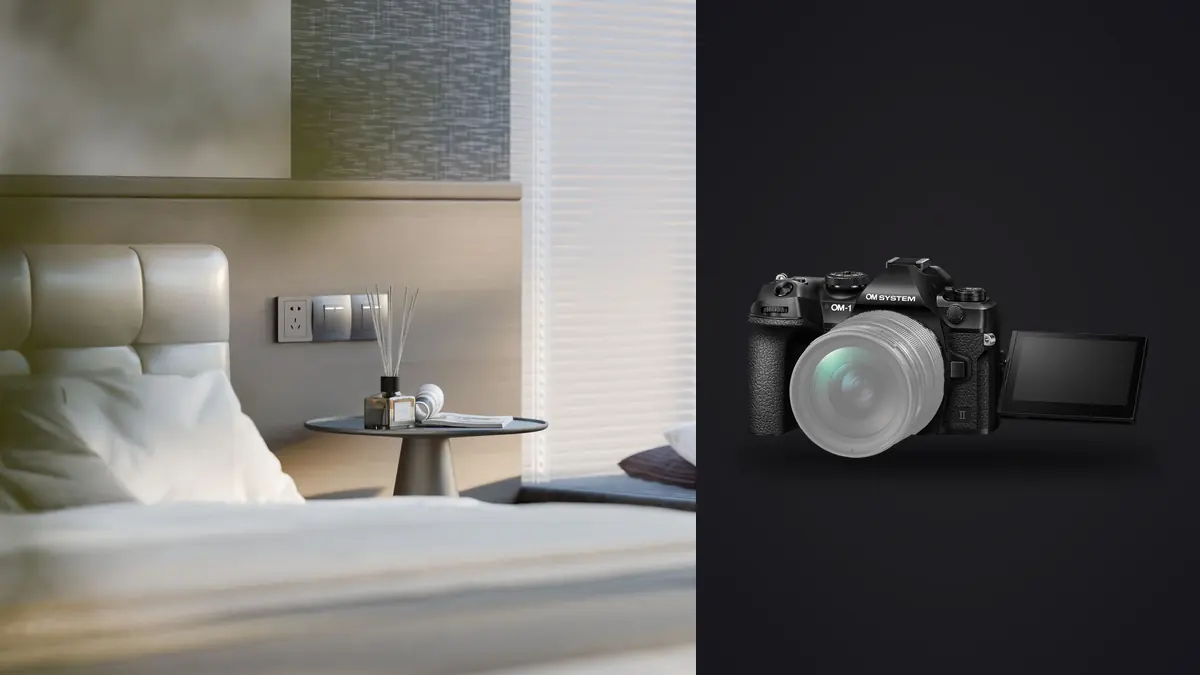
Boudoir and intimate portrait work asks different things of a camera than almost any other genre. You're usually in a bedroom, a hotel suite, or a small rented space with one window and maybe a string of fairy lights, trying to keep a nervous client relaxed while you move around quickly and quietly. I put the OM System OM-1 Mark II into that exact scenario for six months of shoots after years of shooting this genre on full-frame bodies, and the results were specific enough, good and bad, that they're worth writing down instead of summarized in a spec sheet.
The Sensor Size Conversation Nobody Skips
Micro Four Thirds is a 2x crop sensor, and that single fact changes more about boudoir work than most people expect going in. A 45mm f/1.2 lens on the OM-1 Mark II frames like a 90mm on full frame, which is a genuinely good focal length for close, intimate portraits. But the depth of field you actually get at f/1.2 behaves closer to an f/2.4 full-frame equivalent. That matters here specifically because so much of boudoir photography leans on thin focus, separating a shoulder or a collarbone from a soft background. You can still get that look, you just need to shoot the widest apertures available and work closer to your subject than you would with a full-frame 85mm, and you give up some of the background melt that clients scrolling reference images on Instagram have come to expect from full-frame glamour work. That doesn't rule the camera out. It does mean that if a client has sent you reference shots taken on an 85mm f/1.4 full-frame rig, you set expectations before the session rather than during the edit, when it's too late to reshoot.
Working Quietly in a Room You Don't Own
Boudoir sessions often happen in spaces you don't control: a private bedroom, a rented apartment with thin walls, a hotel suite one room away from other guests. Two things about this camera helped more than I expected in that setting. First, in-body stabilization rated up to 8.5 stops with the right lens let me shoot ambient-light frames near a window or beside a single lamp at 1/8 and 1/15 of a second handheld, without visible blur on a held pose. That kept ISO down in rooms where I'd normally be pushing 6400 on a full-frame body just to get a usable shutter speed. Second, the fully silent electronic shutter meant I could run a sequence of expression changes without a mechanical clack breaking the mood on every single frame, which matters more in this genre than any other I've shot. A loud shutter in a quiet bedroom reminds everyone in the room that a camera is running the show. A silent one lets the direction stay conversational instead.
The trade-off with the electronic shutter is rolling shutter distortion on fast movement, hair flips, fabric snapping, quick changes between poses, and occasional banding under certain LED bulbs or string lights, both of which show up constantly in this kind of shoot. I test-fired a few frames under a cheap warm LED strip before committing to electronic-only for a session, saw visible banding on the playback screen, and switched back to the mechanical shutter for that specific light source rather than find out in the edit.
Lens Pairings That Actually Earned a Spot in My Bag
Lens choice matters more on Micro Four Thirds for this genre than it does on full frame, because you're compensating for depth of field with focal length and working distance rather than aperture alone. Here's what I actually reached for across a dozen sessions, with the full-frame equivalent focal length and the effective depth of field at each lens's widest aperture.
| Lens | Full-frame equivalent | Effective depth of field wide open | Where it earned its place |
|---|---|---|---|
| M.Zuiko 45mm f/1.2 PRO | 90mm | ~f/2.4 equivalent | Close, intimate portraits; the lens I reached for most |
| M.Zuiko 25mm f/1.2 PRO | 50mm | ~f/2.4 equivalent | Environmental frames that include the room and the light source |
| M.Zuiko 17mm f/1.2 PRO | 34mm | ~f/2.4 equivalent | Small hotel rooms and low ceilings where 25mm couldn't back up far enough |
| M.Zuiko 12-40mm f/2.8 II PRO | 24-80mm | ~f/5.6 equivalent | Documentation and getting-ready coverage between the actual portraits |
| M.Zuiko 40-150mm f/2.8 PRO | 80-300mm | ~f/5.6 equivalent | Rare, but useful for candid-feeling frames shot across a larger suite |
The 45mm f/1.2 did most of the work on nearly every booking. It's small enough that I could hand-hold it for an hour without the wrist fatigue I get from a full-frame 85mm f/1.2, which matters when you're crouching, kneeling, and shooting from awkward angles around furniture for an entire session.
Autofocus and Eye Detection at Wide Apertures
Face and eye detection on the OM-1 Mark II is solid in good light and gets noticeably less reliable in the low, warm, single-source lighting that defines most boudoir sessions. It tracked eyes well through loose hair, through soft foreground elements like a sheet or a hand, and through partial profile turns. Where it struggled was backlit silhouette work, shooting toward a window with the subject's face in shadow, and any frame where the face was turned more than about 60 percent away from the lens; in both cases it occasionally locked onto fabric texture or hair instead of the eye. I ended up switching to a single, fixed AF point for those two situations rather than trusting subject detection, which cost me a little speed but got sharp eyes more consistently.
The upside of shooting fast, wide-open glass on a body that will occasionally miss focus is that you generate a lot of near-identical frames to sort through afterward, three or four takes of the same pose with only the eye sharpness actually differing between them. That's exactly the kind of sorting I don't want to do by eye on a laptop at midnight after a two-hour session. I run everything through imagic before I open Lightroom now, mainly because its local sharpness scoring flags which frame in a burst actually landed on the eye rather than the eyebrow or the pillow behind the subject, and it does that scoring on my own machine rather than sending images anywhere first.
Weight, Size, and the Psychology of the Room
Nobody puts camera size in a spec comparison, but in this genre it changes how a session feels. The OM-1 Mark II body weighs about 599 grams, and paired with the 45mm f/1.2 the whole rig is still light enough to hold one-handed while I direct a pose with the other. People who are already nervous about being photographed intimately tend to notice a smaller, quieter setup. I'm not claiming the camera itself relaxes anyone, the direction does that, but a smaller rig is one less thing making a bedroom feel like a film set.
The IP53 weather sealing and the -10°C cold rating, meanwhile, are largely wasted on a genre that happens almost entirely indoors on a bed or a chaise. I mention it because it's the spec OM System pushes hardest in its marketing, and it's simply not the reason to buy this camera for boudoir work. If you also shoot outdoor intimate sessions at golden hour or in a light drizzle, it earns its keep. For the studio-and-bedroom sessions that make up most boudoir bookings, it's a feature you'll never test.
RAW Workflow: From Card to Client Gallery
A 90-minute session on this camera, shooting bursts to catch genuine expression changes between poses, easily produces 900 to 1,400 RAW frames. ORF files run around 20 to 25MB each depending on ISO and detail, so a single session lands somewhere around 20 to 25GB before a single edit is made. Sorting that volume by hand at the end of a shoot day is how photographers in this genre burn out faster than in any other. I lean on automated culling to bring the pile down to a shortlist first: imagic's duplicate and burst clustering groups the near-identical frames from each pose together, so I'm choosing between six similar shots instead of scrolling past all of them one at a time, and its sharpness scoring surfaces the frame or two per burst actually worth opening in a RAW editor.
Color is where OM System's output needs the most hands-on work for this genre specifically. Straight out of camera, skin tones under warm bedside lamps or string lights can pull orange in a way that reads as flattering on a phone screen and wrong on a calibrated monitor. I built a consistent boudoir grade once, warmer highlights, slightly desaturated reds, lifted shadows, using imagic's apply_my_style feature, trained on a set of my own previously graded edits, and it now applies that starting point automatically to new sessions before I go in and fine-tune skin tones frame by frame. It isn't a substitute for actually grading each image, but it removes the flat, unedited RAW look from the process before I've even opened a file, which matters when someone is waiting on a same-week gallery. The color grading workflow behind that is worth understanding on its own, separate from whatever camera produced the files.
Where This Camera Genuinely Falls Short for This Genre
I want to be specific about the limits rather than gloss over them. Skin retains less tonal information at high ISO than a comparable full-frame sensor once you're above roughly ISO 3200, and boudoir lighting frequently pushes you there. Fine detail, skin texture, fabric weave, individual hair strands, softens earlier in the ISO range than it would on a larger sensor, and no amount of RAW processing fully brings it back. If a chunk of your business is large-format wall prints, a 24x36 piece from a Micro Four Thirds file shot at ISO 5000 will show its limits under close inspection in a way a full-frame file at the same ISO won't. For web galleries, proofing, and prints up to roughly 16x20, it is unlikely anyone will notice.
Frequently Asked Questions
Is the Micro Four Thirds sensor a dealbreaker for shallow depth of field in boudoir work?
No, but it changes how you get there. You'll want the f/1.2 primes rather than f/1.8 or f/2.8 glass, and you'll be working closer to your subject than you would on full frame to compress the background the way this genre typically wants. The look is achievable, it just isn't identical to an 85mm f/1.4 on full frame, and clients who've sent reference images shot that way should hear that before the session, not after.
Can I shoot a full intimate session without flash on the OM-1 Mark II?
In most rooms with at least one real window or a couple of lamps, yes. In-body stabilization makes handheld shutter speeds down around 1/8 second usable for held poses, which keeps ISO manageable. Sessions with a lot of movement, fabric flowing, quick pose changes, will still need either more ambient light or a small continuous light source, because stabilization steadies the camera, not a moving subject.
How loud is the shutter, and will it break the mood during a session?
Set to the electronic shutter, it's silent, which genuinely helps keep a session conversational instead of mechanical-feeling. The trade-off is rolling shutter artifacts on fast motion and occasional banding under some LED or string lighting, so I keep the mechanical shutter as a fallback for scenes with quick movement or unusual light sources.
Do I need the Pro-line lenses, or will kit glass cover this genre?
The 12-40mm f/2.8 zoom is genuinely useful for coverage and documentation shots between the actual portraits, but the images that define a boudoir gallery lean on the f/1.2 primes. The difference shows up specifically in low-light autofocus speed and in how much background separation you can generate on a crop sensor, both of which come up constantly in this genre.
I kept the OM-1 Mark II in my bag through six months of boudoir shoots before writing any of this down, and it's stayed there. Not because it beats a full-frame body on paper, but because its size, its silence, and its stabilization solve real problems specific to shooting intimate portraits in small, borrowed rooms. If your work leans heavily on shallow-focus, full-frame glamour looks, budget for the f/1.2 primes or look elsewhere. If it leans on connection, movement, and working fast in spaces you don't control, this combination has earned its place in mine.