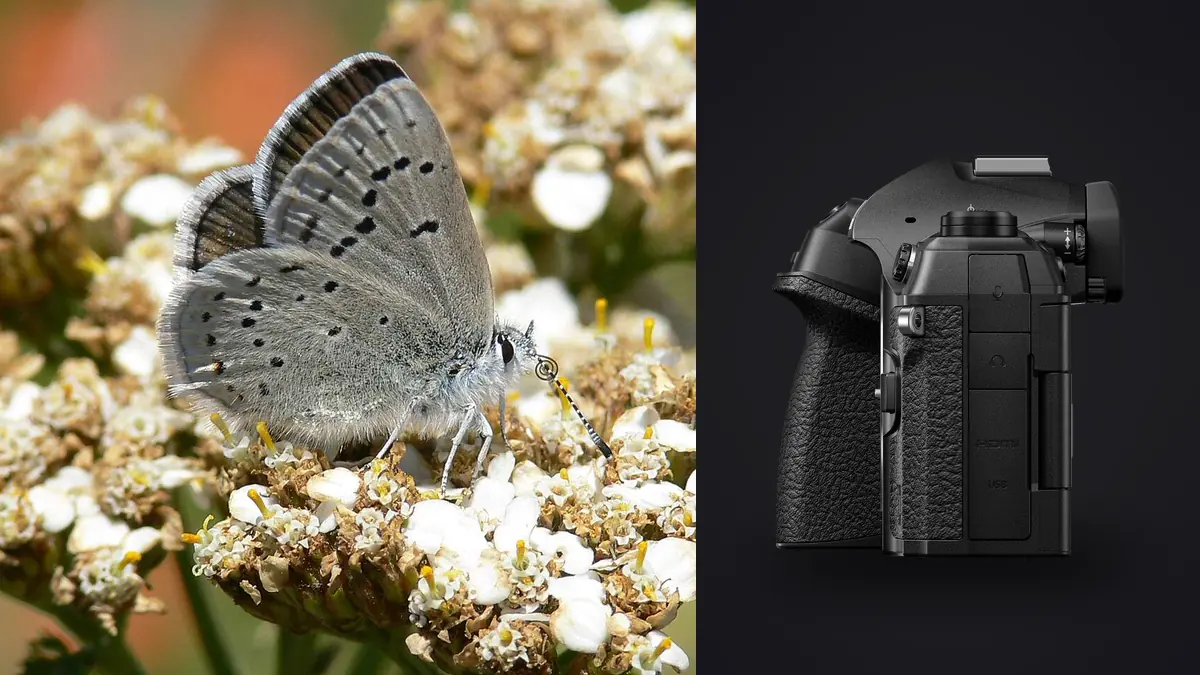
I took the OM System OM-1 Mark II into a friend's overgrown vegetable garden at the start of June specifically to see whether a 20-megapixel Micro Four Thirds body could still hang with the macro crowd in 2026, when most of the buzz online is about full-frame stacking rigs and dedicated focus rails. Two months, one damaged damselfly wing (not caused by me, thankfully), and something like 4,000 exposures later, the honest answer is yes, but only if you stop treating it like a smaller, cheaper full-frame camera and start using it like the specialized macro tool it actually is.
The crop factor is an advantage here, not an apology
Every Micro Four Thirds review eventually reaches the part where the writer apologizes for the 2x crop factor. For insect work you can skip the apology entirely. A 90mm macro lens on this sensor frames like a 180mm lens would on full frame, while still focusing down to true 1:1 and beyond. That means you can fill the frame with a hoverfly from roughly twice the distance a full-frame shooter using a 90mm needs to close to. For anything that bolts when a shadow crosses it, and most insects do exactly that, extra working distance is the difference between a usable shot and an empty leaf where the subject used to be.
The trade-off is depth of field, which at high magnification is already measured in fractions of a millimeter regardless of sensor size. Because the Four Thirds sensor needs less absolute magnification to fill the frame with a small subject than full frame does, you're often working at a slightly less extreme reproduction ratio for the same framing, which claws back a bit of the depth of field you'd otherwise lose. It's not a dramatic effect, but on a windy morning with a jumping spider that refuses to sit still, every fraction of a millimeter of usable focus matters.
Autofocus does not know what an insect is, and that changes how you shoot
OM System's AI subject detection can find birds, dogs, cats, cars, trains and planes. It has no dedicated insect-recognition mode, unlike some newer bodies from other brands that have added exactly that in recent firmware. That's not a dealbreaker, but it does mean subject detection simply isn't part of the macro workflow here. You fall back on small single-point AF (I run mine at the smallest target box the camera offers) combined with the focus limiter switch on whichever macro lens is mounted, so the lens stops racking through its full focus range every time you nudge the point of focus by a centimeter.
For static or slow subjects, a dew-covered orb weaver at first light, say, single-point AF with a small target and a firm half-press is genuinely reliable. For anything actively moving, I mostly stopped trusting continuous AF tracking for insects specifically and switched to manual focus with focus peaking on, rocking my body weight forward and back a few centimeters to find the plane of focus rather than turning the focus ring at all. It sounds primitive next to the marketing copy around this camera's tracking abilities, but it's the same technique macro shooters have leaned on for two decades, and it still wins more usable frames than the AF system once you're working past 1:1 magnification.
Two ways to fight shallow depth of field, and they aren't interchangeable
The Mark II gives you two distinct tools for handling the razor-thin depth of field that comes with macro work, and after a summer of using both I ended up picking one or the other depending on the subject rather than settling on a single favorite.
In-camera focus stacking shoots and blends up to 15 frames into a finished JPEG (the source raws get saved too, if you want them) without ever touching a computer in the field. It's fast, and for a subject that might crawl off the leaf in the eight or nine seconds the sequence takes to shoot, fast is the whole point. Focus bracketing, by contrast, shoots up to 999 frames at a step size you set yourself and hands you every raw file to blend later in Helicon Focus or Zerene Stacker. It's slower to deal with afterward but gives you real control over the blend, and it's the only realistic option once your subject is big enough, a large stag beetle, a hawk moth on a wall, that 15 frames simply won't cover the depth required.
| Method | Max frames | Output | Best for |
|---|---|---|---|
| In-camera focus stacking | 15 | Blended JPEG plus source raws | Skittish live subjects, fast turnaround in the field |
| Focus bracketing + desktop blend | 999 | Individual raw files only | Static subjects, larger insects that need more depth than 15 frames covers |
| Handheld high res shot | 1 composite (50MP) | Single high-resolution raw or JPEG | Texture and fine detail on a subject that isn't moving between exposures |
Settings that actually produced usable stacks
For most flowers-and-bugs subjects I settled on a focus differential of 3 to 4 with the 90mm macro, f/5.6, and ISO left to float up to 3200 before I'd bother switching on a flash. Anything wider than f/4 at high magnification and the individual slices don't overlap enough for a clean blend, especially on a subject with fine hairs or antennae standing off the body. Stopping down past f/8 fights diffraction on this sensor size hard enough that you start losing the crispness the stack was supposed to give you back. It's a narrower window than full-frame shooters get, and it took me a frustrating number of blurry stack attempts to find it.
The IP53 rating earns its keep before 7am
The best insect activity of the day happens right when conditions are worst for camera gear: heavy dew, damp grass, condensation on cold metal as the sun starts to warm the air. I've had this body genuinely wet from kneeling in soaked grass for an hour photographing damselflies drying their wings, and it kept working without a hitch. The IP53 splash and dust rating, combined with a freeze rating down to -10C, is not a marketing bullet point for macro shooters, it's the reason you can actually be out at the hour when the subjects are cooperative and the light is soft. I still wipe the body down and let it come up to ambient temperature slowly before opening any card doors, because moving a cold camera into a warm car too fast is asking for condensation inside the body, not just on it.
The lens decides more of your results than any menu setting
I shot most of this project switching between the M.Zuiko 60mm f/2.8 Macro and the newer 90mm f/3.5 IS Macro, and the difference between them mattered far more day to day than any AF or stacking setting I changed on the body.
| 60mm f/2.8 Macro | 90mm f/3.5 IS Macro | |
|---|---|---|
| Max native magnification | 1:1 (2x full-frame equivalent) | 2:1 (4x full-frame equivalent) |
| Equivalent focal length | 120mm | 180mm |
| Working distance at max magnification | Roughly 4cm | Roughly 9.5cm |
| Built-in stabilization | None (relies on body IS only) | Yes, syncs with body IS |
| Approx. weight | 185g | 453g |
| Best for | Flowers, static subjects, travel kit | Live insects, anything that startles easily |
The working distance gap is the whole story. At 4cm from the front element, a bee or wasp notices you and leaves before you've focused. At closer to 10cm, which is what the 90mm gives you at full 2x magnification, you can often work a subject for several minutes without it registering you as a threat. The 60mm is lighter, cheaper, and genuinely excellent for flowers, fungi, and anything that doesn't have a nervous system telling it to flee, but for insects specifically the 90mm earns its higher price and its extra weight in every session I've used it.
Pro Capture saves the shots you'd otherwise miss by half a second
Pro Capture buffers frames continuously while you have the shutter half-pressed and only commits them to the card once you fully press, backdating the buffer so you get frames from before your reaction time kicked in. For a dragonfly about to launch off a reed, or a bee's legs the instant before it lifts off a flower head, this is the single feature that turned "I think I got it" into an actual reliably repeatable capture. I run it at a modest 20fps rather than the maximum available, mostly to keep card write times and buffer clearing manageable when I'm also shooting bracketed stacks in the same session.
Buffer depth, battery life, and card choice for a stacking-heavy day
A day of mixed Pro Capture bursts and 15-frame stacks eats through storage and battery faster than the spec sheet numbers suggest, because you're not shooting single frames, you're shooting sequences of them for almost every subject. I go through the BLX-1 battery in roughly three to four hours of active shooting when stacking is involved, well under the CIPA rating, and I now carry two spares as a matter of course rather than one. Dual UHS-II card slots mean I shoot raw to one card and JPEG (useful for a quick field check of a stack result) to the other, and a 128GB card lasts a comfortable morning session before I need to swap.
What a morning like this does to your card, and how I get through it
A single productive hour chasing insects with bracketing and Pro Capture both in play can leave you with 600 to 900 files, most of them near-duplicate frames from a burst or a bracket sequence that only has two or three genuinely sharp results buried inside it. Sorting that by eye is where most of an evening used to go for me. I run everything through imagic now specifically because its duplicate and burst clustering groups those bracket sequences and Pro Capture runs together automatically instead of leaving me to scroll past a hundred nearly identical wasp photos one at a time, and the local sharpness scoring flags which frame in each cluster actually landed critical focus on the eye or the compound eye facets, which at this magnification is not something you can always tell from a quick glance on a laptop screen.
The other piece that's become part of my routine is the apply_my_style preset, trained on my own past macro edits rather than a generic look, so a big batch of insect shots from one morning comes out already close to how I'd have graded it by hand. Everything runs locally on the laptop with no cloud upload involved, which matters to me less for privacy reasons and more because I'm often editing from a cabin with no signal the same evening I shot. If your workflow is buried under stacked bracket sequences the way mine gets after a good week outdoors, it's worth reading through how AI photo culling actually works or the broader tips for a faster photo workflow before you assume the only fix is shooting less.
Frequently Asked Questions
Do I need the 90mm PRO macro lens, or will the 60mm do for insect work?
The 60mm is a genuinely good lens and costs a fraction of the 90mm, but its short working distance makes it a poor match for anything with wings or legs that can react to you. If your subjects are mostly flowers, lichen, or slow-moving subjects like snails, the 60mm is fine and honestly more pleasant to carry all day. If bees, dragonflies, and jumping spiders are the target, the extra working distance on the 90mm pays for itself within the first outing.
Is the OM-1 Mark II actually worth it over the original OM-1 for macro shooting?
For macro specifically, the gap is smaller than the marketing suggests. The sensor and stacking capabilities carried over largely unchanged from the original OM-1. What the Mark II adds that I do notice in the field is a better grip, a slightly brighter and more usable rear screen for checking focus stacks outdoors in direct sun, and a handful of AF refinements that help more with birds and fast wildlife than with stationary insects. If you already own an OM-1, I wouldn't upgrade for macro alone.
Can I shoot handheld macro with this camera, or do I need a tripod for stacking?
In-camera focus stacking and focus bracketing both work handheld, and the in-body stabilization is strong enough that I shoot the vast majority of my insect work handheld, including most stacks. A tripod still helps for the largest subjects needing the full 999-frame bracket range, where holding perfectly still through a long sequence gets genuinely difficult, but for everyday insect macro work a tripod is more often a hindrance than a help since it slows you down chasing something that's about to move.
How many images does a typical focus-stacked insect session produce, and how do you manage that volume?
Somewhere between 400 and 900 raw files for two to three hours of active shooting is normal once you're running both bracketing and Pro Capture, and the overwhelming majority of those are near-duplicates from a single sequence. I stopped trying to sort that manually a while back and now lean on imagic's clustering and sharpness scoring to surface the two or three frames per sequence actually worth keeping before I touch anything in an editor.