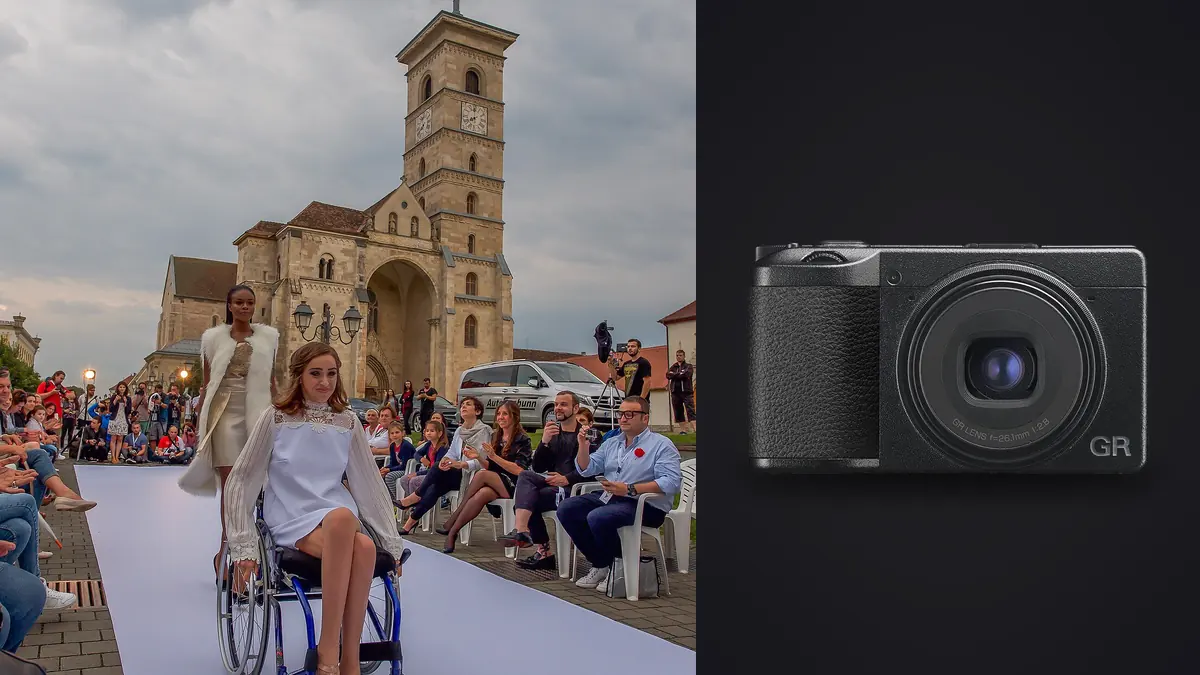
Picture a small streetwear label's spring lookbook: twelve looks, half studio and half on location in a parking garage they've talked their way into for an afternoon. The first instinct is to bring the usual kit: a mirrorless body, a 35mm and an 85mm, a speedlight rig. Instead, shoot the entire thing on a Ricoh GR IIIx, a camera most people associate with street photography, not client work with a call sheet and a mood board. That isn't a stunt. Say the brand wants a documentary, slightly off-kilter feel rather than glossy catalog polish, and the GR IIIx's fixed 40mm-equivalent lens can be exactly the right tool for that brief. This is how that day tends to go, where the camera earns its place and where it makes the day harder than it needs to be.
Why the 40mm Field of View Fit a Lookbook Brief
The GR IIIx sits at 26.3mm actual focal length on its APS-C sensor, which works out to roughly 40mm equivalent, noticeably tighter than the 28mm-equivalent GR III. For street shooting that extra reach is often seen as a downside, less of the scene fits in frame. For lookbook work it's the opposite. A 40mm field of view sits close to how a person actually perceives a subject standing a couple of meters away, so a model's proportions read naturally without the slight barrel stretch you get on wider glass at close range. I didn't have to correct for elongated legs or a widened torso in post the way I sometimes do shooting full-length looks on a 24mm or 28mm.
The tradeoff is that 40mm asks you to physically move. There's no zoom ring to fall back on when you want a tighter waist-up crop between outfit changes, so every framing decision is a step forward or back. On a cramped set that's annoying. In the parking garage, where you have the whole floor to work with, it turns into a rhythm: step back for the full-length hero shot, step in for the editorial crop, step in further for a detail. The fixed focal length also keeps every frame in the lookbook visually consistent without trying, which a client's designer is likely to notice when she sees the contact sheets.
Snap Focus and Working Fast Between Racks
Lookbook days move quickly. A stylist is swapping outfits every four or five minutes, hair and makeup are touching up between looks, and nobody wants to stand around waiting for a camera to hunt for focus. The GR IIIx's snap focus mode, where you assign a fixed distance and the shutter fires instantly at that plane, became the setting I used for probably sixty percent of the day. Set to two meters at f/5.6, I could fire the moment a model hit her mark without waiting on autofocus confirmation, and with that aperture the depth of field forgave the few centimeters of variance in exactly where she stood.
For anything closer or more deliberate, single-point continuous AF with the touch-to-focus screen worked fine, though it's contrast-and-phase hybrid rather than a tracking system built for movement. On static poses it locks confidently. The moment a model starts walking toward camera, which happens a lot with a documentary brief, the AF visibly lags and you lose more frames to soft focus than you'd like to admit. Snap focus solves that problem by removing the guessing entirely, at the cost of needing to think ahead about where the subject would actually be.
Where the Camera Struggled
Three limitations showed up repeatedly and none of them are secret, but they hit differently on a paid shoot than they do on a personal walk. First, the buffer. Shooting RAW, the GR IIIx slows down noticeably after four or five frames in quick succession, which matters when you're trying to catch a natural mid-stride moment across a burst. I adapted by shooting fewer, more deliberate frames per pose instead of spraying and praying, which is honestly better photographic discipline but took some retraining.
Second, screen visibility. There's no viewfinder on the standard GR IIIx, and the rear LCD washes out badly in direct sun. The studio half of the day was fine. The parking garage had big open bays letting in harsh afternoon light, and I spent a fair amount of time squinting at a screen I couldn't fully trust, checking exposure more by histogram glances than by eye. If I did this kind of shoot regularly outdoors I'd budget for the optional external viewfinder.
Third, battery life. The DB-110 battery is small, and between constant screen-on shooting and periodic image review with the client looking over your shoulder, expect to burn through two batteries by early afternoon. USB-C charging during lunch keeps you going, but don't plan on running a full commercial day on one battery with this camera, and carry three as a rule.
A Shot-by-Shot Breakdown of How I Set the Camera
Different parts of a lookbook need different handling, and the settings I actually used varied more than a single "here's my exposure triangle" writeup would suggest. This is roughly how the day broke down.
| Shot type | Focus approach | Aperture | Distance | Practical note |
|---|---|---|---|---|
| Full-length hero | Snap focus, 2m | f/5.6 | ~2.5m | Consistent framing across every outfit change |
| Waist-up editorial crop | Continuous AF, single point | f/2.8-f/3.5 | ~1.2-1.5m | Watch depth of field on fabric texture at wide apertures |
| Walking/movement sequence | Snap focus, pre-set 1.5m | f/8 | Fixed zone | Buffer limits bursts to about 4-5 RAW frames before slowdown |
| Fabric/hardware detail | Macro mode, single AF | f/4 | Hand's width from subject | Small manual nudges needed for exact focus point |
| Backstage/candid | Snap focus, 1m or 2m toggle | f/2.8-f/4 | Variable | No chimping between frames, keep shooting |
The macro row deserves a note. The GR IIIx focuses close enough to fill the frame with a button, a zipper pull, or the weave of a raw denim hem, and for a fashion client that kind of detail insert is often what sells the tactile quality of a garment better than the full-body shot does. I'd budget five to ten minutes per look just for these close-ups if the brand cares about fabric storytelling, which most do once they see the option.
Getting Through Thousands of Frames Afterward
A twelve-look lookbook day on this camera, shot the way described above, can easily produce a little over three thousand RAW files. That's a lot of near-duplicate frames to sort through manually, especially from the walking sequences where four or five shots in a row are nearly identical except for foot position. I run everything through imagic before I open a single frame in an editor. Its local sharpness and focus scoring is genuinely useful here because the snap-focus frames that missed their mark by a few centimeters, which happens more than the marketing copy for zone focusing suggests, get flagged automatically instead of me squinting at thumbnails on a laptop screen.
The burst and duplicate clustering matters even more for this camera specifically, because the shallow buffer means my "bursts" are short but frequent, four or five frames fired close together dozens of times across a shoot day. Instead of comparing forty near-identical walking shots one by one, imagic groups each run and I'm choosing the sharpest of five, which turns a two-hour cull into something closer to thirty minutes. If the client's garments haven't been publicly announced yet, processing everything locally rather than through a cloud culling service isn't a nice-to-have, it's close to a contractual requirement, and it's a reason not to run these files through anything that phones home.
For the edit itself, an apply_my_style preset in imagic can be trained on a previous season's lookbook that the same client had approved, warm midtones, slightly lifted blacks, restrained saturation on skin. Running the new batch through that preset gets you most of the way to a consistent look across all twelve outfits before you touch individual frames, which matters when a client is comparing this season's images side by side with last season's on the same page. If you're weighing camera systems for this kind of work, the file-handling side of the day is worth planning as carefully as the gear list. How AI-assisted culling actually works is a reasonable next read if you want the mechanics behind that part of the process, and if you're regularly shooting high-volume days like this one, tightening up your general workflow pays off well beyond just this camera.
Would I Shoot a Lookbook on This Camera Again
For the right brief, yes, without much hesitation. The GR IIIx isn't a general-purpose commercial fashion camera and it is a poor fit for a brand that wants tightly controlled studio catalog work with hard product accuracy on color and precise framing control shot to shot. But for a brand that wants texture, a slightly candid feel, and images that don't look like every other lookbook in their category, the constraints of this camera (one focal length, no zoom, a shutter that fires the instant you want it to) pushes you toward more deliberate, considered shooting than you sometimes fall into with a full mirrorless kit and three lenses to fuss over. The client gets a lookbook that looks different from their competitors', partly because of styling and partly because the camera itself shapes how those images are made.
Frequently Asked Questions
Can the GR IIIx keep up with models walking or moving on set?
Only if you plan around it rather than trust the autofocus to track motion. The continuous AF will lag on anyone walking toward the camera, so pre-setting snap focus to a distance you know the subject will cross gives far more reliable results than letting the camera hunt in real time. Combined with the shallow RAW buffer, treat movement shots as a handful of deliberate frames rather than a long burst.
Is a 40mm field of view too tight for full-length shots in a small studio?
It can be, depending on ceiling height and how much backdrop space you have. In a studio under roughly four meters deep you may struggle to fit a full-length standing shot without backing into the seamless yourself. On location with more room, or for waist-up and detail work, the framing is comfortable. Measure your actual studio space before committing to this camera as your only body for full-length hero shots.
How many outfit changes can I realistically shoot per battery?
On a shoot like this, roughly six to eight outfit changes can drain one DB-110 battery, factoring in screen-on time for client review between looks. For a full twelve-look day you'd bring at least three charged batteries and a USB-C charging option for downtime, rather than relying on one or two.
Do I need an external flash for a GR IIIx lookbook session?
The built-in flash is weak and mostly useful as fill at very close range, not as a primary light source for a commercial shoot. If the brief calls for controlled studio lighting, plan on continuous LED panels or strobes triggered separately, since the GR IIIx's hot shoe support and flash sync options are limited compared to a full mirrorless system built around off-camera lighting.