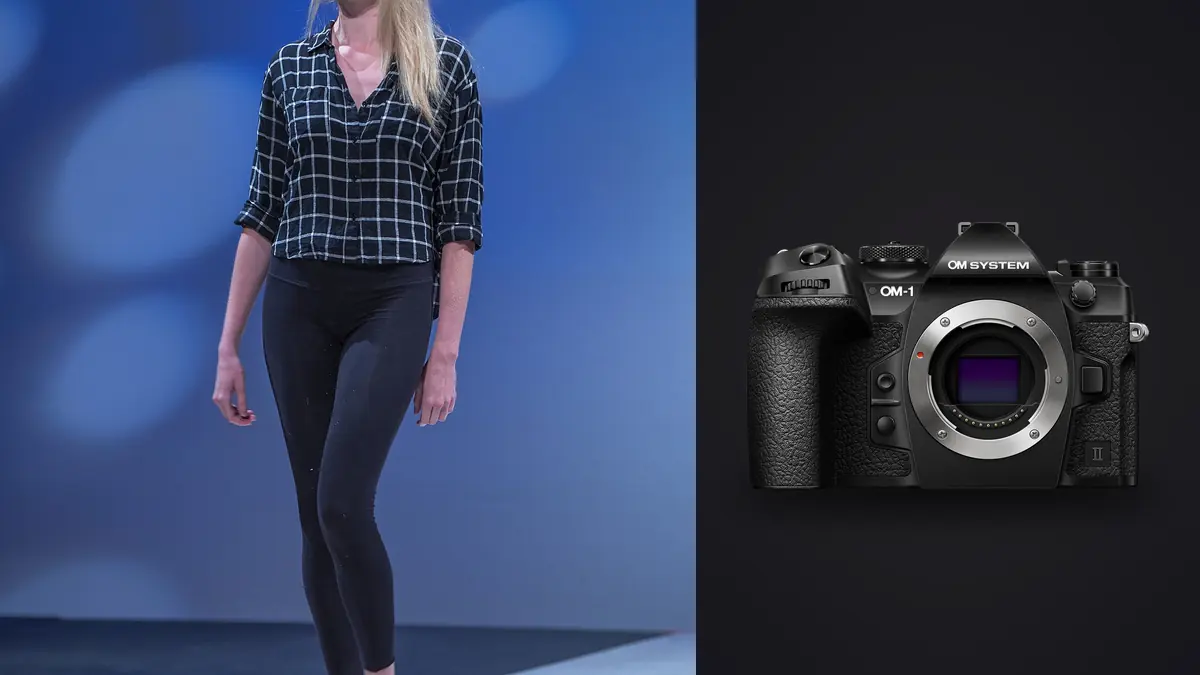
Picture forty looks, two locations, one indoor day with strobes, and a client who wants the full set turned around in five business days. That's the kind of brief where an OM-1 Mark II alongside a full-frame kit for a resort-wear lookbook earns opinions that go beyond a spec sheet. Micro Four Thirds bodies don't come up much in conversations about commercial fashion work, and it is easy to see both why that is and why it's starting to change.
A smaller sensor sounds wrong for fashion until you count looks per day
The OM-1 Mark II carries a 20.4-megapixel stacked BSI sensor at Four Thirds size, which means a 2x crop relative to full frame. On paper that's a downgrade for anyone chasing the creamy, subject-isolated look that a lot of fashion editorial leans on. In practice, for a lookbook specifically, the deeper depth of field at a given aperture turned out to be useful more often than it was a problem. Lookbook work is rarely a single model against a blown-out background. It's three or four garments on one model shot in sequence, sometimes two models in frame together, and the client wants the fabric drape and stitching detail sharp, not just the eyes. Shooting the 25mm f/1.2 PRO (50mm full-frame equivalent field of view) at f/2.8 gave me full-length sharpness across a standing pose that would have needed f/5.6 or narrower on a full-frame body, without pushing ISO to compensate.
The other thing that changes the math is what you're carrying between locations. My two-body kit with the 12-40mm f/2.8 II and 40-150mm f/2.8 PRO weighed noticeably less than the equivalent full-frame zoom pair, and on a day where the crew was me, one assistant, and a rolling rack of garments across a beach parking lot and a downtown alley, that difference in bag weight mattered more than it would in a studio.
Autofocus that keeps up with a model who won't hold still
The Mark II's real upgrade over the original OM-1 isn't the sensor, it's the AI subject detection. Where the first OM-1 split its detection into fairly narrow categories, the Mark II added a dedicated Human detection mode that reads face, eye, and head position together and holds onto it through turns, hair movement, and partial occlusion from a scarf or a hat brim. For a lookbook that includes walking shots, that mattered more than any other single feature on the body. Continuous autofocus at SH2 drive (roughly 50fps with full C-AF, faster in AF/AE-locked mode) tracked a model walking directly at camera through a hair toss without hunting, which is not something I could say confidently about older Micro Four Thirds AF systems.
Pro Capture is the feature I didn't expect to lean on as hard as I did. Set to SH1, it buffers roughly two dozen frames before you fully depress the shutter, so a jump shot or a fabric flare that peaks in a fraction of a second gets caught even when your reaction time doesn't. Picture a sequence where the brief calls for a coat opening mid-turn: the frame the client picks can easily be one that happened before you consciously pressed the button.
Where the tracking still needs a human backup
It's not flawless. Backlit silhouette shots, which came up twice on the beach location around golden hour, confused the subject detection enough that I switched back to a single AF point and focused manually on the rim of the shoulder. The camera wants contrast and a recognizable face shape to lock onto, and a model shot as a dark shape against a bright sky gives it neither. That's a known limitation of on-sensor detection generally, not unique to OM System, but it's worth planning for rather than discovering mid-shoot.
| Shot type | Shutter / drive | AF setting | Why |
|---|---|---|---|
| Walking / movement shots | Electronic, SH2 (~50fps C-AF) | C-AF, Human detection | Silent shutter doesn't distract the model mid-walk; tracking holds through head turns |
| Strobe-lit static poses | Mechanical, sequential low (~10fps) | S-AF, single point on eye | Electronic shutter can band or misfire with flash sync above 1/250; mechanical keeps exposure clean |
| Jump / fabric flare / hair toss | Electronic, Pro Capture SH1 | C-AF, Human detection | Pre-buffers frames before the shutter press to catch a peak moment your reflexes miss |
| Texture / product detail (shoes, jewelry, weave) | Tripod High Res Shot (80MP composite) | Single point, manual focus assist | Delivers files with enough resolution to crop tight for e-commerce zoom without a second lens change |
| Full cast / group looks | Mechanical, sequential low | C-AF all-target, multi-face Human detection | Registers several faces at once, and the crop-factor DOF advantage keeps everyone sharp at f/5.6-8 |
The high-res modes save your reshoot budget, within limits
The handheld high-res shot mode composites up to roughly 50 megapixels from a burst of slightly offset frames, and the tripod version pushes to about 80 megapixels. For a lookbook that's going to be printed large for a showroom wall or blown up for a pop-up retail backdrop, that's genuinely useful, and it's cheaper than renting a medium-format back for the day. I used tripod high-res for flat-lay accessory shots and fabric-texture close-ups where nothing in frame was moving, and the files held up to aggressive cropping for vertical social formats pulled from the same capture.
What it won't do is rescue a moving subject. Any hand or fabric movement during the multi-frame capture shows up as ghosting or soft edges, so this mode lives entirely in the product-detail and static-pose part of the shot list, not anywhere near the walking or jump sequences.
What survives a two-location day
The IP53 weather sealing isn't marketing fluff on a shoot where "outdoor location" means salt air and blowing sand for half the day. Nothing failed, nothing needed a rain sleeve for light spray, and I didn't baby the body the way I would with a less sealed system. Dual UHS-II card slots let me shoot RAW to one card and a backup copy to the second in real time, which on a job with an unreleased collection is not optional, losing a card is not a conversation I want to have with a brand's PR team.
Battery life is the one place the smaller body shows its size. The BLX-1 pack got me through roughly 400 to 500 frames of active shooting with IS engaged before needing a swap, noticeably fewer than the CIPA number on the box once you factor in chimping between setups and reviewing Pro Capture bursts on the rear screen. I carried three spares and used all of them across the two days.
Getting from memory card to a client-ready lookbook
Here's the part nobody warns you about going into fashion work on a high-speed body: the frame count. Forty looks shot with SH2 bursts and Pro Capture sequences left me with just over 3,100 RAW files by the end of day two, and a huge share of them were near-duplicate frames from the same three-second walk cycle. Sorting that by eye is how a five-day turnaround becomes a nine-day turnaround.
This is where imagic earned its place in the workflow rather than staying a nice-to-have. Its local sharpness scoring caught eye softness in a couple of frames that looked fine at thumbnail size on the camera's rear screen, which matters a lot when the difference between the hero frame and the reject is whether the model's eyes were fully open and in focus at 1/500. The duplicate and burst clustering grouped each walk cycle and jump sequence into a stack instead of leaving me to scroll through 40 nearly-identical frames per look, which is the single biggest time saver in the whole post-production chain on a shoot like this. And because the processing runs locally with no cloud upload, you don't have to think twice about client confidentiality on a collection that hasn't been announced yet, which matters more on fashion work than on most other genres given how routinely NDAs come attached to the shoot.
Once the picks were made, imagic's apply_my_style preset, trained on my own past edits rather than a generic filter, got me a consistent starting grade across all 40 looks in one pass, which I then fine-tuned per shot rather than building each look's color from scratch. If you want more detail on how the culling side of that actually works, I wrote up the mechanics separately at how AI photo culling works, and the current pricing for anyone weighing it against a subscription tool is on the pricing page.
Where I'd still reach for a full-frame body
I want to be straight about the limits, because a lookbook is not the hardest test a fashion camera will face. For a beauty-focused hero shot where the whole point is razor-thin depth of field isolating a face against a soft background blur, a full-frame 85mm at f/1.4 still does something the Micro Four Thirds system can't quite match, even with the 45mm f/1.2 PRO wide open. The physics of sensor size and light-gathering area don't go away because the autofocus is excellent. Low light past ISO 6400, which can come up during an evening backstage sequence added at the last minute, shows visibly more noise in shadow detail than you'd get from a full-frame body at the same ISO, and it makes sense to pull out a second camera for that portion of the day rather than pushing the OM-1 Mark II past its comfort zone.
So the honest read is that this body doesn't replace a full-frame kit for every part of a commercial fashion job. It replaces it for the parts that involve motion, weather, and volume, which on a lookbook shoot is most of the day, and it does that while weighing less and costing meaningfully less to build a fast-aperture lens kit around.
Frequently Asked Questions
Does the smaller Micro Four Thirds sensor actually hurt lookbook image quality, or is that just a spec-sheet worry?
For full-length and group lookbook shots it's rarely a practical problem, since the deeper depth of field at a given aperture actually helps keep multiple garments and models sharp. It becomes a real limitation specifically for shallow-DOF beauty shots and for any low-light work past roughly ISO 6400, where full-frame files hold up better.
Which OM System lenses make sense for a fashion lookbook kit specifically?
The 12-40mm f/2.8 II PRO covers wide environmental and full-length shots, the 40-150mm f/2.8 PRO handles compressed walking and detail shots from a distance without crowding the model, and a fast prime like the 25mm f/1.2 or 45mm f/1.2 PRO covers the tighter beauty and portrait-style frames within the set.
Can the high-res shot modes replace a rented medium-format back for print lookbook pages?
For static product detail, flat lays, and fabric texture shots, the 80-megapixel tripod high-res mode gets close enough for large print and gives you crop room for secondary social crops. It's not usable for anything with model movement in frame, since the multi-frame composite ghosts on motion.
How do you keep color consistent across a two-day shoot when the light keeps changing?
Shooting RAW and building a single starting grade from the most representative look of the day, then applying it consistently before per-shot adjustment, keeps the set from looking like it was edited by three different people. Tools that can apply a preset trained on your own established edit style speed that first pass up considerably compared to grading each look from a blank slate.