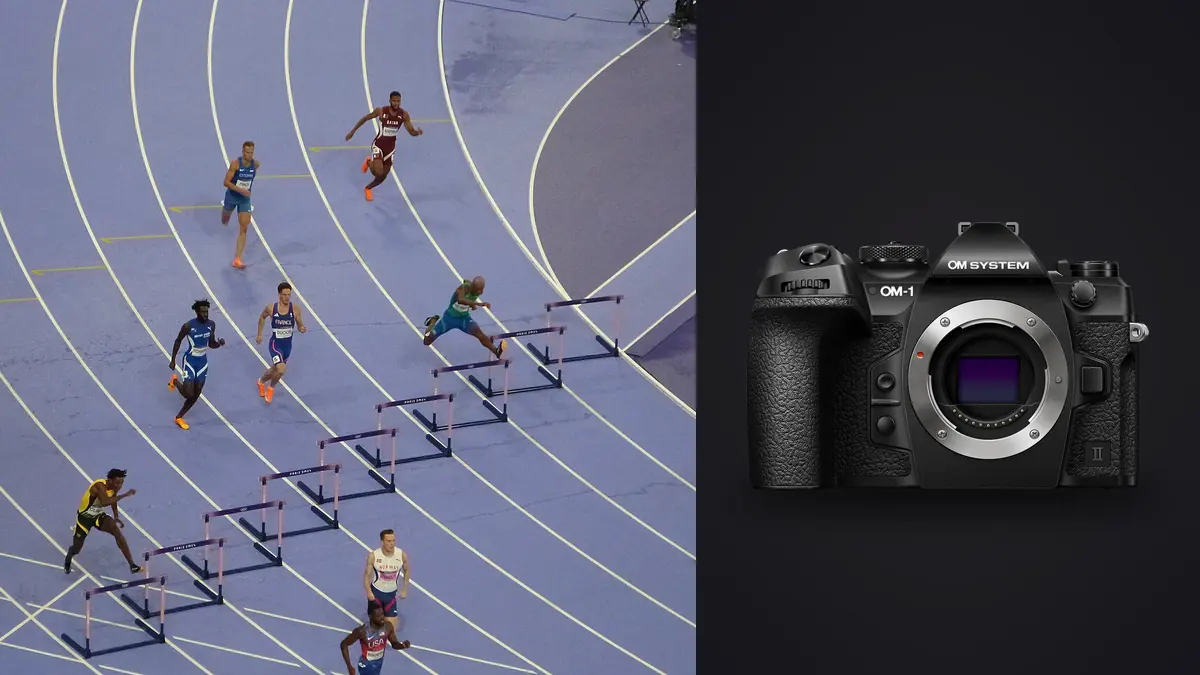
I picked up the OM-1 Mark II for a regional track and field meet last spring mostly out of curiosity. I'd shot the previous two seasons with a full-frame body and a 300mm f/4, and I was tired of cropping sprint finishes down to postage stamps because the athletes never filled the frame from the far side of the infield. Three meets later the OM System body had more or less taken over my track bag, and it's worth explaining exactly why, because the reasons have almost nothing to do with the usual "smaller and lighter" pitch you hear about Micro Four Thirds.
Why the 2x Crop Stops Feeling Like a Handicap at a Track Meet
Track and field is one of the few sports where the sensor crop argument actually flips in favor of Micro Four Thirds instead of against it. At a typical high school or regional stadium, you're shooting from a fixed photographer's box on the infield rail, often 30 to 60 meters from the action on the far straight, and you don't get to move closer once the gun goes off. A 300mm lens on the OM-1 Mark II gives you the field of view of a 600mm on full frame. That's the difference between a hurdler who fills a third of the frame and one who fills two-thirds of it, without buying a lens that costs more than a used car and weighs enough to need its own tripod.
The trade-off is real and I won't pretend otherwise. Push past ISO 3200 under a dim high school stadium's sodium or older metal-halide lighting and the smaller sensor shows more noise than a full-frame body would at the same setting. Under good evening light or at a well-lit college facility, it's a non-issue. Under the lights at a Tuesday night dual meet in October, it's the thing you notice first.
Pro Capture and the Problem of the Gun
Sprint starts are brutal to time by reaction alone. The gap between the gun firing and an athlete actually leaving the blocks is somewhere around 120 to 160 milliseconds for a good start, and human shutter-finger reaction time to an audible cue is rarely faster than 150 to 200 milliseconds on its own. By the time you've heard the gun and your finger has responded, the moment is already half over.
Pro Capture solves this in a way that no amount of skill fixes on a camera without it. Half-press the shutter and the OM-1 Mark II starts buffering frames continuously into memory before you ever fully press down. Complete the press and it backfills up to a few dozen frames from before your reaction, along with everything after. I run mine at a 20-frame pre-capture buffer for the 100m and 200m blocks, which covers roughly a third of a second before the shutter press and has never once left me without the exact frame of an athlete's first foot contact.
It changes how you shoot starts. Instead of trying to anticipate the gun, you watch the starter's hand go up, half-press as the "set" position holds, and let the buffer do the timing work you can't do with your own reflexes.
Autofocus Across Nine Different Events in One Afternoon
A dual meet or invitational throws a lot at an autofocus system in a single afternoon: sprints on the straight, distance races strung out around the whole oval, long jump and triple jump runways coming at you head-on, pole vault with an athlete moving vertically at the very end of the approach, and throws where the implement leaves the frame faster than any runner ever will.
Human detection AF on the OM-1 Mark II is genuinely good for the running and jumping events. It locks onto a torso or head reliably even with three or four athletes bunched together mid-race, and it holds through the kind of brief occlusions you get when a leading runner's arm swings across a trailing runner's face. Where it's less useful is the field events involving an implement rather than a person as the point of focus, javelin and discus in particular, where I switch off subject detection entirely and go back to a single, smaller AF point that I place manually on the athlete's release point. The camera doesn't know a discus is about to leave a hand, and asking it to guess just adds hunting you don't need.
One quirk worth flagging: under mixed stadium lighting, especially the kind of aging metal-halide rigs still common at older high school facilities, I've had the AF system briefly hunt on a distant runner during the transition between light towers with different color temperatures. It's a two or three frame stumble, not a meet-ruining problem, but it's the one situation where I've seen this body genuinely hesitate.
Burst Speed, Buffer Depth, and What Happens After You Stop Shooting
The headline numbers are real: up to 120fps with focus locked, and a more usable 50fps with continuous AF and AE tracking active, which is the mode I actually shoot in for anything with movement. The table below is how I'd actually explain the difference between this body, the original OM-1, and a Canon R7 (the other crop body a lot of track photographers ask me about) for this specific use case, rather than a generic spec dump.
| For track and field shooters | OM-1 Mark II | OM-1 (original) | Canon R7 |
|---|---|---|---|
| Effective reach with a 300mm lens | 600mm equiv. | 600mm equiv. | 480mm equiv. |
| Max burst with continuous AF/AE | 50fps | 50fps | 15fps (mech.) / 30fps (elec.) |
| Pro Capture / pre-shutter buffer | Yes, up to ~99 frames | Yes, up to ~99 frames | No true pre-capture buffer |
| Subject detection for people/track events | Improved, faster lock-on | Good, occasionally slower re-acquire | Good, no dedicated track/field profile |
| Body weight (with battery) | 599g | 599g | 612g |
What that table doesn't show is what happens to your workflow after the meet ends. A single afternoon covering four events at 50fps with Pro Capture turned on for the sprints generates numbers that would have been unthinkable on a DSLR ten years ago. I routinely come home with 6,000 to 9,000 frames from a two-hour meet, most of them near-duplicates from bursts that ran a half second longer than they needed to. Sorting that by eye is a multi-hour job, and it's the reason I now run everything through imagic before I even open Lightroom. It scores sharpness and eye/focus accuracy locally on the raw files straight off the card, clusters the burst sequences so I'm comparing six frames from one stride instead of scrolling past all sixty, and does it without uploading a single frame anywhere, which matters when you're sitting in a stadium parking lot with no signal and a media deadline in two hours.
The Lenses That Actually Earn Their Keep
Three lenses cover almost everything I shoot at a track meet. The 40-150mm f/2.8 Pro handles field events and any race that comes reasonably close to the rail, and it's light enough to shoot handheld for a full session without a monopod. The 300mm f/4 Pro is the workhorse for the far side of the track, sharp wide open and small enough to hand-hold between races rather than leaving it locked down on a tripod head. For meets at bigger stadiums with a longer infield, I'll bring the 150-400mm f/4.5 Pro with the built-in 1.25x teleconverter, which turns into an 800mm equivalent monster at the flick of a lever, though it's the one lens on this list heavy enough that I want a monopod under it by the third hour.
What all three share is genuinely effective in-body stabilization paired with the lens's own IS, which matters more at a track meet than people expect. You're not on a tripod tracking a stationary subject; you're panning with a 200m runner while holding the camera up for twenty minutes at a stretch between heats. Lighter gear you can actually hold steady beats heavier gear you have to fight.
Settings I Actually Dial In, Event by Event
- Sprints (100m-400m): 1/2500s or faster, electronic shutter for silent high-speed bursts, Pro Capture on, continuous AF with human detection.
- Distance races: 1/1000s is plenty since the pace is slower, mechanical shutter to avoid any electronic rolling-shutter skew on fast-moving legs at the bell lap sprint.
- Long jump / triple jump: 1/2000s, AF point placed on the takeoff board rather than tracking the full approach, since the critical frame is always the plant.
- Pole vault: 1/2000s, subject detection off, single AF point that I reposition as the vaulter clears the bar, because the vertical motion confuses tracking more than horizontal motion does.
- Throws (shot, discus, javelin): 1/2000s, manual AF point locked on the athlete's starting position, refocus for the release rather than trying to track the implement.
Where It Still Falls Short
I don't think any camera is worth writing about honestly without saying where it disappoints you. Two things stand out after a full season with this body. First, buffer clearing after a long 50fps burst with continuous AF takes noticeably longer than I'd like on anything but the fastest UHS-II cards, and I've missed a follow-up shot at a false start restart because the camera was still writing the previous burst. Second, the electronic viewfinder, while good, still shows a hair more lag during sustained high-speed bursts than the optical finders I grew up shooting sports with, and if you're used to a DSLR's blackout-free OVF, there's a short adjustment period before panning a sprinter through the frame at 50fps feels natural again.
Neither is a dealbreaker. Both are the kind of thing you learn to work around after a meet or two, the same way you learn any tool's quirks.
After the Meet: Turning Nine Thousand Frames Into a Gallery
The part of shooting track that nobody warns you about going in isn't the camera work, it's the evening afterward staring down a memory card with more frames than you shot at some entire weddings. This is where the local-first side of my workflow matters more than any spec on the camera itself. I let imagic run its focus and sharpness pass on the full card overnight, offline, on my own machine, so nothing about a roster of minors at a school meet is ever leaving my laptop to get sorted. Once the duplicate-heavy bursts are clustered down to the two or three genuinely sharp frames per stride, I lean on the apply_my_style preset I trained from my own previously graded meet photos, which gets every image to roughly the right color and contrast before I do any final individual adjustments. It's cut what used to be a four or five hour post-meet session down to something closer to ninety minutes, most of which is now spent actually looking at images instead of scrolling past duplicates.
If you're new to building that kind of pass entirely before you touch Lightroom, our breakdown of how AI photo culling actually works covers the mechanics in more depth than I have room for here, and the tips for a faster photo workflow piece has a few habits that pair well with a high-volume sport like track specifically.
Frequently Asked Questions
Can the OM-1 Mark II keep up with a Nikon Z9 or Canon R3 for sprint finishes?
For the specific job of nailing a sprint finish, yes, and in some ways it's better suited to it. The pre-shutter Pro Capture buffer is deeper and easier to configure than the equivalents on either full-frame flagship, and the 2x crop means you're filling the frame with the athlete from a normal press position instead of needing an 800mm prime to do it. Where the full-frame bodies pull ahead is dynamic range and high-ISO cleanliness for meets under genuinely bad stadium lighting, which matters more at some venues than others.
Is the crop sensor actually an advantage for track and field, or is that just marketing?
For this specific sport, it's a real advantage, not spin. Track and field photographers are usually locked into a fixed shooting position by meet organizers and can't move closer to the action the way a sideline sports shooter can. Free reach from the sensor crop, rather than needing to buy and carry a longer, heavier, far more expensive lens, is a genuine practical win. It's less of an advantage in sports where you can physically move closer to the subject.
What's the one lens to start with if I only shoot a handful of meets a season?
The 40-150mm f/2.8 Pro. It covers field events and any race near the rail, it's light enough to hand-hold for a full meet, and the effective 80-300mm reach on this sensor covers more of a track meet than people expect before you'd actually need something longer.
How do you realistically manage the number of frames Pro Capture produces?
You need a culling pass that happens before you ever open your editor, not after. Trying to manually flag sharp frames out of a 9,000-image card in Lightroom is the single biggest reason people burn out on shooting track meets. Running a local sharpness and burst-clustering pass first, the way imagic does directly off the card without any of it leaving your machine, is what makes the frame count from Pro Capture a genuine advantage instead of a chore you dread after every meet.