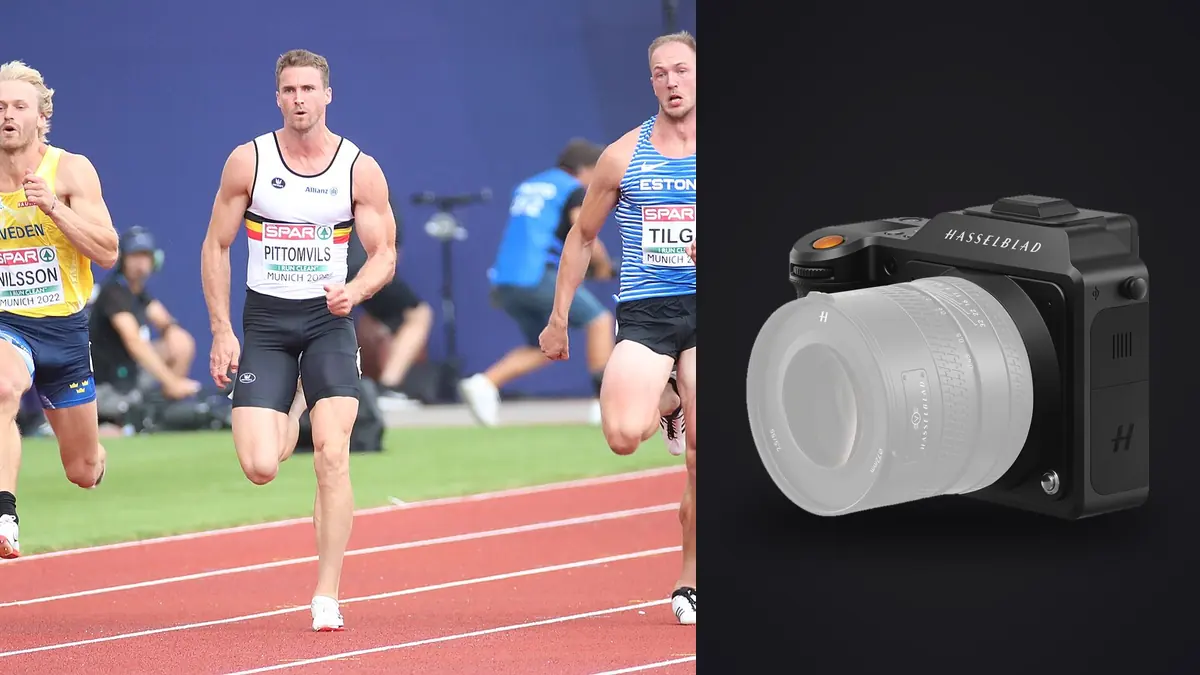
The Hasselblad X2D 100C is not a sports camera. Hasselblad has never once marketed it as one, and if you've spent five minutes with the spec sheet, you already know why: 3.3 frames per second and a native lens lineup that tops out at 135mm are not the numbers that win an autofocus fight with a sprinter coming out of the blocks. So why does this camera keep turning up in the bags of photographers working track meets, from local high school invitationals to sponsor content days at national championships? Because a track meet is not one job. It's a dozen different jobs happening in the same stadium, and only a few of them actually need 20 frames per second.
What This Camera Actually Is, and Isn't
Strip away the marketing language and the X2D 100C is a 100-megapixel medium format body built around a 43.8 x 32.9mm sensor, roughly 1.7 times the surface area of a full-frame chip. It was designed for photographers who need extreme resolution and color fidelity on subjects that hold still, or at least move predictably: architecture, product work, landscapes, studio portraiture. Hasselblad added phase-detection autofocus for the first time in this body (294 points, up from the contrast-only system in the X1D II), and that upgrade genuinely matters. It's the difference between a camera that hunts on a static subject and one that locks reliably. But phase detection alone doesn't give you the subject-tracking algorithms, the eye-detection-for-athletes tuning, or the buffer depth that a dedicated sports body builds its entire autofocus stack around.
At a track meet, that gap shows up immediately in anything involving lateral speed. A 100m dash, a long jump approach, a relay handoff at full stride: these are exactly the situations where a camera needs to predict where a subject will be in 1/2000th of a second, not just where it is right now. The X2D 100C's AF system is competent at holding focus on a subject moving toward or away from the camera at a moderate pace. It is not built to chase erratic lateral motion across the frame while firing a burst.
The Numbers That Matter Trackside
Continuous shooting on the X2D 100C tops out at 3.3fps, and in practice you get a short burst before the buffer starts to back up and the actual frame rate sags. That's not a flaw so much as an honest consequence of moving 100 megapixels of raw data off the sensor per frame. Compare that to what a purpose-built sports body offers and the gap is stark enough that it changes what you plan to shoot, not just how you shoot it.
| Spec (relevant to track coverage) | Hasselblad X2D 100C | Sony a9 III | Nikon Z9 |
|---|---|---|---|
| Continuous shooting | 3.3 fps | Up to 120 fps (global shutter, blackout-free) | Up to 20 fps RAW |
| Autofocus points | 294 (phase-detection) | 759 (phase-detection, ~92% coverage) | 493 (phase-detection) |
| Sensor / resolution | 43.8 x 32.9mm, 100MP | 35mm full-frame, 24.6MP | 35mm full-frame, 45.7MP (stacked) |
| Native telephoto ceiling | XCD 135mm (~107mm full-frame equivalent) | 600mm f4 GM | 800mm f6.3 PF |
| Body-only price at launch | ~$8,199 | ~$5,998 | ~$5,499 |
Read that table honestly and the case for the X2D 100C at a track meet isn't "it competes." It's "it does a different job." Nobody is going to nail a photo finish or a pole vault bar clearance with 3.3fps against 120fps global-shutter bodies built for exactly that moment. But nobody needs 100 megapixels for a wire photo either. The resolution and the frame rate are pulling in opposite directions on purpose, and the trick is knowing which one your specific assignment actually needs.
Where 100 Megapixels Change the Calculus
Here's the part that surprised me the first time I brought the X2D 100C to a meet instead of leaving it in the studio: a 100-megapixel file gives you reach you don't otherwise have. The XCD lineup stops at 135mm, which on this sensor's crop factor works out to roughly 107mm in full-frame terms. That's a portrait lens, not a field-events lens. But crop a 100MP frame down to 50% of its linear dimensions and you're still sitting at around 25 megapixels, which is more resolution than most full-frame bodies deliver natively. In practice that means a runway shot from the infield with the 135mm, cropped hard in post, can still print or run online at sizes that would fall apart from a cropped 24-megapixel file.
That workaround comes with a real cost: you're now culling and editing full-resolution files that run 100 to 130MB apiece as 3FR raws, even for shots you already know you're going to crop by half. A two-day meet where you're also covering warmups, athlete arrivals, and team portraits can put four to six thousand frames on your card, and at that file size the storage and review math changes fast. The X2D 100C's 1TB internal SSD plus a CFexpress Type B slot means you're not swapping cards every hour, which is one less thing to manage when you're moving between the infield, the stands, and a mixed-zone interview area.
Lens Reality: XCD Glass and the 135mm Ceiling
If you're coming from a full-frame sports kit, the XCD lens lineup will feel restrictive at first. There is no native 300mm, no 400mm, nothing built for shooting field events from the far side of a track. The longest XCD glass is the 135mm f/2.8, and beyond that your only option is adapting Hasselblad's older H-series lenses (some of which reach 300mm) through the XH Adapter. That gets you reach, but autofocus performance and speed both take a step back compared to native glass, and the H 300mm f4.5 is a heavy, dated optic to be hand-holding trackside for an afternoon.
Where the XCD lenses do earn their keep is in the leaf shutter built into most of them, which syncs with flash up to 1/2000s. If you're shooting pre-race portraits under a mix of stadium shade and open sky, or doing sponsor content with fill flash at midday, that sync speed lets you overpower harsh sun without stepping down to a slow shutter. It's a studio-lens feature that happens to be genuinely useful on an athletics infield.
A Realistic Trackside Shot List
The photographers getting real value out of this camera at meets aren't trying to replace their sports body. They're using the X2D 100C for a specific subset of the day:
- Pre-race and pre-meet athlete portraits, where you control the moment and don't need burst speed at all.
- Blocks, starting-line tension, and warmup stretching shots, where subjects are relatively still and the medium format color and tonal range make skin and uniform colors look distinct rather than flattened.
- Wide environmental frames of the stadium, crowd, and lighting rigs for editorial layouts that need a hero image with real print resolution.
- Slower field events like shot put or high jump approach, where the action window is longer and 3.3fps can still catch the release or the clearance if your timing is good.
- Team and sponsor group shots after the meet, where the 100MP files hold up for large-format prints or billboard use.
What doesn't make the list: the 100m final, relay exchanges, hurdles sequences, anything where you're relying on the camera to predict fast lateral motion across the frame. Bring a second body for that, or accept that you'll get one usable frame out of a short burst rather than a full sequence to pick from.
The RAW Workflow After the Meet
This is where the resolution decision actually bites you. Four thousand 3FR files at over 100MB each is not a folder you want to scroll through frame by frame at 100% zoom looking for the one where the athlete's eyes are open and the focus actually landed on them instead of the fence behind them. I run everything through imagic before I open a single file in an editor, because its local sharpness and focus scoring flags the frames where the X2D 100C's AF missed by a fraction, which happens more often on this body than on a dedicated sports camera when the subject is moving. Since imagic processes everything on-device with no cloud upload, that matters for sponsor and team content that's often under embargo before an official release.
The other place it saves real time is duplicate and burst clustering. Even at 3.3fps, a five-frame burst of a shot put release or a hurdle clearance produces near-identical images that are tedious to compare side by side at full resolution. Having those grouped automatically means I'm choosing between three visually similar frames instead of scrubbing through the whole card. And because the color and tonal character of Hasselblad files has its own specific look coming out of camera, I lean on imagic's apply_my_style preset, trained on my own past edits, to get a consistent starting grade across hundreds of frames before I go in and fine-tune the handful that are actually running in a gallery or a print piece. If you're new to building a culling pass that doesn't eat your whole evening, our breakdown of how AI photo culling works covers the mechanics in more depth, and the tips for a faster photo workflow post has a few habits worth adopting before your next meet, not after.
Exposure and Technique Notes for Stadium Light
Base ISO on the X2D 100C sits at 64, and Hasselblad's sensor is rated for roughly 15 stops of dynamic range, which is genuinely useful at an outdoor meet where you've got harsh midday shadow under a grandstand roof competing with blown-out sky in the same frame. I shoot most static and portrait work at base ISO and let the dynamic range recover shadow detail in post rather than fighting it with fill flash I don't have time to set up.
For anything handheld at the longer end of the XCD range, the 5-axis in-body stabilization (rated up to 7 stops) makes a real difference. It lets you hold the 135mm at shutter speeds you'd never get away with on an unstabilized body, which matters for panning shots on a runner mid-stride where you want motion blur in the background but a sharp subject. The mechanical shutter caps out at 1/4000s, and the electronic (silent) shutter goes to 1/10000s, which is worth switching to for indoor meets where the mechanical shutter's clack is genuinely intrusive in a quiet arena before a start.
Battery life is the one operational weak point worth planning around. CIPA rates the X2D 100C at roughly 420 shots per charge, which sounds fine until you remember you're not firing bursts, you're often leaving the camera on and metering for long stretches between decisive moments. Carry at least two spares for a full day of coverage.
Frequently Asked Questions
Does the X2D 100C have any continuous autofocus tracking mode built for sports?
It has continuous AF and the 294-point phase-detection system will follow a subject moving predictably toward or away from the camera. It does not have the kind of subject-recognition, erratic-motion tracking that Sony, Canon, and Nikon have built into their flagship sports bodies. Treat it as reliable single-point or small-zone AF rather than a system you can trust to track a runner across the full width of the frame.
What's the realistic reach for field events like javelin or shot put?
With the native 135mm you're at roughly 107mm full-frame equivalent, which is short for field events unless you're positioned close to the action. Cropping a 100MP file gets you usable reach after the fact since even a 50% crop leaves around 25 megapixels, but it's not a substitute for glass if you need to frame tight in camera. Adapting an H-series telephoto through the XH Adapter is the other option, with a real hit to autofocus speed.
Is a 3.3fps burst rate ever fast enough for a track meet?
For slower-developing moments like a shot put release, a high jump clearance, or a relay handoff where you can anticipate the exact instant, yes, if your timing and pre-focus are solid. For anything requiring you to spray and pray across a fast sequence, like a 100m final or a hurdles run, no. Plan those events for a second, faster body if you have access to one.
How many raw files should I expect to manage after a full day of coverage?
Depending on how much of the day you cover (warmups, finals, portraits, team shots), it's realistic to land somewhere between two and six thousand frames, each running 100 to 130MB as a 3FR file. That volume is exactly why a culling pass before editing matters more with this body than with a smaller-file sports camera; skipping it just means dragging the same bloated folder into your editor and doing the sorting manually.
Is It Worth Bringing to the Track?
If your job that day is capturing the race itself, leave the X2D 100C at home and bring glass built for speed. If your job includes the portraits, the environmental frames, the sponsor content, and the images that need to hold up as a large print or a magazine spread six months later, it earns its spot in the bag alongside whatever's actually shooting the finish line. The mistake is expecting one camera to do both jobs equally well. This one was never built to.