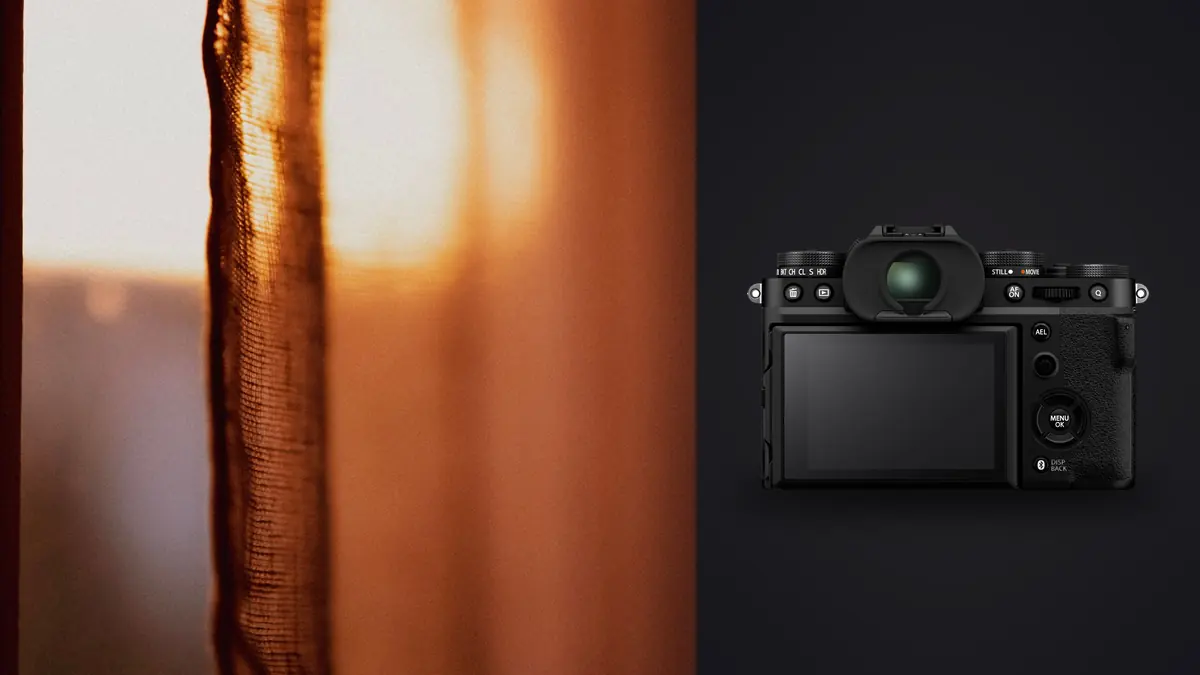
I picked up the X-T5 and switched over from a full-frame body mostly on a whim, thinking the smaller size would be less intimidating in someone's bedroom. It turned out the size was the least important reason to switch. The things that actually changed my sessions were the in-body stabilization, the silent shutter, and, unexpectedly, how the X-Trans color science renders skin under mixed window and continuous light without me fighting magenta casts in post. This isn't a spec sheet regurgitation. It's what actually mattered across roughly forty sessions shot almost entirely in homes and small hotel rooms, where you don't get the luxury of a studio's space or lighting control.
Why this body fits intimate portrait work in the first place
Boudoir and intimate portraiture live and die on client comfort, and comfort is affected by things that never show up in a spec comparison: how loud your shutter is, how big your camera looks in someone's face, and how quickly you can work without breaking the mood by fiddling with settings. The X-T5's electronic shutter is genuinely silent, which matters more here than in almost any other genre I shoot. A DSLR's mechanical clack in a quiet bedroom is a mood killer, and even a mirrorless body with a loud simulated shutter sound draws attention to the fact that a photo was just taken of someone in a vulnerable pose. Set the X-T5 to fully electronic and turn the simulated sound off, and the client stops flinching at every frame.
The X-T5's 40.2-megapixel X-Trans HR sensor is also doing more work than I expected for cropping. Boudoir compositions get reworked a lot in post, tightening a frame, straightening a horizon that got knocked off during a handheld pose adjustment, pulling a vertical crop out of a horizontal capture for a client who wants both formats delivered. Having that resolution headroom means I can crop aggressively without the file falling apart, something I couldn't do casually on my old 24-megapixel body.
In-body stabilization rated to 7 stops is the other genuine workhorse feature. A lot of boudoir work happens in low, warm, deliberately moody light, window light in the evening, a single tungsten lamp, string lights. Without a second body or an assistant, I'm often shooting handheld at 1/60 or slower to keep ISO down, and the IBIS is what makes that usable instead of a gamble.
Lens choices for rooms that are smaller than you'd like
The biggest practical constraint in this genre isn't lighting, it's floor space. Most boudoir sessions happen in a bedroom, and most bedrooms do not give you fifteen feet of backing-up room. This changes which Fujifilm glass actually earns its keep versus which lens sounds great on paper but forces you into a hallway.
| Lens | Full-frame equivalent | Max aperture | Comfortable working distance in a typical bedroom | Where it earns its keep |
|---|---|---|---|---|
| XF33mm F1.4 R LM WR | 50mm | f/1.4 | 6 to 7 feet for a full-length pose | The lens I reach for first. Natural perspective, close enough to talk quietly with the client, wide enough to work in a genuinely small room. |
| XF56mm F1.2 R WR (II) | 85mm | f/1.2 | 8 to 10 feet for waist-up | The signature look for close, soft-background portraits. Focus breathing at minimum distance means you sometimes lose a touch of reach wide open, so leave a little more room than you'd think. |
| XF90mm F2 R LM WR | 137mm | f/2 | 12+ feet | Beautiful compression for detail-driven close crops, but it's the lens most likely to fail you in a genuinely cramped room. Save it for larger spaces or outdoor-adjacent shoots. |
| XF80mm F2.8 Macro | 122mm | f/2.8 | 1 to 3 feet | Underrated for boudoir's detail shots: jewelry, lace texture, hands, garment straps. Not a portrait workhorse but earns a spot in the bag for the gallery variety clients actually pay for. |
| XF16-55mm F2.8 R LM WR | 24-84mm | f/2.8 | Variable, adapts to the room | The practical answer when you can't scout the location ahead of time. Gives up the creamy wide-open look of the primes but saves a session when a room turns out smaller than promised. |
If someone is buying their first prime for this kind of work and can only afford one, it's the 33mm, not the 56mm. Everyone reaches for the 56 first because of the bokeh, then discovers it's genuinely hard to use in a small room without backing into a dresser.
A note on the tilt-only screen
Fujifilm walked back the fully articulating screen from the X-T4 to a three-way tilt on the X-T5, and vloggers were annoyed about it. For this kind of stills work I actually prefer it. Boudoir compositions are frequently shot from low angles, kneeling at the foot of a bed, or from slightly above looking down, and the tilt mechanism covers both of those without needing to flip the screen out to the side where it can catch on fabric or bedding. The one place it genuinely falls short is a straight-on vertical selfie-style composition, which almost never comes up in this genre anyway.
Settings that changed how I shoot, not just how the camera looks on paper
Film simulations get talked about as a gimmick by people who haven't leaned on them for skin tone. For boudoir specifically, I settled on a personal recipe built off Nostalgic Neg for warmer, editorial-leaning sets and a flatter custom profile based on Eterna when I know I'm going to grade heavily afterward and don't want the in-camera simulation fighting my adjustments. Reala Ace, which Fujifilm rolled into firmware for the X-T5 a while after launch, ended up being my default for straight, true-to-skin color when the subject wants something closer to natural rather than moody.
Autofocus is where I had to unlearn habits from other bodies. Face and eye detection on the X-T5 is reliable in good light, but boudoir poses put a lot of hair, hands, and fabric across the face, and the subject-detection AF sometimes locks onto an eyebrow or a strand of hair instead of the eye when the face is partially turned. I've moved to a smaller single-point AF box that I place manually more often than I use full subject tracking, especially at f/1.2 where the plane of focus is thin enough that a half-inch miss shows up as a soft eye and a sharp ear.
For shutter, I default to electronic for the reasons above, but I switch back to mechanical for anything shot near a window with strong daylight, since the electronic shutter's rolling readout can introduce banding under certain LED or fluorescent household lighting. It's rare in a home setting, but it happens with some smart bulbs on a dimmer, and it's worth a quick test frame if you're not sure what's lighting the room.
ISO handling deserves a specific mention because so much of this work happens without strobes. At base ISO 125 the dynamic range on the X-T5's sensor is genuinely good for pulling shadow detail out of a moody, underexposed frame, but I try to stay under ISO 3200 for anything I plan to print large. Above that, X-Trans's color filter pattern starts introducing a slightly different noise character than Bayer sensors, more of a fine grain than blotchy noise, which honestly looks fine for web delivery but gets messier in a big matted print.
Lighting without turning a bedroom into a studio
Most people sitting for boudoir portraits don't want to feel like they're in a lit set, they want to feel like they're in their own space having a good day. That pushes me toward window light and a single continuous source rather than strobes most of the time. A large diffusion panel angled to soften a west-facing window gets me through the bulk of a session, with a small LED panel (dimmable, warmed with a gel to roughly 3200K) filling shadow on the side away from the window. The X-T5's IBIS is what makes this approach viable handheld rather than needing a light stand and softbox setup that changes the whole feel of the room for the subject.
When I do bring a flash, it's a single small speedlight bounced off a ceiling or wall rather than direct, both because direct flash is unflattering on skin at close range and because the pop of a bare flash is jarring in an intimate setting in a way it just isn't at a wedding reception. The X-T5 syncs cleanly at 1/180s with the mechanical shutter for this, which is enough for anything short of trying to overpower bright midday sun through a window.
The part nobody talks about: what happens after the shutter
A boudoir session at f/1.2 to f/1.4 with a client who's moving through a series of similar poses produces a brutal number of near-duplicate frames, and a meaningful percentage of them are technically soft in a way that's hard to catch on a laptop screen at 1am. Eyes drift half a stone off a pupil, a hand shifts a hair's width and pulls focus off the face entirely. Going through four or five hundred frames from a single session by eye, at full resolution, checking sharpness on each one, is where a lot of editing time actually goes, more than the retouching itself.
This is the part of my workflow where imagic replaced what used to be an evening of squinting at thumbnails. It scores local sharpness and focus on-device and clusters the near-identical burst frames from a pose sequence, so instead of opening all four hundred images I'm looking at maybe sixty genuine options grouped by pose, with the sharpest frame in each cluster already flagged. For a genre where the difference between a keeper and a reject is often "is the near eye actually in focus," that scoring saves real time. If you want the mechanics of how that kind of scoring works, this breakdown of AI photo culling covers it in more depth than I will here.
The privacy angle matters more in this genre than almost any other kind of photography I've shot. Boudoir images are sensitive by definition, and clients ask, reasonably, where their photos are going during editing. Because imagic processes everything locally rather than uploading to a cloud service to do the culling and scoring, you can tell the people you photograph, honestly, that their images never leave your machine until you choose to export a gallery. That's not a marketing line, it's worth bringing up unprompted because it can ease a first-timer's nerves.
Once I'm through culling, I lean on apply_my_style to carry my established color grade, the Nostalgic Neg-leaning warmth I mentioned earlier, across a fresh set of session files trained on my own past finished edits rather than a generic preset pack. It's not magic, it still needs a pass for exposure outliers and any frame with unusual lighting, but it gets a fresh set of two hundred images to roughly seventy percent finished before I touch a slider by hand.
Things I'd tell myself before the first session
- Scout the room's light before the client arrives if you can. A bedroom that looks bright to the eye at 2pm can be two stops darker than you expect once you meter it, especially with heavy curtains or north-facing windows.
- Don't bring the 90mm to a first session in an unfamiliar space. Bring the 33mm and the 56mm and decide on location whether there's room for anything longer.
- Turn off every camera beep and the simulated shutter sound before the client walks in, not after you realize it's bothering them.
- Shoot a test burst at your planned ISO and check it at 100% before the client undresses. Nothing kills confidence in a session faster than having to ask someone to hold a pose again because your settings were off.
Frequently Asked Questions
Is 40 megapixels actually useful for boudoir, or is it just marketing?
It's genuinely useful, but not for the reason most people assume. The benefit isn't printing enormous wall art, it's the flexibility to recompose and crop hard in post without visible quality loss, which matters a lot in a genre where clients often want both a tight detail crop and a full-scene version of the same capture.
Which lens should I buy first if I can only afford one for this kind of work?
The XF33mm F1.4. It handles small rooms without forcing you into a hallway, it's fast enough for low continuous light, and the perspective reads naturally on a person rather than compressing or distorting them. Save the 56mm for once you've got a feel for how much space your typical location gives you.
Does the in-body stabilization mean I can skip bringing lights entirely?
Mostly, if you're comfortable working with window light and can time sessions around it. IBIS solves the camera-shake half of the low-light equation, but it does nothing for a client who moves during a longer exposure, so you still need enough light to keep shutter speeds reasonable for a person, not just a stationary object.
Is the X-T5 a real upgrade over the X-T4 for this specific kind of shooting, or should I hold on to my X-T4?
If you already own an X-T4 and it's paid off, I wouldn't rush the upgrade purely for boudoir work. The resolution jump and slightly improved AF subject detection are nice, but the X-T4's fully articulating screen and existing IBIS already cover most of what this genre demands. The upgrade makes more sense if you're buying into the system fresh or you specifically need the extra cropping headroom.