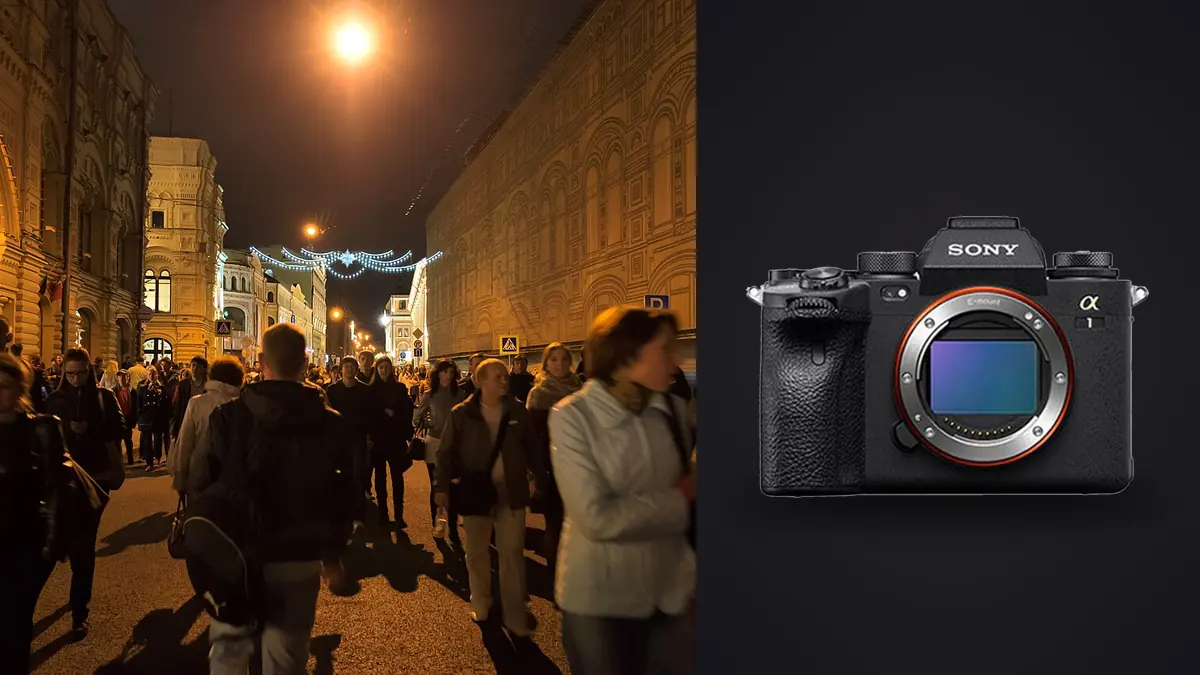
I get asked, usually by someone standing next to me at a street photography meetup, why I'm hauling a 737-gram flagship sports camera around a market instead of something that fits in a jacket pocket. It's a fair question. The Sony A1 was built to shoot Olympic sprinters and birds in flight at 30 frames per second, not to disappear into a crowd. But I've spent the better part of two years running it as my main body for both street work and documentary projects, and the honest answer is more complicated than "wrong tool for the job." In some ways it's genuinely the wrong tool. In others, it solves problems that smaller, quieter cameras can't touch.
The size and weight problem, stated plainly
Let's deal with the obvious complaint first, because it's a real one. Street photography has a long tradition built around small, quiet cameras: Leicas, the Fuji X100 line, old Contax rangefinders. There's a reason for that beyond nostalgia. A camera that looks like a professional's tool changes how people react to you on the street. A big camera with a gripped body and an f/1.4 GM lens hanging off the front reads as "photojournalist" or "paparazzi," and that reading shapes your access before you've made a single frame.
The A1 does nothing to hide that. It's not as heavy as an A9 II with a battery grip, but paired with something like the 35mm f/1.4 GM it's a two-handed camera, not a one-handed grab-shot camera. On a twelve-hour wedding-adjacent documentary day, or a multi-day street project where you're walking eight or nine miles, that weight adds up in your shoulder and your neck long before it shows up in your images. If your priority is minimal footprint and maximum discretion, I'd steer you toward a Fuji X100VI or a used X-Pro body before I'd steer you toward this camera.
Where the A1 actually earns its keep
So why do I keep using it? Because documentary work isn't only about blending in. A good chunk of it is about not missing the moment when it happens, and that's where a 30fps blackout-free electronic shutter with real-time tracking autofocus becomes something closer to a superpower than a novelty spec.
Silent shooting where it matters most
The fully electronic, fully silent shutter mode is, for me, the single feature that justifies the camera for this kind of work more than the resolution or the burst rate. Court hearings, religious ceremonies, quiet interior scenes, hospital corridors: these are all situations where a mechanical shutter clack is not just impolite, it can end your access entirely. I've shot inside a small church during a funeral procession where the A1's silent mode let me work from six feet away without a single head turning. Try that with a mechanical SLR-style shutter and you'll be asked to leave, politely or otherwise.
Tracking autofocus in genuinely chaotic scenes
Street and documentary subjects don't hold still, and they don't announce when they're about to do something interesting. Sony's real-time eye and subject tracking, inherited and refined from the sports and wildlife side of the A1's design brief, holds focus on a moving face in a crowd better than almost anything else I've used, including cameras I liked more for other reasons. In a market scene with people crossing in front of and behind my subject, the A1 keeps locking back onto the right eye instead of hunting on the nearest object, which is exactly the failure mode that ruins decisive-moment shots on lesser autofocus systems.
Dynamic range for the scenes documentary work actually hands you
Documentary shooting rarely happens in flattering light. You get harsh midday sun through a bus window, a single bare bulb in a workshop, backlit doorways where your subject is a silhouette against blown highlights. The A1's sensor has enough dynamic range that I can expose for the highlights and still pull usable shadow detail without the image falling apart, which matters enormously when you don't get a second take of a real moment.
The buffer and the file problem nobody warns you about
Here's the part that doesn't show up in marketing copy. Shoot a street scene at 30fps for even a second and a half, and you've generated 45 frames of one gesture. Do that a few dozen times over a day of documentary work and you can easily come home with 3,000 to 4,000 frames, most of them near-duplicates separated by fractions of a second. Fifty-megapixel uncompressed RAW files at that volume will eat a memory card and then eat your evening when you sit down to cull.
This is the actual cost of the A1's speed, and it's the part that changes your workflow more than any spec sheet number. I switched to compressed RAW for anything that doesn't need maximum latitude, which cuts file size by roughly forty percent with a loss in dynamic range that's genuinely hard to see outside of extreme shadow recovery. Even so, the culling problem doesn't go away. I run those card dumps through imagic before I open a single frame in an editor, because manually clicking through four thousand near-identical burst frames to find the one where the eyes are sharp and the hand gesture reads correctly is not a good use of a night after a twelve-hour shoot. It scores sharpness locally on the actual frame data rather than relying on lens metadata guesses, and it clusters burst sequences and duplicates together so I'm choosing between five real options instead of scrolling past forty-five near-identical ones.
The offline part matters more here than it does for most photography. A lot of documentary work involves subjects who haven't consented to broad distribution, sometimes in politically sensitive contexts, sometimes just people who didn't expect to end up in anyone's portfolio. Running culling entirely on my own machine, with nothing uploaded anywhere during that process, isn't a nice-to-have for that kind of assignment. It's closer to a professional obligation.
Lens choices that actually make sense for this genre
The A1's body is only half the equation, and the lens you put on it does more to determine whether you look like a street photographer or a photojournalist on assignment than the camera does. A few that have earned a permanent place in my bag:
- Sony 40mm f/2.5 G: small, light, quiet-feeling in hand, close enough to a classic documentary focal length that it doesn't distort faces at conversational distance. This is the lens I reach for when I actually want the A1 to feel less obtrusive.
- Sony 35mm f/1.4 GM: heavier and more conspicuous, but the low-light performance and rendering are worth it for evening market scenes and interiors where the 40mm's smaller aperture starts to hurt.
- Sony 24mm f/1.4 GM: for getting physically close and pulling the viewer into a scene, which documentary work often demands more than street work does.
- Sony 20-70mm f/4 G: the one genuine walkaround compromise. Slower than the primes, but on days where I don't know what the story needs until I'm standing in front of it, having a zoom saves me from missing a frame while swapping glass.
Sony A1 against the cameras people actually cross-shop it with
If you're deciding between the A1 and something more purpose-built for street work, here's how the tradeoffs actually stack up in practice, not on a spec sheet.
| Camera | Body weight | Shutter discretion | Burst / buffer for documentary bursts | Approx. price (body) | Where it wins for this genre |
|---|---|---|---|---|---|
| Sony A1 | 737g | Fully silent electronic mode available | 30fps, deep buffer, tracking AF holds through chaos | ~$6,500 | Fast-breaking documentary moments, low light, paid assignment reliability |
| Leica Q2 | 734g | Near-silent leaf shutter, fixed 28mm f/1.7 | 10fps, shallow buffer | ~$5,300 | Discreet single frames, not burst-heavy sequences |
| Fuji X100VI | 521g | Fully silent electronic mode, fixed 35mm equiv. | Up to 20fps with 1.25x crop, buffer fills fast | ~$1,600 | All-day carry, pure street work, lowest social friction |
| Sony A7C II | 514g | Silent electronic mode, small grip | Up to 10fps, moderate buffer | ~$2,200 | A1-family autofocus and color science in a much smaller, cheaper body |
Looking at that table honestly, the A7C II is probably the smarter buy for most people reading this. It shares a lot of the A1's autofocus intelligence and Sony's color science at roughly a third of the price and two-thirds of the weight. I keep the A1 specifically because some documentary projects demand the buffer depth and the file quality that justify the extra cost and bulk, but if someone tells me they're starting a street photography practice from scratch, I don't point them at the A1 first.
Menu and button setup that actually gets used in the field
A flagship body with this many customizable controls is only useful for fast documentary work if you set it up before you need it, not while you're missing a shot fumbling through menus. My working setup, after a lot of trial and error:
I keep the C1 button mapped to toggle between silent and mechanical shutter, because there are moments where the mechanical shutter's slightly better rolling shutter behavior matters for a fast-panning shot and I don't want to dig into a menu to switch. AF-On is back-button focus, always, because it lets me pre-focus and recompose without the shutter half-press hunting again. I run Focus Area on a dial-accessible custom key so I can drop from wide tracking to a single spot instantly when I need to grab focus on one face in a crowd rather than letting the camera guess. And I shoot APS-C crop mode more often than the internet seems to expect for a 50MP body: cropping in-camera to roughly 21 megapixels gives real reach with a shorter lens, and 21 megapixels is still plenty for anything short of a gallery print, while keeping file sizes and card fill rates sane on a long shooting day.
Battery life is the thing that will actually catch you out
The A1 is rated for a few hundred shots per charge under CIPA testing, and in real documentary use with the screen on, tracking AF running, and a lot of burst shooting, you'll burn through a battery faster than that number suggests. On a full day covering an event start to finish, I carry three batteries as a baseline and I've drained all three before. This isn't unique to the A1 among mirrorless cameras, but it's worth factoring into your kit list before you're standing in a market at 4pm with a dead camera and the best light of the day just starting.
Frequently Asked Questions
Is the A1's silent shutter mode actually silent, or just quieter?
In fully electronic silent mode there is no mechanical noise at all, no shutter slap, nothing. The only sound is whatever you've left enabled for AF beeps or the electronic shutter simulation sound, both of which I turn off. The tradeoff is a higher risk of rolling shutter distortion on fast horizontal motion or under flickering artificial light, so I switch to the mechanical shutter for anything with quick panning or gym-style lighting.
Do I need the full 50 megapixels for street and documentary work, or is that overkill?
For most single frames, yes, it's more resolution than you'll use. Where it earns its place is in reframing after the fact. A lot of my strongest street frames get cropped significantly in post because the decisive moment happened slightly off from where I'd composed, and having 50 megapixels of source data means that crop still holds up at a reasonable print size. If you never crop aggressively, you won't miss the extra resolution.
How does the A1 handle a full day of documentary shooting for battery and card management?
Plan on multiple batteries (I carry three) and fast, high-capacity cards in both slots, since the A1 supports simultaneous backup recording, which I run for anything I cannot reshoot. That backup habit alone has saved a shoot for me once, after a card developed a write error mid-afternoon and I didn't notice until I got home.
Is the Sony A1 worth the price over an A7C II or A7 IV for this kind of work?
Only if you're regularly shooting fast-moving, unpredictable scenes where the buffer depth, tracking AF speed, and blackout-free viewfinder genuinely change your keeper rate, or if you need the file quality for large-format documentary publishing. For general street photography and most documentary assignments, the A7C II gets you close to the same autofocus intelligence in a smaller, far cheaper body, and that's the camera I'd actually recommend to most photographers asking this question.
What I'd tell someone before they buy one for this
The A1 is not a street camera in the traditional sense, and I don't think Sony designed it to be one. But documentary work sits in a different category from classic street photography: it tolerates more visible gear in exchange for reliability, tracking accuracy, and the ability to shoot through fast, unrepeatable moments without missing frames to buffer lag or shutter blackout. If that's the work you're doing, and you can live with the weight, the price, and a workflow built around culling large burst sets efficiently (imagic's automated culling approach is what makes that part manageable for me, and its apply_my_style preset feature has kept my color grading consistent across three-day shoots where I'm editing in hotel rooms at midnight), the A1 rewards you. If you're shooting pure street work and discretion is your top priority, save the money and the shoulder strain and look elsewhere first.