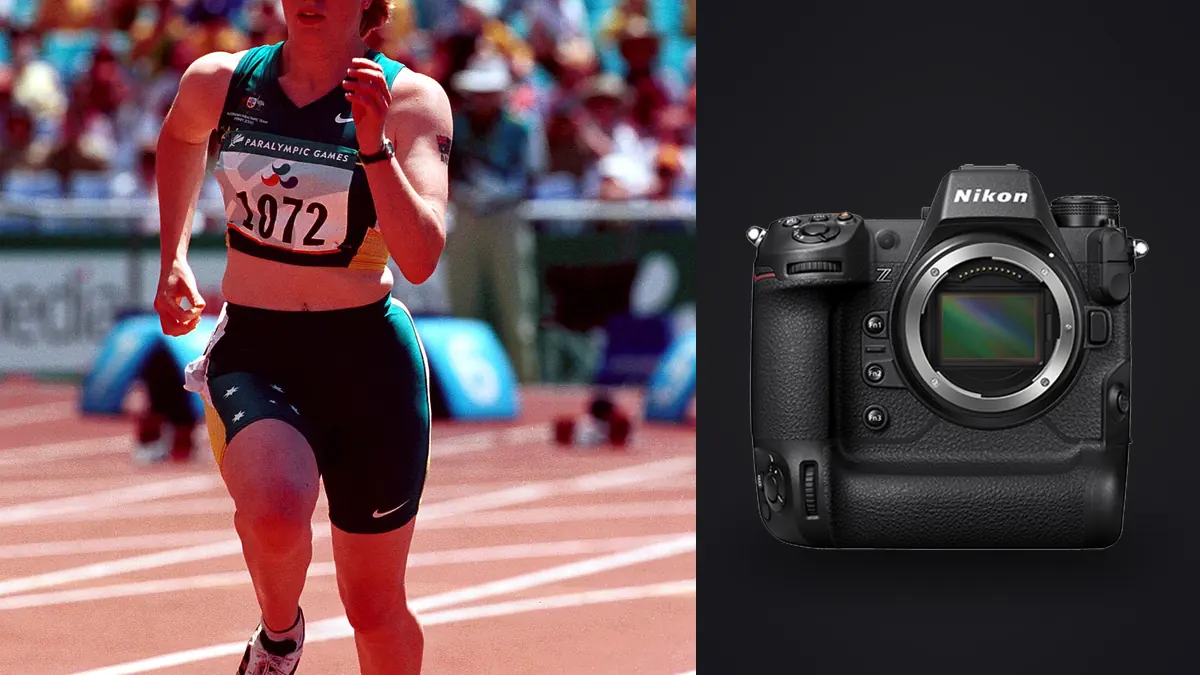
I picked up a Nikon Z9 two seasons ago mostly to solve one problem: my old DSLR would fold under a full day of track meets, mirror slap and shutter wear included, right around the point in the afternoon when the 400m finals and the long jump runway were both happening at once. The Z9 solved that problem and created a different one, which is what this article is actually about. A camera that can shoot 20 frames per second with no mechanical shutter and effectively no blackout is not automatically a better tool at the track. It is a much faster way to generate files you now have to deal with.
Why track and field is a different problem than most sports
Most people who write about the Z9 and sports mean football, basketball, or motorsport, where the action moves across a fairly predictable plane and you have one main subject to hold onto. A track meet is really six or seven different sports running at once in the same stadium. A sprinter finishing in under 10 seconds is a completely different tracking problem than a shot putter whose entire useful motion happens in about half a second of spin and release, which is itself different from a pole vaulter whose subject is moving vertically and diagonally at the same time while a fifteen-foot pole crosses in front of their body. The Z9 handles all of these, but not with the same settings, and that's the part that took me longer to get right than the marketing copy suggests.
Frame rate: the decision that actually matters
The Z9's full-resolution 45.7MP output at 20 fps with 12-bit lossless compressed RAW is the mode I use for probably 70 percent of the day, because it's the one that gives you a printable, croppable file without forcing you into the smaller-resolution high-speed modes. But the C30 and C120 high-speed frame capture options, which drop resolution to roughly 11 megapixels and shoot JPEG only, are not gimmicks at a track meet. They earn their keep specifically at the moments where timing is the whole game and resolution is secondary: the exact instant a discus leaves a thrower's hand, or a baton crosses from one runner's palm to the next in a relay exchange.
What sold me on C30 for throws specifically is pre-release capture. Half-press the shutter and the camera is already buffering up to a second of frames before you fully commit, so when the shot putter's release genuinely surprises you, which it will, you still have the frame. I don't use it for sprints, where the motion is long enough and predictable enough that full 20fps RAW gives me plenty to choose from without sacrificing file quality.
One thing worth saying plainly: buffer depth stopped being a real limitation for me once I moved to fast CFexpress Type B cards in both slots. I have not filled the buffer mid-burst in two seasons of shooting finals. The bottleneck moved entirely to card capacity and to how long I'm willing to hold the shutter down, not to the camera choking.
Autofocus, event by event
Nikon's subject detection recognizes people reliably, including through the kind of partial occlusion you get when a runner's arm swings across their own torso or when a hurdler's lead leg briefly blocks their head from the sensor's view. But "recognizes people" doesn't mean one AF setup works for every event, and this is where I see photographers new to the Z9 leave a lot of keepers on the table.
For sprints, wide-area or auto-area with person detection locked on works because there's really only one subject in your frame doing anything interesting and the background is either track surface or a blur of stands. For field events, I've had much better luck narrowing the AF area myself rather than trusting the widest tracking box, because sand kicked up on a long jump landing, or a raised bar and standards in pole vault, can pull subject detection onto the wrong thing at exactly the moment you need it locked onto the athlete.
| Event | AF area mode | Frame rate / mode | Shutter speed | Notes from the field |
|---|---|---|---|---|
| 100m / 200m sprints | 3D-tracking, person detect | 20fps full-res RAW | 1/2000 to 1/3200 | Lock on early in the blocks and let tracking ride the torso through the line; chasing the head loses lock when they dip. |
| 400m / 800m | Wide-area (L), person detect | 20fps RAW, C30 for the pack off the final bend | 1/1600 | Widen the box for the bunched pack coming off the last turn, tighten it once runners separate down the straight. |
| Long jump / triple jump | Single-point or Wide-area (S) | 20fps RAW from three strides out | 1/2500 or faster | Pre-focus on the board area, let tracking pick the athlete up as they enter; sand mid-flight can confuse subject detection. |
| Shot put / discus / javelin | 3D-tracking | C30 with pre-release capture for the release, 20fps RAW for the throw itself | 1/2000 | Pre-release capture earns its keep here; release timing is genuinely unpredictable even watching for it. |
| Pole vault | Wide-area (L) | 20fps RAW | 1/2000 to 1/3200 | Keep the athlete's body centered in the tracking box, not the pole; the bar and standards can steal focus at the top of the clearance. |
| Relay handoffs | Wide-area (L), two-subject awareness | 20fps RAW | 1/2000 | Track the incoming runner rather than the receiver until the baton is actually in the second runner's hand. |
Electronic shutter, stadium lights, and the flicker question
The Z9 has no mechanical shutter at all, which was the thing I was most nervous about switching to, because older electronic-shutter implementations on other cameras I've used produced visible rolling shutter skew on anything moving fast, plus banding under certain stadium lighting rigs. The stacked sensor's readout speed genuinely changes this. I've shot evening meets under mixed metal-halide and LED lighting rigs at various regional stadiums and haven't had a banding problem I couldn't fix by nudging shutter speed slightly, which the camera's flicker reduction feature usually catches on its own anyway. Rolling shutter distortion on a sprinter's legs at 1/2000s and 20fps has not been something I've had to explain away, where it absolutely was an issue on earlier electronic-shutter bodies I tested years back.
The one place I still watch for it is panning shots on the backstretch at slower shutter speeds, somewhere under 1/500s, where you're intentionally blurring the background. Vertical elements like lane markers can show a very slight lean if you're really pixel-peeping, but it's subtle enough that I've never had it flagged in a print.
Lens choices for a full day at the track
A track meet is usually a two-lens day for me, sometimes three. The 400mm f/2.8 TC VR S with the built-in teleconverter is my primary body glass for anything on the far side of the track, sprints in particular, because the ability to punch to 560mm without a lens swap matters when a false start moves the whole field's starting position and you don't have time to change position. For field events closer to the stands, a 100-400mm S gives me the range to go from a full-body shot of a long jumper's approach down to a tight crop on a shot putter's release without physically moving.
If I know I'm covering a meet with a stacked infield schedule, a second body with a 24-70mm or 70-200mm handles the awards, the coaches, the crowd reactions, the stuff that makes a gallery feel like it covers the whole event rather than just the competitive frames. I'll say plainly that an 800mm PF is overkill for most high school and college meets unless you're shooting from way up in the stands at a stadium with a long track-to-seating distance; for most venues I've worked, 400 to 560mm handheld or on a monopod covers it.
What happens after the meet is the part nobody talks about
Here's the number that surprised me the first season: a single 20fps burst through a 10-second sprint final is roughly 200 frames. Multiply that across heats, finals, four field events running simultaneously, and relays, and I've come home from a single Saturday meet with more than 30,000 frames on two cards. That's not a camera problem, that's a workflow problem, and it's the part of shooting the Z9 that actually determines whether you deliver galleries the same week or three weeks later.
This is where I stopped trying to cull manually. I run everything through imagic before I touch Lightroom, because its local sharpness and focus scoring will flag the one genuinely sharp frame out of a 40-frame sprint burst faster than I can scrub through it myself, and the duplicate and burst clustering groups those near-identical frames so I'm reviewing maybe 15 candidate images instead of 200 for a single race. Because it runs entirely on the laptop with no upload step, I can do a first pass sitting in the stands between events or in the car in the parking lot after finals, which matters at away meets where stadium wifi is either nonexistent or unusable with two hundred parents also trying to get online.
The other piece I lean on is imagic's apply_my_style preset. After a season of editing my own track galleries, I trained it on a batch of my finished edits, and it now applies that same color and contrast treatment automatically to new imports, so a Saturday meet's photos land close to my finished look before I've made a single manual adjustment. It's saved me real hours specifically during outdoor season, when I'm shooting six or seven meets in ten days and don't have the bandwidth to grade every gallery from scratch.
If you're new to culling workflows in general rather than specifically for track, it's worth reading up on how AI photo culling actually works before you commit to a tool, since the sharpness-scoring approach matters more for burst-heavy sports shooting than it does for, say, portrait or landscape work. I'd also point anyone shooting multiple meets a week toward some general workflow habits in tips for a faster photo workflow, several of which apply directly to high-volume sports days even though that piece isn't track-specific.
Battery and card management across a full meet day
The EN-EL18d battery in the Z9 has genuinely surprised me on long meet days. Nikon's CIPA rating undersells it badly for burst shooting specifically, because CIPA numbers assume a lot of single-shot power cycling that doesn't reflect how a sports photographer actually uses the camera. I've shot full eight-hour meets, heats through finals, on a single battery with charge to spare, though I still carry a second as insurance because a dead battery during a final you can't reshoot is not a risk worth taking to save weight in the bag.
Cards are the bigger practical concern. Dual CFexpress Type B slots mean no fallback to cheaper SD media, and at 20fps full-resolution RAW you'll eat through card capacity fast on a day with this many events. I run overflow recording across both slots rather than backup, purely for capacity, and back up to a laptop at the venue whenever there's a lull between events rather than waiting until I'm home.
Frequently Asked Questions
Is the Z9's 20fps mode overkill for a single-event youth track meet?
For one event, probably. Where it earns its cost is a full meet day with overlapping events, where the ability to shoot a sprint final at full resolution and still have the C30 or C120 modes available for an unpredictable throw or vault means you're not choosing which event to under-cover.
Do I need pre-release capture for track and field specifically?
For sprints and mid-distance races, not really, since the start is a known moment (the gun) and you can time your burst around it. For throws and vault clearances, where the exact peak moment is genuinely hard to anticipate even watching closely, I've found it consistently rescues frames I would have missed by a fraction of a second.
Will shooting fully electronic shutter cause problems under stadium floodlights?
In my experience across several stadiums with mixed lighting, no, not in a way that's shown up in delivered galleries. The Z9's sensor readout is fast enough that I haven't fought visible banding once flicker reduction is switched on, though I'd still recommend a quick test burst under a given venue's specific lights before a final, since fixtures vary meet to meet.
How do I actually get through 20,000+ frames from a single meet without losing a weekend to it?
This is the real question most Z9 owners underestimate before their first big meet. Manual culling at this volume doesn't scale, which is why I run a first automated pass for sharpness and duplicate bursts before I ever open an editor, and only hand-review the shortlist. Trying to eyeball 30,000 frames one at a time is how galleries end up delivered two weeks late.