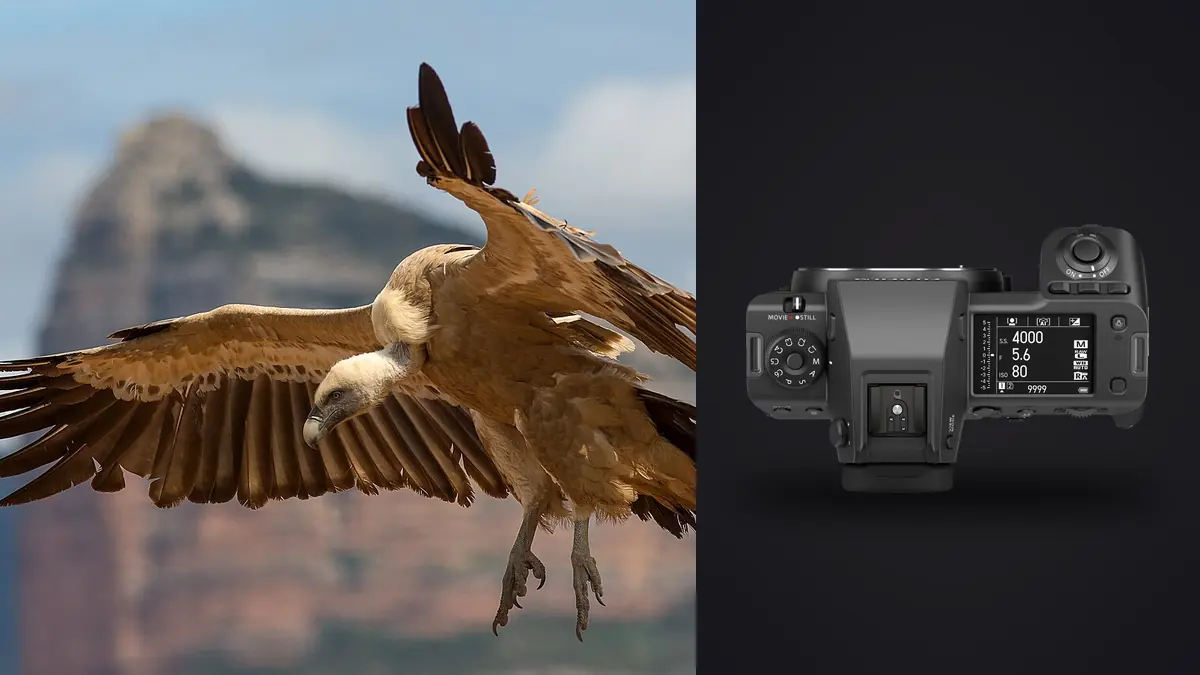
I took the GFX 100 II to Gigrin Farm in mid-Wales specifically to answer one question I'd been arguing about with another photographer for months: can a 102-megapixel medium format body actually keep pace with red kites stooping on a feeding station, or does it just produce a very expensive pile of soft, badly timed frames? Medium format has never been the tool anyone reaches for when a bird folds its wings and drops out of the sky at speed. Fujifilm built this camera knowing that, and it shows in some genuinely surprising engineering choices. It also shows in a few places where the sensor size just can't be argued with, no matter how good the processor behind it is.
This isn't a spec sheet regurgitation. It's what happened across four sessions with kites, a morning with oystercatchers on a estuary, and a few frustrating hours trying to track swifts over a barn roof, which nothing short of a dedicated action body handles well anyway.
The number nobody wants to talk about: 8 frames a second
Fujifilm quotes 8fps on mechanical shutter for the GFX 100 II, up from the 5.3fps ceiling on the GFX 100S. That's a meaningful jump for this sensor class, and Fuji deserves credit for it. But put it next to a Sony a1 II at 30fps or a Nikon Z9 at 20fps mechanical-equivalent and the gap is obvious. At 8fps you are getting roughly one frame every 125 milliseconds. A kite's wingbeat cycle is faster than that. You will miss the exact peak of the downstroke more often than you'd like, and you learn to fire earlier than instinct tells you to, anticipating the moment rather than reacting to it.
Electronic shutter doesn't rescue you here either, and this is where the sensor size actually works against you. Full-frame stacked sensors on the fastest current bodies read out in a few milliseconds, which keeps rolling shutter distortion low even at high frame rates. The GFX 100 II's sensor is bigger and carries more photosites, and even with the X-Processor 5 handling readout, it's noticeably slower to scan the full frame than a purpose-built action camera. Pan hard on a kite cutting across a tree line in electronic shutter and you'll see the trunks lean, or catch a faint skew on the leading wing. Mechanical shutter avoids that at the cost of some noise and a slightly lower top speed. For anything moving fast against a hard-edged background, I stayed on mechanical the entire time.
| Mechanical shutter | Electronic shutter | |
|---|---|---|
| Continuous rate | Up to 8fps | Up to 8fps, no real speed advantage on this body |
| Rolling shutter risk | Minimal | Visible skew on fast horizontal pans against straight lines |
| Shutter sound/vibration | Audible, some micro-shake at long focal lengths | Silent, useful near nesting sites or skittish waders |
| Best use for BIF | Fast, erratic flight against branches, wires, or fences | Slower soaring flight, distant subjects with clean backgrounds |
Crop modes stop being a gimmick once you're chasing reach
Every GFX body since the 100S has offered in-camera crop shooting at 1.53x and 2x, originally there to let phase-detect AF cover smaller apparent subjects. For wildlife work they do double duty as a cheap reach extender that doesn't touch the optical path. On the GFX 100 II I used the 1.53x crop constantly with the GF 500mm f/5.6, because it turns a 500mm lens into the rough equivalent of a 605mm full-frame lens while still leaving you 44 effective megapixels, which is plenty for anything short of a magazine cover.
| Shooting mode | Resolution | Effective reach (GF 500mm f/5.6) | Buffer behavior |
|---|---|---|---|
| Full sensor | ~102MP | 500mm (approx. 395mm FF-equivalent) | Fills fastest, especially in uncompressed RAW |
| 1.53x crop | ~44MP | 765mm (approx. 605mm FF-equivalent) | Noticeably deeper, my go-to for kite sessions |
| 2x crop | ~25MP | 1000mm (approx. 790mm FF-equivalent) | Deepest buffer, usable for distant gulls or waders |
The trade-off is framing discipline. At 2x crop your effective viewfinder field shrinks a lot, and losing a bird mid-frame at that magnification happens fast if your panning isn't smooth. I found 1.53x the sweet spot: enough reach to matter, still enough frame to recover a bird that drifts off your intended composition.
Autofocus: better than the reputation, still not a Sony killer
Fujifilm added subject detection AF to the GFX 100 II through a firmware update that includes birds as a recognized category, and it works. Phase-detect coverage sits close to the full frame, and on a kite gliding against open sky the camera locks and holds convincingly. Where it struggles is exactly where every camera struggles: a bird crossing in front of branches, or several birds tumbling together over the feeding station, which happens constantly at Gigrin once the food goes out. In that chaos the AF sometimes latches onto the nearest wing rather than the eye, and hunts for a beat before recovering.
I run back-button focus with AF-C, tracking sensitivity pushed toward "responsive" rather than "locked on," because kites change direction hard and often. Zone AF with a moderate box size outperformed full-frame subject tracking whenever more than two birds were in the air, since the wider tracking area kept jumping between targets. None of this is unique to Fujifilm. It's the same trade-off every camera brand makes. What's notable is that a 102-megapixel sensor is keeping up at all, given how much data the AF system has to chew through per frame.
Where it genuinely surprised me
Head-on flight, historically the hardest case for any AF system because there's so little the algorithm can lock onto, was handled well. A kite banking directly at the camera kept its eye in focus more consistently than I expected from a body this size. That's a real credit to the X-Processor 5, which is shared architecture with Fuji's X-H2S.
Glass and weight: plan for a monopod
The GF 500mm f/5.6 R LM OIS WR is the obvious pairing, and it's a genuinely sharp lens wide open. Add the GF 1.4X teleconverter and you're at 700mm f/8, which drops you into contrast-detect-adjacent AF territory in low light, since f/8 is where a lot of hybrid AF systems start to slow down. Stack the 1.53x crop mode on top of the teleconverter and you're pushing past 1000mm native equivalent without ever cropping in post, but you're also asking a lot of a system that wasn't built primarily for this.
Body plus lens comes in over 2.4kg. That's not brutal for a few minutes, but across a three-hour session tracking kites overhead, my arms were done well before the light was. A monopod with a gimbal head isn't optional gear here, it's close to mandatory if you want your hit rate to hold up in the last hour of a session.
What 102-megapixel files do to your evening
This is the part nobody mentions in the spec-sheet comparisons. A single compressed RAW off this sensor runs well over 100MB. A three-hour session at 8fps in bursts produces thousands of frames and a card full of data that will not fit comfortably into a laptop workflow the way a 24-megapixel full-frame file does. I came back from Gigrin with over 4,000 frames from one afternoon, and manually scrubbing through that at full resolution on a laptop screen in a farmhouse B&B with no signal was never going to happen.
This is where I lean on imagic rather than Lightroom's flag-and-cull workflow. It runs entirely on the machine, no upload, which matters when you're shooting somewhere without reliable connectivity, which is most good birding locations. Its sharpness scoring works directly against the actual pixel data rather than a downsampled preview, so it catches the difference between a kite with a tack-sharp eye and a nearly identical frame half a wingbeat later where the head has drifted. With action bursts like this, most frames in a sequence are near-duplicates by definition, and having the duplicate and burst clustering group them automatically saves the kind of manual comparison that used to eat an entire evening. If you haven't worked through how that kind of automated culling actually scores focus versus just guessing from thumbnails, it's worth reading up on how AI photo culling works before you trust it with a shoot this size.
The other piece I use constantly is the apply_my_style preset, trained on my own past edits rather than someone else's preset pack. Kite plumage in overcast Welsh light needs a specific, fairly restrained white balance and contrast treatment that generic wildlife presets tend to get wrong, pushing orange too hard or crushing the shadow detail in the wing feathers. Having a model that's learned my own corrections means the first pass on 200 selects looks close to finished rather than like a starting point.
Settings I actually shoot with
- Mechanical shutter, 8fps, 1/2500s minimum for kites, 1/3200s if the light allows it
- 1.53x crop mode as default, full sensor only when a bird is genuinely close
- Back-button AF-C, Zone AF with a medium-sized box rather than full-frame tracking
- Bird subject detection on, but I don't rely on it exclusively when several birds are in frame
- Auto ISO capped at 6400, since noise at that level cleans up fine but shutter speed drops don't
- Compressed RAW, not lossless, because the file size difference matters when you're shooting thousands of frames a day
Frequently Asked Questions
Is the GFX 100 II actually fast enough for birds in flight, or is this a marketing angle?
It's fast enough to get usable results, not fast enough to compete with a dedicated action body on raw hit rate. Erratic, close-range flight against cluttered backgrounds will cost you more misses than you'd get from a 20-30fps full-frame body. Soaring raptors, gulls working a thermal, or anything with a more predictable flight path are well within what this camera can track reliably.
Do I need to use the crop modes, or is full resolution fine for wildlife?
Full resolution gives you more room to crop after the fact, but the 1.53x crop mode gets you real optical reach without touching your lens budget, and the buffer holds up noticeably better. I treat full sensor as the mode for close subjects and switch to crop the moment a bird is more than thirty or forty meters out.
What lens setup would you actually recommend starting with?
The GF 500mm f/5.6 alone covers most situations and stays reasonably fast to autofocus. Add the 1.4x teleconverter only once you're comfortable with the weight and the slower AF at f/8, since chasing extra reach before you've mastered the base combo tends to just produce more missed frames, not better ones.
How do you deal with the sheer volume of RAW files from a single outing?
Automated culling isn't optional at this file size, doing it by eye simply doesn't scale to thousands of near-identical burst frames. I run everything through imagic first to cluster the bursts and surface the sharpest frame in each sequence, then only open the survivors in a full editor. It's also worth building a faster habit around the rest of the pipeline, not just the culling step, and a few workflow adjustments compound quickly once you're dealing with this much data per session.