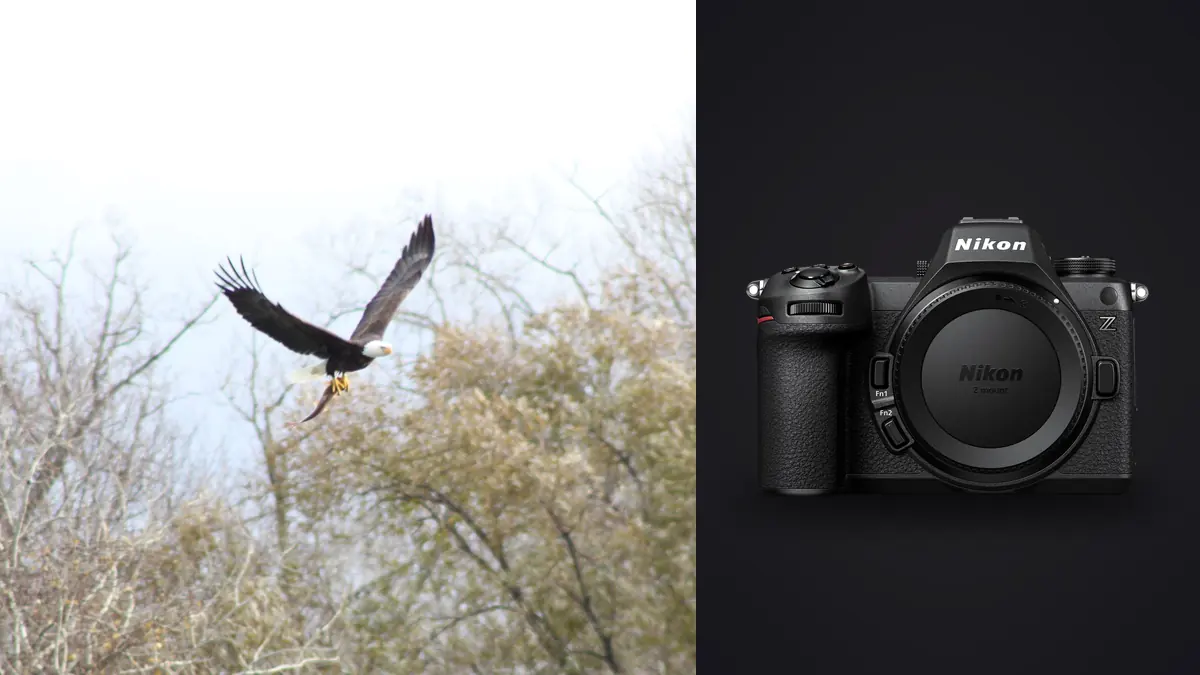
I spent four mornings in April at a heron rookery about forty minutes from home, mostly because it's the easiest place I know to get repeatable birds in flight without driving three hours. Great blue herons lift off a dead snag every few minutes when the wind is right, which makes it a decent proving ground for a camera body rather than a place to get a "keeper" shot. I brought the Z6 III paired with the 100-400mm and, on the last morning, swapped to the 800mm PF just to see how the smaller body handled a lens that heavy. What follows is what actually happened across those sessions and a few later outings for ospreys and swallows, not a spec sheet rewrite.
Why the Sensor Change Matters More Than the Megapixel Count
The Z6 III uses what Nikon calls a partially stacked sensor, which sits between the older BSI-CMOS design in the Z6 II and the fully stacked sensors in the Z8 and Z9. In practice this means faster readout than the Z6 II without the price jump that comes with a fully stacked chip. For birds in flight specifically, readout speed is the thing that determines whether a heron's wingtip smears into a curve or stays a straight line when you pan through a wingbeat.
I noticed the difference most on fast horizontal pans against open sky, the classic osprey-diving-toward-water shot. On the Z6 II I'd get visible skew on maybe one in five frames at full extension with the electronic shutter. On the Z6 III that dropped noticeably, though it hasn't disappeared. If you pan hard against a high-contrast edge (a bird crossing a treeline, say) you can still coax out some jello if you go looking for it in a 400% crop. It's just far less common than it used to be, and for anything shot with the mechanical shutter the point is moot anyway.
Autofocus: Where It Locks On and Where It Doesn't
The subject detection carried over from the Z8/Z9 line, including the bird-specific mode, is the single biggest upgrade this body brings to birding work. Set to Auto-area AF with Bird detection, the camera will pick out an osprey against blown-out sky, a warbler half-hidden in leaves, or a heron's eye at forty feet with a consistency the Z6 II never managed. Eye detection on birds specifically (as opposed to just "a bird-shaped blob") holds up surprisingly well once the subject is more than about a third of the frame.
Where it gets less reliable is small, fast-moving birds against cluttered backgrounds. Swallows over water are the worst case I've tried: erratic flight paths, low contrast against reflections, and a subject that's rarely more than a few percent of the frame. In that situation I get better hit rates switching out of Auto-area and into 3D-tracking with a smaller starting AF point, initiating focus manually on the bird before it's moving fast, then letting tracking carry it. Auto-area with bird detection tends to want to jump to the highest-contrast bird in the frame rather than staying locked on the one I actually initiated on when there are several birds close together, which happens constantly at that rookery.
One more practical note: bird detection works noticeably better with backlighting than I expected going in, probably because EXPEED 7 is doing shape recognition rather than relying purely on contrast detection. Herons against a bright overcast sky, which used to be a coin flip on older bodies, focus reliably now.
Frame Rates and Buffer Depth
The shutter mode you pick changes more than fps. It changes bit depth, rolling shutter risk, and how long you can hold the trigger down before the camera stalls. Here's roughly how the modes I actually use for birds in flight compare, based on a 325GB CFexpress Type B card rated around 1700MB/s write:
| Shutter mode | Max fps | RAW bit depth | Rough buffer before slowdown | When I use it |
|---|---|---|---|---|
| Mechanical (S) | 14 fps | 14-bit lossless compressed | ~40-50 frames | Perched birds, slower takeoffs, when rolling shutter risk needs to be zero |
| Electronic Hi | Up to 20 fps | 12-bit lossless compressed | ~120-150 frames | Most birds-in-flight work, ospreys diving, herons lifting off |
| Electronic Hi, JPEG only | Up to 20 fps | n/a (JPEG) | Effectively unlimited on a fast card | Rarely, only if I'm burning through a card with no laptop nearby to offload raw |
| Pre-Release Capture | 30 fps buffered before shutter press | 12-bit | Captures up to ~1 second before you press | Unpredictable launches, e.g. a heron that startles off the snag with no warning |
Pre-Release Capture is the mode I undersold before actually using it. It buffers frames continuously while you have the shutter half-pressed, so when a bird bolts before you consciously react, you still have it. I missed the exact moment a heron launched off that snag probably a dozen times over two mornings before I turned this on, and zero times after. The tradeoff is battery life and a fuller buffer sooner, so I only leave it on when I'm specifically waiting on a launch rather than tracking a bird already in the air.
Matching Glass to the Body
The Z6 III is light enough (about 760g body only) that lens choice does more to determine whether you can shoot handheld all day than the body does. Four combinations cover most of what I'd actually recommend for birding with this body:
| Lens | Focal range | Combined weight w/ Z6 III | Handheld all day? | Best for |
|---|---|---|---|---|
| Z 100-400mm f/4.5-5.6 VR S | 100-400mm | ~1.87kg | Yes, comfortably | Perched birds, mixed wildlife walks, anything where you also want wider reach |
| Z 180-600mm f/5.6-6.3 VR | 180-600mm | ~2.62kg | Yes, with breaks after 2-3 hours | Distant raptors, rookery work from a fixed spot, best value-per-mm in the lineup |
| Z 400mm f/4.5 VR S + TC-1.4x | 560mm effective | ~2.19kg | Yes | Fast-moving birds in flight where you want the widest usable aperture at reach |
| Z 800mm f/6.3 VR PF | 800mm | ~2.55kg | Short bursts, or a monopod | Small, distant, or skittish birds where you can't close the distance |
The 800mm PF is the one that surprised me most paired with this body. It's a Fresnel lens, so it's dramatically lighter than a conventional 800mm would be, and the Z6 III's smaller grip and lighter overall weight compared to a Z8 keeps the whole rig from feeling front-heavy in a way that fatigues your wrist by hour two. I wouldn't call it a walk-around combo, but for a morning parked at a known perch it's genuinely usable handheld, which isn't something I expected going in.
The Part Nobody Puts in the Marketing Copy: What Happens After the Shoot
A morning at 20fps produces a number of files that's honestly a little embarrassing to admit to. Three hours at that rookery with the shutter held down through takeoffs and landings routinely leaves me with 2,000 to 3,000 raw frames, and most of a session for a bird actually in flight is 30 to 60 near-identical frames of the same wingbeat cycle. Culling that by eye, frame by frame, is the part of wildlife photography nobody puts on the box.
This is the point where I stopped doing it manually. I run the card through imagic before I touch Lightroom, and the two things it actually saves me time on are the sharpness scoring and the burst clustering. It scores focus and sharpness locally on the machine, no upload, which matters to me less for privacy reasons and more because I'm often doing this triage from a laptop in the truck with no signal. It groups near-duplicate frames from a burst together so I'm picking the sharpest wing position out of a cluster of 40 instead of scrubbing through them one at a time. On a 3,000-frame day that turns an hour of squinting at near-identical frames into something closer to fifteen minutes, which is the difference between processing that night and letting three shoots pile up unedited.
The other thing I lean on is the apply_my_style preset, which is trained on my own past edits rather than a canned look. Rookery light shifts fast between overcast and breaks of sun through a session, and having a starting point that already matches how I tend to grade greens and skin-tone-adjacent brown feathers saves the repetitive part of a big edit pass without flattening every frame to the same identical look, which is what happens when I've tried generic presets on this kind of subject before.
If you're trying to figure out how AI-assisted culling actually differs from a plain "pick the sharpest" filter, this breakdown of how AI photo culling works covers the mechanics in more depth than I want to get into here. And if the bottleneck for you is less about culling and more about the whole pipeline from card to delivery, these workflow tips are worth a look regardless of what body you're shooting.
Settings That Actually Held Up in the Field
- Back-button focus, always. With 3D-tracking especially, separating focus from the shutter button means a half-press doesn't reset tracking every time you reframe.
- Custom shooting bank for BIF specifically. I keep Bank C set to Electronic Hi, 12-bit raw, Auto-area with bird detection, and Pre-Release Capture off by default (I switch it on manually when I'm anticipating a launch, since it does chew through buffer and battery faster).
- Shutter speed floor, not a fixed value. Auto ISO with a 1/2500s minimum handled everything from perched portraits to full-speed pursuit without me touching a dial, though I'd push that to 1/3200s for smaller, faster birds like swallows.
- AF-area size matched to bird size, not left on the widest setting. Wide-area AF (S) for anything smaller than a heron in the frame, Auto-area only once the subject fills a meaningful chunk of it.
Where It Still Falls Short
None of this is a case for the Z6 III being a Z9 at half the price, and it's worth being honest about where the gap actually is. Buffer clearing is noticeably slower than a fully stacked sensor body when you fill it; on the Z8 you'd barely notice the pause, on the Z6 III a full buffer at 20fps means a couple of seconds where the camera is writing before it's fully responsive again. Rolling shutter is much improved over the Z6 II but not eliminated, so extreme pans against contrasty edges can still show it if you're pixel-peeping. And there's only one CFexpress slot, with the second slot being UHS-II SD, so if you're shooting fast enough to need CFexpress write speeds, your backup card is meaningfully slower than your primary, which matters if you're relying on simultaneous dual-card backup rather than overflow.
None of that changed my opinion of the body for this use. It changed how I set expectations before a shoot, which is a more useful thing for a review to do than pretend the camera has no limits.
Frequently Asked Questions
Is the Nikon Z6 III fast enough for birds in flight, or do I need a Z8?
For the vast majority of birding, yes, the Z6 III is fast enough. The subject detection and 20fps electronic mode cover perched birds, takeoffs, and most in-flight sequences without issue. Where the Z8 pulls ahead is buffer clearing speed and rolling shutter control on the most demanding pans, which matters more if you're shooting fast-moving raptors against busy backgrounds at high volume every week than if you're shooting a few outings a month.
Which lens should I actually start with for wildlife on this body?
If you only buy one lens, the 100-400mm S gets you the most usable range for the widest set of subjects and keeps the whole kit light enough to carry all day. Add the 180-600mm once you know reach is your actual bottleneck rather than versatility, since it's noticeably heavier but covers distances the 100-400mm can't.
Does the Z6 III's bird detection work on small songbirds, or just larger birds like herons and raptors?
It works on both, but reliability drops as the subject gets smaller in the frame and the background gets busier. Herons and raptors filling a meaningful portion of the frame track close to automatically. Small songbirds partially obscured by branches, or swallows moving erratically against water, need more help from you (a tighter AF area, manual initiation) than the camera's automatic detection alone.
How many raw files should I expect to manage after a typical birding session with this camera?
At 20fps with the shutter held through takeoffs, landings, and pursuit sequences, a few hours easily produces 2,000 to 3,000 raw frames, most of them near-duplicates from the same burst. Planning your culling workflow (whether that's manual review or software that clusters bursts and scores sharpness automatically) matters as much as any camera setting once you're shooting at this frame rate regularly.