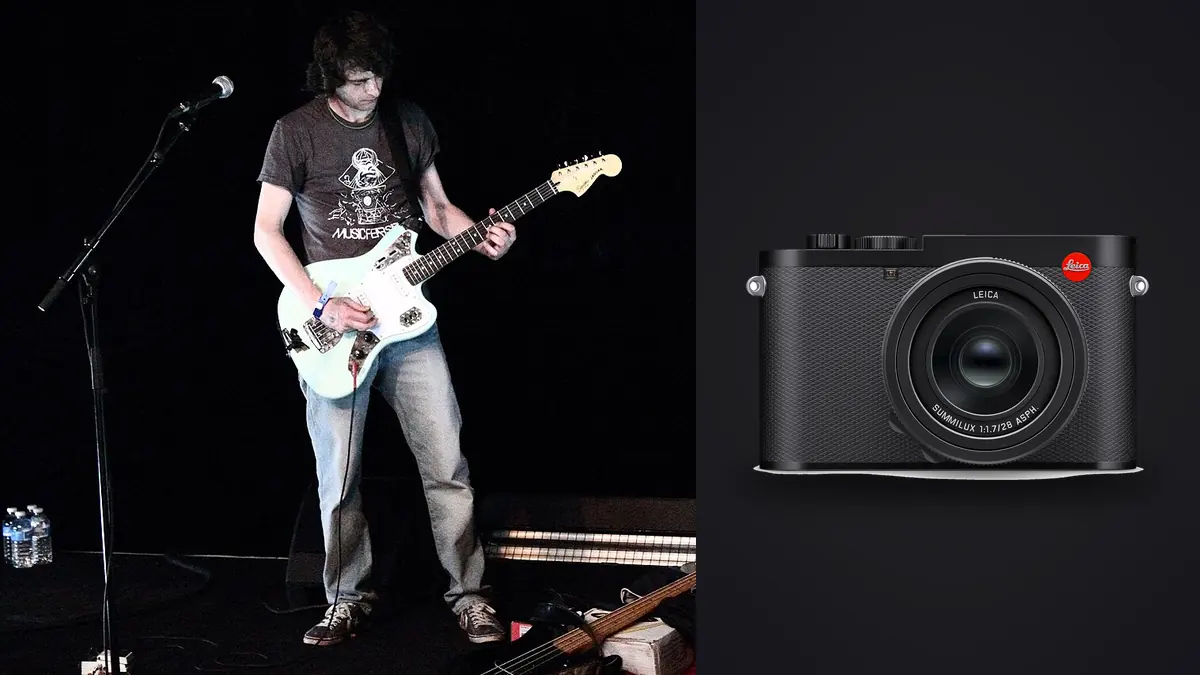
A fixed 28mm lens sounds like a strange choice for photographing bands. Most tour photographers live somewhere between a 24-70mm and a 70-200mm, swapping bodies mid-set so they're never caught wide when they need long or long when they need wide. The Leica Q3 doesn't give you that option. You get one focal length, one aperture that opens to f/1.7, and a 60-megapixel sensor that's supposed to make the missing zoom ring irrelevant. I've spent the better part of a year bringing this camera to everything from a 90-capacity basement show to a festival photo pit, and the honest answer is: it works, but not for the reasons Leica's marketing copy suggests.
The 28mm Problem, and the Crop Modes That Patch It
28mm is a crowd lens, not a stage lens. Point it at a singer from ten rows back and you get a small person surrounded by a lot of ceiling truss. Leica's answer is in-camera cropping: because the sensor captures at 60 megapixels, you can punch in digitally to 35mm, 50mm, or 75mm equivalent framing and still walk away with a file that holds up. This isn't optical zoom, there's no glass moving, it's a crop applied to the RAW file with framing lines shown in the viewfinder so you compose for it live.
The math is more forgiving than I expected going in, but it's not free. Every step in you lose real pixels, and by the time you're at 75mm crop you're down to a file that's fine for a website gallery or a 5x7 print and not much beyond that. Here's roughly what you're working with:
| Crop mode | Approx. resolution | What it's actually good for at a show |
|---|---|---|
| 28mm (native) | ~60 MP | Full stage width, band-plus-crowd shots, wide festival scenes |
| 35mm crop | ~38 MP | Front-row performer shots with some environment still visible |
| 50mm crop | ~19 MP | Waist-up shots from the photo pit rail, still fine for print |
| 75mm crop | ~8 MP | Tight expression or hand shots, web-resolution only |
What actually changed how I shoot was accepting that the Q3 is at its best inside the first three rows or in a photo pit, not from the back of a theater. If your access only gets you general admission fifteen feet from the stage, this camera will frustrate you. If you can get close, close enough that 28mm reads as a normal lens and not a wide one, it turns into something closer to a rangefinder with a very fast, very sharp normal-to-short-tele range built in.
Autofocus and Shutter in a Room Full of Moving Bodies
The Q3's autofocus moved to a hybrid phase and contrast system, which is a real improvement over the older Q2's contrast-only setup, and it shows most under stage lighting that keeps shifting in color and intensity. Face detection locks reliably on a singer under a wash of red or blue light, situations that used to hunt for a full second on the previous generation. It's not flawless. Backlit performers in silhouette, which happens constantly with rim lighting, will occasionally send the AF searching, and I've learned to switch to a single focus point on the mic stand rather than trust wide-area tracking in that specific scenario.
Shutter choice matters more than most reviews mention. The mechanical shutter tops out around 1/2000s, which is plenty for concert work, but the electronic shutter option (silent, up to a much higher top speed) is where you want to be for quiet acoustic sets or any venue that's asked photographers not to make noise. The catch is that LED stage lighting flickers at frequencies that can cause banding with electronic shutter, visible as horizontal stripes across the frame. I default to mechanical for anything with heavy LED rigs (most modern touring productions) and only drop to electronic for genuinely dim, static-lit rooms where the shutter clack would actually be audible between songs.
Continuous shooting sits around 15fps with the electronic shutter, which sounds excessive for a fixed-lens camera but turns out to matter a lot for catching the exact moment a drummer's stick connects or a singer's mouth is open mid-note instead of between words. The tradeoff is that a three-song set shot in bursts generates an enormous number of near-duplicate frames, which becomes its own problem later.
What High ISO Actually Looks Like Under Real Stage Lighting
Leica doesn't publish concert-specific ISO guidance, so here's what I've settled on after enough nights of trial and error across different room sizes:
| Venue type | Typical ISO | Aperture | Notes |
|---|---|---|---|
| Small club or basement bar | 6400-12500 | f/1.7 | Often just two or three par cans on stage; you need every bit of that f/1.7 |
| Mid-size theater | 3200-6400 | f/2-2.8 | More even lighting rig lets you stop down slightly for depth of field |
| Festival main stage, night set | 1600-3200 | f/2.8-4 | Bigger lighting rig, but moving fixtures demand a faster shutter to match |
| Arena photo pit, full production | 800-1600 | f/2.8 | Professional lighting design; priority shifts to freezing fast movement |
Files at ISO 6400 hold detail well enough that I don't hesitate to use them for print. Past 12500 you start losing color fidelity in the shadows first, noticeable as a slight greenish cast that shows up in black clothing and dark backgrounds before it shows up anywhere else. It's usable, it's just not something I'd share without a pass through noise reduction first.
Getting the Camera Past the Door
This is the part nobody puts in a spec sheet comparison, but it matters if you're shooting shows regularly without a photo pass. A lot of general-admission venues restrict "professional cameras," and the wording on the sign at the door usually targets interchangeable-lens bodies specifically, sometimes with a line about lenses longer than a few inches. A Q3 is fixed-lens, and I've gotten it past a few doors where a mirrorless body with a 70-200mm would have been turned away outright.
I wouldn't count on it. The Q3 is not a small camera by point-and-shoot standards, it reads as serious gear the moment security actually looks at it rather than glances at the bag. I've had it waved through at three shows and had it flagged for a bag check and a "no professional cameras" conversation at a fourth, at a venue with an otherwise identical policy. If you're shooting on spec rather than on assignment, message the venue ahead of time, or plan on the photo pit process like everyone else with a lanyard.
After the Set: Turning Three Hours of Bursts Into a Gallery
A single 20-minute opener shot at 15fps in bursts, plus a headline set twice that length, routinely leaves me with 1,800 to 2,500 RAW files by the time the house lights come up. Almost none of that volume represents distinct moments, it's the same three seconds of a guitar solo captured forty times over, most of them soft because a hand or a headstock moved through the frame between shutter clicks.
This is where I actually rely on imagic rather than sorting by eye at 1am in a parking lot. It scores every frame in a burst for sharpness locally on the laptop, no upload, which matters when you're dealing with unreleased tour visuals a lot of artists and labels are particular about keeping off anyone's servers until a show has actually happened. It also clusters the near-identical frames from a burst so I'm reviewing one representative shot per moment instead of scrolling through forty variations of the same guitar solo. If you want the mechanics of how that scoring actually works rather than taking my word for it, this breakdown of how AI photo culling works covers it in more depth than I will here. What used to take me ninety minutes of squinting at thumbnails now takes closer to twenty.
Building One Look Across a Whole Tour
The other problem with shooting the same band across multiple nights is consistency. Stage lighting changes venue to venue, sometimes song to song, and if you're editing each show from scratch you end up with a gallery that looks like five different photographers touched it. I trained imagic's apply_my_style feature on a batch of my own edited concert photos from earlier shows, the color balance and contrast curve I actually use for stage work, and it now applies that same treatment automatically to new imports before I fine-tune anything by hand. It's not replacing judgment on individual frames, blown highlights from a spotlight still need their own attention, but it means I'm not manually rebuilding the same color grade every single night of a run.
What I'd Actually Change
Single SD card slot, no backup redundancy, which is a real risk on a paid gig where a corrupted card means an unrecoverable set. No in-body stabilization either, the lens has optical stabilization built in, which helps handheld shots at slower shutter speeds but doesn't do anything for a moving subject the way sensor-shift systems on some competitors do. Battery life gets you through a headline set comfortably but not a full festival day of multiple acts without a spare in your pocket. And the fixed 28mm, even with crop modes, is a real limitation the moment you're shooting from anywhere other than close range. None of these are dealbreakers for the kind of shooting I do, but they're worth knowing before you commit to a camera you can't reconfigure with a different lens on a bad night.
Frequently Asked Questions
Will a Q3 actually get past "no professional cameras" signage at a general-admission show?
Sometimes. The wording on most door policies targets interchangeable-lens bodies and long lenses specifically, and a fixed-lens camera occasionally slides through where a mirrorless kit with a zoom wouldn't. It's inconsistent enforcement, not a guarantee, and I've been stopped at venues with policies identical to ones that waved me straight through. If the shoot actually matters, don't gamble on ambiguity, get a pass or clear it with the venue beforehand.
Is 28mm too wide to shoot a full set, or do I need a second body?
From a photo pit or the first few rows, no, especially using the crop modes to reach 50mm or 75mm equivalent framing when you need it. From general admission further back, yes, honestly. I've brought a second body with a longer lens to shows where I knew my access would be limited to the back half of the room, because pixel-cropping a 28mm frame from thirty feet away doesn't recover detail that was never captured in the first place.
How does it handle strobes and fast-changing stage lighting?
Reasonably well on dynamic range, the sensor holds detail in shadows even when a spotlight is blowing out a performer's face in the same frame. The one thing to watch is electronic shutter banding under LED lighting rigs that flicker at certain refresh rates, which shows up as visible stripes across a frame. I shoot mechanical shutter for anything with a heavy LED production and save electronic shutter for quiet, simply-lit rooms.
What's the fastest realistic path from last song to a finished gallery?
Cull first, edit second, and don't do either by eye at full resolution if you can avoid it. I run the night's import through imagic to score sharpness and group the burst duplicates before I look at a single frame properly, and because it processes everything locally there's no upload step to worry about with photos a label or artist wants kept private until release. From there it's a matter of applying a consistent edit and exporting. If your bottleneck is the editing stage rather than culling, these workflow tips cover the rest of that pipeline well.