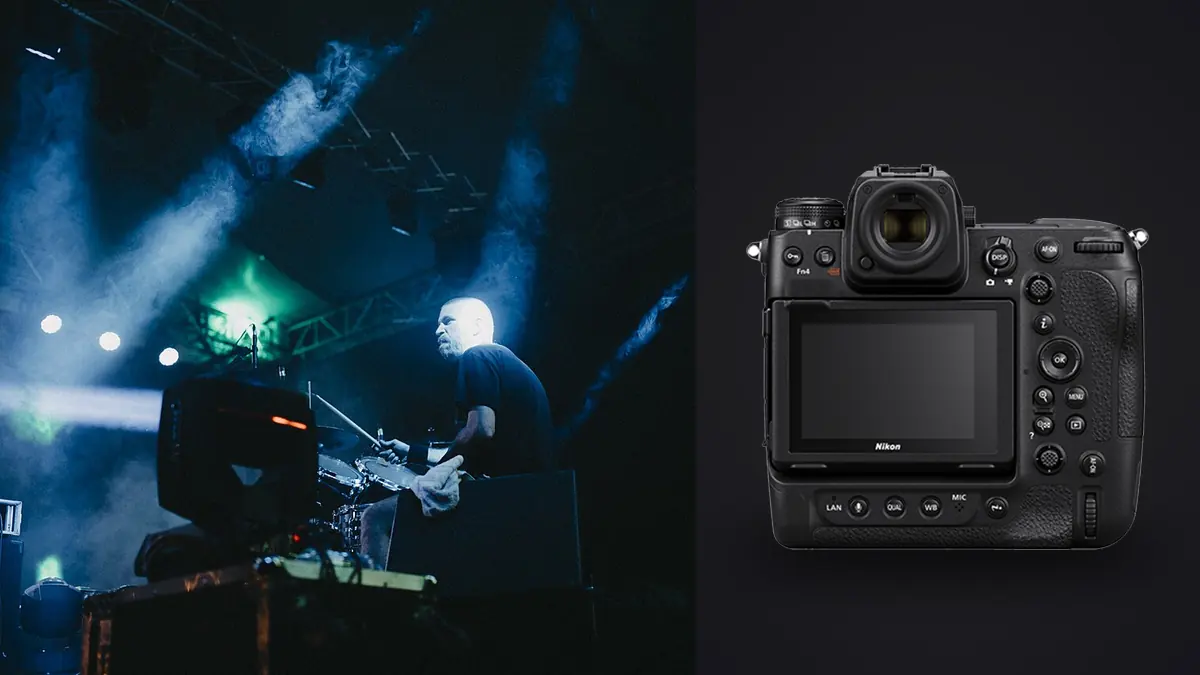
Picture being handed a Nikon Z9 at the last minute before an arena show, with nothing more than the drive over to figure out the menu. Three songs, no flash, house lighting doing whatever the lighting director felt like that night. That's the real test for this camera, not a spec sheet comparison. Here's what actually matters when the Z9 is the body in your hands and the room is dark, loud, and moving fast.
Why the buffer matters more than the megapixels here
Everyone talks about the Z9's 45.7-megapixel sensor and stacked readout like they're the headline feature for concert work, but for live music the number that actually changes your night is the buffer depth. Shooting 20fps in raw, the Z9 will run for well over 1,000 frames before it even thinks about slowing down, because there's no mechanical shutter to protect and the buffer is backed by fast internal memory rather than being purely card-limited the way older bodies were. In practice that means during a guitar solo or a drum fill you can just hold the shutter down through the whole thing instead of rationing bursts like you would on a body that chokes after 40 frames.
That freedom is a double-edged sword. A three-song pit set at a big room can leave you with 2,000 to 3,000 frames, most of them near-duplicates of the same gesture from slightly different angles of the singer's head. The camera solved the "can I keep shooting" problem. It created a new problem, which is that you now have to sit down at 1am and find the 25 usable frames buried in three thousand raw files. More on that later, because it's the part nobody warns you about when they're excited about buffer depth.
The settings I actually run in the pit
Metering in a room that changes exposure every four bars
I shoot manual exposure with Auto ISO almost every time, capped between ISO 100 and 25600 depending on the venue, with the shutter speed fixed based on what the performer is doing (1/500 for anything with fast movement, sometimes down to 1/250 if the lighting is brutal and the artist tends to hold poses). Matrix metering gets fooled constantly by spotlights against black backdrops, so I lean on the histogram and highlight-weighted metering when the Z9 offers it, watching for blown highlights on faces under a single hard key light. Aperture sits wide open on whatever fast prime or zoom I'm carrying, because at most pits you're fighting for stops, not depth of field.
The one habit that saved more shots than any menu setting: chimping the histogram, not the LCD image, every time the lighting rig changes color or intensity. A screen that looks fine in a dark venue lies to you constantly about actual exposure.
Autofocus for a moving target under moving light
3D-tracking with subject detection set to People, eye priority on, is the default I start every show with. It genuinely holds focus through hair whips, mic stand obstructions, and lighting changes better than any DSLR I used before this. Where it gets unreliable is heavy haze or fog machines combined with strong backlight, situations where the camera occasionally locks onto a lit particle of smoke instead of the singer's face. When that happens I drop to a single-point AF-C zone and manually place it, which costs some tracking convenience but wins back reliability.
I also keep a custom Fn button mapped to switch AF-area modes on the fly, because a guitarist working the stage edge and a vocalist locked to a mic stand need genuinely different tracking behavior, and there isn't time to dig through menus between songs.
File format and the buffer trap nobody mentions
High-efficiency raw (compressed to roughly half the size of lossless raw with visually negligible quality loss for this kind of work) is what I shoot 90 percent of the time at gigs. It lets the buffer run longer in practical terms because card write speed stops being the bottleneck, and it roughly halves the storage burden on a night when you might be filling two 128GB CFexpress cards. Full lossless raw only comes out for seated, controlled shows where I know I'm only taking a few hundred frames and want every bit of dynamic range for heavy post work later.
Lens and venue combinations that actually hold up
The lens question depends entirely on how close the pit puts you to the stage, and that varies wildly by venue size and by how strict the tour's photo pass rules are. A 24-70mm f/2.8 covers most club and theater work from the rail. Arena and festival work usually demands something longer, a 70-200mm f/2.8 at minimum, sometimes a 100-400mm if the barrier is set far back from the stage, which happens more often on larger productions with in-ear monitor wedges and extended stage lips.
| Venue type | Typical shooting distance | Lens I'd actually bring | Common lighting problem |
|---|---|---|---|
| Small club (200-500 cap) | 3-8 feet | 24-70mm f/2.8, sometimes a 35mm prime | Single-color wash, low output, heavy underexposure on skin tones |
| Theater / mid-size venue | 10-20 feet | 70-200mm f/2.8 | Hard spotlights with deep shadow falloff on the rest of the stage |
| Arena | 25-60 feet from barrier | 70-200mm f/2.8 plus a 1.4x, or a 100-400mm | Follow spots overpowering the fixed rig, constant color temperature swings |
| Outdoor festival, daylight set | 15-40 feet | 24-70mm f/2.8 or 70-200mm depending on stage design | Backlighting from low sun, LED screens throwing mismatched color |
The 70-200mm earns its keep at almost every venue size above a small club, but I'll admit the weight adds up over a three-hour set list when you're also carrying a second body. If I could only own one lens for this genre it would be the 70-200, not the 24-70, because you can crop a tight shot wider in post more gracefully than you can manufacture reach you didn't have.
Where the after-show workflow actually breaks
Here's the part that changed how I think about gear entirely. A camera this capable doesn't just capture the show better, it generates a culling problem that didn't exist with older, slower bodies. Coming home with 2,500 raw frames from one gig and needing to deliver a gallery of 40 to 60 images by the next morning used to mean either staying up until 3am clicking through Lightroom one frame at a time, or getting sloppy and missing the actual best frame in a burst because fatigue sets in around frame 800.
What actually fixed that for me was switching my first cull pass to imagic instead of doing it inside Lightroom. It runs entirely on my laptop, no upload queue, no waiting on a cloud service at 1am on hotel wifi, which matters a lot when you're filing from a tour bus with no signal. It scores focus and sharpness locally across the whole take and groups near-duplicate burst frames from the same gesture together, so instead of scrolling through fifteen nearly identical frames of a singer mid-jump I see one cluster with the sharpest frame flagged. That alone cuts the first pass from a couple of hours down to maybe twenty minutes on a big show. It's the same idea covered in tightening up a faster photo workflow, just pushed to the volume extreme a concert pit produces.
The other piece that's specific to concert work is that my color treatment for live music is nothing like my color treatment for anything else I shoot, heavy on contrast, protecting the color casts from stage lighting rather than correcting them to neutral. I trained imagic's apply_my_style feature on a batch of my own past concert edits, and it's genuinely useful for the first-pass grade on the bulk of frames that don't need individual attention, which lets me spend my actual editing time on the dozen hero shots instead of resetting sliders on frame four hundred. If your process is closer to what's described in how AI photo culling actually separates the keepers from the noise, the concert use case is close to the extreme end of that problem: high volume, high near-duplicate rate, tight deadline.
Honest gripes after two years with this body
The Z9 is not small. Carrying it plus a 70-200mm through a three-hour set, often while also managing a second body with a wider lens on a strap, is real physical work by the end of a tour week. Battery life is genuinely excellent (I've gone a full multi-band festival day on a single EN-EL18d without swapping), but the body's bulk means I notice my shoulders the next morning in a way I never did with smaller mirrorless bodies I used previously.
Card door reliability has been fine for me, but I know photographers who've had issues with CFexpress cards not seating properly after repeated hot-swaps mid-show, which is a bad time to discover a card problem. I now check the door click twice before every set, which sounds paranoid until you've missed a headliner's encore because a card wasn't fully seated.
The blackout-free viewfinder gets talked about as a gimmick by people who haven't shot fast action with it, but for concert work it's a genuine advantage. Not losing the frame during a burst means you can track a performer's movement continuously instead of guessing where they'll be when the finder blacks out and reappears, which older mirrorless and DSLR bodies both suffer from in different ways.
Frequently Asked Questions
Do I need the Z9's mechanical shutter mode for concert shooting, or is electronic-only fine?
For almost all concert work, electronic shutter only is fine and is what I use essentially every time. Rolling shutter distortion (the skewing effect on fast-moving subjects) is only a real risk with very fast horizontal movement like a whip pan or a spinning guitar, situations that come up rarely enough in typical concert photography that I haven't found it worth switching back to mechanical for the slower flash sync speed it would cost me.
Is 20fps overkill for live music, or does it actually help?
It helps more than I expected before I owned the camera. Facial expressions during a vocal peak change in a fraction of a second, and having more frames per gesture means a much higher hit rate on the specific instant where eyes are open, mouth is mid-word rather than mid-grimace, and the pose reads well. The tradeoff is entirely on the back end in culling volume, which is a workflow problem, not a shooting problem.
What's the biggest mistake photographers make bringing the Z9 into a photo pit for the first time?
Trusting the rear LCD's brightness in a dark venue instead of the histogram. The screen looks correctly exposed because your eyes have adjusted to the dark room, and you walk away with a card full of frames that are a full stop underexposed once you get them onto a calibrated monitor. Set custom exposure warnings and actually look at them between songs.
How many keeper images should I realistically expect from a typical three-song pit set?
From roughly 2,000 to 3,000 raw frames in a big room, I typically keep somewhere between 30 and 60 final images, depending on the show. That ratio is exactly why the culling step matters as much as the shooting technique, since even a technically perfect capture rate doesn't help if sorting the take takes longer than the show itself did.