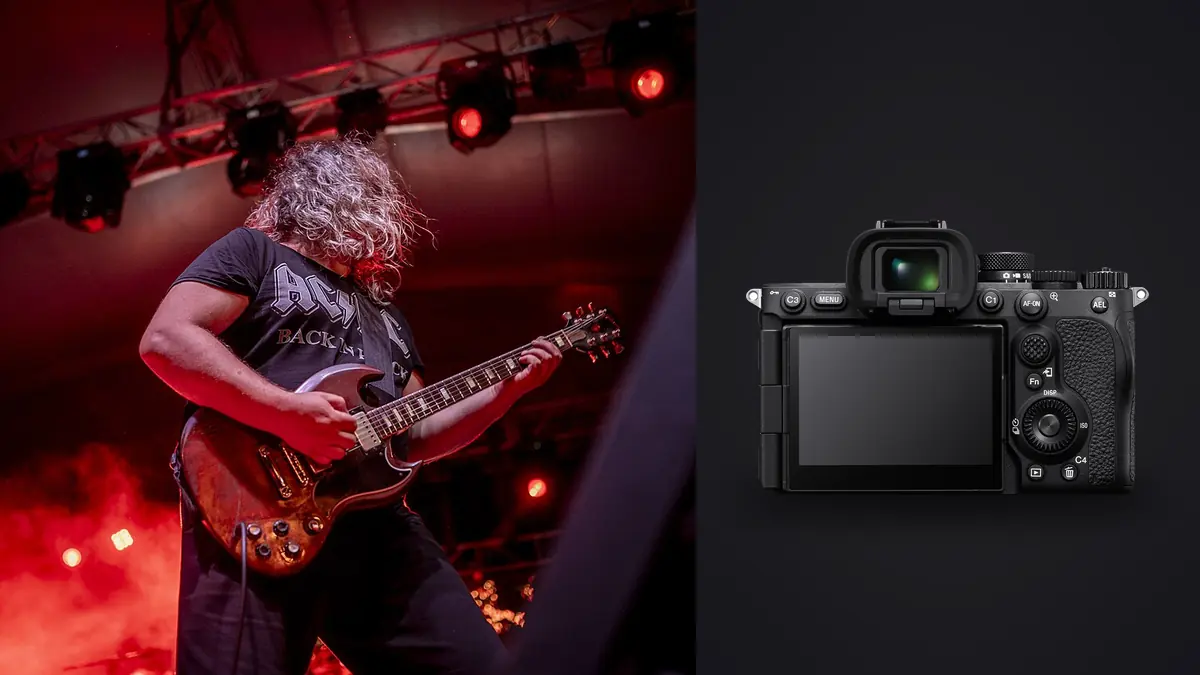
I did not buy the Sony A7R V to shoot bands. I bought it for interiors and the occasional portrait, where 61 megapixels of detail and a flippable rear screen mattered more than frame rate. Then a friend invited me along to a three-night residency at a 900-capacity room, camera in hand. I almost said no. A resolution monster built around a non-stacked sensor is not the first camera anyone reaches for when the lighting rig is chasing a drummer through green and magenta strobes. I said yes anyway, and what I learned over those three nights is the reason I'm writing this instead of just recommending an A9 III and moving on.
A camera that wasn't built for the pit, and it shows
Start with the honest complaint. The A7R V does not have a stacked sensor, so its rolling shutter readout is noticeably slower than the A9 series or the A1. That matters at a concert in two specific ways. First, if you drop into electronic (silent) shutter to stay quiet during a quieter acoustic number, you can pick up horizontal banding from LED fixtures running on pulse-width dimming, the cheap PAR cans and moving heads that make up most small-venue lighting rigs. It is not subtle once you see it in a 61-megapixel file at 100%. Second, fast horizontal pans during a guitarist's stage-diving climax can skew straight mic stands into slight parallelograms. Neither problem is disqualifying, but neither is something Sony's marketing copy for this body ever mentions.
The buffer is the other real constraint. A camera engineered for landscape and product work was never going to match a sports body's write speed, and it doesn't. Push through an entire song firing at 10 fps in your highest quality RAW setting and you will feel the camera hesitate before the bridge hits. That single fact reshaped how I shoot with this body more than anything else in this article.
Where the resolution actually earns its keep
Here's the part that surprised me. Once I stopped fighting the camera and started using it for what it's good at, the extra resolution turned into a genuine advantage in a genre it was never marketed for.
Most photo pits give you the first three songs, no flash, shooting over a barrier from a fixed position twenty to thirty feet back. A 70-200mm at that distance leaves you cropping in post more often than you'd like, especially for a singer who spends half the set at the far side of the stage working the crowd on that side. With a 24-megapixel body, aggressive cropping means handing a client a soft, noisy 8-megapixel frame. With the A7R V's files, I can crop to half the frame and still deliver something a magazine could run at a reasonable size. That headroom changed how tightly I frame in the moment. I stopped trying to guess where the singer would end up and started shooting a little wider, knowing I could recompose later without losing usable resolution.
The dynamic range helps just as much. Stage lighting at a mid-size venue swings from near-total darkness to a blown-out spotlight within the same frame, sometimes within the same second. I've pulled back highlight detail from a singer's face under a hard key light that would have been an unrecoverable white blob on a lower dynamic range sensor, without introducing the color banding you get pushing shadows on a smaller sensor. That single trait, more than the megapixel count itself, is what makes me reach for this body over a lighter secondary camera when I know a show has harsh, high-contrast lighting.
Buffer depth by file format, tested at a real three-song set
These are the numbers I actually got shooting a 900-cap room with a fast CFexpress Type A card, not lab figures. Your mileage will vary with card speed and how warm the body is after two hours under stage heat, but this is close enough to plan around.
| File format | Roughly how many frames before the buffer chokes at 10 fps | What I actually use it for |
|---|---|---|
| Compressed RAW | ~65-70 frames | The whole set. Fastest recovery between bursts, smallest files, good enough quality for 99% of concert deliverables. |
| Lossless compressed RAW | ~40-45 frames | Cover shots and anything likely to be printed large. Enough headroom for a 4-5 second burst. |
| Uncompressed RAW | ~28-30 frames | Rarely. Only for a single planned frame, like a pre-timed pyro or confetti hit, never for chasing unpredictable movement. |
| Extra fine JPEG | 180+ frames | Never for a real gig. Fine as a fallback if a card is filling up mid-set and you need to keep shooting. |
The settings I actually changed before the first show
Anti-flicker shooting, on, always
Sony's anti-flicker feature reads the LED rig's dimming frequency and times the shutter to avoid the exposure banding I mentioned earlier. It costs nothing in speed and has saved me from throwing away half a burst more than once. Leave it on for every venue, even ones you've shot before, because the lighting company running the rig changes from tour to tour.
Mechanical shutter unless the room demands silence
Given the rolling shutter behavior, I default to the mechanical shutter for anything with fast lateral movement and only drop to electronic when a quieter, seated show genuinely requires it. The frame rate ceiling is a little lower mechanically, but the geometry stays honest.
AF tracking sensitivity turned up, not maxed
I run Locked-on AF tracking sensitivity around 4 out of 5. Maxed out, the camera jumps to every crew member who walks behind the drum riser. Too conservative, and it lags behind a singer who spins to face the drummer and back. Four is the setting that's stuck across a dozen shows now.
Back-button focus, always
Not unique to this camera, but worth repeating for anyone new to pit shooting: separate your focus trigger from your shutter button. Strobes and sudden blackouts will fool continuous autofocus constantly, and you want the ability to hold focus on a face through a blackout without the shutter button re-hunting.
Lenses that actually make sense on this body
The 24-70mm f/2.8 GM II lives on the camera for most of a set. It's light enough that three hours of holding it overhead during a crowd-surfing moment doesn't wreck your shoulder, and f/2.8 is workable once you accept you'll be shooting at ISO 6400 and above for most of the night. For headliner slots on a bigger stage, I bring the 70-200mm f/2.8 GM II, and I've started leaning on the 20mm f/1.8 G for wide, low crowd shots from the barrier, the kind that show the whole room and not just the performer.
One thing worth saying plainly: at f/1.4 or f/1.8 with 61 megapixels behind the lens, focus misses are unforgiving in a way they simply aren't on a 24-megapixel body. A frame that would pass as "sharp enough" on a lower resolution sensor shows visible softness here. That pushed me toward shooting a stop or two down from wide open more often than I would on a different body, trading a little background blur for a much higher hit rate.
What a three-night residency actually does to your hard drive
Three nights, three songs each in the pit plus another hour or so of stage-side access for the headliner's set, and I came home with just over 4,800 RAW files. At roughly 55-70MB per compressed RAW frame from this sensor, that's north of 300GB before I'd touched a single edit. That volume is the real cost of shooting concerts on a 61-megapixel body, and it's where the workflow after the show matters as much as anything that happened on stage.
This is the part of the job I used to dread, and it's why I moved my culling pass onto imagic instead of scrolling through Lightroom's grid view at 1am with a beer going warm next to the keyboard. Concert bursts are brutal to cull by eye: five frames in a row of the same guitar solo, lit by the same strobe, where the only real difference is which frame has the singer's eyes actually open and the focus actually landed on the face instead of the mic stand in front of it. imagic's local sharpness scoring picks the sharpest frame out of a burst like that automatically, and because it's scoring focus rather than just guessing from thumbnail contrast, it catches the difference between "looks fine at a glance" and "actually in focus" far more reliably than my tired eyes did at 1am. The duplicate and burst clustering groups those five near-identical frames together in the first place, so I'm reviewing one group instead of five separate decisions per moment.
The other piece that's specific to touring photographers is that all of this runs locally, no upload queue, no waiting on a hotel wifi connection that can't handle 300GB of RAW files. If you want a broader explanation of how the scoring and clustering actually work under the hood, this breakdown of how AI photo culling works covers the mechanics in more detail than I will here.
For color, every venue lights a stage differently, and I don't want to rebuild a grade from scratch for every show. I trained imagic's apply_my_style preset on a batch of concert edits I was already happy with, the ones where I'd corrected for a magenta-heavy rig or pulled back an overly green wash, and now new sets from a similarly lit room get a starting grade that's close to what I'd have landed on manually anyway. It's not magic for a totally new lighting setup, but for the bar shows and mid-size venues that make up most of my calendar, it cuts the color pass down to a handful of tweaks per gallery instead of starting cold on every image. It's a one-time purchase too, which matters more than people admit when you're already paying for lens rentals and a laminate that costs more than the ticket.
Frequently Asked Questions
Is 61 megapixels overkill for shooting bands in a small club?
For delivery, mostly yes, most venues and publications don't need files that large. For shooting, no, because the crop headroom it gives you when you're stuck at a fixed barrier position with a 70-200mm is genuinely useful. Think of the extra resolution as insurance against bad positioning rather than something you need for final output.
Does the A7R V's autofocus keep up with a moving performer under strobing lights?
Mostly, with tracking sensitivity set around the middle of the range rather than maxed out. It handles a singer moving across a stage under normal lighting changes well. Sudden total blackouts followed by a hard strobe hit will still occasionally fool it, which is exactly why back-button focus and a willingness to hold focus through a blackout matters more than any AF menu setting.
Should I shoot silent shutter to avoid disturbing an acoustic set?
Only if you've tested that specific venue's lighting rig first. The A7R V's non-stacked sensor makes it more prone to banding under electronic shutter with PWM-dimmed LED fixtures than a stacked-sensor body would be. If you haven't shot the room before, stick with the mechanical shutter and accept the extra noise rather than risk banding across an entire quiet set you can't reshoot.
What's a realistic way to go from a three-song pit set to a delivered gallery the same night?
Import while you're still packing up gear, run a culling pass to cut the burst duplicates and soft frames before you even look at the images individually, then apply a starting color grade and spot-check rather than grading from zero. That sequence, done locally without waiting on any upload, is realistically how you turn 1,500 frames from one night into a 40-image gallery before you're too tired to trust your own judgment on which frames actually work.