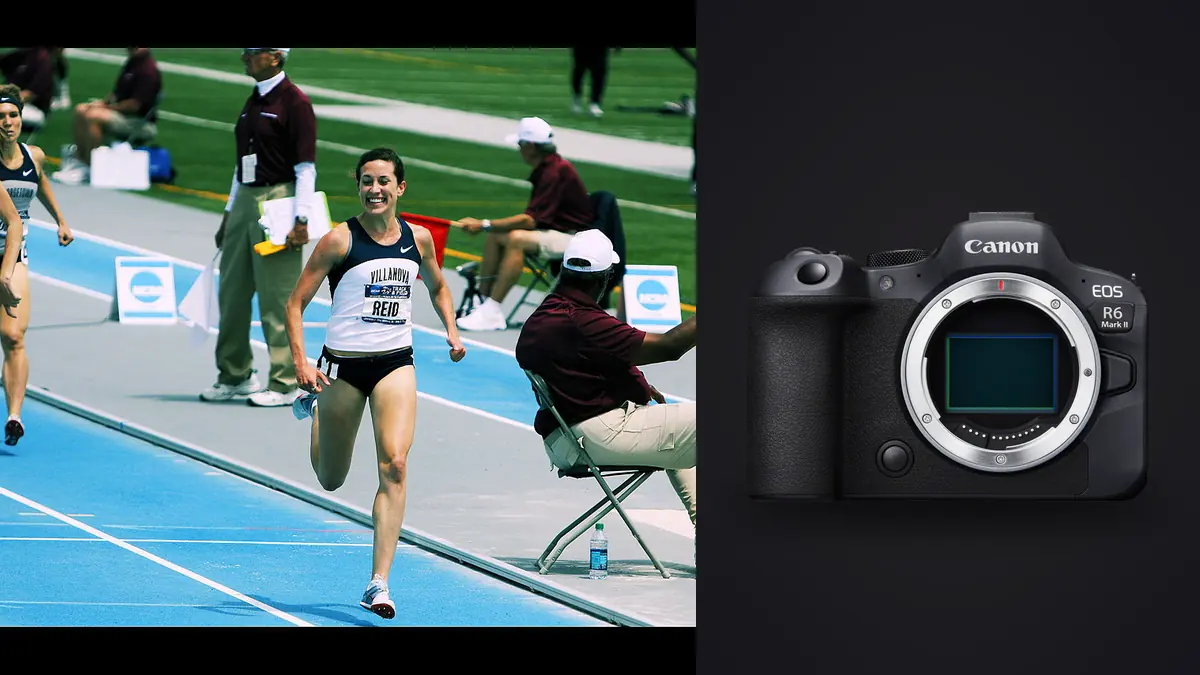
I shot my first regional track meet with the R6 Mark II on a Thursday evening in April, standing on the infield grass with a monopod I barely used and a card wallet I filled twice before the 4x400 relay even started. Track and field is a strange sport to photograph because it is really six or seven different sports happening on the same oval at the same time: a sprint finish needs different settings than a pole vault clearance forty yards away, and you rarely get a second attempt at either. This is what I have learned running the R6 Mark II through a full season of meets, indoors and out, with the lenses I actually own rather than the ones I wish I did.
Why This Body Fits an Oval Better Than My Old One
I came to the R6 Mark II from an original R6, and the jump that mattered most for track wasn't resolution (24.2 megapixels is plenty for web galleries and 11x14 prints, which is nearly everything a track program needs) but the autofocus system and the option of a genuinely fast electronic shutter. Sprint work rewards a camera that can hold focus on a small, fast, low-contrast subject against a busy background of lane lines, hurdles, and other athletes warming up in the background. The Mark II's Dual Pixel CMOS AF II handles that noticeably better than the first-generation R6 did, especially in the last thirty meters of a 100m final when the runner's stride opens up and their head bobs more than people expect.
Weight is the other reason I kept it over a 1-series body. Track meets run three to five hours, and I am carrying the camera on a strap most of that time, not on a tripod. A body under 700 grams with a 100-500mm attached is a very different four hours on your neck than a 1DX-class body with the same glass.
Autofocus Through an Actual Race
People detection (Canon's subject detection menu, set to People rather than Animals or Vehicles) picks up runners reliably from about 15 meters out to the far side of a standard 400m oval with a 400-500mm equivalent focal length, as long as there's decent light. Where it struggles: heat shimmer off the track surface on a hot afternoon meet, which softens focus lock on the far straight even when the AF box is sitting right on the runner. I've also had it grab a spectator's face in the background during a crowded finish line shot when my AF area was too wide. Tightening from Whole Area tracking down to a Flexible Zone, roughly a quarter of the frame, fixed that for me.
For pure sprints I run AF Case 2, mild acceleration/deceleration tracking, high tracking sensitivity so it doesn't wander to the runner in the next lane. For the 400m and 800m, where pace and stride length change more across the race, I switch to Case 3. Long jump and triple jump are the events where I turn subject detection off entirely and just use a single AF point, because the athlete's profile turns away from the sensor mid-flight and eye/head detection has nothing reliable to lock onto.
Frame Rate, Shutter Choice, and What the Buffer Actually Gives You
The 40fps electronic shutter is the headline spec, and it is genuinely useful for a 100m final where you want the exact frame of a lean at the tape. But I don't shoot the whole meet at 40fps. Rolling shutter shows up as a mild skew on anything moving fast and close, most visibly when panning with a sprinter in the near lanes at a wide aperture. For those shots I drop to the 12fps mechanical shutter, which has none of that skew and, frankly, is still plenty of frames to pick from for a stride sequence.
Buffer depth is the practical limit, not the frame rate. Shooting CRAW at 12fps mechanical with a fast UHS-II card, I get well over a hundred frames before the camera slows down, which covers a full sprint easily. At 40fps electronic on the same card, the buffer fills inside two to three seconds of continuous RAW capture, which is fine for a finish line burst but means you have to be deliberate about when you hold the shutter down rather than spraying the whole race.
| Event | Shutter Speed I Use | Focal Length | AF / Notes |
|---|---|---|---|
| 100m / 200m sprint | 1/2000-1/2500 | 300-500mm far side, 100-200mm near lane | Case 2, People detection, tight zone |
| 400m / 800m | 1/1250-1/1600 | 300-400mm | Case 3, pace varies through the lap |
| Long / triple jump | 1/2000 | 200-300mm | Single point, detection off, athlete turns profile |
| Pole vault | 1/1600 (or 1/500 for a deliberate blur on the bar) | 300-400mm | Manual point, pole crosses the frame unpredictably |
| Shot put / discus | 1/1250 | 200-300mm | Case 1, standing throw, AF has time to settle |
| High jump | 1/2000 at the bar | 200-300mm | Manual point on the bar height, not on the runway |
| 4x100/4x400 relay exchange | 1/2000 | 100-300mm zoom | Wide zone, two runners overlap in the box |
The Glass I Actually Bring
Two lenses cover about ninety percent of my track season. The RF 100-500mm F4.5-7.1L lives on the camera for anything happening on the far side of the oval, sprint finishes shot from the infield, and the backstretch of longer races. It's not a fast lens wide open at the long end, F7.1 at 500mm means ISO climbs fast once the sun starts going down, but the reach is what a track photographer without field access actually needs.
For infield events (long jump, shot put, pole vault, high jump) where I can get within thirty or forty meters, I switch to the RF 70-200mm F2.8L. The extra two stops matter enormously for evening meets under stadium lights, and the faster glass keeps AF locking speed noticeably quicker than the 100-500 at its dim end. I tried the RF 800mm F11 for a season thinking it would be a cheap reach solution for far-side sprints, and while it's sharp, the fixed F11 aperture makes autofocus hunt in anything but bright daylight, and evening meets are where most of the meaningful action happens. I sold it after two meets.
A 1.4x extender on the 100-500 gets me to 700mm for the rare moment I need it (a distant pole vault at a stadium where I can't get infield access) but it costs enough light and AF speed that I only mount it when I know in advance I'll need the reach.
Handholding a Long Lens for Four Hours Straight
In-body stabilization on the R6 Mark II, combined with the lens's own IS, is rated for up to 8 stops in ideal conditions, and while I don't shoot handheld at anything close to that slow (subject motion blur would ruin the shot regardless of how steady the camera is), it does let me hold 1/60-1/125 comfortably for between-race shots and warmup coverage without a monopod. For the actual events I'm still at 1/1250 or faster, so the stabilization isn't doing heavy lifting on those frames, but it noticeably reduces fatigue and micro-shake over a long session, which matters more than people expect by hour three when your arms are tired and your framing starts drifting.
I bring a monopod for the 100-500 on outdoor all-day meets but leave it in the bag more often than I use it, mostly for tracking pans where a fluid head would actually fight against the panning motion rather than help it.
What I'd Change
Single UHS-II SD card slots, no CFexpress option, is the real limitation once you're shooting 40fps electronic bursts regularly. Buffer clearing takes noticeably longer than I'd like between events when I've been aggressive with frame rate, and on a meet with back-to-back finals I've missed the start of a following race waiting for the buffer to drain. Weather sealing has held up fine through a rainy outdoor meet in May, no complaints there, but battery life takes a real hit when subject detection and continuous eye tracking are running most of the afternoon. I carry three batteries to a full day meet and use all three.
The other thing I'd flag for anyone coming from a DSLR: the electronic viewfinder blackout during 40fps bursts is minimal but not zero, and on a fast finish it's enough that I sometimes prefer 12fps mechanical just to keep visual contact with the runner through the frame.
Getting Through Four Thousand Frames the Same Night
A single outdoor meet with a full slate of events routinely leaves me with three to five thousand frames, and that number climbs fast once you're running 40fps for finishes. Sorting that by hand used to eat my whole evening. What I run now is imagic, which does local sharpness and focus scoring on the whole card before I open an editor, so the soft frames from a 40fps burst (the ones where the runner's head turned or focus drifted onto the background) get flagged automatically instead of me clicking through every single frame at 100% zoom. Everything processes on my own machine, nothing gets uploaded anywhere, which matters to me since a lot of these are minors and I don't want a full SD card of kids' faces sitting on someone else's server.
It also clusters the burst sequences, so a 40-frame sprint finish becomes one group I can flip through quickly rather than forty individual thumbnails competing for attention in the grid. Once I've picked the keepers, I use imagic's apply_my_style preset, trained on my own past edits rather than a generic filter, to get consistent color across a set that was shot across three lighting conditions in one evening (bright sun at 4pm, stadium lights by 7). If you're trying to understand how automated culling actually scores frames rather than just guessing at sharpness, I wrote more on that in how AI photo culling works. For anyone shooting multiple meets a week, some of the general pacing advice in 10 tips for a faster photo workflow applies directly to a track season's card-dump-to-delivery timeline.
Frequently Asked Questions
Is 40fps electronic shutter actually worth using for sprint finishes, or is it overkill?
For the finish line specifically, yes. A lean at the tape happens in a fraction of a second and 12fps can genuinely land you a frame or two off from the exact moment. For the rest of the race, 12fps mechanical gives you plenty of options without filling your buffer or introducing the rolling shutter skew that shows up on close, fast panning shots at 40fps.
Can a 70-200mm f/2.8 cover a track meet on its own, or do I need something longer?
If you have infield access, the 70-200 handles field events (jumps, throws, vault, high jump) and even mid-distance running shots well. Without infield access, shooting sprints from the stands or an outer rail, you'll want something in the 300-500mm range for the far side of the oval. Most meets I shoot, I carry both and swap depending on which event is up next.
How many usable images actually come out of a full meet, and how do you get through them the same night?
Out of three to five thousand raw frames I typically deliver somewhere between 150 and 300 selects per meet. Getting there fast depends on culling by focus quality first (so you're not manually reviewing near-duplicate burst frames one by one) and grouping burst sequences before you start picking, which is the part imagic handles for me before I ever open an editing app.
Does the R6 Mark II overheat if I'm also recording 4K clips for a highlight reel between stills?
Across a normal meet, shooting stills for most of the session with occasional short 4K clips of relay handoffs or a vault attempt, I haven't hit a thermal shutdown. It's a real concern if you're recording long continuous 4K60 segments in hot weather, but that's not typical track meet coverage, where video is usually short highlight clips rather than sustained recording.