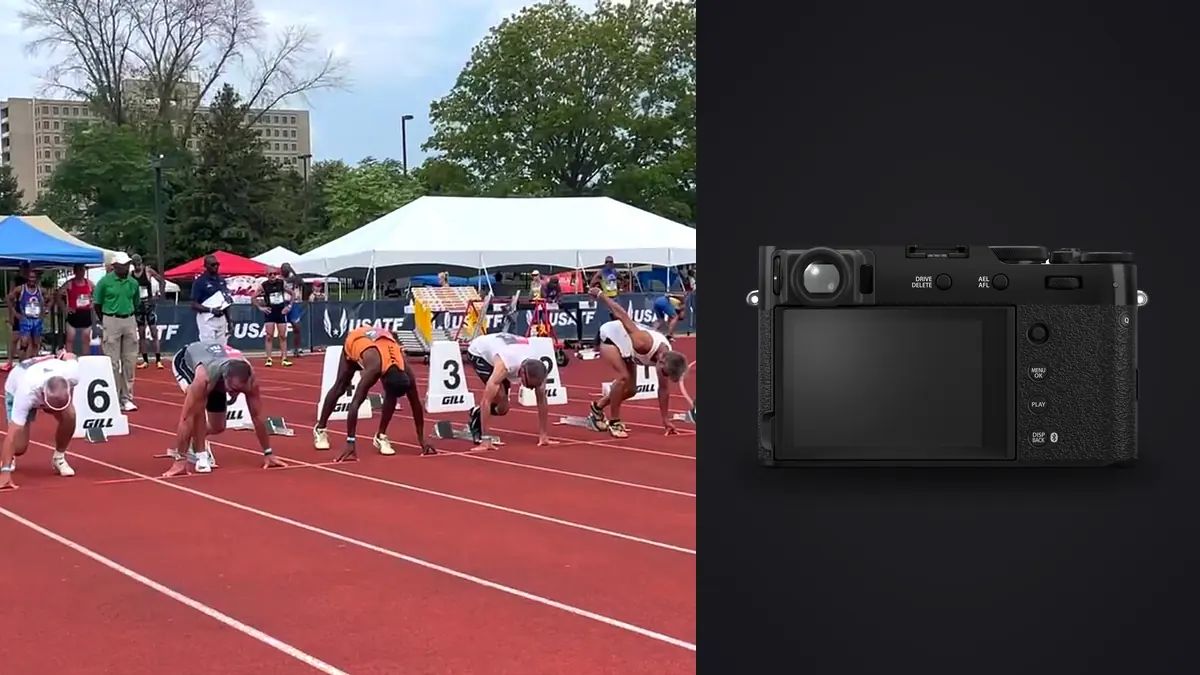
I get asked at least once a month by someone standing trackside with an X100VI slung over their shoulder whether it's a real option for shooting their kid's meet. The honest answer is that it depends almost entirely on where you're allowed to stand, because this is a camera built around one 23mm f/2 lens (35mm equivalent) with no zoom ring to bail you out. If you can get track apron access, or you're working a field event from a fence line, it's a genuinely capable little tool with fast, sticky autofocus and a sensor that resolves enough detail to crop hard after the fact. If you're stuck in row 20 of the bleachers next to someone with a 300mm zoom, it's the wrong camera for the job, and I'd rather say that up front than let you find out mid-meet.
A Fixed 35mm Lens Is the First Decision You're Making, Whether You Like It or Not
Every other consideration in this article sits downstream of one fact: the X100VI has no zoom. At 35mm equivalent, a runner needs to be uncomfortably close before they fill enough of the frame to read bib numbers or facial expression. From a standard bleacher seat, thirty to fifty feet back, a sprinter on the X100VI is a small figure in a wide scene. That's not a knock on the camera, it's just optics. A 35mm lens on a 40-megapixel sensor and a 35mm lens on a 12-megapixel sensor cover the same angle of view either way.
What changes the math is the two accessory converters Fujifilm sells for this body. The WCL-X100 II widens things out to roughly 28mm equivalent, which is the wrong direction for sports. The TCL-X100 II tele converter brings you to roughly 50mm equivalent without touching the f/2 aperture rating, and that's the one worth owning if you're going to use this camera for anything with distance involved. Fifty millimeters still isn't a sports lens by any conventional definition, but it's a meaningful step up from 35mm for shooting the long jump runway or triple jump pit from behind the sector rope.
There's also a free option built into the menu: the digital teleconverter, which crops in-camera to simulate 50mm or 70mm equivalent framing. Because the X100VI's sensor is 40.2 megapixels, that crop isn't as punishing as it would be on an older, lower-resolution body. The 50mm setting leaves you with something in the neighborhood of 20 effective megapixels, and the 70mm setting drops to roughly 10, still enough for web use and reasonable print sizes. One nuance worth knowing: shoot RAW+JPEG and the crop only applies to the JPEG preview, your RAW file keeps the full 40-megapixel frame. That means you can compose loosely with the digital tele engaged to judge framing on the rear screen, then decide your actual crop later with the whole sensor's worth of data to work from.
What the Autofocus and Burst System Can Actually Track
The X-Trans 5 HR sensor and the X-Processor 5 behind it are shared with the X-T5 and the X-H2, and the subject-detection AI inherited from those bodies is the real upgrade over earlier X100 generations. It picks out animals, birds, cars, motorcycles, planes, and trains as dedicated categories, and human face and eye detection runs separately and reliably once someone's close enough in the frame to register as a subject rather than a smudge. At a track meet that means the camera locks onto an athlete's face confidently the moment they're large enough in frame, which, again, ties back to that fixed 35mm field of view. Get close and the AF is trustworthy. Stay far and there isn't enough resolution on the subject for the algorithm to have much to grab onto.
Burst rate is where the X100VI quietly earns some respect. Fuji rates the mechanical shutter at up to 11 frames per second, and the electronic shutter climbs to 20fps at full sensor width or 30fps with a 1.25x crop. That electronic top end is fast enough to catch a clean start-of-race reaction or a baton exchange if you're positioned right. The catch is the card slot: there's only one, and it's UHS-I, not the faster UHS-II standard you'd find on an X-T5 or X-H2. Shoot a long burst in RAW or compressed RAW at 20fps and you will hit the buffer and then sit there waiting for the camera to write it all out before you can fire another long burst. Mechanical shutter at 11fps with compressed RAW is the safer choice for anything longer than a couple of seconds of continuous action.
The leaf shutter design (as opposed to a focal-plane shutter) is worth understanding too, because it changes how the camera behaves under certain conditions. Mechanically, it has no rolling shutter distortion and syncs with flash at any shutter speed up to 1/4000s, which is irrelevant for most daytime meets but genuinely useful if you're shooting an indoor event and want to supplement with strobes. Switch to full electronic shutter for that 20 or 30fps rate, though, and you're reading the sensor line by line again, so under flickering gymnasium or arena lighting you can pick up banding in your files that you won't see with the mechanical shutter. I've had this happen at an indoor 200m final under fluorescent lighting and not noticed until I got home and saw horizontal bands across half the burst. For indoor meets I default to mechanical shutter and accept the lower frame rate.
The hybrid viewfinder helps here in a way that's easy to overlook. Switch to the optical finder and Fuji overlays a small, parallax-corrected frame line showing your actual capture area inside a wider view, so you can watch a runner approach from outside the frame before you swing onto them, the same trick rangefinder shooters have leaned on for decades. There's also an electronic Sports Finder mode carried over from the X-T5 that boxes your capture area inside a wider live view for the same reason. Neither replaces a long lens, but both make it easier to time your shot when you can't zoom to compensate for bad timing.
Comparing the Realistic Shooting Distances
This is the table I wish someone had shown me before I brought this camera to a regional meet expecting bleacher-seat results. It's built from actual distances I've measured at local tracks, not a spec sheet.
| Configuration | Effective focal length | File resolution | Usable subject distance | Best track/field use |
|---|---|---|---|---|
| Native lens, no crop | 35mm equiv. | ~40MP | Under 20 ft | Starting blocks, handoffs from the infield, finish-line press position |
| Built-in digital tele (50mm) | ~50mm equiv. | ~20MP (JPEG) | 25 to 35 ft | Long/triple jump pit from the runway fence |
| Built-in digital tele (70mm) | ~70mm equiv. | ~10MP (JPEG) | 40 to 60 ft | High jump or pole vault from a permitted standing area |
| TCL-X100 II attached | ~50mm equiv. (optical) | ~40MP | 25 to 35 ft | Same range as digital 50mm but full resolution retained for later cropping |
| Standard bleacher seat, no conversion | 35mm equiv. | ~40MP | 80 to 150 ft | Wide crowd and atmosphere shots, not tight action |
The Settings I'd Actually Dial In Trackside
AF-C with the wide/tracking zone active, and I bump the AF point size down from the default so it's not grabbing the fence or the person next to the athlete. Continuous shooting on mechanical shutter outdoors, electronic only if I need the higher frame rate for a single decisive moment like a photo finish and I've confirmed the lighting won't band. Shutter speed manual or shutter-priority around 1/1000s to 1/1600s for sprints, dropping to 1/500s if I want a deliberate motion blur pan on a middle-distance runner, which the in-body stabilization actually complicates a little. Fuji's IBIS is excellent for handheld stills but it can fight you on an intentional horizontal pan unless you're in a body/lens combination that recognizes panning motion and stabilizes only the vertical axis, so I'll often just switch IBIS off entirely when I know I'm panning.
Battery life takes a real hit once you're running continuous AF and boosted EVF refresh rates for a couple of hours straight. The NP-W126S battery is not large, and I don't go to a meet with fewer than two spares if I'm shooting all day. Between events I switch back to the optical viewfinder, which draws less power than running the EVF continuously, and that alone buys me another hour or so of shooting.
Where the Culling Actually Happens
Shoot a track meet at 11 or 20fps for even a couple of hours and you come home with several thousand frames, most of them nearly identical bursts of the same handoff or the same jump. Going through that manually on a laptop at the kitchen table is the part of this hobby nobody enjoys, and it's the actual bottleneck, not the camera. I run everything through imagic before I open Lightroom at all. Its local sharpness and focus scoring flags which frame in a ten-shot burst is genuinely the sharpest one on the athlete's face rather than the background fence, and its burst and duplicate clustering groups those near-identical frames together so I'm reviewing one representative thumbnail per moment instead of scrolling past the same handoff nine times.
Because it processes everything on the machine rather than uploading a card full of kids' faces to somewhere else, I don't think twice about running a youth meet's worth of images through it. Once I've picked my keepers, I lean on the apply_my_style preset feature, which is trained on my own past edits rather than a generic look, to get a consistent starting point across a folder of mixed lighting (some frames shot in direct sun, some under a stadium roof shadow) before I do any individual fine-tuning. If your workflow is still built around scrubbing through a card manually, our guide to a faster photo workflow covers some of the habits that matter even before culling software enters the picture.
What This Camera Is Genuinely Good For at a Meet
I want to be fair to it, because I keep coming back to mine even though I own longer glass on other bodies. The X100VI is small enough to carry all day without the neck fatigue of a gripped body and a 70-200mm, and that changes what you actually shoot. I get the warm-up laps, the coach's hands adjusting a starting block, the tape being wound around an ankle, the huddle before the 4x400 relay, the exhausted grin at the finish line once someone's walked back toward the fence. None of that needs 400mm of reach. It needs a fast, quiet, unobtrusive camera that doesn't look like a credentialed press rig, and the X100VI's rangefinder-style body does that better than almost anything else in this class. If your goal is a documentary story of a meet rather than a tack-sharp 200mm frame of a sprinter's stride, this camera is arguably better suited to the job than a telephoto-first setup, because you'll actually get close enough to the moments that make the story.
What it won't do is replace a 70-200mm or 100-400mm on a body with a deeper buffer if your actual goal is frame-filling shots of the race itself from standard spectator seating. I've tried to talk myself into it being enough for that and it isn't, not without either credentialed track access or the digital tele crop eating into your resolution. Know which of those two jobs you're actually there to do before you leave the long lens at home.
Frequently Asked Questions
Can I shoot a 100m sprint from the stands with the X100VI?
Technically yes, in the sense that the shutter will fire, but at 35mm equivalent from a typical stand thirty or more meters back, a sprinter occupies a small fraction of the frame. You'll get a usable wide shot of the field crossing the line together, not a tight portrait of your athlete mid-stride. If bleacher seating is your only vantage point, this isn't the camera for frame-filling sprint shots.
Is mechanical or electronic shutter better for indoor track meets?
Mechanical, in most cases I've run into. Indoor arenas frequently run lighting that flickers at a rate your electronic shutter's line-by-line sensor readout can pick up as visible banding, especially at higher frame rates. The leaf shutter has no rolling readout and no banding risk, at the cost of a lower top frame rate (11fps versus up to 20 or 30fps electronic).
Does the TCL-X100 II teleconverter make this a real sports camera?
It gets you to roughly 50mm equivalent, which helps for field events shot from a fence line, but it's still well short of what dedicated sports shooters use for track action from a distance. Think of it as extending your usable range for close-to-medium access, not turning this into a telephoto sports rig.
How should I handle culling after a full day of burst shooting?
Don't try to do it by eye in a grid view, you'll miss the sharpest frame in a burst more often than you'd expect. Running the card through imagic first groups near-duplicate burst frames and scores focus so you're picking from a shortlist rather than several thousand raw files, which is the difference between an evening of editing and a weekend lost to it. Our piece on how AI-assisted culling actually works goes into the mechanics if you're curious what's happening under the hood.