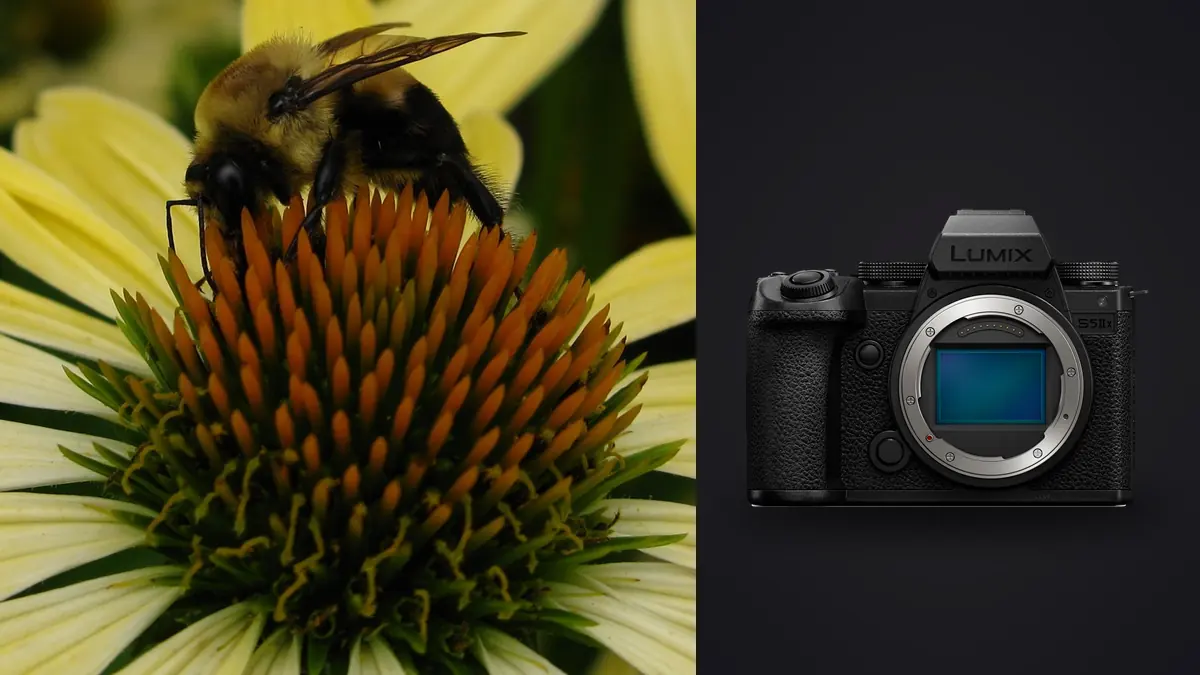
Nobody buys a Lumix S5IIx thinking about damselflies. Panasonic built it for run-and-gun video shooters who wanted ProRes, an active cooling fan, and unlimited recording without the bulk of an S1H. But the sensor, the autofocus system, and the lens mount underneath all that video plumbing are identical to the stills-first S5II, and that quietly makes it a competent, occasionally excellent, tool for chasing bugs at 1:1. I've spent three mornings a week for the better part of a season with one strapped to a macro rail, mostly photographing hoverflies and jumping spiders in a scrappy patch of overgrown garden, and the results have been better than I expected and worse in a couple of specific, predictable ways.
This isn't a spec sheet reprint. It's what actually changes when you point this specific body, with its phase-hybrid autofocus and its video-shooter ergonomics, at something six millimeters long that is actively trying to leave the frame.
The sensor and lens mount matter more than the badge on the body
The 24.2MP full-frame sensor in the S5IIx is the same one Panasonic has used since the original S5II, and for macro work that full-frame format buys you something APS-C and Micro Four Thirds shooters have to work around: a shallower depth of field at any given aperture, which sounds like a liability until you realize it also means you can open up to f/5.6 or f/6.3 and still isolate an insect's head from a busy leaf, rather than being forced to f/11 just to get anything soft in the background on a smaller sensor.
The bigger practical win is the L-mount itself. Panasonic, Sigma, and Leica have all built dedicated macro glass for it, and a couple of manual-focus specialists (Voigtländer and Laowa) support it natively too. That gives you a wider spread of working distances and magnification ratios than most single-brand insect shooters get to choose from, which matters a lot more than most people think until they've tried to photograph a wasp that flees the instant your lens hood gets within four centimeters of it.
Autofocus on an eyelash-thin depth of field
The S5IIx uses the same phase-hybrid detection system as the S5II, with 779 phase-detect points layered over contrast AF, and Panasonic's animal-eye detection genuinely does try to lock onto insect eyes in good light. It works reasonably well on larger, high-contrast subjects: dragonflies perched with their compound eyes catching the light, bumblebees with dark heads against pale flowers. On anything smaller than about 10mm, or anything translucent (thrips, aphids, most true flies), eye detection gives up and hunts, and you're better off switching it off entirely.
At true macro magnifications the depth of field at f/5.6 can be under a millimeter, and no autofocus system, phase-detect or otherwise, is precise enough to consistently nail an insect's near eye at that tolerance while the insect is breathing, let alone walking. What I actually do in the field is set single-point AF to its smallest box, use it to get roughly close, then finish the job with manual focus and focus peaking turned up to high sensitivity. The peaking overlay on the S5IIx's screen is fine enough to actually distinguish "in focus on the eye" from "in focus on the antenna" if you zoom the live view in first, which you should always do.
For anything stationary (dew-chilled insects at dawn, resting moths, spiders in a web) the camera's built-in focus bracketing is worth learning properly. It fires a sequence of frames at incrementing focus distances that you merge afterward in Helicon Focus, Zerene Stacker, or Photoshop; the S5IIx doesn't merge in-camera, so budget the extra step. I typically shoot 15 to 40 frames per stack depending on subject size and step width, which sounds excessive until you remember that at 2:1 magnification, individual frames might each be in focus across less than half a millimeter of depth.
Stabilization helps, but don't lean on it for true 1:1
Panasonic rates the S5IIx's in-body stabilization at up to 6.5 stops on its own and higher when paired with a Dual IS 2 lens. That number is measured at normal shooting distances, and it degrades fast as you approach macro magnification, because IBIS corrects for angular shake, not the linear, front-to-back wobble that dominates when your lens is four centimeters from the subject. In practice I still get real benefit from it: it steadies the frame enough that focus peaking isn't jumping around uselessly while I hunt for the plane of focus, and for handheld shots in the 0.3x to 0.5x range (bigger insects, a bit more working distance) it lets me shoot at 1/60s instead of 1/250s without visible blur.
Past roughly 0.7x magnification, though, the stabilization stops being the limiting factor and your own breathing and the insect's own micro-movements take over. For serious stacking work I use a manual focus rail on a tripod and don't rely on IBIS at all; for handheld opportunistic shots of things that won't sit still for a rail, I lean on IBIS, a fast shutter, and volume (shoot 30 to 60 frames of the same pose and keep the two or three that land).
Native L-mount macro lens options
The lens you pair with the body changes the experience more than any menu setting does. Here's how the four L-mount macro options I've actually used stack up for insect work specifically, not landscape or product photography.
| Lens | Max magnification | Working distance at MFD | Autofocus | Weight | Street price (approx.) |
|---|---|---|---|---|---|
| Panasonic Lumix S 100mm F2.8 Macro | 1:1 | ~14cm | Yes, fast for a macro lens | 298g | $700-800 |
| Sigma 105mm F2.8 DG DN Macro Art | 1:1 | ~13cm | Yes, slower hunting up close | ~715g | $600-650 |
| Laowa 100mm F2.8 2x Ultra Macro APO | 2:1 | ~15cm | Manual only | ~638g | $450-500 |
| Voigtländer Macro APO-Lanthar 110mm F2.5 | 1:1 | ~13cm | Manual only | ~624g | $1,050-1,100 |
The Panasonic 100mm is the one I reach for most often because autofocus, even the imperfect kind, is genuinely useful for the "get roughly close" step before you switch to manual peaking, and at 298 grams it's light enough to handhold for a two-hour session without your wrist filing a complaint. The Laowa 2x is a different animal: manual focus only, and the extra magnification means an even thinner slice of sharpness, but for genuinely tiny subjects (springtails, mites, the smaller jumping spiders) nothing else on this list gets you as close without extension tubes stacked on top.
The Voigtländer is the odd one out. It's built like a tank, the focus throw is long and buttery in a way that actually helps precision manual focusing, but it's a luxury purchase at that price for a genre where you're going to be crawling through wet grass.
Field settings that actually hold up
I keep coming back to roughly the same four setting combinations depending on what's in front of me. This isn't a universal formula, insect photography has too many variables for that, but it's a reasonable starting point if you're new to the S5IIx specifically and don't want to burn the first hour of golden light on trial and error.
| Scenario | Aperture | Shutter | ISO | Drive / AF | Light |
|---|---|---|---|---|---|
| Dew-still insect, dawn, tripod stack | f/5.6 | 1/125s | 200-400 | Focus bracketing, MF fine-tune | Natural, reflector |
| Bee or hoverfly on a moving flower head | f/9 | 1/500s | 800-1600 | Single AF-S, small box, handheld | Twin macro flash, diffused |
| Jumping spider, alert and mobile | f/11 | 1/320s | 1000-3200 | Manual focus, burst of 20-30 | Ring light, low power |
| Backlit wing detail, damselfly | f/4 | 1/1000s | 400-800 | Single AF-S, eye/animal detect | Natural backlight only |
The pattern worth noticing there is how often ISO climbs and how rarely I go past f/11. Full-frame diffraction softening becomes visible past about f/13 on this sensor, so stopping down further to chase depth of field is usually a losing trade; better to accept a narrower plane of focus and either stack it or work with it compositionally. High ISO noise on the S5IIx at 1600 to 3200 is genuinely usable, cleaner than the older S5 generation, and I'd rather have a slightly grainy sharp frame than a clean blurry one every time.
Light, heat, and dew
Two small flashes on brackets, angled in from either side of the lens and pointed through a diffuser, do more for insect macro image quality than any camera body upgrade. Direct on-camera flash flattens an insect's texture and blows out the shine on wing membranes; twin diffused flash keeps the specular highlights small and controlled and lets you shoot at f/9 or f/11 without dragging ISO into the thousands. A cheap ring light is a fine backup for mobile subjects where you don't have time to fuss with bracket angles, though it tends to produce a flatter, more clinical look than a twin-flash rig.
The S5IIx's magnesium-alloy, weather-sealed body has been genuinely useful on dewy mornings, which is prime insect macro time because cold insects move slower. I've had condensation form on the front lens element more than once from carrying the camera out of an air-conditioned car into humid morning air, and the body itself has never complained, though you do need to let the lens acclimatize before you start shooting or you'll spend the first ten minutes fogged. The active cooling fan that's the S5IIx's whole reason for existing over the plain S5II is mostly wasted on stills work like this, since you're not running long 4K sessions that generate sustained heat, but it does mean the body never gets uncomfortably warm sitting in full sun on a tripod between stacks, which the fanless S5II occasionally does on the longest days.
What happens after the shutter closes
A single decent focus-stacking session produces an absurd number of files. Thirty frames per stack, ten subjects worked over a morning, and you're looking at 300 raw files where maybe 40 are actually usable, spread across dozens of near-identical bursts where the only difference between frame 12 and frame 13 is a hair's width of focus shift. Sorting that by eye on a laptop screen at the kitchen table is exactly the kind of task that eats an entire evening and makes you dread the next morning's shoot.
This is where I've actually changed my workflow. I run the card through imagic before touching Lightroom: its local sharpness scoring flags which frame in each stack sequence is genuinely the crispest at the point I care about, which matters a lot when eight frames in a bracket look nearly identical at thumbnail size but only two are actually tack sharp on the eye. It also clusters the accidental duplicate bursts (the ones from chasing a jumping spider around a leaf, firing 25 frames to get three usable poses) so I'm reviewing groups instead of scrubbing through a flat filmstrip one image at a time. Because it processes everything on the machine rather than pushing raws to a cloud service, it's also just faster when I'm working somewhere with no useful signal, which describes most of the places I actually go to photograph insects.
Once the culling pass narrows a morning's shoot down to the frames worth editing, I lean on imagic's apply_my_style preset, trained on how I've actually graded my own macro work rather than a generic filter, to get a consistent starting point across a batch before I do the close per-image work in Lightroom. It's saved me from the drift you get when fifteen edited insect photos from the same morning end up with fifteen slightly different color temperatures because you got tired halfway through. If you're new to culling workflows generally, how AI photo culling works is a reasonable primer on what's actually happening under the hood, and these workflow tips cover some of the broader habits that make a heavy shooting day less painful to process afterward.
Frequently Asked Questions
Is the S5IIx actually worth it over the plain S5II for insect macro work?
Not on its own merits, no. The sensor, autofocus, IBIS, and lens mount are identical between the two, and the S5IIx's extra money buys you video features (ProRes, unlimited recording, the active fan, timecode) that a macro insect shooter mostly won't use. If you're choosing purely for stills and already own or were going to buy an S5II, there's no reason to pay the premium. It only makes sense if you're also shooting serious video and want one body to cover both.
Can the S5IIx autofocus reliably on something as small as an ant or a springtail?
Reliably, no. Phase-detect autofocus, animal-eye detection included, struggles below roughly 10mm subject size because there isn't enough contrast or edge detail for the system to lock confidently, and at true macro magnification the depth of field is thinner than the AF system's precision anyway. For anything genuinely tiny, manual focus with peaking turned up, ideally on a focus rail, is the only method that consistently works.
Do I need extension tubes if I already own a 1:1 macro lens for this body?
Only if you're chasing subjects smaller than roughly 8-10mm where even 1:1 doesn't fill the frame the way you want. For most garden insects, bees, wasps, larger flies, spiders, a good 1:1 lens like the Panasonic 100mm is enough on its own. If you're regularly after springtails, mites, or fine wing scale detail, either extension tubes on a 1:1 lens or a dedicated higher-magnification lens like the Laowa 2:1 will get you further without the added complexity and light loss that stacked tubes introduce.
What's the biggest mistake people make shooting insect macro with a full-frame body like this one?
Chasing more depth of field by stopping down past the point of diffraction softening. On this sensor that starts costing you real sharpness somewhere around f/13-f/16, and the temptation to go there is strong when you're staring at a stack of frames where nothing looks fully sharp. It's almost always better to accept the narrow plane of focus at f/5.6 to f/9 and either use focus stacking for static subjects or compose so the thin sharp slice lands exactly where the viewer's eye should go.